Medical Disclosure: This article is for informational purposes only and does not constitute medical advice. Creatine supplementation may interact with kidney function and medications. Always consult your physician before starting creatine, especially if you have pre-existing kidney conditions or take diuretics.
Medically Reviewed by: This article has been reviewed for clinical accuracy by a registered dietitian nutritionist (RDN) with specialist knowledge in sports nutrition and post-menopausal health. Last reviewed: October 2026.
Affiliate Disclosure: SupplementsOver50.com is reader-supported. Some links on this page are affiliate links. If you purchase through one of these links, we may earn a small commission at no extra cost to you. This does not influence our product recommendations, which are based on independent research and clinical evidence.
Why the Best Creatine for Women Over 60 Is Not What You Think
Finding the best creatine for women over 60 matters more than most people realise. Creatine has spent decades being marketed almost exclusively to young male bodybuilders. That is a marketing failure, not a scientific one. The clinical research increasingly points to women over 60 as one of the populations who stand to benefit most — for reasons that go well beyond gym performance.
After 60, women face compounding physiological shifts: sarcopenia accelerates to 1–2% muscle loss per year, post-menopausal estrogen decline reduces the body’s natural capacity to synthesise phosphocreatine, bone density losses intensify, and cognitive performance begins measurable decline. Creatine monohydrate addresses all four simultaneously through overlapping mechanisms no other single supplement can match at this price point.
Sarcopenia — the progressive loss of skeletal muscle mass with age — begins in earnest around age 40 but accelerates significantly after 60, particularly in women following menopause. It is closely accompanied by dynapenia: the loss of muscle strength and power independent of mass. A woman can maintain relatively normal muscle volume while losing disproportionate strength — dynapenia is actually the stronger predictor of fall risk and functional decline than sarcopenia alone, yet it is rarely mentioned in mainstream supplement discussions.
Estrogen has direct anabolic effects on muscle: it stimulates muscle protein synthesis, inhibits muscle protein breakdown, and supports satellite cell activity. Its loss after menopause removes a significant driver of muscle maintenance. By age 70, women who do not intervene will typically have lost 20–30% of their peak muscle mass. A 2021 meta-analysis covering 22 RCTs found that creatine supplementation in older adults produced a mean increase of 1.37 kg in lean mass and 0.25 kg/kg improvement in handgrip strength compared to placebo. (PubMed: Forbes et al. 2021)
How Creatine Works: ATP Resynthesis Explained
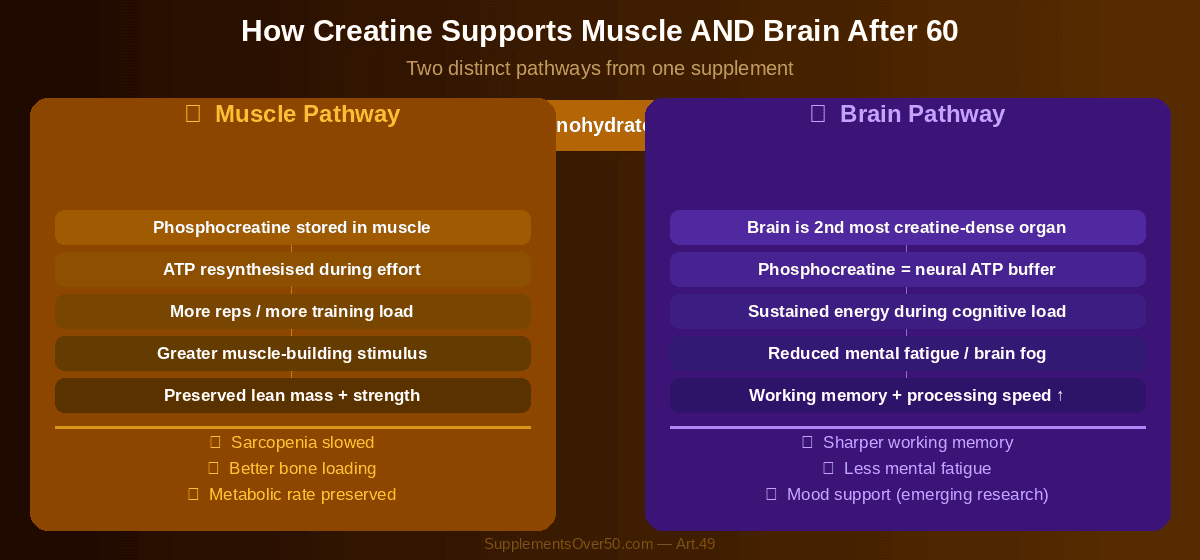
To understand why creatine matters so much at this life stage, it helps to know exactly what it does at the cellular level. During short, intense muscular effort — standing up from a chair, climbing stairs, catching yourself from a fall — your muscles need adenosine triphosphate (ATP), the cell’s energy currency, faster than aerobic metabolism can supply it. Phosphocreatine acts as an immediate phosphate donor, rapidly regenerating ATP from ADP (adenosine diphosphate) in the first 8–15 seconds of effort. This ATP resynthesis pathway is what allows explosive, high-force movements. Without adequate phosphocreatine stores, this buffer depletes quickly and muscles fatigue faster.
Phosphocreatine Stores Decline After Menopause
Estrogen upregulates creatine transporter expression in muscle cells. After menopause, lower estrogen means less efficient creatine uptake into muscle, lower resting phosphocreatine stores, and faster depletion during physical effort. This is why post-menopausal women often report that exercise that used to feel manageable now feels disproportionately hard — the energy substrate that used to buffer the first 10–15 seconds of intense effort is present in smaller quantities. Supplementation directly replenishes this depleted substrate.
Bone Mineral Density: From Osteopenia to Osteoporosis
The progression from normal bone density to osteoporosis runs through an intermediate stage: osteopenia, where bone mineral density (BMD) is below normal but not yet at fracture threshold. Most women over 60 are somewhere on this spectrum without realising it — DEXA scanning is still underused in primary care despite being the definitive diagnostic tool. Creatine’s relevance here is not as a treatment for osteoporosis but as an intervention that may slow the trajectory from normal density toward osteopenia, and from osteopenia toward osteoporosis, particularly when combined with mechanical loading through resistance training.
Women lose 1–3% of bone mineral density per year in the first 5–10 years after menopause. A 2015 RCT found that post-menopausal women who took creatine combined with resistance training showed significantly less bone mineral density loss at the femoral neck and trochanter compared to training-only controls over 52 weeks. (PubMed: Chilibeck et al. 2015)
Processing speed, working memory, and executive function show measurable decline in most people from their late 50s and 60s. The brain uses approximately 20% of the body’s total ATP despite comprising only 2% of body weight. The phosphocreatine/creatine system plays a buffering role in cerebral energy metabolism, particularly during cognitively demanding tasks. A 2018 review found that creatine supplementation in older adults improved processing speed, working memory, and cognitive test performance, with larger effects in sleep-deprived or cognitively stressed states. (PubMed: Avgerinos et al. 2018)
How the best creatine for women over 60 works across three systems: muscle ATP, bone mineral density, and brain energy
Creatine Monohydrate vs HCL vs Buffered: Which Is Best for Women Over 60?
Creapure is a trademark for creatine monohydrate manufactured by AlzChem Trostberg GmbH in Germany under pharmaceutical GMP standards. It is tested to greater than 99.95% purity and is the raw material used in the majority of clinical creatine trials. Look for the Creapure logo on the label.
Third-Party Certification
For women over 60 managing multiple health conditions and medications, third-party certification matters. NSF Certified for Sport tests for 200+ banned substances and verifies potency and identity. Informed Sport provides similar testing. USP Verified checks potency, purity, and disintegration. Any one of these is a meaningful quality signal.
Dosing Protocol: Best Creatine for Women Over 60
Standard Protocol (No Loading Phase Needed)
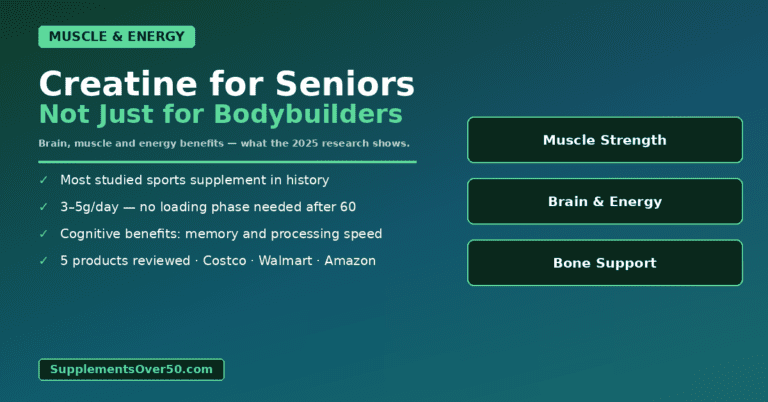
Daily dose: 3–5 g creatine monohydrate per day. Start at 3 g to minimise water retention. The creatine loading phase — taking 20 g/day for 5–7 days — is entirely unnecessary for women over 60. Loading achieves muscle saturation faster but causes digestive upset and excessive water retention. The same saturation level is reached over 3–4 weeks at 3–5 g/day, without the GI discomfort. Loading was developed for competitive athletes who needed peak creatine stores within days of a competition — not for older adults building a long-term health protocol.
Timing matters less than consistency. Post-exercise timing with protein or carbohydrate may modestly improve uptake — insulin release upregulates creatine transporter expression in muscle cells. On non-exercise days, take creatine with any meal. Missing a day does not eliminate stores but cumulative skipping delays saturation.
Hydration Requirement
Creatine draws water into muscle cells through osmotic action — this intracellular hydration is the mechanism behind the initial weight gain and is health-positive. However, it does mean total body water demand increases. Add at least 1–2 extra glasses of water per day when starting creatine. Monitor urine colour — pale yellow is the target.
Kidney Safety
Creatine raises serum creatinine slightly as a metabolic byproduct — this is normal and does not indicate kidney damage, but it can create a false flag on standard kidney function panels. Inform your physician you take creatine before kidney function tests. For women with Stage 3+ CKD, consult a nephrologist before supplementing.
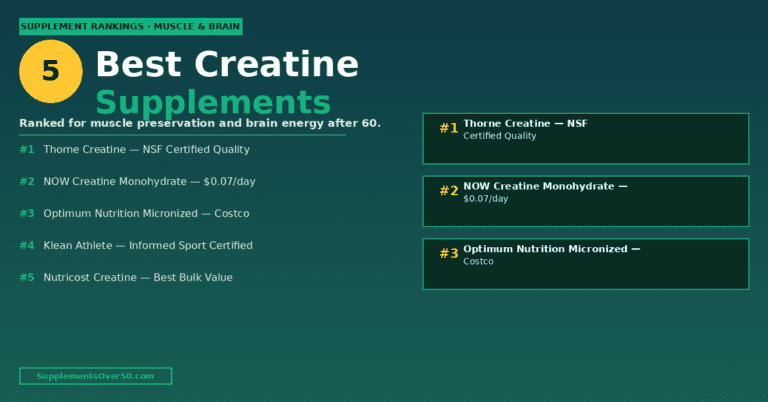
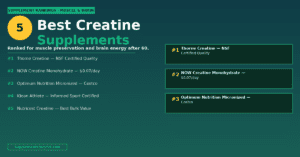
5 Best Creatine Supplements for Women Over 60 (2026)
NSF Certified for Sport, unflavoured monohydrate powder, pharmaceutical-grade manufacturing. Easy to measure at 3 g or 5 g per scoop. Mixes completely clear in water or coffee.
The only creatine with dual NSF Certified for Sport + Informed Sport certification. Uses Creapure raw material. Widely recommended by sports medicine physicians and longevity-focused clinicians.
Form: Creapure monohydrate
Dose: 5 g per serving
Third-party: NSF + Informed Sport (dual certified)
2026 price: ~$45/30 servings
3. Klean Athlete Klean Creatine: Best for Women on Multiple Medications
Clean label, no fillers, NSF Certified for Sport. Clinical positioning means batch documentation is available for healthcare providers.
Form: Creatine monohydrate powder
Dose: 5 g per serving
Third-party: NSF Certified for Sport
2026 price: ~$35/60 servings
4. Optimum Nutrition Micronised Creatine: Best Mid-Range Option
Uses Creapure raw material. Micronised for better mixability. One of the most widely available creatine products with a long track record of ConsumerLab reviews.
Form: Creapure monohydrate (micronised)
Dose: 5 g per serving
Third-party: Informed Sport certified
2026 price: ~$25/60 servings
5. BulkSupplements Creatine Monohydrate: Best Budget Option
ISO 17025-accredited lab testing on every batch, CoA available on request, ConsumerLab-reviewed. Most cost-effective for long-term daily use.
Form: Creatine monohydrate powder
Dose: 5 g per serving; sold in 500 g and 1 kg bags
Third-party: ISO 17025 lab tested per batch
2026 price: ~$14/100 servings
Creatine and Resistance Training for Women Over 60
Creatine without resistance training produces smaller, slower results. The minimum effective dose for synergy in older adults is two sessions per week of 20–30 minutes. Suitable starting exercises include chair squats, wall push-ups, resistance band rows, and step-ups. Progress slowly — the goal in the first 4–6 weeks is movement quality and habit formation, not maximum load.
What to Expect: Body Composition Timeline
Weeks 1–2: Weight may increase 0.5–1.5 kg from intracellular water retention. Not fat gain, not visible, health-positive.
Weeks 3–6: Strength and functional capacity begin to improve. Everyday tasks — carrying groceries, rising from chairs, climbing stairs — become noticeably easier.
Weeks 8–12: Lean mass gains become measurable on DEXA scan. Most women over 60 gain 0.5–1.5 kg lean mass over 12 weeks with creatine plus resistance training.
Months 3–6: Bone marker improvements begin to reflect the osteoblast-stimulating effect of creatine plus mechanical loading.
Stacking Creatine with Other Supplements
Creatine + Protein
Taking creatine with 20–30 g of protein post-exercise enhances insulin-mediated creatine uptake and provides the amino acid substrate for muscle protein synthesis. Whey has the highest leucine content; pea + rice protein blends are an effective dairy-free alternative.
Creatine + Vitamin D3 + K2
Vitamin D3 supports muscle function and calcium absorption. K2 (menaquinone-7) directs calcium to bone rather than arterial walls. This trio addresses muscle and bone through complementary mechanisms alongside creatine.
Creatine + Magnesium Glycinate
ATP is only metabolically active when bound to magnesium (Mg-ATP). Supplementing both ensures the energy system has the substrate (phosphocreatine) and the cofactor (magnesium) for optimal muscle contraction and recovery.
Creatine and Mental Health in Women Over 60
A 2021 study in Translational Psychiatry found that higher dietary creatine intake was significantly associated with lower odds of depression, with the effect stronger in women and in people who experienced sleep disruption. The proposed mechanism involves the phosphocreatine system’s role in maintaining neuronal energy homeostasis. (PubMed: Bakian et al. 2021)
Frequently Asked Questions
Will creatine make women over 60 look bulky?
No. Women lack the testosterone levels required for significant muscle hypertrophy. The initial 0.5–1.5 kg weight gain is intracellular water inside muscle cells — not subcutaneous bloating and not visible. Over 12 weeks most women gain 0.5–1.5 kg lean mass — a health-positive outcome, not an aesthetic problem.
Is creatine safe for women over 60 with osteoporosis?
The evidence is supportive. One RCT found reduced bone mineral density loss at fracture-risk sites with creatine plus exercise versus exercise alone in post-menopausal women. Creatine does not replace bisphosphonate therapy but the mechanisms are complementary.
How long does creatine take to work for women over 60?
Intramuscular stores saturate in 3–4 weeks at 3–5 g/day. Strength improvements appear by weeks 4–6. Lean mass changes measurable by DEXA take 8–12 weeks. Continue for at least 12 weeks before judging effectiveness.
Should women over 60 cycle creatine on and off?
No. There is no clinical evidence supporting cycling in older adults. Daily continuous use at 3–5 g is the protocol best supported by evidence for sustained muscle, bone, and cognitive benefits.
Can I take creatine if I have high blood pressure?
Clinical trials do not show creatine raising blood pressure. Some studies suggest a mild lowering effect. Monitor your BP more frequently when starting creatine if you take antihypertensive medication.
Is creatine the same as testosterone or steroids?
No. Creatine is an amino acid derivative the body makes naturally. It does not affect sex hormones, is not a controlled substance anywhere in the world, and has completely different mechanisms from anabolic steroids.
Can women over 60 take creatine without exercising?
Yes. Creatine’s cognitive benefits are independent of exercise. For women who cannot exercise due to mobility limitations or illness, creatine still supports neurological energy metabolism. The muscle and bone benefits are largely exercise-dependent, but even light movement significantly amplifies them.
Does creatine cause weight gain in women over 60?
Creatine causes an initial 0.5–1.5 kg increase from intracellular water in the first 1–2 weeks. This is not fat and is not visually apparent. Track waist measurement rather than scale weight for a more accurate picture of body composition changes.
What happens when you stop taking creatine?
Intramuscular stores return to baseline within 4–6 weeks. The initial water weight is lost. Muscle mass gained while training is retained. There are no withdrawal effects or hormonal consequences. Creatine can be restarted at any time and resaturates within 3–4 weeks.
Can I take creatine if I have kidney disease?
For Stage 1–2 CKD with otherwise healthy kidney function, the clinical evidence does not support harm at 3–5 g/day. For Stage 3+ CKD, consult a nephrologist — creatine raises serum creatinine, which is also the primary marker used to monitor kidney function, making it harder to track disease progression accurately.
Key References
Forbes SC et al. (2021). Meta-analysis of the effects of creatine supplementation on strength in older adults. Nutrients, 13(6):1915.
Chilibeck PD et al. (2015). Effect of creatine supplementation during resistance training on bone mineral density. Med Sci Sports Exerc, 47(8):1582–91.
Avgerinos KI et al. (2018). Effects of creatine supplementation on cognitive function. Exp Gerontol, 108:166–173.
Bakian AV et al. (2021). Dietary creatine intake and depression risk among US adults. Translational Psychiatry, 11:14.
Kreider RB et al. (2017). ISSN position stand: safety and efficacy of creatine supplementation. J Int Soc Sports Nutr, 14:18.
Pair it with:Urolithin A for Seniors — creatine and Urolithin A target different parts of muscle energy metabolism and produce additive benefits in clinical data. Together they form one of the strongest evidence-backed muscle preservation protocols available to women over 60.
The best energy supplements for women over 50 fix real gaps like low B12 or iron. Check these fatigue causes first, then compare 5 non-stimulant picks.







 ✓ In stock
 ✓ In stock
 ✓ In stock
 ✓ In stock
 ✓ In stock