
Review Disclaimer: This article is for informational purposes only and does not constitute medical advice. Information is sourced from peer-reviewed research, the NIH Office of Dietary Supplements, and clinical databases. Always consult your physician or pharmacist before starting any supplement, especially if you take prescription medications or have kidney disease.
You wake up at 2 a.m. with a searing cramp in your calf or foot — a sudden, involuntary muscle spasm that can last anywhere from a few seconds to several excruciating minutes. If you’re over 50, this experience is frustratingly common. Nocturnal leg cramps affect an estimated 50–60% of adults, and their frequency increases significantly with age, which is why magnesium for leg cramps after 50 is one of the most searched supplement questions we see.
Magnesium is one of the most commonly recommended supplements for leg cramps — and for good reason. After 50, your body absorbs up to 30% less magnesium from food, and several common medications — including proton pump inhibitors (PPIs), diuretics, and statins — can lower your magnesium levels further. But not all magnesium supplements are equally effective or well-tolerated.
This guide covers what the research actually shows, which form of magnesium works best for nighttime cramps, and five specific products available at Costco, Walmart, and Amazon with current US pricing.
Quick Answer: Best Magnesium for Leg Cramps After 50
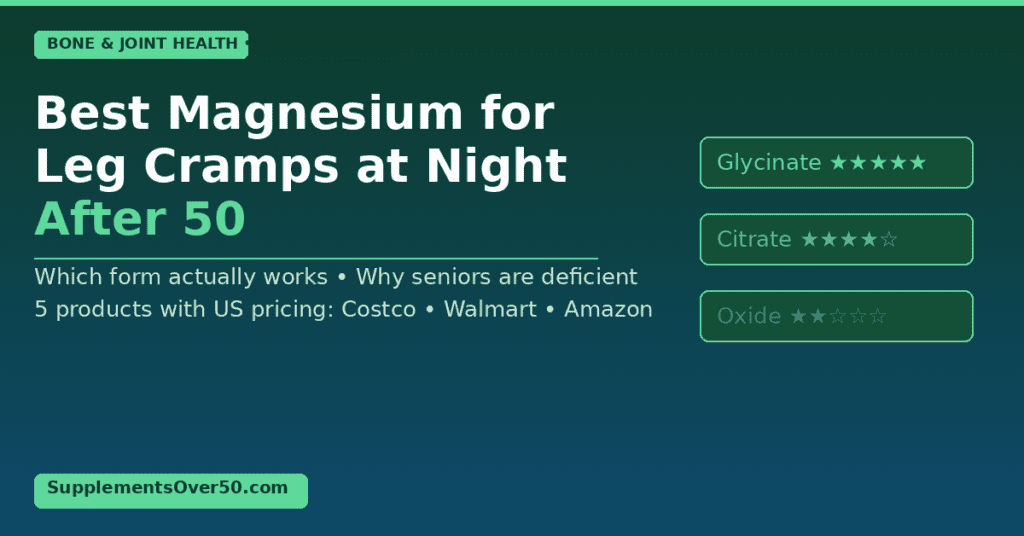
Magnesium glycinate is the form most recommended for seniors with leg cramps. It has superior bioavailability, is gentle on the digestive system, and includes glycine — an amino acid that supports muscle relaxation and sleep quality. Take 200–400 mg of elemental magnesium in the evening, about 1–2 hours before bed. Best budget option: Doctor’s Best (Amazon, ~$20 for 4 months). Best premium option: Thorne Magnesium Glycinate (~$35 for 3 months). Best value for Costco members: Nature’s Bounty Magnesium Glycinate 240 mg (~$22 for 3 months).
Why Magnesium for Leg Cramps After 50 Is So Common
According to the NIH National Health and Nutrition Examination Survey (NHANES), 48% of Americans consume less magnesium than recommended — and the gap widens significantly with age. One analysis found that 63% of women aged 71 and older fall short of the daily magnesium target.
Several age-related changes drive this deficiency:
- Reduced intestinal absorption: Aging impairs the active transport mechanism that pulls magnesium from food into your bloodstream
- Increased urinary excretion: Kidneys become less efficient at retaining magnesium as you age
- Lower stomach acid: Reduced acid production (common after 60) impairs mineral absorption generally
- Medication interference: Common drugs in seniors significantly lower magnesium levels (see table below)
- Dietary changes: Reduced appetite, chewing difficulties, and reliance on processed foods reduce magnesium intake
Medications That Lower Magnesium Levels
| Medication Type | Common Examples | How It Lowers Magnesium |
| Proton Pump Inhibitors (PPIs) | Omeprazole, Pantoprazole | Impairs intestinal absorption channels |
| Diuretics (water pills) | Furosemide, Hydrochlorothiazide | Increases urinary magnesium loss |
| Statins | Atorvastatin, Simvastatin | Associated with lower plasma magnesium |
| Bisphosphonates | Alendronate (Fosamax) | Interferes with magnesium metabolism |
| Metformin | Glucophage | Linked to hypomagnesemia in studies |
| H2 Blockers | Famotidine (Pepcid) | Reduces gastric acid needed for absorption |
Source: NIH/PMC — Magnesium and Drugs (Gröber et al., 2019)
What Does the Research Say About Magnesium for Leg Cramps?
Here’s the honest picture: the research on magnesium for nocturnal leg cramps in older adults is mixed — and that’s important to know upfront.
A comprehensive Cochrane Review on magnesium for skeletal muscle cramps found that magnesium supplementation was not significantly better than placebo for reducing cramp frequency in most non-pregnant adults. Several randomized trials using magnesium citrate and magnesium oxide showed no statistically significant reduction in cramp frequency, duration, or severity.
However, there are important nuances:
- Studies have used various forms of magnesium with varying bioavailability — most research used magnesium citrate or oxide, not the better-absorbed glycinate form
- Participants who were already magnesium-deficient showed more benefit than those with normal magnesium status
- Magnesium plays a well-established role in muscle contraction and relaxation at the cellular level — deficiency is directly linked to muscle cramps, seizures, and spasms
- Magnesium is safe, inexpensive, and has multiple other health benefits for adults over 50, including bone health, heart function, and sleep quality
The NIH Office of Dietary Supplements notes that muscle contractions and cramps are a documented symptom of magnesium deficiency. If your leg cramps are driven by low magnesium — which is common in older adults taking the medications listed above — supplementation may provide meaningful relief.
Bottom line: Magnesium supplementation is most likely to help if you are deficient — and many adults over 50 are, often without knowing it. Even if the direct evidence for cramp reduction is mixed, correcting a magnesium deficit improves neuromuscular function, sleep, and bone health simultaneously.
Which Form of Magnesium Is Best for Leg Cramps After 50?
Not all magnesium supplements work the same way. The form — the compound magnesium is bound to — determines how much your body actually absorbs and how well it’s tolerated.
| Form | Absorption | GI Tolerance | Best For | Notes |
| Glycinate | ★★★★★ | Excellent | Cramps + sleep + seniors | Top choice for over 50 |
| Citrate | ★★★★☆ | Good | Constipation + cramps | Laxative at high doses |
| Malate | ★★★★☆ | Good | Fatigue + muscle pain | Less studied for cramps |
| L-Threonate | ★★★★☆ | Excellent | Brain + cognitive health | Premium price, crosses blood-brain barrier |
| Oxide | ★★☆☆☆ | Poor | Not recommended | Most common in cheap supplements — avoid |
| Sulfate (Epsom) | ★★★☆☆ | N/A (topical) | Sore muscle soaks | Bath soak only |
Why Magnesium Glycinate Is the Top Pick for Seniors
Magnesium glycinate is chelated — meaning the magnesium is bound to glycine, an amino acid. This bond makes it more resistant to stomach acid breakdown and enables it to be absorbed more efficiently through the intestinal wall. The glycine component adds meaningful benefits beyond the magnesium itself:
- Acts as an inhibitory neurotransmitter that helps reduce nerve excitability and relax muscles
- Supports deeper, more restorative sleep — a 2025 clinical trial published in PMC found that magnesium bisglycinate (a related form) produced statistically significant improvements in sleep quality scores
- Virtually no laxative effect — important for seniors who are sensitive to digestive disruption
- Well-tolerated for long-term daily use
Recommended Dosage and Timing
The NIH Recommended Dietary Allowance (RDA) for magnesium is:
- Women 51+: 320 mg/day
- Men 51+: 420 mg/day
For leg cramp relief, most clinical studies used 200–400 mg of elemental magnesium daily. Important: the elemental magnesium content is not the same as the total weight of the supplement. For example, a 500 mg magnesium glycinate capsule typically contains about 50–100 mg of elemental magnesium, depending on the chelation ratio. When choosing magnesium for leg cramps after 50, timing and form both matter.
Timing tip: Take magnesium glycinate 1–2 hours before bed. The glycine component promotes relaxation and may improve sleep onset. Taking it in the evening also means magnesium is present in your system during the nighttime hours when cramps are most likely to occur.
Always start at a lower dose (100–200 mg elemental magnesium) and increase gradually. Even with glycinate, very high doses can cause loose stools. Individuals with kidney disease should not supplement magnesium without medical supervision, as impaired kidneys cannot efficiently excrete excess magnesium.
5 Best Magnesium Supplements for Leg Cramps After 50 — US Pricing
All five products below are available at major US retailers. Prices reflect current 2026 availability and may vary by location and membership.
1. Doctor’s Best High Absorption Magnesium Glycinate Lysinate — Best Budget Pick
Doctor’s Best is consistently the top-selling magnesium glycinate on Amazon and offers exceptional value. The chelated magnesium glycinate lysinate formula — bound to both glycine and lysine amino acids — is 100% chelated with no fillers, vegan, non-GMO, and gluten-free. Each serving provides 200 mg of elemental magnesium.
| Retailer | Size | Price (approx.) | Cost/Serving |
| Amazon | 240 tablets | ~$18–22 | ~$0.08 |
| Walmart | 120 tablets | ~$12–15 | ~$0.10–0.13 |
- Elemental magnesium: 200 mg per serving (2 tablets)
- Third-party tested: Yes
- Certifications: Vegan, non-GMO, gluten-free, soy-free
- Supply: ~4 months at 1 serving/day from 240-tablet bottle
2. Nature’s Bounty High Absorption Magnesium Glycinate 240 mg — Best Costco Value
Nature’s Bounty’s magnesium glycinate is sold at Costco in a 180-capsule format — an excellent deal for Costco members who want a reputable brand at warehouse pricing. Non-GMO, gluten-free, lactose-free, and vegetarian. Two capsules provide 240 mg of magnesium glycinate per day.
| Retailer | Size | Price (approx.) | Cost/Serving |
| Costco | 180 capsules | ~$18–22 | ~$0.20–0.24 |
| Walmart | 60 capsules | ~$10–13 | ~$0.33–0.43 |
| Amazon | 120 capsules | ~$16–19 | ~$0.27–0.32 |
- Elemental magnesium: 240 mg per 2-capsule serving
- Third-party tested: Yes (Nature’s Bounty Quality Seal)
- Certifications: Non-GMO, gluten-free, vegetarian, no soy, no lactose
- Supply: ~3 months at 1 serving/day from 180-capsule bottle
3. Thorne Magnesium Glycinate — Best Clinical-Grade Option
Thorne is a clinical supplement brand trusted by over 100 professional sports teams and recommended by healthcare practitioners. Their magnesium glycinate is third-party certified and manufactured in NSF-registered facilities. It’s the cleanest formulation on this list — minimal excipients, no unnecessary additives. Each capsule provides 120 mg of elemental magnesium.
| Retailer | Size | Price (approx.) | Cost/Serving |
| Amazon | 90 servings | ~$35–40 | ~$0.39–0.44 |
| Thorne.com | 90 servings | ~$38 (FSA/HSA eligible) | ~$0.42 |
- Elemental magnesium: 120–480 mg/day (flexible 1–4 capsule dosing)
- Third-party tested: Yes — Thorne is NSF Certified for Sport
- Certifications: Gluten-free, dairy-free, soy-free; FSA/HSA eligible via Truemed
- Supply: 90 servings (3 months at 1 capsule/day; 1.5 months at 2/day)
4. Pure Encapsulations Magnesium Glycinate — Best Hypoallergenic Formula
Pure Encapsulations is a practitioner-grade brand designed for patients with food sensitivities or allergies. Their magnesium glycinate contains no fillers, binders, preservatives, artificial colors, or GMO ingredients. It is free from all common allergens and tested for potency and purity. This is the best choice for seniors with multiple food sensitivities.
| Retailer | Size | Price (approx.) | Cost/Serving |
| Amazon | 180 capsules | ~$45–52 | ~$0.25–0.29 |
| Amazon | 90 capsules | ~$28–33 | ~$0.31–0.37 |
- Elemental magnesium: 120 mg per capsule (take 1–4 daily)
- Third-party tested: Yes — tested for potency and purity by independent labs
- Certifications: Hypoallergenic, non-GMO, free from 14 common allergens
- Supply: 90–180 days depending on dose
5. Nature’s Truth Magnesium Blend 250 mg — Best Multi-Form Option
Available at Costco, Nature’s Truth combines three forms of magnesium (citrate, glycinate, and aspartate) plus 2,500 mcg of methylcobalamin B12 — a smart combination for seniors, since B12 deficiency and magnesium deficiency often co-occur. The multi-form approach may offer broader absorption across different absorption pathways.
| Retailer | Size | Price (approx.) | Cost/Serving |
| Costco | 180 capsules | ~$18–24 | ~$0.20–0.27 |
- Magnesium: 250 mg per 2-capsule serving (citrate + glycinate + aspartate blend)
- Bonus: 2,500 mcg Methylcobalamin B12 per serving
- Third-party tested: Yes (Nature’s Truth quality assurance)
- Certifications: Vegetarian, non-GMO, gluten-free, no soy, no artificial ingredients
Magnesium Isn’t the Only Answer: Other Causes of Nighttime Leg Cramps
Even the best magnesium supplement won’t eliminate cramps if another factor is driving them. Nocturnal leg cramps after 50 can have multiple overlapping causes:
| Cause | Mechanism | What Helps |
| Magnesium deficiency | Impairs muscle relaxation and neuromuscular signaling | Magnesium glycinate supplement |
| Dehydration | Electrolyte imbalance triggers involuntary contractions | 8+ glasses of water daily; reduce evening alcohol |
| Potassium deficiency | Low potassium disrupts nerve-muscle communication | Potassium-rich foods: bananas, potatoes, avocado |
| Prolonged sitting/inactivity | Calf muscles shorten and become prone to spasm | Calf stretches before bed; short walks |
| Medications | Statins, diuretics, beta-agonists linked to cramps | Discuss with doctor; magnesium may help offset |
| Poor circulation | Reduced blood flow to lower limbs | Elevate feet; light compression socks |
| Nerve compression | Spinal stenosis or disc issues | Physical therapy; orthopedic evaluation |
Simple nightly routine: Stand facing a wall. Step one foot back about 2–3 feet. Keep your back heel flat on the floor and lean forward until you feel a stretch in your calf. Hold 30 seconds. Switch legs. Repeat twice per side. Done consistently before bed, calf stretching has shown benefit in several small trials for nocturnal leg cramps.
Safety, Drug Interactions, and Who Should Be Cautious
Magnesium glycinate is generally very safe for most adults over 50. However, several groups should exercise caution:
- Kidney disease: Impaired kidneys cannot regulate magnesium excretion — magnesium supplements can accumulate to toxic levels. Always consult your nephrologist first.
- Bisphosphonate medications (Fosamax, Boniva): Magnesium can reduce absorption of bisphosphonates. Take them at least 2 hours apart.
- Certain antibiotics: Magnesium may reduce absorption of tetracyclines and quinolones. Separate doses by 2 hours.
- Heart medications: If you take digoxin or have a heart rhythm disorder, discuss magnesium supplementation with your cardiologist.
The NIH tolerable upper intake level (UL) for supplemental magnesium is 350 mg/day of elemental magnesium from supplements alone (not including food sources). Exceeding this increases the risk of diarrhea and GI upset, though magnesium glycinate is significantly better tolerated than other forms at higher doses.
Frequently Asked Questions
Here are the questions we see most often about magnesium for leg cramps after 50.
Q: How long does it take for magnesium to work for leg cramps?
Most people notice a reduction in cramp frequency after 4–8 weeks of consistent supplementation. Magnesium builds up in tissues gradually — don’t judge efficacy after just a few days. If you see no improvement after 8 weeks at the recommended dose, the cramps may have another underlying cause.
Q: Can I take magnesium glycinate every night?
Yes. Magnesium glycinate is suitable for daily, long-term use. Taking it every night is actually ideal for maintaining steady tissue levels and maximizing the sleep-support benefits of glycine. There is no evidence of harm from long-term use at recommended doses in adults with healthy kidney function.
Q: Is magnesium glycinate the same as magnesium bisglycinate?
Essentially yes. Magnesium bisglycinate means the magnesium is bound to two glycine molecules. The terms are often used interchangeably on product labels. Both forms have equivalent bioavailability and tolerability — don’t be confused by the different naming.
Q: Should I take magnesium with calcium?
Calcium and magnesium compete for absorption when taken together in high doses. If you take a calcium supplement, it’s best to take magnesium at a different time of day — for example, calcium with breakfast or lunch and magnesium in the evening. The ratio to aim for in total daily intake is roughly 2:1 (calcium to magnesium).
Q: What’s the difference between magnesium for sleep vs. magnesium for cramps?
The same supplement does both. Magnesium glycinate taken in the evening supports muscle relaxation (reducing cramp risk overnight) and promotes sleep via the calming effect of glycine. You don’t need a separate ‘sleep magnesium’ — a quality magnesium glycinate supplement covers both.
Q: Can I get enough magnesium from food instead of supplements?
In theory, yes. Foods high in magnesium include dark leafy greens (spinach, kale), pumpkin seeds, almonds, cashews, black beans, avocado, and dark chocolate. However, data from NHANES shows that most Americans — especially older adults — do not reach the RDA from diet alone. If you’re experiencing cramps and eating a reasonably balanced diet, supplementation is worth trying.
Sources & Citations
| # | Source | Type | URL |
| 1 | NIH Office of Dietary Supplements — Magnesium Fact Sheet for Health Professionals | Government / Tier 1 | ods.od.nih.gov/factsheets/Magnesium-HealthProfessional/ |
| 2 | Garrison et al. — Magnesium for Skeletal Muscle Cramps (Cochrane Review), PMC 2020 | Peer-Reviewed / Cochrane | pmc.ncbi.nlm.nih.gov/articles/PMC7025716/ |
| 3 | Gröber et al. — Magnesium and Drugs, International Journal of Molecular Sciences (PMC 2019) | Peer-Reviewed | pmc.ncbi.nlm.nih.gov/articles/PMC6539869/ |
| 4 | Barbagallo & Dominguez — Magnesium in Aging, Health and Diseases, PMC 2021 | Peer-Reviewed | pmc.ncbi.nlm.nih.gov/articles/PMC7912123/ |
| 5 | Schuster et al. — Magnesium Bisglycinate Supplementation and Sleep Quality (RCT), Nature Science of Sleep, 2025 | Peer-Reviewed / RCT | pmc.ncbi.nlm.nih.gov/articles/PMC12412596/ |
| 6 | Van Laecke et al. — Drug Use and Lower Plasma Magnesium Levels in Geriatric Outpatients, PubMed 2018 | Peer-Reviewed | pubmed.ncbi.nlm.nih.gov/30581015/ |
| 7 | Hanikeri et al. — Magnesium Oxide for Nocturnal Leg Cramps (RCT), PMC 2018 | Peer-Reviewed / RCT | pmc.ncbi.nlm.nih.gov/articles/PMC5818780/ |
| 8 | Gommers et al. — Total Magnesium Intake and Risk of Frailty in Older Women, PMC 2024 | Peer-Reviewed | pmc.ncbi.nlm.nih.gov/articles/PMC11294045/ |
| 9 | Right at Home — Magnesium for Older Adults (references Harvard Health, NIH, Cleveland Clinic) | Reference | rightathome.net/blog/magnesium-for-older-adults |
* These statements have not been evaluated by the Food and Drug Administration. These products are not intended to diagnose, treat, cure, or prevent any disease. Always consult your physician before starting any new supplement, especially if you take prescription medications or have kidney disease.