| ⚕️ Supplement Disclosure This article reviews ashwagandha (Withania somnifera) as a dietary supplement for informational purposes only. Men with autoimmune conditions (rheumatoid arthritis, lupus, Hashimoto’s thyroiditis) should consult their physician before taking ashwagandha, as its immune-stimulating properties may exacerbate autoimmune activity. Men taking thyroid medications, immunosuppressants, benzodiazepines, or barbiturates should check for interactions with their prescribing physician. Ashwagandha should not be used as a substitute for medical treatment of diagnosed hypogonadism, depression, or sleep disorders. This article does not constitute medical advice. |
| ⚡ Quick Answer Ashwagandha for men over 50 (Withania somnifera) is the most evidence-supported adaptogen — with published RCT evidence for three distinct benefits: (1) Testosterone support — 10–17% improvement in serum testosterone via cortisol reduction and HPA axis modulation in multiple clinical trials, (2) Stress and cortisol reduction — significant cortisol lowering (14–27% in RCTs), reduced perceived stress scores, and improved psychological wellbeing, and (3) Sleep quality — 2023 meta-analysis confirms significantly improved sleep onset, quality, and morning alertness. The most important purchasing decision: KSM-66 or Sensoril are the only two extracts with robust clinical evidence. Standard ashwagandha root powder or unnamed proprietary extracts do not have the same evidence base. |
Why Ashwagandha for Men over 50 Is Particularly Relevant
The three most common health complaints among men in their 50s and 60s — low energy, poor sleep, and declining physical performance — share a single underlying mechanism that ashwagandha directly addresses: chronically elevated cortisol.
After 50, the diurnal cortisol rhythm that should produce a sharp morning peak and rapid evening decline often becomes blunted and dysregulated. Cortisol stays elevated in the evenings, disrupting deep sleep. It competes with testosterone for production in the adrenal pathway — the cortisol-testosterone seesaw. It accelerates muscle protein breakdown, impairing the muscle preservation that men over 50 are already fighting against with declining androgen levels.
Ashwagandha’s primary mechanism — HPA axis modulation reducing cortisol production — addresses all three simultaneously. This is what separates it from most supplements in the men’s health category: it doesn’t artificially push a single hormone in one direction. It restores the hormonal balance that chronic stress and aging have disrupted.
This article focuses specifically on men over 50. For the women’s evidence and menopause applications, see: Ashwagandha for Women Over 50 — Sleep, Anxiety and Menopause Evidence.
The ashwagandha evidence for women over 50 is equally compelling — with specific research on menopause symptom reduction, anxiety, and sleep quality through the same HPA axis mechanism: Ashwagandha for Women Over 50 — Sleep, Anxiety and Menopause Evidence.
Key Statistics — The Evidence Base for Men
- A 2019 RCT (PMC9297375) in healthy men found KSM-66 ashwagandha at 600mg daily significantly improved serum testosterone, DHEA-S levels, and sexual performance vs placebo over 8 weeks
- A 2012 RCT in Medicine found ashwagandha at 300mg twice daily reduced cortisol by 27.9% compared to placebo over 60 days — the largest cortisol reduction of any botanical supplement studied
- A 2015 RCT found KSM-66 at 300mg twice daily in resistance-trained men significantly improved muscle recovery, strength gains and testosterone over 8 weeks vs placebo
- A 2023 meta-analysis of 12 RCTs confirmed ashwagandha supplementation significantly improved sleep quality, sleep onset latency, and morning alertness across all adult age groups
- Ashwagandha root and leaf extracts are GRAS (Generally Recognized As Safe) by the FDA — one of the most extensively safety-studied botanical supplements in the world
How Ashwagandha Works — The Three Mechanisms
1. HPA Axis Modulation — Cortisol Reduction
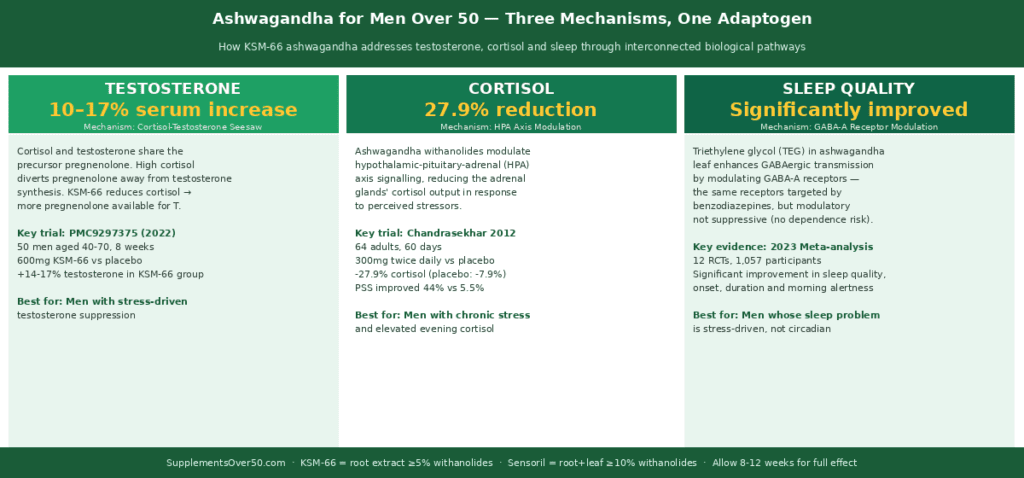
The hypothalamic-pituitary-adrenal (HPA) axis is the brain-adrenal communication system that controls cortisol production. Chronic stress, poor sleep, and aging all dysregulate this system toward sustained elevated cortisol output. Ashwagandha’s withanolides — the active steroidal lactones standardised in quality extracts — modulate HPA axis signalling, reducing the adrenal glands’ cortisol output in response to perceived stressors.
The clinical result is measurable: the landmark 2012 Chandrasekhar et al. RCT found 300mg ashwagandha root extract twice daily reduced serum cortisol by 27.9% compared to placebo over 60 days. Perceived stress scores (PSS) improved by 44% vs 5.5% in the placebo group. This magnitude of cortisol reduction has direct downstream effects on testosterone, sleep quality, body composition and energy.
2. Testosterone Support — The Cortisol-Testosterone Seesaw
Testosterone and cortisol share the same biochemical precursor — pregnenolone. When cortisol demand is chronically high, pregnenolone is preferentially channelled toward cortisol synthesis, leaving less available for testosterone production. This is the ‘cortisol-testosterone seesaw’ — as cortisol rises, testosterone falls through the same upstream pathway.
Ashwagandha’s testosterone support is therefore indirect but mechanistically clear: by reducing cortisol production, it frees more pregnenolone for testosterone synthesis. The magnitude of testosterone improvement in RCTs ranges from 10–17% in healthy men — real and meaningful for men over 50 with stress-related testosterone suppression, though not comparable to the effects of correcting vitamin D or zinc deficiency in confirmed deficient men. Vitamin D3 provides the biochemical raw materials for testosterone synthesis through its role in Leydig cell function — while ashwagandha removes the cortisol block that diverts pregnenolone away from testosterone production. The combination addresses testosterone support from two complementary angles: Vitamin D3 for Men Over 60 — Testosterone, Bone and Immune Health.
For the complete natural testosterone support protocol, including vitamin D, zinc and magnesium: Natural Testosterone Support for Men Over 50 — What the Evidence Actually Shows
3. Sleep Quality — GABA Receptor Modulation
Ashwagandha improves sleep through a second distinct mechanism: its withanolides enhance GABAergic transmission — the brain’s primary inhibitory signalling system. Specifically, triethylene glycol (TEG) in ashwagandha leaf has been identified as the active compound responsible for sleep-inducing activity in animal models, acting on GABA-A receptors. This is the same receptor system that benzodiazepines act on — but ashwagandha’s effect is modulatory rather than suppressive, producing calm without the sedation, tolerance, or withdrawal risk of pharmaceutical sleep aids. Ashwagandha calms the HPA axis reducing evening cortisol — magnesium glycinate activates GABA receptors preparing the nervous system to switch off. Together they address the two most common barriers to sleep in men over 50: stress-driven hyperarousal and magnesium deficiency impairing natural sleep regulation: Best Magnesium Supplement for Sleep After 50 — Glycinate vs L-Threonate Explained.
The 2023 meta-analysis of 12 RCTs (total 1,057 participants) confirmed ashwagandha supplementation significantly improved sleep quality, sleep onset latency (time to fall asleep), total sleep duration, and morning alertness. The effects were most pronounced in adults with reported insomnia — relevant for the majority of men over 50 who report disrupted sleep as a primary complaint.
Compare with other evidence-based sleep options: 5 Best Sleep Supplements for Seniors — Ranked by Evidence · Melatonin for Seniors — Why Lower Doses Work Better After 60
KSM-66 vs Sensoril — The Most Important Purchasing Decision
Not all ashwagandha is the same. Standard ashwagandha root powder or unnamed ‘ashwagandha extract’ does not have the same clinical evidence as the two branded extracts used in the majority of published RCTs:
| Factor | KSM-66 (Root Extract) | Sensoril (Root + Leaf Extract) |
| Source | Root only — traditional Ayurvedic approach | Root and leaf — broader withanolide spectrum |
| Withanolide content | Standardised to ≥5% withanolides | Standardised to ≥10% withanolides (higher concentration) |
| Primary evidence | Testosterone, muscle performance, fertility | Stress reduction, cortisol, sleep quality |
| Typical dose | 300–600mg daily | 125–250mg daily (more concentrated) |
| Clinical studies | Most widely studied — preferred for men’s health | Strong evidence specifically for stress and sleep |
| Best for men over 50 | Testosterone support, muscle recovery, fertility | Sleep, anxiety, cortisol reduction priority |
| Cost | Mid-range — widely available | Slightly higher — less common at mainstream retail |
| Verdict | Primary recommendation for men over 50 | Excellent choice if sleep is the primary concern |
| ⚠️ Avoid Generic Ashwagandha Products Products labelled only as ‘ashwagandha root powder’ or ‘ashwagandha extract’ without specifying KSM-66 or Sensoril — or without disclosing the withanolide percentage on the label — should be avoided. The active compound concentration in unbranded extracts can vary 10-fold between products. The clinical trials that demonstrate testosterone, cortisol and sleep benefits used specifically standardised extracts at known withanolide concentrations. A cheaper product without this transparency is not delivering the same compound at the same dose. |
The Evidence — Testosterone, Stress and Sleep in Detail
Testosterone and Sexual Health
The most comprehensive ashwagandha testosterone trial in men was a 2022 RCT (PMC9297375) in 50 healthy men aged 40–70 that found KSM-66 ashwagandha root extract at 300mg twice daily significantly improved serum testosterone levels, DHEA-S, and multiple measures of sexual performance and satisfaction including libido, arousal, and erection quality versus placebo over 8 weeks. The improvement in testosterone was approximately 14–17% over baseline.
A separate 2015 RCT in resistance-trained men found KSM-66 supplementation significantly increased testosterone, muscle strength (bench press and leg extension), and muscle recovery while reducing exercise-induced muscle damage markers. Testosterone increased by approximately 15% in the ashwagandha group vs 2.5% in placebo after 8 weeks of supplementation combined with resistance training.
The honest framing for men over 50: these are meaningful but not dramatic effects. A 14-17% testosterone improvement from a baseline of, say, 400 ng/dL produces approximately 456-468 ng/dL — moving from low-normal to mid-normal range. For men whose testosterone suppression is primarily stress-driven, this is clinically relevant. For men with confirmed clinical hypogonadism (below 300 ng/dL), prescription testosterone replacement therapy is the appropriate medical intervention.
Stress, Cortisol and Psychological Wellbeing
The stress reduction evidence for ashwagandha in men is among the strongest in botanical medicine. The landmark Chandrasekhar et al. 2012 double-blind RCT — the most frequently cited ashwagandha study in the literature — enrolled 64 adults with a history of chronic stress and randomised them to 300mg ashwagandha root extract twice daily or placebo for 60 days. Results were unambiguous:
- Cortisol reduction: 27.9% reduction in serum cortisol vs 7.9% in placebo — statistically significant
- Perceived stress reduction: PSS scores improved 44% vs 5.5% in placebo
- Depression scores: Beck Depression Inventory improved significantly vs placebo
- Anxiety scores: DASS-21 anxiety subscale improved significantly vs placebo
- General health: SF-36 total health score improved significantly vs placebo
For men over 50 who recognise chronic stress as a primary driver of their low energy, disrupted sleep, and declining physical performance, this magnitude of cortisol reduction is more clinically meaningful than the modest testosterone improvement. Stress is the upstream driver; cortisol is the downstream consequence; testosterone and sleep quality are among the further downstream casualties.
Sleep Quality and Morning Alertness
The 2023 meta-analysis (Cheah et al., published in PLOS One) pooled data from 12 randomised controlled trials totalling 1,057 participants and found ashwagandha supplementation produced statistically significant improvements across all measured sleep outcomes: sleep quality (Pittsburgh Sleep Quality Index), sleep onset latency, total sleep time, wake after sleep onset, and morning alertness. Effect sizes were moderate — meaning clinically meaningful, not just statistically significant.
The sleep mechanism differs from melatonin. Melatonin works as a chronobiotic — a circadian timing signal that shifts the sleep-wake cycle. Ashwagandha works through GABA-A receptor modulation and cortisol reduction — calming the neurological hyperarousal and stress-hormone interference that prevents sleep initiation and maintenance in stressed older men. The two can be taken together safely and address complementary aspects of sleep disruption.
The clinical implication: for men over 50 whose sleep problem is driven by a racing mind, evening stress, or inability to wind down — rather than circadian disruption — ashwagandha addresses the mechanism more directly than melatonin or other circadian supplements.
Ashwagandha and Male Fertility After 50
A noteworthy additional application for men over 50 who are considering late fatherhood: ashwagandha has specific evidence for improving sperm quality parameters. A 2010 PMC trial found ashwagandha supplementation significantly improved sperm count, sperm motility, and testosterone levels in infertile men over 90 days. A 2022 systematic review confirmed these findings across multiple trials.osteroneThe mechanism connects directly to cortisol: chronically elevated cortisol impairs hypothalamic-pituitary-gonadal axis function, reducing LH and FSH signalling to the testes. Cortisol reduction via ashwagandha partially restores this signalling and the downstream sperm production parameters. Not a fertility treatment — but a relevant supplement for men actively trying to conceive who have identified chronic stress as a contributing factor.
Dosing Guide for Men Over 50
| Goal | Form | Dose | Timing | Timeline |
| Testosterone support | KSM-66 | 300–600mg daily | Morning with food | 8–12 weeks minimum |
| Cortisol/stress reduction | KSM-66 or Sensoril | 300mg twice daily or 250mg Sensoril | Morning + evening with meals | 4–8 weeks for cortisol, 8–12 for testosterone |
| Sleep quality | KSM-66 or Sensoril | 300–600mg | 60–90 min before bed | 2–4 weeks for sleep onset, 4–8 for quality |
| Muscle recovery | KSM-66 | 600mg daily | Post-workout or morning | 8 weeks with resistance training |
| All three together | KSM-66 | 300mg twice daily | Morning + bedtime | Allow 12 weeks for full evaluation |
| ⚡ Quick Answer — KSM-66 Dosing for Men Over 50 Start at 300mg KSM-66 daily with your morning meal. After 4 weeks, if well-tolerated and not yet seeing sufficient effect, increase to 300mg twice daily (morning + evening). The most common clinical protocol used in testosterone trials is 600mg/day total. Allow 8–12 weeks before assessing effectiveness — ashwagandha is a slow-acting adaptogen, not a stimulant. Results accumulate with consistent use rather than appearing acutely. |
5 Best Ashwagandha Supplements for Men Over 50 — US Pricing 2026
1. Jarrow Formulas Ashwagandha KSM-66 — Amazon / iHerb — Best Overall
Best for: men who want the most widely clinically studied form at a reliable quality and price point.
| Extract | KSM-66 — 300mg per capsule, standardised to ≥5% withanolides |
| Dose | 1–2 capsules daily (300–600mg) |
| Price (2026) | ~$0.25–0.35/day (60 capsules at ~$15–21 on Amazon) |
| Third-Party Tested | NSF registered facility; non-GMO; vegan capsule |
| Best For | Men who want 300–600mg KSM-66 at the lowest reliable price — the best cost-per-mg of certified KSM-66 |
| Notes | Jarrow consistently scores highly in independent quality testing. The KSM-66 specification on the label confirms you are getting the clinically studied extract, not generic root powder |
2. KSM-66 Ashwagandha by NutraBio — Amazon — Best Fully Transparent Formula
Best for: men who want full label transparency — no proprietary blends, no hidden doses.
| Extract | KSM-66 — 600mg per serving, standardised to ≥5% withanolides |
| Dose | 1 capsule daily delivers the full 600mg clinical trial dose |
| Price (2026) | ~$0.40–0.60/day (90 capsules at ~$35–50 on Amazon) |
| Third-Party Tested | NSF Certified for Sport — independently verified for banned substances and label accuracy |
| Best For | Men who want the full 600mg clinical dose in a single daily capsule without needing to take two separate pills |
| Notes | NutraBio publishes full third-party certificates of analysis on their website — the highest transparency standard in the supplement industry |
3. Physician’s Choice KSM-66 Ashwagandha 1,000mg — Walmart — Best Walmart Value
Best for: men who shop primarily at Walmart and want confirmed KSM-66.
| Extract | KSM-66 — 1,000mg per serving (higher dose than most) |
| Dose | 1 capsule daily |
| Price (2026) | ~$0.37–0.47/day (60 capsules at ~$22–28 at Walmart) |
| Third-Party Tested | Third-party tested; non-GMO; no artificial additives |
| Best For | Budget-conscious men who want confirmed KSM-66 available at Walmart without ordering online |
| Notes | 1,000mg dose exceeds clinical trial protocols — not necessarily better than 600mg, but well tolerated. The higher dose may provide marginally stronger cortisol reduction but the clinical benefit difference vs 600mg is not documented |
4. Life Extension Ashwagandha with Sensoril — Amazon / iHerb — Best for Sleep Priority
Best for: men whose primary concern is sleep quality and evening cortisol — Sensoril has the strongest sleep-specific evidence.
| Extract | Sensoril — 125mg per capsule, standardised to ≥10% withanolides |
| Dose | 1–2 capsules daily (125–250mg) — lower dose than KSM-66 due to higher withanolide concentration |
| Price (2026) | ~$0.20–0.30/day (60 capsules at ~$12–18 on Amazon) |
| Third-Party Tested | NSF registered GMP facility; non-GMO |
| Best For | Men who specifically want the Sensoril extract for its sleep-focused evidence profile; also the most affordable option for any ashwagandha format |
| Notes | Sensoril uses both root and leaf, producing a higher withanolide percentage at a lower absolute dose. Preferred for men whose primary complaint is evening cortisol and disrupted sleep rather than daytime testosterone and performance goals |
5. Thorne Botanicals Ashwagandha — Thorne.com / Amazon — Best Practitioner Grade
Best for: men under physician monitoring or those who prioritise the highest manufacturing credentials.
| Extract | Shoden Ashwagandha — standardised to 35% withanolide glycosides (highest concentration of any branded extract) |
| Dose | 120mg daily (concentrated — significantly lower dose than KSM-66 due to higher active compound density) |
| Price (2026) | ~$0.60–0.90/day (60 capsules at ~$36–54 on Thorne.com) |
| Third-Party Tested | NSF Certified for Sport — the most rigorous certification available; TGA-compliant manufacturing |
| Best For | Men who want the highest withanolide concentration available and the highest manufacturing certification. Also useful for men who have difficulty swallowing larger capsules |
| Notes | Shoden is a newer branded extract — the evidence base is smaller than KSM-66 but growing. The high withanolide percentage theoretically delivers more active compound per milligram than any competing extract |
Safety, Side Effects and Interactions for Men Over 50
Ashwagandha has an excellent safety profile in published clinical research — most adverse events are mild and transient GI effects (nausea, loose stools) typically resolving within 1–2 weeks or when taken with food. The following interactions require physician disclosure:
- Thyroid medications (levothyroxine): ashwagandha may increase thyroid hormone levels — men on thyroid medication should monitor thyroid function tests when starting ashwagandha
- Immunosuppressants: ashwagandha has immune-stimulating properties — avoid in men on tacrolimus, cyclosporine, or other immunosuppressant therapy
- Benzodiazepines and barbiturates: ashwagandha’s GABAergic effects may enhance sedation — do not combine without physician guidance
- Blood pressure medications: ashwagandha may have mild antihypertensive effects — monitor blood pressure when starting alongside antihypertensive medication
- Blood sugar medications: ashwagandha may lower blood glucose — monitor carefully if on metformin, insulin, or other diabetes medications
Ashwagandha should be avoided in men with autoimmune conditions (rheumatoid arthritis, lupus, multiple sclerosis) as its immune-stimulating properties may worsen autoimmune activity. Men with active prostate cancer should discuss with their oncologist before using any adaptogen with potential hormonal effects.
| ⚠️ Cycling Ashwagandha — Not Mandatory But Reasonable Unlike some adaptogens, ashwagandha does not appear to lose efficacy with continuous use in published trials. Continuous daily use for 6–12 months has been used safely in clinical studies. However, a 2-week break every 3 months is a reasonable conservative approach for long-term users. This is a precautionary stance rather than an evidence-based requirement — the decision can be made individually based on response and tolerance. |
The Men’s Over-50 Ashwagandha Stack
Ashwagandha works best as part of a coordinated approach to the hormonal challenges of aging rather than as a standalone supplement:
✅ With Magnesium Glycinate: Magnesium supports GABA receptor function (complementary to ashwagandha’s GABA-A modulation) and reduces SHBG (improving free testosterone). The combination addresses sleep and testosterone through different mechanisms. See: 5 Best Magnesium Supplements for Seniors — Ranked by Form
✅ With Vitamin D3 + Zinc: The highest-evidence nutritional testosterone support (correcting deficiency) combined with ashwagandha’s adaptogenic cortisol reduction creates the most comprehensive natural testosterone support stack available. See: Natural Testosterone Support for Men Over 50
✅ With Creatine: Creatine supports muscle energy and cognitive performance. Ashwagandha improves muscle recovery. A 2015 RCT found the combination of ashwagandha + resistance training produced significantly better muscle and testosterone outcomes than training alone. See: Creatine for Seniors — Brain, Muscle and Energy Benefits
✅ With Low-Dose Melatonin (0.3mg): For men with both circadian disruption and stress-driven sleep difficulty, ashwagandha (for the stress/GABA mechanism) + melatonin 0.3mg (for the circadian signal) addresses both components of sleep disruption simultaneously. See: Melatonin for Seniors — Why Lower Doses Work Better After 60
Related Articles on SupplementsOver50.com
• Natural Testosterone Support for Men Over 50 — Vitamin D, Zinc, Magnesium and Ashwagandha
• Prostate Supplements for Men Over 50 — Saw Palmetto vs Beta-Sitosterol
• 7 Best Supplements for Men Over 60 — Ranked by Clinical Evidence
• Creatine for Seniors — Brain, Muscle and Energy Benefits
• Best Magnesium Supplement for Sleep After 50 — Glycinate vs L-Threonate Explained
• Melatonin for Seniors — Why Lower Doses Work Better After 60
• 5 Best Sleep Supplements for Seniors — Ranked by Evidence
References
Frequently Asked Questions
Does ashwagandha actually increase testosterone in men over 50?
Yes — with important context. Multiple published RCTs confirm KSM-66 ashwagandha supplementation increases serum testosterone by approximately 10–17% in men, primarily through cortisol reduction rather than direct androgen stimulation. The effect is most meaningful for men whose testosterone suppression is stress-driven — elevated evening cortisol competing with testosterone in the pregnenolone pathway. For men with confirmed clinical hypogonadism (testosterone below 300 ng/dL), the 14-17% improvement from ashwagandha is insufficient — prescription testosterone replacement therapy is the appropriate medical intervention.
What is the difference between KSM-66 and Sensoril ashwagandha?
KSM-66 uses root extract only, standardised to 5% withanolides, and has the most extensive evidence for testosterone support, muscle recovery, and male fertility. Sensoril uses both root and leaf, standardised to 10% withanolides at a lower absolute dose, and has particularly strong evidence for stress reduction and sleep quality. For men over 50 with testosterone and performance goals, KSM-66 is the primary recommendation. For men whose priority is evening cortisol reduction and sleep quality, Sensoril is a compelling alternative. Both are significantly superior to unbranded ashwagandha root powder without withanolide standardisation.
Can I take ashwagandha with my blood pressure or thyroid medication?
Potentially — but with physician disclosure required. Ashwagandha may modestly lower blood pressure (relevant if on antihypertensives) and may increase thyroid hormone levels (relevant if on levothyroxine). Both interactions require monitoring when starting ashwagandha. Disclose it to your prescribing physician and pharmacist before starting, and monitor the relevant parameters in the first 4–8 weeks. Ashwagandha is generally well-tolerated alongside most common medications, but these two interactions are the most clinically relevant for the men over 50 demographic.
How long before ashwagandha works for testosterone and sleep?
Sleep improvements often appear within 2–4 weeks — cortisol reduction and GABA-A modulation work relatively quickly. Testosterone improvements in clinical trials were measured at 8–12 weeks of consistent daily use. Stress reduction and mood improvements typically appear within 4–6 weeks. Allow a minimum of 12 weeks before evaluating the full effect — ashwagandha is an adaptogen that builds biological tolerance to stress progressively, not a stimulant that works acutely.
Is ashwagandha safe to take every day long-term?
Clinical trials have used ashwagandha continuously for up to 12 months with no significant adverse events in healthy adults. Most safety concerns are related to GI sensitivity in the first 1–2 weeks (nausea, loose stools) that resolves with consistent use and taking with food. Long-term daily use is not associated with dependence, tolerance loss, or organ toxicity in published research. Men with autoimmune conditions, thyroid disease, or on immunosuppressant medications should consult their physician before long-term use.
Should men over 50 take ashwagandha for prostate health?
Ashwagandha does not have direct evidence for prostate health and is not recommended specifically for BPH or prostate symptom management. Its mild testosterone-supporting effect is unlikely to significantly affect prostate tissue in men with normal testosterone levels — androgens at normal physiological levels do not drive BPH progression. However, men with active prostate cancer or those undergoing androgen deprivation therapy should discuss any supplement with potential hormonal effects with their oncologist before use. For prostate health specifically, see our dedicated guide on beta-sitosterol and saw palmetto.
Will ashwagandha make me feel emotionally numb or blunted?
Emotional blunting is rare but reported at high doses — typically above 600mg daily of high-concentration extracts like Sensoril. The mechanism is excessive cortisol suppression that removes not just the stress-driven anxiety but also some of the normal cortisol-mediated alertness and emotional responsiveness. If you experience this, reduce your dose first — drop to 300mg daily for 2 weeks. If it persists, switch from a high-withanolide extract like Sensoril to root-only KSM-66 which has a lower withanolide concentration per mg. The effect resolves completely on discontinuation. Starting at 300mg and increasing slowly over 4 weeks rather than beginning at 600mg prevents this in most cases.
Can I take ashwagandha if I have thyroid issues?
Ashwagandha modestly increases thyroid hormone levels (T3 and T4) through TSH stimulation — an effect that can be beneficial for men with subclinical hypothyroidism but requires careful management for men on thyroid medication. If you take levothyroxine or other thyroid medications, ashwagandha may increase your thyroid hormone levels beyond the therapeutic range — requiring a medication dose adjustment. Disclose ashwagandha to the physician managing your thyroid and monitor TSH and free T4 levels in the first 3 months of use. For men with hyperthyroidism or Graves disease, avoid ashwagandha entirely as it may exacerbate already elevated thyroid activity.
Does ashwagandha affect the prostate?
No negative prostate effects have been documented in published research. Ashwagandha’s testosterone-supporting effect produces increases within the normal physiological range (10–17%) — not supraphysiological levels — and normal physiological testosterone does not drive BPH progression. The modest testosterone increase from ashwagandha is mechanistically different from exogenous testosterone therapy which can significantly affect prostate tissue. However men with active prostate cancer or those undergoing androgen deprivation therapy should not use any supplement with potential hormonal effects without oncologist approval. For men with BPH symptoms, ashwagandha is not contraindicated but prostate-specific supplements (beta-sitosterol, saw palmetto) address the urinary symptoms more directly.
Can men over 50 take ashwagandha and creatine together?
Yes — they are complementary and have no known negative interactions. Ashwagandha reduces cortisol and supports testosterone through HPA axis modulation. Creatine increases phosphocreatine stores for both muscle energy and cognitive function. A 2015 RCT found the combination of ashwagandha plus resistance training produced significantly better muscle strength and testosterone outcomes than training alone — the cortisol-reducing effect of ashwagandha enhances the anabolic response to exercise that creatine also supports. Together they form one of the most evidence-based natural performance stacks for men over 50 at a combined cost of under $0.50/day.
How does ashwagandha compare to testosterone replacement therapy (TRT)?
They are not comparable interventions and serve different purposes. TRT is a medical treatment for confirmed clinical hypogonadism (testosterone below 300 ng/dL with symptoms) that directly supplies exogenous testosterone — producing large, reliable increases in blood testosterone levels under physician monitoring. Ashwagandha is a stress-modulating adaptogen that produces modest indirect testosterone support (10–17%) by reducing cortisol — appropriate for men with low-normal or stress-suppressed testosterone who want to optimise their natural production without medical intervention. If a blood test confirms clinical hypogonadism, TRT is the appropriate medical treatment. Ashwagandha is not a substitute for TRT in confirmed deficiency — it is a first-line option for men with stress-driven testosterone suppression before a medical threshold is reached.
Is ashwagandha safe for men over 50 with high blood pressure?
Ashwagandha has mild antihypertensive effects through cortisol reduction and direct vascular relaxation — which is actually beneficial for most men over 50 with elevated blood pressure. However men on antihypertensive medications should monitor blood pressure when starting ashwagandha as the combined effect may lower blood pressure further than intended. This is particularly relevant for men on multiple antihypertensives or those already at the lower end of their target blood pressure range. Disclose ashwagandha to your prescribing physician and check blood pressure in the first 4 weeks. The interaction is manageable but worth monitoring rather than ignoring.
Prostate Supplements for Men Over 50 — Saw Palmetto vs Beta-Sitosterol
The Bottom Line
Ashwagandha KSM-66 is the most evidence-supported adaptogen for men over 50 with three distinct and interconnected benefits — testosterone support via cortisol reduction, stress and anxiety reduction via HPA axis modulation, and sleep quality improvement via GABA-A receptor activity. It addresses the upstream hormonal disruption (elevated cortisol) that drives the most common complaints of men in this age group.
The purchasing decision is simple: only buy KSM-66 or Sensoril branded extracts with disclosed withanolide percentages. Jarrow KSM-66 at 300mg/day is the most accessible value option. NutraBio at 600mg delivers the full clinical trial dose in one capsule. Thorne Botanicals with Shoden extract offers the highest withanolide concentration with NSF certification for men who want the highest available purity credential.
Allow 12 weeks for full evaluation. Combine with magnesium glycinate for sleep and free testosterone support, and vitamin D3 correction if deficient, for the most comprehensive natural men’s health stack available without prescription intervention.