⚕️ Supplement Disclosure This article reviews multivitamins as dietary supplements for informational purposes only. Women with diagnosed nutritional deficiencies, kidney disease, thyroid conditions or those taking anticoagulant medications should consult their doctor before starting any multivitamin, as some nutrients interact with medications or conditions.
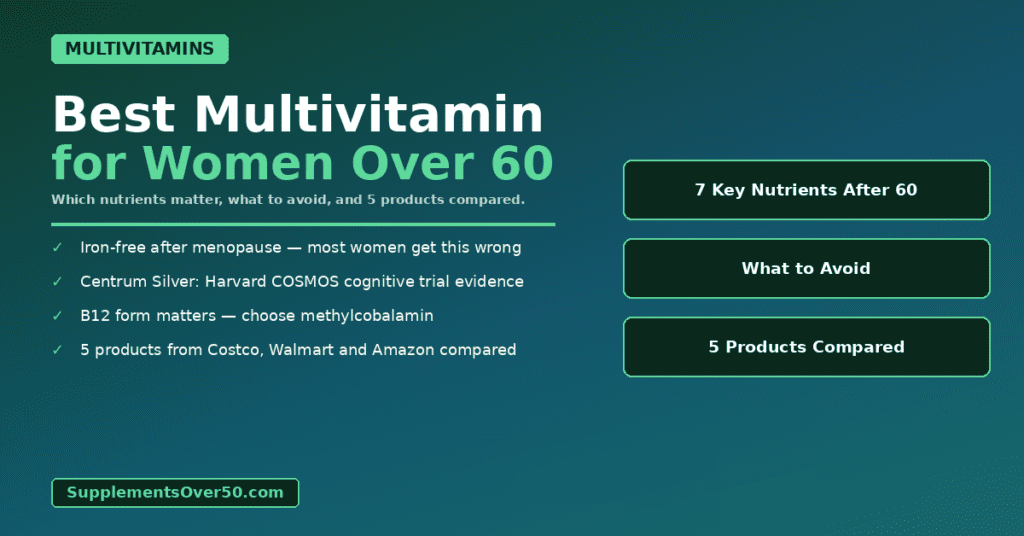
Best multivitamin for women over 60 is one of the most searched supplement questions — and one where the quality of advice available online varies enormously. The honest answer is more nuanced than most articles acknowledge: a multivitamin is not a nutritional insurance policy, and choosing the wrong formula can create as many problems as it solves.
The right multivitamin for a woman over 60 needs to deliver adequate amounts of the nutrients most likely to be deficient in this age group — vitamin D3, B12, B6 and magnesium — while avoiding excessive doses of nutrients that can cause harm at high levels, particularly vitamin A, iron and vitamin E. It also needs to be calibrated for post-menopausal needs: no iron in most cases, higher calcium and D3, adequate K2 if possible.
This guide explains exactly what to look for, what to avoid, and reviews five specific products with current US pricing from Costco, Walmart and Amazon.
The key insight most articles miss: women over 60 generally should NOT take a standard iron-containing women’s multivitamin. Menstruation has stopped, so iron losses have ceased. Excess iron in post-menopausal women is associated with oxidative stress and increased disease risk. Look specifically for iron-free or low-iron formulas designed for women 50+.
The 7 Nutrients That Matter Most for Women Over 60
Before evaluating any multivitamin, understand which nutrients the research consistently identifies as most likely to be deficient in women over 60 and most impactful for this age group:
Nutrient
Why It Matters After 60
Recommended Daily Amount
Look For on Label
Vitamin D3
Bone density, immune function, calcium absorption — deficiency affects ~40% of US adults over 60
1,000–2,000 IU minimum; 4,000 IU if deficient
D3 (cholecalciferol) — not D2
Vitamin B12
Absorption from food declines significantly with age and PPI use — neurological and cognitive consequences
500–1,000 mcg
Methylcobalamin or cyanocobalamin
Vitamin B6
Homocysteine regulation, immune function, nerve health — needs increase after 50
1.5–2mg daily
Pyridoxine HCl or P-5-P
Magnesium
Sleep, muscle function, bone health — commonly deficient, poorly represented in most multis
50–100mg in multi; supplement separately for full dose
Glycinate or citrate — avoid oxide
Folate
Homocysteine control, cardiovascular protection — especially with MTHFR gene variant
400–800 mcg
Methylfolate preferred over folic acid for 50+
Vitamin K2 (MK-7)
Directs calcium to bone, arterial protection — rarely included in standard multis
90–180 mcg if included
MK-7 specifically — not K1 alone
Zinc
Immune function, wound healing, cognitive support — absorption declines with age
8–11mg — do not exceed 40mg total across all supplements
Zinc citrate or gluconate — well absorbed
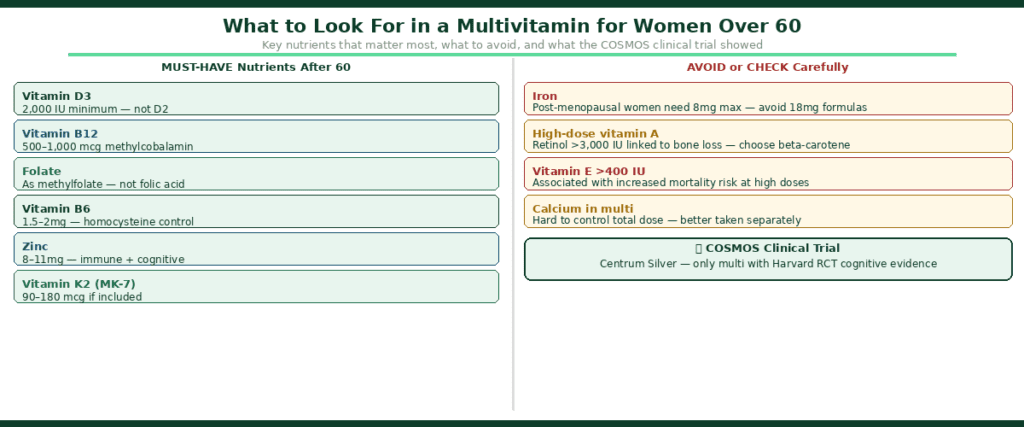
What to look for — and what to avoid — in a multivitamin for women over 60. Post-menopausal women should choose iron-free formulas and prioritise methylcobalamin B12 and methylfolate over synthetic forms. Centrum Silver is the only multivitamin tested in Harvard COSMOS clinical trials showing significant cognitive benefit in adults over 60. Sources: NIH Office of Dietary Supplements, COSMOS trial 2024, National Institute on Aging.
What to Avoid in a Multivitamin for Women Over 60
Iron — unless specifically prescribed
This is the most important point. Most generic women’s multivitamins contain 18mg of iron — the pre-menopausal RDA. Post-menopausal women have an RDA of only 8mg, easily met through diet. Excess iron in older women is associated with oxidative stress, liver stress and increased cardiovascular risk. Always choose a formula specifically designed for women 50+ that is iron-free or contains only minimal iron.
Excess preformed vitamin A (retinol) at doses above 3,000 IU daily is associated with reduced bone density and increased hip fracture risk in post-menopausal women — the opposite of what most women over 60 need. Check the label: multivitamins for seniors should get vitamin A primarily as beta-carotene, which the body converts to vitamin A as needed without accumulation risk.
High-dose vitamin E
Large studies have shown that vitamin E supplementation above 400 IU daily may increase all-cause mortality and has been associated with increased prostate cancer risk in men and bleeding risk in both sexes. Most multivitamins stay well below this threshold, but check that vitamin E is listed as mixed tocopherols rather than dl-alpha-tocopherol (a synthetic form).
Calcium in high doses
Many women’s multivitamins include 500–600mg of calcium. For women over 60 who are also eating dairy and calcium-fortified foods, total calcium can easily exceed 2,000mg daily — associated with kidney stones and potentially cardiovascular calcification without adequate K2. Better to take calcium separately at a controlled dose where needed, rather than getting variable amounts from a multi.
Head-to-Head — 5 Best Multivitamins for Women Over 60
Product
D3 per serving
B12 per serving
Iron
Certification
Centrum Silver Women 50+
1,000 IU
25 mcg
Low
USP Verified, COSMOS trial tested
Garden of Life Vitamin Code Women 50+
2,000 IU
200 mcg
Iron-free
NSF, Non-GMO, whole food raw
Nature Made Women’s Multi 50+
1,000 IU
6 mcg
Low
USP Verified
Kirkland Signature Adult 50+ (Costco)
1,000 IU
500 mcg
None
USP Verified — best value
Life Extension Two-Per-Day (Amazon)
2,000 IU
1,000 mcg (methylcobalamin)
None
Third-party tested — best comprehensive formula
1. Centrum Silver Women 50+ (Amazon / Walmart) — Best Mainstream Option with Clinical Backing
The only multivitamin with published clinical evidence for cognitive benefit in older adults — three COSMOS clinical trials conducted by Harvard Medical School researchers found Centrum Silver significantly improved memory and cognitive function compared to placebo in adults 60+. Contains 1,000 IU D3, 25mcg B12, and is non-GMO and gluten-free. Available at Amazon and Walmart for approximately $20–26 for 200 tablets (~$0.10–0.13 per day — exceptional value).
D3: 1,000 IU | B12: 25 mcg | Iron: low | Calcium: 210mg
Price per day: ~$0.11 (Amazon/Walmart — best value)
Standout: Only multivitamin tested in large-scale Harvard clinical trials for cognitive benefit
Limitation: B12 dose is modest — women with known B12 concerns may need a separate supplement
Best for: Women who want a well-priced, evidence-tested mainstream multivitamin
If you choose a multivitamin with a low B12 dose — Centrum Silver contains only 25mcg — check our guide on Signs of Vitamin B12 Deficiency in Adults Over 60 to see whether your symptoms suggest you need a separate high-dose methylcobalamin supplement.
2. Garden of Life Vitamin Code Women 50+ (Amazon) — Best Whole-Food Formula
A raw, whole-food multivitamin made with organically grown fruits and vegetables — nutrients are presented in their natural food-matrix form alongside co-factors, enzymes and probiotics. Contains 2,000 IU D3, 200mcg B12, is iron-free, and includes live probiotics and enzymes to support absorption. Available on Amazon for approximately $38–48 for 120 capsules (~$1.27–1.60 per day).
D3: 2,000 IU | B12: 200 mcg | Iron: none | Includes probiotics + enzymes
Price per day: ~$1.43 (Amazon)
Certification: NSF Certified, Non-GMO, raw whole-food sourced
Best for: Women who prefer whole-food sourced nutrients and want iron-free at a premium quality tier
3. Life Extension Two-Per-Day (Amazon / Walmart) — Best Comprehensive Formula
The most nutrient-dense mainstream option — 2 capsules daily deliver 2,000 IU D3, 1,000mcg methylcobalamin B12 (the best-absorbed form), methylfolate, and no iron. Life Extension consistently ranks among the most comprehensive formulas for older adults. Available at Amazon and Walmart for approximately $26–32 for 60 capsules (~$0.87–1.07 per day).
D3: 2,000 IU | B12: 1,000 mcg methylcobalamin | Iron: none | Folate: methylfolate
Price per day: ~$0.97 (Amazon/Walmart)
Standout: 1,000mcg methylcobalamin B12 is the highest and best-absorbed form in this category
Best for: Women who want the most complete formula with highest B12 — especially those on PPIs or with known B12 absorption concerns
4. Kirkland Signature Adult 50+ (Costco) — Best Value Certified Option
Costco’s house-brand 50+ multivitamin is USP Verified, contains 1,000 IU D3 and 500mcg B12 with no iron — and is consistently one of the best-value certified multivitamins available in the US. Available at Costco for approximately $18–24 for a large supply (~$0.05–0.08 per day — extraordinary value).
D3: 1,000 IU | B12: 500 mcg | Iron: none | USP Verified
Price per day: ~$0.06 (Costco — exceptional value)
Certification: USP Verified — highest quality standard
Best for: Budget-conscious Costco members who want a certified iron-free 50+ formula at the lowest cost per day
5. Nature Made Women’s Multi 50+ (Amazon / Walmart) — Best Widely Available Budget Option
USP Verified, widely available at most US pharmacies and Walmart, and specifically formulated for women 50+ with iron-free or low-iron options. Contains 1,000 IU D3 and is non-GMO. Available at Walmart and Amazon for approximately $14–20 for 90 tablets (~$0.16–0.22 per day).
D3: 1,000 IU | B12: 6 mcg (low — may need separate B12) | Iron: low
Price per day: ~$0.19 (Walmart)
Limitation: B12 content is low at 6 mcg — supplement separately with at least 500mcg methylcobalamin
Best for: Women who want USP Verified quality at Walmart pricing without a Costco membership
Should Women Over 60 Take a Multivitamin at All?
This is the honest question most multivitamin articles avoid. The evidence for multivitamins in healthy adults with adequate diets is mixed — the COSMOS trial (which tested Centrum Silver) is the strongest recent evidence showing cognitive benefit, but most large studies do not find that multivitamins reduce disease risk in well-nourished populations.
For women over 60, the case for a multivitamin is strongest when: dietary variety is limited, gastric acid production is reduced (impairing B12 and mineral absorption), medications interfere with nutrient absorption (particularly PPIs, metformin and acid-reducing drugs), or blood tests have revealed specific deficiencies. A targeted approach — supplementing only the nutrients identified as deficient through blood testing — is more precise than a multivitamin, but a well-designed 50+ formula is a reasonable safety net.
The practical recommendation: get a blood test for vitamin D, B12 and iron status at your next check-up. If D and B12 are low, address those specifically. If your diet is generally good and blood levels are normal, a Costco Kirkland 50+ at $0.06/day is a reasonable low-cost safety net without over-supplementing.
It depends on your priorities and budget. For the best evidence: Centrum Silver Women 50+ is the only multivitamin tested in large Harvard clinical trials (COSMOS) showing cognitive benefit in older adults, at approximately $0.11 per day. For the most comprehensive formula: Life Extension Two-Per-Day delivers 1,000mcg methylcobalamin B12, 2,000 IU D3 and methylfolate with no iron at approximately $0.97 per day. For the best value certified option: Kirkland Signature Adult 50+ at Costco is USP Verified with 500mcg B12 and no iron at approximately $0.06 per day.
Should women over 60 take a multivitamin with iron?
In most cases no. Iron requirements drop significantly after menopause — the RDA for post-menopausal women is 8mg daily, easily met through diet. Excess iron in older women is associated with oxidative stress and may increase cardiovascular and liver disease risk. Look specifically for a multivitamin labeled for women 50+ or adults 50+ that is iron-free or contains minimal iron. Avoid standard reproductive-age women’s multivitamins that contain 18mg of iron.
Is Centrum Silver good for women over 60?
Yes — it is the only multivitamin with published large-scale clinical evidence for cognitive benefit in older adults. Three separate COSMOS clinical trials conducted by Harvard Medical School researchers found that daily Centrum Silver significantly improved memory and cognitive test performance compared to placebo in adults over 60. It is USP Verified, non-GMO, gluten-free, and costs approximately $0.11 per day. The main limitation is the B12 dose (25mcg) which is modest — women with B12 concerns may want to supplement separately with 500–1,000mcg methylcobalamin.
What vitamins should a 60-year-old woman take daily?
The most important nutrients for women over 60 are vitamin D3 (2,000–4,000 IU daily), vitamin B12 (500–1,000mcg methylcobalamin), magnesium (200–350mg elemental — best from glycinate form), and omega-3 fatty acids (1,000–2,000mg EPA+DHA). A good 50+ multivitamin covers D3 and B12 at baseline levels, but magnesium and omega-3 are almost always under-dosed in multivitamins and should be taken separately. See our complete guide to the 5 essential supplements for adults over 60 for the full stack.
Most multivitamins deliver only 1,000 IU of D3 — adequate as a baseline but insufficient for women who are already deficient. See our dedicated guide on How Much Vitamin D Should a 60-Year-Old Woman Take Daily? for blood level targets and dosing specifics.
Do multivitamins interact with any medications common in women over 60?
Yes — several common interactions to know. Vitamin K in multivitamins can affect warfarin (Coumadin) dosing — inform your doctor if you are on warfarin. Calcium and magnesium in multivitamins can reduce the absorption of thyroid medication (levothyroxine) and some antibiotics — take these medications at least 2 hours apart from your multivitamin. High-dose vitamin B6 (above 100mg) can interfere with levodopa for Parkinson’s disease. Most standard 50+ formulas stay within safe ranges for these interactions, but always disclose your supplement use to your prescribing doctor.
The Bottom Line
Best multivitamin for women over 60 comes down to three decisions: iron-free or not (post-menopausal women should choose iron-free), B12 form and dose (methylcobalamin at 500–1,000mcg is optimal), and D3 level (minimum 1,000 IU; 2,000 IU is better for most women over 60).
Centrum Silver Women 50+ is the evidence-backed mainstream choice at $0.11/day with Harvard COSMOS clinical trial data behind it. Kirkland Signature at Costco is the best-value certified option at $0.06/day. Life Extension Two-Per-Day is the most comprehensive formula for women with higher B12 needs at $0.97/day. Garden of Life Vitamin Code 50+ is the best whole-food option for women who prefer natural sourced nutrients at $1.43/day.
Whichever you choose: get a blood test for D and B12 first, choose an iron-free formula designed for women 50+, and consider supplementing magnesium and omega-3 separately — neither is adequately dosed in any standard multivitamin.Since no multivitamin contains an adequate dose of magnesium, pair your daily multi with a separate magnesium glycinate supplement — the form with the best absorption and no laxative effect — for sleep, bone health and muscle function.”
Looking for the equivalent guide for men? See our Best Multivitamin for Men Over 60 — the nutrient priorities are meaningfully different.
References
1. American Journal of Clinical Nutrition (2024). Effects of multivitamin-mineral supplementation versus placebo on cognitive function: COSMOS randomised clinical trial — Harvard Medical School. COSMOS trial summary
2. NIH Office of Dietary Supplements. Multivitamin/Mineral Supplements — Health Professional Fact Sheet. View on NIH
3. National Institute on Aging (2023). Vitamins and Minerals for Older Adults. View on NIA