⚕️ Medical Disclosure Adults with Stage 3 or higher chronic kidney disease must consult their physician before supplementing magnesium — impaired kidneys cannot excrete excess magnesium and hypermagnesaemia risk is real at standard supplementation doses. This article covers how much Magnesium should seniors take daily over 60 without diagnosed kidney impairment. Seniors on diuretics, PPIs, antibiotics, or cardiac medications should disclose magnesium supplementation to their physician.
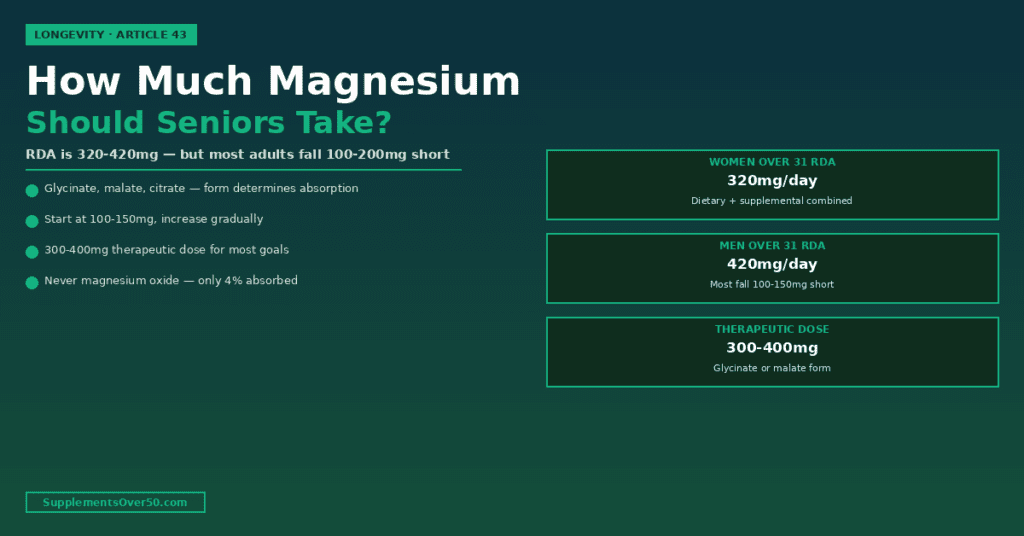
⚡ Quick Answer — The Dosing Summary The NIH RDA for magnesium is 320mg daily for women over 31 and 420mg daily for men over 31. Most adults over 60 consume only 200-250mg through diet and fall 100-200mg short of the RDA. The practical supplemental dose for most seniors is 150-300mg elemental magnesium daily from a well-absorbed form — glycinate for sleep and general use, malate for energy and muscle, taurate for heart rhythm, L-threonate for brain health. Magnesium oxide, found in most cheap supplements and multivitamins, absorbs at only 4% and should be avoided entirely. Start at 100-150mg and increase gradually every two weeks to avoid loose stools. The form matters as much as the dose.
Why Most Seniors Fall Short of the Magnesium RDA
Magnesium is involved in over 300 enzymatic reactions spanning energy production, protein synthesis, nerve signal transmission, muscle contraction, blood glucose regulation, DNA repair, and blood pressure control. Despite this central biological role, approximately 48% of US adults fail to meet the RDA — a rate that rises to an estimated 60-70% in adults over 60.
Three changes after 60 converge to make the gap between dietary intake and functional requirements larger than at any earlier life stage. Understanding these mechanisms is essential for choosing the right dose — because a senior with all three changes needs meaningfully more supplemental magnesium than one facing only the first.
Mechanism 1 — Reduced Intestinal Absorption
Magnesium absorption occurs through two pathways in the small intestine: active transport (saturable, primary at low intakes) and passive paracellular diffusion (proportional to intake, primary at high intakes). Both pathways decline with age. Intestinal active transport efficiency decreases by approximately 20-30% between ages 20 and 70 due to reduced expression of the TRPM6 and TRPM7 transporter channels that move magnesium across the gut wall. This means a senior eating a magnesium-rich meal extracts fewer milligrams per gram consumed than a young adult eating the same food.
Mechanism 2 — Increased Renal Losses
The kidneys regulate magnesium balance by reabsorbing magnesium from the glomerular filtrate back into the bloodstream. Age-related decline in tubular reabsorption efficiency means that older adults excrete more magnesium in urine per day than younger adults at the same intake level. This increased renal loss raises the effective daily requirement — even if intake is unchanged, the net retained magnesium is lower.
Mechanism 3 — Medication Depletion
Three of the most commonly prescribed medication classes in seniors actively deplete magnesium status. Proton pump inhibitors (omeprazole, pantoprazole, esomeprazole — taken by an estimated 15% of seniors) reduce intestinal magnesium absorption through an incompletely understood mechanism; the FDA issued a safety communication about this risk in 2011. Loop and thiazide diuretics (furosemide, hydrochlorothiazide — taken by approximately 25% of seniors) increase urinary magnesium excretion directly. Certain antibiotics (fluoroquinolones, aminoglycosides) also reduce magnesium status during treatment courses.
A senior taking a PPI plus a thiazide diuretic may have a functional magnesium requirement 100-200mg higher than the RDA simply due to medication depletion — requiring a correspondingly higher supplemental dose to achieve the same tissue saturation as an unmedicated peer.
48% of US adults fail to meet the magnesium RDA — rising to an estimated 60-70% in adults over 60
Average US dietary magnesium intake is approximately 250mg for women and 320mg for men over 60 — 70mg and 100mg below the respective RDAs
A 2025 meta-analysis of 38 clinical trials found magnesium supplementation reduces systolic blood pressure by an average of 2.81 mmHg — comparable to lifestyle interventions
Magnesium deficiency is a cofactor for vitamin D resistance — 48% of US adults who are vitamin D deficient are simultaneously magnesium deficient, and D3 cannot be activated without adequate magnesium
A 2023 meta-analysis of 12 RCTs confirmed magnesium supplementation significantly improves sleep quality, onset latency, and morning alertness in adults
Standard serum magnesium tests miss subclinical deficiency in approximately 80% of affected adults — only 1% of total body magnesium circulates in blood
The Magnesium Form Guide — Why Form Matters More Than Dose
The most important decision when choosing a magnesium supplement is not the dose — it is the form. Two products both labelled ‘500mg magnesium’ can deliver dramatically different amounts of absorbed elemental magnesium depending on the compound used. Understanding this is the difference between a supplement that works and one that does nothing except cause loose stools.
Magnesium Glycinate — Best for Sleep, Anxiety, and General Use
Magnesium glycinate is magnesium chelated to two glycine molecules — an amino acid that has independent calming properties through GABA-A receptor interaction. This chelation dramatically improves absorption compared to inorganic forms (oxide, sulfate) because the glycine allows the compound to be absorbed through amino acid transporters rather than relying solely on the limited inorganic mineral transport channels.
For seniors, glycinate is the most versatile daily form. It delivers approximately 14-19% elemental magnesium by weight, is well tolerated at doses up to 400mg daily without GI effects in the majority of adults, and combines the sleep-promoting properties of both magnesium (GABA-A) and glycine (glycine receptor agonism). Best products: Doctor’s Best Magnesium Glycinate 200mg (Amazon, ~$0.17/day) and NOW Magnesium Glycinate 200mg (Amazon/Walmart, ~$0.13/day).
Magnesium Malate — Best for Muscle Energy and Fatigue
Magnesium malate combines magnesium with malic acid — a Krebs cycle intermediate that participates directly in cellular energy production. This dual mechanism makes malate the preferred form for seniors experiencing muscle fatigue, low stamina, or fibromyalgia-like symptoms where both the magnesium deficiency and the malic acid support for ATP production are addressing contributing factors simultaneously.
Malate has a mild energising effect — it is better taken in the morning or midday rather than at bedtime, where glycinate is preferred. Absorption is comparable to glycinate. Best product: Doctor’s Best Magnesium with Malic Acid (Amazon, ~$0.13/day).
Magnesium Taurate — Best for Heart Rhythm and Blood Pressure
Magnesium taurate combines magnesium with taurine — an amino acid with independent cardiovascular-protective properties including antiarrhythmic activity, arterial relaxation, and cardiac membrane stabilisation. The combination addresses cardiac electrical stability through two non-overlapping mechanisms. Taurate is the most cardiovascular-targeted magnesium form and is specifically appropriate for seniors with palpitations, atrial fibrillation risk, or elevated blood pressure.
The 2025 meta-analysis showing 2.81 mmHg systolic blood pressure reduction used mixed magnesium forms — taurate-specific trials showed somewhat larger cardiovascular effects. Best product: Cardiovascular Research Magnesium Taurate (Amazon, ~$0.25/day).
Magnesium L-threonate (Magtein) is the only magnesium form that significantly increases brain magnesium concentrations — it crosses the blood-brain barrier through a specific transport mechanism unavailable to other forms. A landmark MIT study found it increased hippocampal synaptic density substantially in animal models. A 2016 human RCT found significant improvements in executive function and episodic memory in adults 50-70 taking 1.5-2g Magtein daily.
The limitation: Magtein is the most expensive magnesium form per milligram of elemental magnesium delivered (approximately 7-8% elemental). Seniors primarily concerned with brain health or cognitive support may find the premium justified. Best products: Life Extension Neuro-Mag Magtein (Amazon, ~$0.60/day) and Jarrow MagMind (Amazon, ~$0.55/day).
Magnesium Citrate — Best Budget Option
Magnesium citrate absorbs moderately well (approximately 11-16% elemental) and is the most widely available form at the lowest price point. It is a reasonable choice for seniors seeking general magnesium supplementation without specific sleep, cardiovascular, or cognitive priorities. The main limitation: citrate has a mild laxative effect at doses above 300mg daily in some individuals — more than glycinate but less than oxide. Best product: Nature Made Magnesium Citrate 250mg (Walmart/Amazon, ~$0.08/day).
Magnesium Oxide — Avoid for Supplementation
Magnesium oxide has 60% elemental magnesium by weight — the highest of any form. This is why it dominates cheap supplements, store-brand multivitamins, and budget products. However, magnesium oxide absorbs at approximately 4% — meaning a 500mg magnesium oxide tablet delivers only 20mg of usable magnesium, while the remaining 480mg passes through the gut drawing water into the colon (producing the laxative effect). Magnesium oxide is appropriate only as a constipation remedy. For any other supplementation purpose, it is essentially ineffective.
⚠️ The Oxide Trap A supplement labelled ‘500mg Magnesium’ using magnesium oxide delivers approximately 20mg of absorbable magnesium. The same dose of magnesium glycinate delivers 70-95mg. Check the form on the Supplement Facts panel — not just the milligrams on the front label. If it says ‘magnesium oxide’ or simply ‘magnesium’ without specifying the form, assume oxide unless stated otherwise.
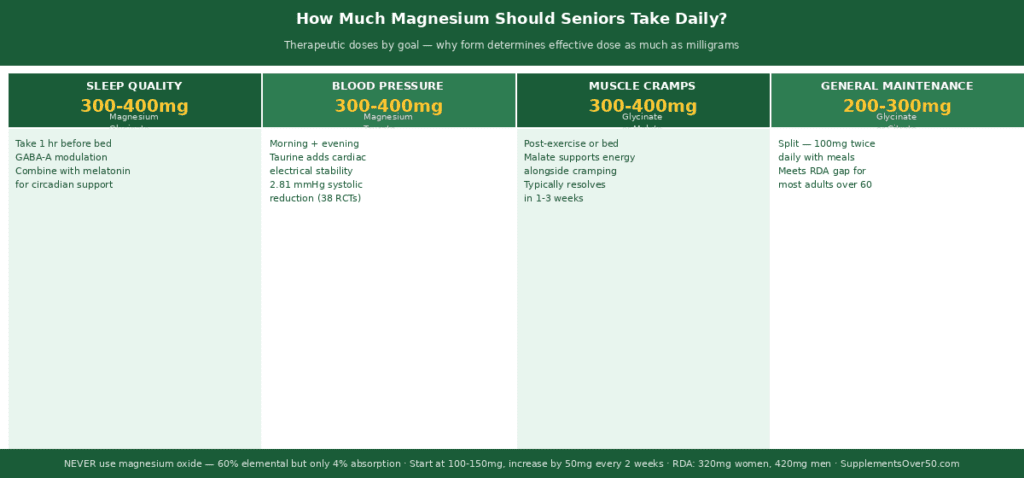
Never use magnesium oxide — 60% elemental but only 4% absorption. Caption: The therapeutic dose is similar across goals (300-400mg) but the form changes significantly based on the primary health target. Always start at 100-150mg and increase by 50mg every two weeks to avoid loose stools.
Dosing by Goal — The Evidence-Based Guide
Goal
Daily elemental dose
Best form
Timing
Notes
General maintenance — meeting RDA
200–300mg
Glycinate or malate
Divided — 100mg twice daily with meals
Foundation dose for most healthy seniors; addresses the average 100-150mg dietary shortfall
Sleep quality improvement
300–400mg
Glycinate or L-threonate
Single dose 1 hour before bed
GABA-A modulation requires higher dose; glycinate is more affordable, L-threonate more brain-targeted
Blood pressure support
300–400mg
Taurate or glycinate
Divided — morning and evening
2025 meta-analysis: 2.81 mmHg systolic reduction averaged across 38 trials
Heart rhythm / AFib risk
300–400mg
Taurate specifically
Divided with meals
Taurine adds independent cardiac electrical stability — most targeted form for this use
Muscle cramps and recovery
300–400mg
Glycinate or malate
Post-exercise or bedtime
Malate supports energy production alongside cramping; glycinate for night cramps specifically
Bone density support
200–300mg
Glycinate alongside D3+K2
With largest meal
Cofactor for vitamin D activation — 48% of D3-supplementing adults are simultaneously Mg insufficient
Anxiety and stress reduction
300–400mg
Glycinate or L-threonate
Divided — morning and bedtime
L-threonate crosses BBB most effectively for neurological anxiety; glycinate for physical restlessness
Constipation relief
400–500mg
Citrate or oxide
Evening — single dose
Osmotic laxative effect; use only for constipation; other goals require absorbed forms
Dosing by Medication — Adjusted Targets
The three medication classes that actively deplete magnesium require upward dose adjustments to achieve the same tissue magnesium levels as unmedicated seniors:
Medication
Depletion mechanism
Adjusted supplemental dose
Monitoring
PPIs (omeprazole, pantoprazole, esomeprazole)
Reduces intestinal Mg absorption — FDA 2011 warning
300–400mg daily in divided doses
Serum Mg annually; symptoms monthly
Loop diuretics (furosemide/Lasix)
Directly increases urinary Mg excretion — significant loss
350–400mg daily; physician may order serum Mg monitoring
Serum Mg every 3-6 months
Thiazide diuretics (HCTZ)
Moderately increases urinary Mg excretion
300–400mg daily
Serum Mg annually
Metformin (diabetes)
Reduces intestinal Mg absorption over time
300mg daily — also increases B12 monitoring need
Annual serum Mg and B12
Antibiotics (fluoroquinolones)
Chelates Mg in gut during treatment course
Supplement at 200mg during course; space 2 hrs from antibiotic
Symptoms during treatment
Special Populations — Further Adjusted Dosing
Condition
Dosing adjustment
Reason
Notes
Kidney disease Stage 3+
Only supplement under physician supervision — do not self-supplement
The most common reason seniors abandon magnesium supplementation is loose stools or mild diarrhea in the first 1-2 weeks. This is dose-dependent and form-dependent — glycinate causes far fewer GI effects than citrate or oxide — but is almost entirely preventable with a gradual start:
Week 1-2: 100-150mg elemental magnesium glycinate daily with evening meal. Most seniors tolerate this without any GI effects.
Week 3-4: Increase to 200mg daily. Either take all 200mg with dinner or split as 100mg with lunch and 100mg with dinner.
Week 5-6: Increase to 300mg daily if your goal requires it (sleep, blood pressure, muscle cramps). Add the extra 100mg at bedtime.
Week 7+: Increase to 400mg if needed — typically adding a morning dose of 100mg with breakfast alongside the 300mg already established.
At any point loose stools or diarrhea appear: reduce dose by 50mg and hold at that level for 2 additional weeks before attempting another increase.
Most seniors tolerate 300-400mg magnesium glycinate daily without GI effects once the gradual titration is complete. Seniors who experience persistent GI effects at glycinate doses above 200mg often tolerate magnesium malate at the same dose — the two have slightly different gut absorption kinetics.
How to Read a Magnesium Supplement Label
Magnesium supplement labels are one of the most confusing in the supplement industry. Here is exactly what to look for:
Front label ‘500mg Magnesium’ — means nothing without knowing the form. A 500mg magnesium oxide tablet delivers 20mg absorbed. A 500mg magnesium glycinate tablet delivers 75-95mg absorbed.
Supplement Facts ‘Magnesium (as magnesium glycinate)’ — the parenthetical tells you the form. Always find this line.
Serving size matters — some labels show a per-tablet dose and others show per 2-tablet dose. Check whether the elemental magnesium listed is per tablet or per serving.
‘Elemental magnesium’ — this is the number that matters. Some labels list both the total compound weight and the elemental magnesium separately. Always use the elemental figure.
Certifications — USP Verified, NSF Certified, or Informed Sport labels confirm label accuracy and absence of contaminants.
Signs You Are Getting the Right Dose
Unlike some supplements where effects are subtle or delayed, magnesium at the correct dose and form produces measurable improvements in specific symptoms within 1-4 weeks for most deficient seniors:
Muscle cramps: nighttime calf cramps should reduce in frequency and severity within 1-3 weeks at 300-400mg daily. Complete resolution confirms the cramps were magnesium-driven.
Sleep quality: difficulty initiating sleep and staying asleep should improve within 2-4 weeks at 300-400mg glycinate taken at bedtime. If no improvement after 4 weeks, consider switching to malate or adding L-threonate.
Anxiety and restlessness: physical anxiety, hypervigilance, and the inability to physically relax typically improve within 3-6 weeks. Psychological anxiety with cognitive rumination responds less consistently.
Blood pressure: measurable reductions require 8-12 weeks of consistent supplementation — the 2.81 mmHg average reduction in meta-analyses was measured at this timeframe.
Constipation: the osmotic effect of citrate or oxide on bowel regularity is immediate — within 24-48 hours.
Muscle cramps persisting after 3 weeks at 300mg: try increasing to 400mg, or switch from citrate to glycinate if currently on citrate
Sleep not improving after 4 weeks at 300mg glycinate: switch to malate form or add 300mg L-threonate for the brain-specific sleep pathway
Blood pressure not responding after 12 weeks: switch to magnesium taurate 300-400mg and confirm no concurrent use of NSAIDs (which blunt Mg’s antihypertensive effect)
Fatigue persisting: recheck vitamin D status — magnesium is required for D3 activation and co-deficiency is extremely common; supplementing both simultaneously is more effective than either alone
Loose stools at any dose: switch from citrate to glycinate; reduce dose by 50mg and reattempt gradual increase
Magnesium and Vitamin D — The Critical Co-Dependency
One of the most clinically important and least discussed interactions in senior nutrition is the co-dependency between magnesium and vitamin D. Magnesium is a required cofactor for the enzymes that convert cholecalciferol (storage D3) to 25-hydroxyvitamin D and then to 1,25-dihydroxyvitamin D (the active hormone form). Without adequate magnesium, this conversion is impaired — meaning that seniors taking vitamin D3 supplements may have inadequate conversion if they are simultaneously magnesium deficient.
This explains a clinical pattern frequently observed but rarely correctly attributed: seniors taking 2,000-4,000 IU vitamin D3 daily for months without their 25(OH)D blood levels reaching the 40-60 ng/mL target range. In many of these cases, the limiting factor is not the D3 dose but the magnesium co-factor availability. Correcting magnesium deficiency in these individuals often produces a substantial rise in measured 25(OH)D without any change in vitamin D3 dose.
Top Magnesium Products for Seniors — US Pricing 2026
1. Doctor’s Best High Absorption Magnesium Glycinate 200mg — Amazon — Best Overall
Best for: the majority of seniors wanting reliable glycinate at a competitive price. Two 200mg tablets provide 400mg elemental glycinate at the full therapeutic dose. Third-party tested, non-GMO, well-reviewed for GI tolerability. ~$0.17/day for 400mg dose.
2. NOW Magnesium Glycinate 200mg — Amazon / Walmart — Best Value
Best for: budget-conscious seniors. Equivalent quality to Doctor’s Best at a slightly lower price point. Available at Walmart which is important for seniors who prefer in-store purchasing. ~$0.13/day.
3. Cardiovascular Research Magnesium Taurate 125mg — Amazon — Best for Heart Health
Best for: seniors with palpitations, atrial fibrillation risk, or blood pressure as the primary concern. Taurine provides independent cardiac electrical stability alongside magnesium. ~$0.30/day at 375mg total dose (3 capsules).
4. Doctor’s Best Magnesium with Malic Acid (Malate) 200mg — Amazon — Best for Energy and Muscle
Best for: seniors with fatigue, muscle weakness, or fibromyalgia symptoms where energy production support is the primary goal alongside magnesium repletion. Take in the morning — malic acid has mild energising properties. ~$0.13/day.
5. Life Extension Neuro-Mag Magtein — Amazon — Best for Cognitive Support
Best for: seniors prioritising brain health alongside sleep improvement. The Magtein form crosses the blood-brain barrier more effectively than any other magnesium form. Higher cost reflects the specialised patented form. ~$0.60/day.
400mg elemental magnesium from a well-absorbed form like glycinate is within the NIH safe upper limit for supplemental magnesium (350mg supplemental — note the NIH limit applies to supplemental magnesium only; dietary magnesium has no established upper limit). Most healthy seniors with normal kidney function tolerate 400mg supplemental magnesium glycinate daily without adverse effects. The limiting side effect is loose stools, not toxicity — if this occurs, reduce to 300mg. Magnesium toxicity (hypermagnesaemia) at oral supplemental doses requires kidney impairment to develop — in seniors with normal renal function, excess is efficiently excreted.
Should I take magnesium with food or without food?
Always with food for most forms. Taking magnesium glycinate, malate, taurate, or citrate with food reduces GI side effects and in some cases improves absorption. The exception is magnesium L-threonate — some research suggests it absorbs similarly with or without food, and the brain-targeted transport mechanism is not fat-dependent. For general supplementation, the practical rule is: take your magnesium at your largest meal of the day. This also pairs well with vitamin D3 and K2 (both fat-soluble) at the same meal.
Why does my multivitamin list 400mg magnesium but I still feel deficient?
This is almost certainly the magnesium oxide problem. Check your multivitamin’s Supplement Facts panel for the word in parentheses after ‘Magnesium.’ If it says ‘oxide,’ the 400mg on the label delivers approximately 16mg of absorbed magnesium — essentially none. This is the most common supplement label deception in the entire industry. Switch to a dedicated magnesium glycinate supplement at 200-300mg elemental and you will notice the difference within 2-3 weeks if deficiency was driving any symptoms.
Can I take magnesium and calcium together?
Not at the same meal — they compete for absorption through the same intestinal transport channels. Space calcium and magnesium at separate meals for optimal absorption of both. This is particularly relevant for seniors taking calcium supplements alongside magnesium, and for those whose multivitamin contains significant amounts of both. Calcium taken at breakfast, magnesium glycinate taken at dinner and bedtime, is a practical separation schedule that maximises absorption of each.
How long before magnesium supplements work?
Timeline varies by symptom. Muscle cramp frequency: 1-3 weeks at 300-400mg daily. Sleep onset and quality: 2-4 weeks at 300-400mg glycinate at bedtime. Anxiety and physical restlessness: 3-6 weeks. Blood pressure reduction: 8-12 weeks (the meta-analysis timeframe). Mood improvements: 4-8 weeks. Bone density contribution: months to years. The most immediate effect is the laxative property of citrate and oxide — within 24-48 hours. For non-laxative purposes, consistent daily use for a minimum of 4-6 weeks before assessing whether the supplement is working is the standard evaluation window.
What is the best magnesium supplement for seniors over 70?
Magnesium glycinate at 200-300mg daily is the best choice for most seniors over 70 as a general recommendation. The chelated form is gentler on the gut than citrate (more important for older adults with sensitive digestion), well-absorbed despite the reduced intestinal transport efficiency that comes with aging, and addresses both the sleep and muscle cramping concerns that are most common in the over-70 population. For those with specific cardiovascular concerns — palpitations, atrial fibrillation, elevated blood pressure — magnesium taurate at 300-400mg daily is the more targeted choice. For those with cognitive concerns, Magtein L-threonate at 1.5-2g daily is worth the additional cost.
Can I take magnesium if I have kidney disease?
This is the most important safety caveat for any senior considering magnesium supplementation. Healthy kidneys regulate magnesium balance by excreting excess through urine — in Stage 3 or higher chronic kidney disease (eGFR below 60), this excretory capacity is significantly impaired, and supplemental magnesium can accumulate to dangerous levels (hypermagnesaemia). Symptoms of hypermagnesaemia include nausea, flushing, muscle weakness, low blood pressure, and in severe cases cardiac arrhythmia. If you have any history of kidney disease, have been told your kidney function is reduced, or take medications for kidney-related conditions, consult your nephrologist or primary care physician before starting any magnesium supplement — regardless of dose or form.
Why does magnesium give me diarrhoea?
Two reasons, either independently or together. First, the form — magnesium citrate, oxide, and sulfate are osmotic: they pull water into the colon, producing loose stools or diarrhoea as a direct pharmacological effect. This is the same mechanism used intentionally in magnesium citrate bowel preparation products. Switching to magnesium glycinate or malate eliminates this effect for most seniors. Second, the dose — even glycinate can cause loose stools at doses above 400mg in sensitive individuals. The solution is to switch to glycinate and start at 100mg, increasing by 50mg every two weeks. At 200-300mg of glycinate, the majority of seniors experience no GI effects at all.
Does magnesium interact with blood pressure medication?
Yes — and in a beneficial direction that requires monitoring. Magnesium relaxes vascular smooth muscle through its natural calcium channel antagonist effect, producing mild blood pressure reduction. If you already take antihypertensive medications (ACE inhibitors like lisinopril, calcium channel blockers like amlodipine, or beta-blockers), adding 300-400mg magnesium supplementation may lower your blood pressure further than your medication alone achieves. For most seniors this is desirable — but if your blood pressure is already well-controlled at the lower end of target range, the additive effect could bring it below 90/60 mmHg. Check your blood pressure readings weekly for the first 4-6 weeks after starting magnesium supplementation and report significant changes to your prescribing physician.
What is the best magnesium supplement for leg cramps in seniors?
Magnesium glycinate at 300-400mg daily is the most evidence-supported form for nocturnal leg cramps. The calcium-magnesium imbalance in muscle cells — where inadequate magnesium fails to counteract calcium-driven contraction — is the primary mechanism. Glycinate is preferred over citrate for this application because it can be taken at bedtime without the laxative effect that citrate produces at higher doses. Allow 2-3 weeks of consistent use before expecting significant reduction in cramp frequency. Seniors who experience cramps primarily during or after exercise also benefit from magnesium malate taken post-exercise due to its Krebs cycle support alongside the mineral effect.
Can seniors take magnesium with zinc?
Not at the same meal — zinc and magnesium compete for absorption through the same intestinal transport channels when taken together at high doses. The practical solution is simple: take zinc with breakfast or lunch and magnesium glycinate at dinner or bedtime. This separation eliminates the competition and maximises absorption of both. For seniors taking a multivitamin that contains both minerals at moderate doses (11-15mg zinc and 50-100mg magnesium), the competition is clinically insignificant at those doses — only meaningful when supplementing both at therapeutic doses simultaneously at the same meal.
Is it better to take magnesium in the morning or at night?
The optimal timing depends on your primary goal. For sleep quality: take magnesium glycinate 300-400mg one hour before bed — this is when the GABA-A receptor modulation and cortisol-lowering effect most directly supports sleep onset. For blood pressure and cardiovascular support: split the dose as 150-200mg with breakfast and 150-200mg with dinner to maintain consistent blood magnesium levels throughout the day. For muscle cramps: a bedtime dose addresses the nighttime cramping pattern most common in seniors. For energy and fatigue: magnesium malate is best taken in the morning as malic acid has mild energising properties that complement rather than interfere with waking function. When in doubt, bedtime dosing with glycinate is the most versatile default.
The Bottom Line
The magnesium dosing question for seniors has a clear answer: 300-400mg elemental magnesium daily from a well-absorbed form (glycinate for most, malate for energy, taurate for heart, L-threonate for brain), taken with food, built up gradually from 100-150mg over 4-6 weeks. This dose reliably fills the 100-200mg gap between average dietary intake and the RDA in most seniors and exceeds what is needed for specific therapeutic outcomes like sleep improvement and blood pressure support.
The form is more important than the dose. A senior taking 500mg of magnesium oxide is getting less benefit than one taking 200mg of magnesium glycinate. A senior on PPIs or diuretics needs 50-100mg more supplemental magnesium than one who is unmedicated. A senior who is also vitamin D deficient may find their D3 supplementation becomes substantially more effective once magnesium deficiency is corrected.
Check the form on the label before purchasing. Start low and increase gradually. Allow 4-6 weeks before evaluating results. And do not take calcium and magnesium at the same meal.