| ⚕️ Supplement Disclosure This article reviews ashwagandha as a dietary supplement and is for informational purposes only. Women who are pregnant, breastfeeding, have thyroid conditions, or take medications including sedatives, thyroid medication or immunosuppressants should speak with their doctor before using ashwagandha. Do not use if pregnant — ashwagandha has been associated with potential abortifacient effects at high doses. |
Ashwagandha for women over 50 is a topic that deserves far more attention than it typically gets in mainstream menopause discussions. Most women approaching or past menopause hear about hormone therapy or black cohosh. Very few hear about ashwagandha — yet the 2024 and 2025 clinical trial evidence specifically in perimenopausal and postmenopausal women is genuinely compelling.
Ashwagandha (Withania somnifera) is an adaptogenic herb with a 3,000-year history in Ayurvedic medicine. As an adaptogen, it helps the body regulate its response to stress — which has direct relevance for the hormonal turbulence of perimenopause and the chronic elevated cortisol that many women over 50 experience. But the evidence now goes beyond stress. Recent RCTs show meaningful improvements in hot flashes, sleep quality, anxiety, cognitive function and even estradiol levels in women in the perimenopausal transition.
This guide covers what ashwagandha actually does in the female body after 50, what the newest clinical evidence shows, honest caveats where the research is preliminary, and five specific US products with pricing.
| Quick summary: ashwagandha is best supported by evidence for anxiety and stress reduction, sleep quality improvement, and perimenopause symptom management in women over 50. The KSM-66 branded extract has the most clinical trials behind it. Allow 6–8 weeks of consistent use before evaluating results. |
Why Ashwagandha Is Particularly Relevant After 50
The transition through perimenopause and into postmenopause involves a cascade of hormonal changes that extend well beyond estrogen decline. Cortisol — the primary stress hormone — frequently becomes dysregulated, contributing to anxiety, sleep disruption, brain fog and weight changes that many women experience as the most disruptive aspects of midlife hormonal transition.
Ashwagandha’s core mechanism is HPA axis modulation — it helps regulate the hypothalamic-pituitary-adrenal axis, which controls the body’s cortisol response. By reducing chronically elevated cortisol, ashwagandha can indirectly improve sleep (cortisol disrupts melatonin production), reduce anxiety (cortisol drives sympathetic nervous system activation), and potentially support estrogen levels (high cortisol is inversely associated with sex hormone production).
For women over 50 who experience the overlapping constellation of sleep disruption, anxiety, fatigue and brain fog — all of which can be driven or worsened by cortisol dysregulation — ashwagandha targets a root mechanism rather than treating each symptom separately.
What the 2024–2025 Clinical Evidence Shows
Menopause symptoms — strongest recent evidence
A 2025 randomised, double-blind, placebo-controlled study published in Journal of Menopausal Medicine (PMC) enrolled postmenopausal women aged 40–55 and tested ashwagandha at 250mg and 500mg doses. The study found dose-dependent reductions in menopause-specific quality of life (MENQOL) scores, vascular dysfunction and bone resorption markers. Women receiving ashwagandha showed significantly greater improvements across vasomotor, physical and psychological symptom domains compared to placebo.
Chronic high cortisol also directly suppresses bone-building activity — another reason managing stress matters for post-menopausal bone density alongside the K2, D3 and boron stack covered in our dedicated bone health guide.”
A separate 2025 randomised, double-blind, placebo-controlled study published in Frontiers in Reproductive Health enrolled 60 women aged 45–55 taking 300mg ashwagandha root extract twice daily for 56 days. The ashwagandha group showed statistically significant reductions in total Menopause Rating Scale (MRS) scores (p<0.0001), including significant improvements in psychological symptoms (p=0.0003), somato-vegetative symptoms (p=0.0152) and urogenital symptoms (p<0.0001). Hot flash frequency, quality of life scores and perceived stress all improved significantly.
Anxiety and stress reduction — most consistent evidence base
A 2024 randomised controlled trial published in Nutrients enrolled chronically stressed adults and found ashwagandha supplementation significantly reduced perceived stress scores, cortisol levels and anxiety measures compared to placebo. This is consistent with the broader evidence base — a systematic review and meta-analysis confirmed that ashwagandha supplementation significantly improves anxiety and stress symptoms across multiple well-designed RCTs.
Sleep quality — well-supported
A double-blind, randomised, placebo-controlled study published in Journal of Ethnopharmacology confirmed ashwagandha root extract significantly improved sleep onset latency, total sleep time and sleep quality in adults with insomnia. This is mechanistically consistent — cortisol reduction by ashwagandha removes one of the primary drivers of sleep disruption, allowing melatonin to function more effectively.
or women struggling with 3am wakefulness, pairing ashwagandha with magnesium glycinate creates a powerful non-hormonal sleep stack — ashwagandha lowers nighttime cortisol while magnesium glycinate calms the nervous system through GABA pathways.
Estradiol and hormonal support — promising but preliminary
A study cited on Examine.com found women aged 18–64 taking 300mg ashwagandha root extract twice daily saw increases in estrogen levels and sexual function alongside reductions in follicle-stimulating hormone and luteinizing hormone. A 2023 RCT found perimenopausal women showed a 137% increase in estradiol concentrations from baseline to week 12. These findings are biologically plausible (cortisol suppression may allow greater sex hormone production) but the evidence base for this specific effect is still developing.
| The honest E-E-A-T caveat: the ashwagandha evidence for menopause symptoms, anxiety and sleep is genuine and growing — particularly the 2025 trials. The evidence for direct hormonal effects (estradiol increases) is promising but based on smaller studies. The strongest, most consistent effect is on cortisol reduction and the downstream improvements to sleep, anxiety and stress resilience. |
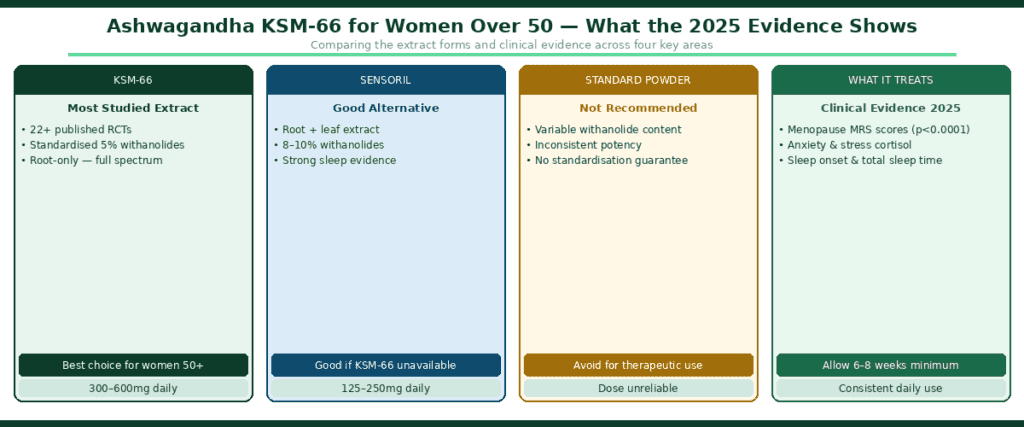
MK-4 vs KSM-66 vs Sensoril — Which Extract Form Matters
| Extract Form | Characteristics | Best For |
| KSM-66 | Root-only extract, 5% withanolides. The most clinically studied form — 22+ published RCTs. Full-spectrum root profile. | Stress, anxiety, sleep, menopause symptoms — first choice for women over 50 |
| Sensoril (Ashwagandha) | Root and leaf extract, higher withanolide content (8–10%). Fewer RCTs than KSM-66 but strong stress and sleep evidence. | Sleep support — good alternative if KSM-66 unavailable |
| Standard root powder | Variable withanolide content. Cheap but inconsistent potency — quality varies widely between brands. | Not recommended for therapeutic use — use standardised extracts instead |
| Witholytin | Novel standardised extract tested in 2023 Witholytin RCT. Early evidence for stress and fatigue. Less studied than KSM-66. | Emerging option — more evidence needed |
| For women over 50: always look for KSM-66 or Sensoril on the label. These are standardised to 5% and 8–10% withanolides respectively — the active compounds responsible for ashwagandha’s effects. Generic ‘ashwagandha root powder’ without a standardisation percentage is unlikely to deliver consistent therapeutic results. |
Dosing Guide for Women Over 50
| Question | Answer |
| Effective dose? | 300–600mg of standardised KSM-66 extract daily. Most clinical trials used 300mg twice daily (600mg total) or 300–500mg once daily. Do not exceed 1,000mg daily without medical guidance. |
| When to take? | Morning dose for general stress and daytime anxiety support. Evening dose (or second dose) for sleep quality improvement. Taking with food reduces any GI sensitivity. |
| How long to see results? | Cortisol and anxiety improvements typically appear within 2–4 weeks. Sleep quality improvements often emerge within 2–6 weeks. Menopause symptom improvements were documented at 8 weeks in key trials. Give it 8 weeks minimum before evaluating. |
| Cycle or take continuously? | Most clinical trials ran 8–12 weeks without cycling. For long-term use beyond 6 months, some practitioners recommend a 2-week break every 3 months, though this is precautionary rather than evidence-based. |
5 Best Ashwagandha Supplements for Women Over 50 — US Pricing 2026
1. Physician’s Choice KSM-66 Ashwagandha 1,000mg (Walmart / Amazon) — Best KSM-66 Value
Uses organic KSM-66 standardised to 5% withanolides — the most clinically studied ashwagandha extract. 1,000mg per serving (2 capsules), vegan. Available at Walmart for approximately $22–28 for 60 capsules (~$0.37–0.47 per day for the 1,000mg dose). One of the most popular KSM-66 products at US retail.
- KSM-66 per serving: 1,000mg (standardised 5% withanolides)
- Price per day: ~$0.42 (Walmart)
- Caffeine: none
- Certification: Organic, vegan, third-party tested
- Best for: Women who want the clinically studied KSM-66 form at the best Walmart price
2. Nature’s Bounty Ashwagandha KSM-66 + L-Theanine (Walmart) — Best Stress + Calm Stack
Combines 600mg KSM-66 with 200mg L-theanine — a pairing that addresses both the cortisol side (ashwagandha) and the nervous system calming side (L-theanine acts on GABA receptors) simultaneously. Available at Walmart for approximately $18–24 for 50 tablets (~$0.36–0.48 per day).
- KSM-66: 600mg + L-theanine: 200mg per tablet
- Price per day: ~$0.42 (Walmart)
- Certification: Non-GMO, gluten-free, no artificial additives
- Best for: Women whose primary concerns are anxiety and sleep — the L-theanine pairing enhances both
3. Garden of Life Organic Ashwagandha (Amazon) — Best Certified Organic
USDA Organic, Non-GMO Project Verified, NSF Gluten-Free certified, vegan and kosher. Contains 600mg organic ashwagandha root extract plus a probiotic and fermented ginger blend for improved absorption. Available on Amazon for approximately $20–26 for 60 tablets (~$0.33–0.43 per day).
- Ashwagandha: 600mg organic root extract per tablet
- Price per day: ~$0.38 (Amazon)
- Certification: USDA Organic, NSF, Non-GMO, Vegan, Kosher
- Best for: Women who prioritise certified organic ingredients with the highest certification standard
4. Nature’s Lab KSM-66 Ashwagandha 600mg (Walmart) — Best Budget KSM-66
600mg KSM-66 standardised to 5% withanolides plus 700mg ashwagandha root powder per 2-capsule serving — giving both the standardised extract and whole root. 120 capsules is a 60-day supply. Available at Walmart for approximately $18–24 for 120 capsules (~$0.30–0.40 per day).
- KSM-66: 600mg + 700mg root powder per 2-capsule serving
- Price per day: ~$0.35 (Walmart)
- Certification: cGMP certified, USA manufactured
- Best for: Women who want KSM-66 at the lowest cost per day
5. Gaia Herbs Ashwagandha Root (Amazon) — Best Liquid Phyto-Cap
Gaia Herbs uses a liquid phyto-cap technology that many users find easier to absorb than compressed tablets — particularly relevant for women over 60 with reduced gastric acid production. Contains 500mg concentrated ashwagandha root extract. Available on Amazon for approximately $22–28 for 60 capsules (~$0.37–0.47 per day).
- Ashwagandha: 500mg liquid phyto-cap per capsule
- Price per day: ~$0.42 (Amazon)
- Certification: Certified B Corp, non-GMO, certified organic
- Best for: Women who prefer a liquid herbal extract format for better absorption
Safety and Important Cautions for Women Over 50
| ⚠️ When NOT to take ashwagandha Do not use ashwagandha if you are pregnant — it has been associated with potential uterine-stimulating effects. Women with thyroid conditions (hyper or hypothyroidism) should use with caution and inform their doctor — ashwagandha can affect thyroid hormone levels. Women taking sedatives, anti-anxiety medications, immunosuppressants or thyroid medication should check with their doctor before starting. Denmark and France have raised safety concerns at high doses — stay within 300–600mg KSM-66 daily. |
Related Articles
• Magnesium Glycinate vs Citrate — Best Form for Sleep After 50
• K2, D3 and Boron for Post-Menopausal Bone Density
• Best Magnesium Supplement for Sleep and Leg Cramps After 50
Frequently Asked Questions
Does ashwagandha help with menopause symptoms?
Yes — and the 2025 clinical evidence is the strongest to date. A 2025 randomised, double-blind, placebo-controlled study in the Journal of Menopausal Medicine found ashwagandha significantly reduced menopause-specific quality of life scores in postmenopausal women, including vasomotor, physical and psychological symptom domains. A separate 2025 Frontiers in Reproductive Health RCT in 60 perimenopausal women found statistically significant reductions in total Menopause Rating Scale scores (p<0.0001) at 300mg twice daily for 56 days.
Can ashwagandha help women over 50 sleep better?
Yes. Ashwagandha improves sleep primarily by reducing cortisol — chronically elevated cortisol suppresses melatonin production and keeps the nervous system in a state of arousal that prevents restful sleep. A double-blind RCT published in the Journal of Ethnopharmacology confirmed ashwagandha significantly improved sleep onset latency, total sleep time and sleep quality compared to placebo. For women over 50 whose sleep disruption is driven by stress and cortisol dysregulation rather than purely hormonal changes, ashwagandha addresses the root mechanism.
What is the best form of ashwagandha for women?
KSM-66 is the best-evidenced form for women over 50 — it is a root-only extract standardised to 5% withanolides with 22+ published randomised controlled trials including several specifically in perimenopausal and postmenopausal women. Look for KSM-66 clearly labelled on the product. Physician’s Choice KSM-66 at Walmart and Nature’s Lab KSM-66 at Walmart are the best-value options. Avoid products listing only ‘ashwagandha root powder’ without a standardisation percentage — potency is unreliable.
How long does ashwagandha take to work for menopause symptoms?
The key 2025 clinical trial showed significant menopause symptom improvements at 56 days (8 weeks) of twice-daily use. Anxiety and stress improvements typically appear within 2–4 weeks. Sleep quality improvements often emerge within 2–6 weeks. Allow a minimum of 8 weeks at consistent daily dosing before deciding whether ashwagandha is helping — its effects build gradually through HPA axis recalibration rather than providing acute relief.
Chronically elevated cortisol is also a known driver of cognitive decline — it damages hippocampal neurons involved in memory consolidation. Managing stress through ashwagandha supports the same brain health goals covered in our omega-3 brain health guide and caffeine-free nootropic stack.
Is ashwagandha safe for women over 60 to take daily?
For most healthy women over 60 not on contraindicated medications, KSM-66 ashwagandha at 300–600mg daily is well tolerated with only mild, transient side effects reported in clinical trials. The main precautions: avoid if pregnant, use caution with thyroid conditions or thyroid medication, and inform your doctor if you take sedatives or immunosuppressants. A 2024 safety review by India’s Ministry of Ayush confirmed ashwagandha’s safety profile at therapeutic doses. Stay within 300–600mg KSM-66 daily for long-term use.
The Bottom Line
Ashwagandha for women over 50 is one of the most evidence-backed adaptogenic supplements available for the specific constellation of symptoms that accompany the menopausal transition — anxiety, sleep disruption, fatigue, hot flashes and brain fog.
The 2025 clinical trials specifically in perimenopausal and postmenopausal women confirm what the broader ashwagandha evidence base has suggested for years: cortisol modulation through KSM-66 ashwagandha produces measurable improvements across multiple quality-of-life domains. The effect is real, the safety profile at 300–600mg KSM-66 daily is good, and the cost at mainstream US retail is modest.
Start with Physician’s Choice KSM-66 at Walmart (~$0.42/day) or Nature’s Lab KSM-66 at Walmart (~$0.35/day). Take 300mg with breakfast and 300mg with dinner, allow 8 weeks minimum, and track your anxiety and sleep quality week by week to assess response. The natural companion to ashwagandha for menopause is shatavari — addressing the phytoestrogenic pathway that ashwagandha does not directly target. See our complete guide on Shatavari for Menopause for the 2025 clinical trial evidence
References
1. Journal of Menopausal Medicine / PMC (2025). Ashwagandha and Shatavari Extracts Dose-Dependently Reduce Menopause Symptoms, Vascular Dysfunction, and Bone Resorption in Postmenopausal Women. View on PMC
2. Frontiers in Reproductive Health (2025). Randomised double-blind placebo-controlled study on Ashwagandha root extract for managing menopausal symptoms. View article
3. PMC / Journal of Psychopharmacology (2023). Exploring the efficacy and safety of a novel standardized ashwagandha root extract (Witholytin) in adults with high stress and fatigue. View on PMC
4. Nutrients (2024). Effects of Withania somnifera extract in chronically stressed adults: A Randomized Controlled Trial. PubMed.