| ⚕️ Supplement Disclosure This article reviews collagen supplements for informational purposes only. Collagen supplements are not a treatment for arthritis, osteoporosis or other medical conditions. If you have diagnosed joint disease or bone loss, speak with your doctor about appropriate medical management alongside any supplement routine. |
Best collagen supplement after 50 is a question that deserves a more honest answer than most health sites provide. The collagen supplement market is a $2 billion industry driven heavily by marketing claims that run well ahead of what the clinical evidence actually demonstrates. That does not mean collagen is useless — the evidence for skin hydration, elasticity and joint comfort is genuinely encouraging. But the type of collagen matters, the dose matters, and understanding what to expect vs what is hype matters.
This guide covers the different collagen types and which to choose for skin vs joints, what the best 2024–2025 clinical trials actually show, honest caveats about industry-funded research, and five specific products with current US pricing from Costco, Walmart, and Amazon.
| Quick guide: Type I and III hydrolyzed collagen peptides are best for skin, hair and nails. Type II collagen (undenatured or hydrolyzed) is best for joint cartilage support. Most powder supplements contain Type I and III. If joints are your primary concern, look specifically for Type II collagen or a multi-collagen formula. |
Why Collagen Matters More After 50
Collagen is the most abundant structural protein in the human body — it makes up the scaffolding of skin, cartilage, tendons, ligaments and bone. The body produces collagen continuously throughout life, but production declines by approximately 1–1.5% per year from around age 25, and the rate of decline accelerates noticeably after 50, particularly in women after menopause due to the loss of estrogen’s collagen-stimulating effects.
The practical consequences for adults over 50 are familiar: skin becomes thinner, less elastic and more prone to wrinkling. Joints become stiffer and more prone to discomfort. Tendons and ligaments recover more slowly from strain. Bone density declines partly because the collagen matrix that calcium attaches to becomes less robust.
Collagen forms the organic scaffold that calcium attaches to in bone — but calcium also needs to be properly directed there. See our guide on Vitamin K2, D3 and Boron for Post-Menopausal Bone Density for the full bone health stack.
Oral collagen supplementation works not by delivering intact collagen molecules to these tissues — collagen is digested like any other protein — but by delivering specific peptides (particularly proline-hydroxyproline-glycine tripeptides) that act as signalling molecules to stimulate fibroblasts to produce more collagen. This mechanism has been confirmed in human bloodstream studies showing collagen-specific peptides appear in the circulation 30–60 minutes after ingestion.
Collagen Types — Which One Do You Actually Need?
| Type | Where Found | Best For | Typical Source |
| Type I | Skin, tendons, bone, hair, nails | Skin hydration, elasticity, wrinkles, hair and nail strength | Bovine hide, marine (fish skin) |
| Type II | Joint cartilage | Joint comfort, cartilage support in knees, hips | Chicken sternal cartilage |
| Type III | Skin, blood vessels, intestinal lining | Often paired with Type I — skin firmness and vascular integrity | Bovine hide |
| Type V | Placenta, hair, nails | Hair quality — minor role | Various animal sources |
| Type X | Cartilage and bone growth plates | Joint and bone support — minor supplemental role | Eggshell membrane |
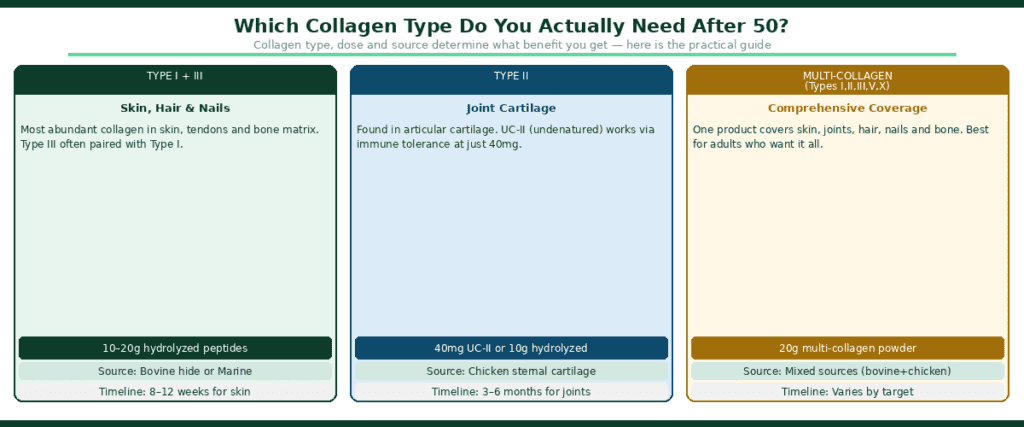
| For most adults over 50: a hydrolyzed Type I and III bovine or marine collagen powder (10–20g daily) is the right choice for skin, hair, nails and general connective tissue. If joint cartilage is the primary concern, add or switch to a Type II collagen source — undenatured Type II collagen (UC-II) at 40mg daily or hydrolyzed Type II at 10g daily. |
What the Clinical Evidence Actually Shows
For skin — the evidence is genuinely positive
A 2024 randomised, double-blind, placebo-controlled trial published in Dermatology Research and Practice followed adults for 12 weeks taking daily hydrolyzed collagen with vitamin C. Researchers used high-resolution ultrasound imaging to confirm significantly increased dermal collagen content in the papillary layer of the skin. Skin hydration, elasticity, wrinkles and hair condition all improved significantly compared to placebo.
A systematic review and meta-analysis of 26 RCTs involving 1,721 participants published in PMC confirmed that hydrolyzed collagen supplementation significantly improved both skin hydration (Z=4.94, p<0.00001) and elasticity (Z=4.49, p<0.00001) compared to placebo.
| ⚠️ Important caveat on industry funding A 2025 meta-analysis in the American Journal of Medicine analysed 23 RCTs and found that when studies NOT funded by supplement companies were analysed separately, the effects on skin hydration, elasticity and wrinkles were not statistically significant. Industry-funded studies showed significant benefits; independently funded studies did not. This does not mean collagen doesn’t work — but it means the evidence is not as clean as the marketing suggests, and expectations should be modest rather than dramatic. |
For joints — more targeted evidence
A 2025 review published in PMC found that higher doses of collagen peptides (10–20g daily) are more effective for joint health and bone mineral density than the lower doses used in skin trials (2.5–5g). A multi-collagen supplement combining Types I, II and III improved pain, balance and walking ability in patients with osteoarthritis after 8 weeks.
The mechanism for joint benefit: collagen peptides accumulate in cartilage tissue and stimulate chondrocytes (cartilage-building cells) to increase collagen synthesis. This process takes longer to show effects than the skin benefits — allow 3–6 months for meaningful joint improvements.
The vitamin C co-factor — often overlooked
Vitamin C is an essential co-factor for collagen synthesis — the enzyme that forms collagen’s triple helix structure (prolyl hydroxylase) requires vitamin C to function. Taking collagen without adequate vitamin C is like having all the building materials but no tools. Look for products that include vitamin C, or take 250–500mg of vitamin C alongside your collagen supplement.
Collagen is a specialised structural protein but it is not a complete protein — it is missing tryptophan and is low in several essential amino acids. If preventing muscle loss is also a priority, pair your daily collagen with a complete protein source covered in our guide on Whey vs Plant Protein for Sarcopenia After 60.
Marine vs Bovine Collagen — Which Is Better?
| Factor | Marine Collagen (Fish) | Bovine Collagen (Cow) |
| Collagen types | Primarily Type I | Type I and III (most powders) |
| Absorption | Smaller peptide size — potentially faster absorption | Well absorbed at standard particle sizes |
| Sustainability | Utilises fish processing byproducts — sustainable sourcing possible | Grass-fed/pasture-raised sourcing matters |
| Allergens | Not suitable for fish allergy | Not suitable for beef allergy |
| Taste/odour | Can have mild fish odour if not well processed | Generally neutral — odourless when high quality |
| Cost | Slightly higher per gram | Lower — most widely available |
| Verdict | Good choice for Type I skin focus; avoid if fish allergic | Best all-round value — Types I and III for skin and connective tissue |
5 Best Collagen Supplements for Adults Over 50 — US Pricing 2026
1. Vital Proteins Collagen Peptides (Costco) — Best Overall Value
The most popular collagen supplement at US retail. Grass-fed, pasture-raised bovine hide — Type I and III hydrolyzed collagen peptides at 20g per serving. Unflavoured and odourless — mixes into coffee, smoothies or water. Available at Costco for approximately $38–48 for 1.5 lbs (34 servings) — roughly $1.12–1.41 per 20g serving.
- Collagen per serving: 20g Type I and III bovine peptides
- Price per serving: ~$1.25 (Costco)
- Source: Grass-fed, pasture-raised bovine
- Vitamin C included: No — add separately
- Best for: Best mainstream option at Costco — mix daily into coffee or smoothies
2. Orgain Collagen Peptides + Probiotics (Costco) — Best Collagen + Gut Health Combo
An upgraded collagen formula that adds a probiotic blend alongside 20g Type I and III grass-fed collagen peptides. The probiotic addition is a smart pairing — gut health affects nutrient absorption, and the gut microbiome influences skin health through the gut-skin axis. Available at Costco for approximately $35–44 for 1.6 lbs (~$1.10–1.38 per serving).
- Collagen: 20g Type I and III + probiotics per serving
- Price per serving: ~$1.24 (Costco)
- Source: Grass-fed bovine
- Best for: Adults who want collagen and probiotic support in one scoop
3. Sports Research Collagen Peptides with Vitamin C (Amazon / Walmart) — Best with Vitamin C
One of the few mainstream collagen powders that includes vitamin C in the formula — the essential co-factor for collagen synthesis. 11g Type I and III hydrolyzed collagen peptides plus 90mg vitamin C per serving. Third-party tested for purity. Available at Amazon and Walmart for approximately $25–30 for 30 servings (~$0.83–1.00 per serving).
- Collagen: 11g Type I and III + 90mg vitamin C per serving
- Price per serving: ~$0.92 (Amazon/Walmart)
- Certification: Third-party tested
- Best for: Adults who want vitamin C included — removes the need for a separate supplement
4. Orgain Hydrolyzed Multi Collagen Powder (Amazon / Walmart) — Best Multi-Collagen Formula
A five-type collagen formula providing Type I, II, III, V and X collagen in one scoop — the most comprehensive coverage available at mainstream retail. 20g collagen per serving plus vitamin C and amino acids. Available at Amazon and Walmart for approximately $28–36 for 21 servings (~$1.33–1.71 per serving).
- Collagen: 20g Types I, II, III, V, X + vitamin C per serving
- Price per serving: ~$1.52 (Amazon/Walmart)
- Certification: Non-GMO
- Best for: Adults who want joint (Type II) and skin (Type I/III) coverage in one product
5. NOW Foods UC-II Undenatured Type II Collagen 40mg (Amazon / Walmart) — Best Joint-Specific
The clinical form of Type II collagen for joint health. Undenatured Type II collagen (UC-II) at 40mg per capsule — the dose used in published clinical trials for knee joint comfort. This is dramatically lower than hydrolyzed collagen powders because UC-II works through a completely different immune tolerance mechanism rather than structural peptide delivery. Available at Amazon and Walmart for approximately $18–24 for 60 capsules (~$0.30–0.40 per day).
- Collagen: 40mg undenatured Type II (UC-II) per capsule — clinical dose for joints
- Price per serving: ~$0.35 (Amazon/Walmart)
- Certification: NPA GMP certified
- Best for: Adults whose primary concern is knee and joint cartilage — NOT for skin
| # | Product | Types | Price/Serve | Best For |
| 1 | Vital Proteins (Costco) | I + III | ~$1.25 | Best overall value |
| 2 | Orgain + Probiotics (Costco) | I + III + probiotics | ~$1.24 | Collagen + gut health |
| 3 | Sports Research + Vit C (Amazon) | I + III + vitamin C | ~$0.92 | Best with vitamin C |
| 4 | Orgain Multi Collagen (Amazon) | I, II, III, V, X | ~$1.52 | Best multi-collagen |
| 5 | NOW UC-II 40mg (Amazon) | II (undenatured) | ~$0.35 | Best joint-specific |
For adults using collagen specifically for knee and joint comfort, pairing it with an anti-inflammatory supplement may enhance results — our comparison of Turmeric vs Boswellia for Knee Pain After 50 covers the two most evidence-backed natural joint pain ingredients.
How to Get the Most from Collagen Supplements
| Question | Answer |
| How much per day? | 10–20g hydrolyzed collagen peptides for skin and general connective tissue. 10–20g for joint health, with 3–6 months needed for meaningful cartilage benefit. UC-II: 40mg (much lower dose — different mechanism). |
| When to take? | Timing matters less than consistency. Most people add collagen powder to morning coffee, smoothies or oatmeal. UC-II capsules are best taken on an empty stomach. |
| With or without food? | Hydrolyzed peptides: either. UC-II: empty stomach or with a light meal for best immunological effect. |
| How long before results? | Skin improvements: 8–12 weeks of daily use. Joint improvements: 3–6 months. Hair and nail improvements: 12–16 weeks. |
| Do I need vitamin C? | Yes — either from your diet, a separate supplement or a formula that includes it. 250–500mg vitamin C alongside collagen supports the enzyme that builds collagen’s triple helix structure. |
Related Articles
• Turmeric vs Boswellia for Knee Pain After 50
• K2, D3 and Boron for Post-Menopausal Bone Density
• Whey vs Plant Protein for Sarcopenia After 60
Frequently Asked Questions
What is the best type of collagen for seniors over 60?
For skin, hair, nails and general connective tissue: hydrolyzed Type I and III bovine or marine collagen peptides at 10–20g daily. Vital Proteins at Costco is the best-value mainstream option. For joint cartilage specifically: undenatured Type II collagen (UC-II) at 40mg daily, as used in clinical trials for knee comfort — NOW Foods UC-II at Amazon is a good value option. For both skin and joint coverage in one product: Orgain Multi Collagen at Amazon provides Types I, II, III, V and X in one scoop.
How long does it take for collagen supplements to work after 50?
Skin improvements — hydration, elasticity, reduced wrinkle appearance — typically take 8–12 weeks of consistent daily use. Joint improvements take longer: most clinical trials showing meaningful benefit ran for 3–6 months of daily supplementation. Hair and nail improvements typically take 12–16 weeks. Consistency matters more than timing — daily use over months produces the cumulative effect, not any single dose.
Is marine or bovine collagen better for seniors?
Both are effective for skin and connective tissue support. Marine collagen is predominantly Type I with potentially smaller peptide size and faster absorption, while bovine collagen provides both Type I and III in most powder formulas. The practical choice for most seniors: bovine collagen from a quality grass-fed source (like Vital Proteins at Costco) is more widely available, lower cost, and covers both Type I and III. Marine collagen is a good alternative for those avoiding red meat products.
Should I take collagen with vitamin C?
Yes. Vitamin C is an essential co-factor for collagen synthesis — the enzyme that forms collagen’s triple helix structure requires vitamin C to function. Without adequate vitamin C, the body cannot efficiently build new collagen even with supplemental collagen peptides as raw material. Take 250–500mg vitamin C alongside your collagen supplement, or choose a formula that includes it — Sports Research Collagen Peptides with Vitamin C at Amazon is the best mainstream option that includes both.
Can collagen supplements help with knee pain after 50?
The evidence is encouraging but modest. Multiple RCTs show that Type II collagen supplementation — either hydrolyzed at 10g daily or undenatured (UC-II) at 40mg daily — improves joint comfort, stiffness and function in adults with knee osteoarthritis over 3–6 months. The effect is real but modest — collagen supports cartilage maintenance and reduces joint inflammation rather than reversing structural damage. For significant knee pain, collagen is best used alongside other joint-support measures including appropriate exercise, body weight management, and guidance from a physiotherapist or doctor.
The Bottom Line
Best collagen supplement after 50 depends on what you are trying to support. For skin, hair and nails: hydrolyzed Type I and III collagen peptides at 10–20g daily — Vital Proteins at Costco is the best-value option at approximately $1.25 per serving. For joint cartilage: undenatured Type II (UC-II) at 40mg daily — NOW Foods at Amazon covers this well at $0.35 per day. For both simultaneously: Orgain Multi Collagen at Amazon covers Types I through X in one 20g serving.
Take collagen with vitamin C, set realistic expectations — skin improvements take 8–12 weeks, joint improvements take 3–6 months — and be aware that the evidence, while genuinely encouraging for skin and joints, is stronger in industry-funded studies than in independently funded research. Modest, consistent benefits over time are the realistic expectation.
References
1. Dermatology Research and Practice (2024). Clinical Trial — Improvement in Skin Collagen, Hydration, Elasticity, Wrinkles, Scalp and Hair following 12-Week Oral Hydrolysed Collagen. View article
2. PMC (2023). Effects of Oral Collagen for Skin Anti-Aging: Systematic Review and Meta-Analysis of 26 RCTs, 1,721 participants. View on PMC
3. PMC (2025). Collagen supplementation and regenerative health — review of over 60 clinical studies. View on PMC
4. American Journal of Medicine (2025). Effects of Collagen Supplements on Skin Aging — Meta-Analysis of 23 RCTs by funding source. View article