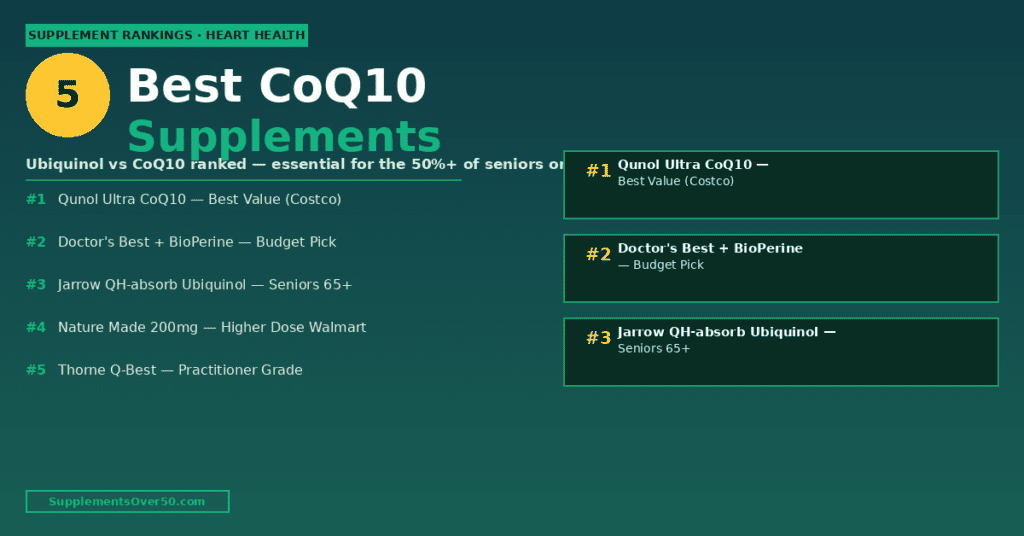
| ⚡ Quick Answer The 5 best CoQ10 supplement for seniors ranked: (1) Qunol Ultra CoQ10 100mg at Costco — best value water-and-fat soluble formula, the most widely recommended by cardiologists, (2) Doctor’s Best High Absorption CoQ10 — best value ubiquinone with BioPerine for enhanced absorption, (3) Jarrow Formulas QH-absorb Ubiquinol — best ubiquinol specifically for seniors over 65 and statin users, (4) Nature Made CoQ10 200mg — best USP-verified option at Walmart at a higher dose, and (5) Thorne Q-Best 100 — best practitioner-grade ubiquinone with NSF certification. Seniors over 60 should choose ubiquinol (the active form) over standard CoQ10 (ubiquinone) because the conversion enzyme drops ~50% with age. |
Ubiquinol vs CoQ10 — Why the Form Matters After 60
- CoQ10 exists in two forms: ubiquinone (oxidised, standard CoQ10) and ubiquinol (reduced, active form). The body must convert ubiquinone to ubiquinol before it can be used in mitochondria
- The conversion enzyme (NQO1) declines by approximately 50% between ages 20 and 65 — meaning seniors convert standard CoQ10 to the active ubiquinol form less efficiently
- Ubiquinol absorbs approximately 3–8x better than ubiquinone in adults with reduced conversion capacity — making it the strongly preferred form for seniors over 60
- Statin medications block the same biosynthetic pathway that produces CoQ10 — reducing levels by up to 40% in statin users. Over 50% of adults over 60 take a statin, making CoQ10 supplementation relevant to the majority of this age group
- CoQ10 is the energy currency of cardiac mitochondria — CoQ10 depletion from statins contributes to the muscle pain, fatigue, and exercise intolerance many statin users experience
The 5 Best CoQ10 Supplement for Seniors — Ranked
| #1 — BEST VALUE — CARDIOLOGIST RECOMMENDED Qunol Ultra CoQ10 100mg — Costco / Walmart Qunol Ultra is the most widely recommended CoQ10 by cardiologists at mainstream retail — it uses a water-and-fat soluble formulation that delivers approximately 3x better absorption than standard CoQ10 softgels. At Costco, a 120-count bottle costs approximately $25–35, making it $0.21–0.29/day — the best value for enhanced-absorption CoQ10 available in the US. Available in both 100mg and 200mg doses. For statin users, start at 100mg; for those with confirmed cardiac concerns or high statin doses, 200mg is reasonable. 📖 Deep dive: Ubiquinol vs CoQ10 — Is the More Expensive Form Worth It After 60? 💰 Best product: Qunol Ultra CoQ10 100mg 120 count (Costco ~$25–35) · ~$0.21–0.29/day |
| #2 — BEST VALUE UBIQUINONE WITH BIOPERINE Doctor’s Best High Absorption CoQ10 — Amazon / iHerb Doctor’s Best combines CoQ10 (ubiquinone form) with BioPerine (black pepper extract) which enhances absorption by approximately 30%. For seniors whose budget doesn’t extend to ubiquinol pricing, Doctor’s Best provides a meaningful absorption improvement over standard CoQ10 at a very low per-serving cost. 100mg or 200mg options available. GMP certified, non-GMO, soy-free. A practical middle ground between cheap standard CoQ10 and premium ubiquinol. 📖 Deep dive: Heart Health Supplement Stack for Seniors — CoQ10 as a Core Component 💰 Best product: Doctor’s Best High Absorption CoQ10 with BioPerine 120 softgels (Amazon ~$14–24) · ~$0.12–0.20/day |
| #3 — BEST UBIQUINOL FOR SENIORS 65+ Jarrow Formulas QH-absorb Ubiquinol — Amazon / iHerb Jarrow QH-absorb uses Kaneka QH — the most clinically researched form of ubiquinol, the same form used in the majority of ubiquinol clinical trials. For seniors specifically over 65, or any senior on a statin, ubiquinol is the superior choice because declining NQO1 enzyme activity makes ubiquinone conversion increasingly inefficient. Jarrow’s 100mg and 200mg softgels provide true ubiquinol — the pre-converted, bioactive form ready for mitochondrial use. 📖 Deep dive: Ubiquinol vs CoQ10 — Full Evidence Comparison for Adults Over 60 💰 Best product: Jarrow QH-absorb Ubiquinol 100mg 60 softgels (Amazon ~$22–35) · ~$0.40–0.60/day |
| #4 — BEST HIGHER DOSE — WALMART Nature Made CoQ10 200mg — Walmart For seniors with confirmed cardiovascular concerns, on high-dose statins, or with cardiologist recommendations for higher CoQ10 doses, Nature Made 200mg provides a USP-verified higher-dose option at Walmart pricing. USP Verification confirms label accuracy and purity. At 200mg, this is twice the standard maintenance dose — appropriate for statin users with significant symptoms (muscle pain, exercise fatigue) or those with diagnosed heart failure. Creatine fuels skeletal muscle energy through the phosphocreatine system — CoQ10 fuels cardiac muscle energy through the mitochondrial electron transport chain. Both address different aspects of the age-related energy decline that affects physical function after 60: Creatine for Seniors — Brain, Muscle and Energy Benefits. CoQ10 is specifically listed as a recommended addition for statin users in our comprehensive men’s supplement guide — for the full men’s heart health protocol including omega-3, berberine, and magnesium taurate alongside CoQ10: 7 Best Supplements for Men Over 60 — Ranked by Clinical Evidence. Omega-3 EPA and DHA manage the inflammatory and triglyceride side of cardiovascular health — CoQ10 manages the mitochondrial energy side. Together they form the two most evidence-supported non-prescription cardiovascular supplements available: Can Omega-3s Really Slow Brain Decline After 60? — The Heart and Brain Evidence. 📖 Deep dive: Best Supplements for Men Over 60 — CoQ10 as #5 Ranked for Statin Users 💰 Best product: Nature Made CoQ10 200mg 80 softgels (Walmart ~$16–24) · ~$0.20–0.30/day |
| #5 — BEST PRACTITIONER GRADE Thorne Q-Best 100 — Thorne.com / Amazon Thorne Q-Best 100 provides 100mg CoQ10 (ubiquinone) in a highly refined formulation manufactured in Thorne’s TGA-approved facility — the Australian pharmaceutical manufacturing standard, one of the most rigorous in the world. NSF Certified for Sport. For seniors under physician monitoring for cardiac conditions, Thorne’s manufacturing credentials are the most defensible choice. More expensive than mainstream options but the standard against which quality is measured. 📖 Deep dive: Ubiquinol vs CoQ10 — Which Form Is Right for Your Situation? 💰 Best product: Thorne Q-Best 100 60 gelcaps (Thorne.com / Amazon ~$36–48) · ~$0.60–0.80/day |
Full guides:
Ubiquinol vs CoQ10 — Is the More Expensive Form Worth It After 60? ·
Heart Health Supplement Stack for Seniors ·
Best Supplements for Men Over 60
Frequently Asked Questions
Should seniors take ubiquinol or standard CoQ10?
Seniors over 60 should prefer ubiquinol (the active, pre-converted form) over standard CoQ10 (ubiquinone) because the conversion enzyme NQO1 declines by approximately 50% with age, making ubiquinone increasingly inefficient. For seniors under 60 or on tight budgets, Qunol Ultra (enhanced-absorption ubiquinone) or Doctor’s Best with BioPerine provide meaningful absorption improvements over standard CoQ10 at lower cost. For seniors over 65 or on statins, ubiquinol is the better investment.
How much CoQ10 should seniors take per day?
100mg daily is the standard maintenance dose for most seniors. For statin users experiencing muscle pain or fatigue, 200mg is commonly recommended. For diagnosed heart failure, doses of 300–600mg daily have been used in clinical trials (PEP-CHF trial) — discuss with your cardiologist. Take CoQ10 with your largest fat-containing meal for optimal absorption — it is fat-soluble and absorbs poorly on an empty stomach.
Is CoQ10 safe to take with statins?
Yes — CoQ10 is specifically recommended for statin users to replace the CoQ10 that statins deplete. There are no negative interactions between CoQ10 and statins. Some cardiologists include CoQ10 recommendations alongside statin prescriptions, particularly for patients reporting muscle pain. CoQ10 may enhance the blood-pressure-lowering effects of antihypertensives — monitor blood pressure when starting if on multiple cardiac medications.
Can I take CoQ10 if I am on blood thinners like Warfarin?
Yes with monitoring — CoQ10 has a mild vitamin K-like structural similarity that can modestly affect warfarin’s anticoagulant activity in some patients. The interaction is less consistent than vitamin K itself but worth monitoring. Disclose CoQ10 supplementation to your anticoagulation clinic before starting and have your INR checked within 2–4 weeks of beginning supplementation. Most patients on warfarin tolerate CoQ10 at 100–200mg daily without significant INR changes, but the monitoring step is essential since anticoagulation management is highly individual. CoQ10 does not interact significantly with direct oral anticoagulants (Eliquis, Xarelto) through this mechanism.
Why does my cardiologist recommend 200mg CoQ10 instead of 100mg?
Higher doses are indicated for more significant CoQ10 depletion or cardiac energy deficits. 100mg daily is the standard maintenance dose for most seniors and statin users with mild symptoms. 200mg is commonly recommended for statin users with significant muscle pain, exercise intolerance, or confirmed low CoQ10 blood levels. 300–600mg daily has been used in clinical trials specifically for congestive heart failure (the PEP-CHF trial used 300mg). The general principle: match the dose to the severity of depletion and symptoms. Since CoQ10 is expensive, the minimum effective dose is preferable — start at 100mg, assess response at 8 weeks, and increase to 200mg if symptoms persist. Always use the ubiquinol form above 150mg daily for adults over 60.
Does CoQ10 help with high blood pressure?
Yes — modestly. Multiple meta-analyses confirm CoQ10 supplementation produces small but statistically significant reductions in systolic blood pressure (approximately 11 mmHg in some analyses, though more conservative reviews find 3–5 mmHg). The mechanism is improved endothelial function — CoQ10 reduces oxidative stress in blood vessel walls, improving their ability to dilate. This effect is meaningful as a complementary measure but is not sufficient as standalone therapy for diagnosed hypertension. CoQ10 may enhance the blood-pressure-lowering effects of antihypertensive medications — monitor blood pressure when starting CoQ10 alongside antihypertensives to ensure it doesn’t drop excessively.
When is the best time to take CoQ10 for seniors?
Take CoQ10 with your largest fat-containing meal of the day — it is fat-soluble and absorbs significantly better with dietary fat than on an empty stomach. Studies confirm absorption increases approximately 3-fold when taken with a high-fat meal versus fasted. Most seniors find dinner or lunch works best. Splitting the dose across two meals (50mg at lunch and 50mg at dinner) may further improve absorption compared to taking 100mg at once — fat-soluble nutrients generally absorb better in smaller divided doses. Avoid taking CoQ10 with fibre supplements or high-fibre meals as fibre can bind to and reduce absorption of fat-soluble nutrients.
How long before CoQ10 starts working for statin-related muscle pain?
Most statin users who respond to CoQ10 notice improvement in muscle pain and fatigue within 4–8 weeks of consistent daily supplementation at 100–200mg. The response rate is not universal — approximately 60–70% of statin users with muscle symptoms report meaningful improvement. Those who do not respond at 100mg ubiquinone sometimes respond when switching to ubiquinol (the pre-converted active form) at the same or lower dose. If no improvement after 12 weeks at 200mg ubiquinol, discuss with your cardiologist — some cases of statin myopathy require a statin class change or dose reduction rather than CoQ10 supplementation alone.
Is there a difference between CoQ10 and ubiquinol for seniors over 65?
Yes — and it is clinically significant. Both are forms of the same molecule but in different oxidation states. Standard CoQ10 (ubiquinone) must be converted to ubiquinol by the NQO1 enzyme before it can be used in mitochondria. This conversion enzyme declines by approximately 50% between ages 20 and 65. For seniors over 65, ubiquinol is the strongly preferred form because it is already in the active state — bypassing the conversion step that the aging body performs increasingly poorly. Ubiquinol costs more but delivers meaningfully better blood level increases per milligram in adults over 60. Jarrow QH-absorb and Qunol Ultra both use the Kaneka QH-branded ubiquinol that was used in the majority of clinical trials demonstrating benefit.
The Bottom Line
The best CoQ10 supplement for most seniors is Qunol Ultra at Costco ($0.25/day) for best value with enhanced absorption. For seniors specifically over 65 or on statins, Jarrow QH-absorb Ubiquinol provides the true active form. For the highest manufacturing standards, Thorne Q-Best. Always take with your largest fat-containing meal and pair with omega-3 fish oil — the two together have complementary cardiovascular mechanisms.