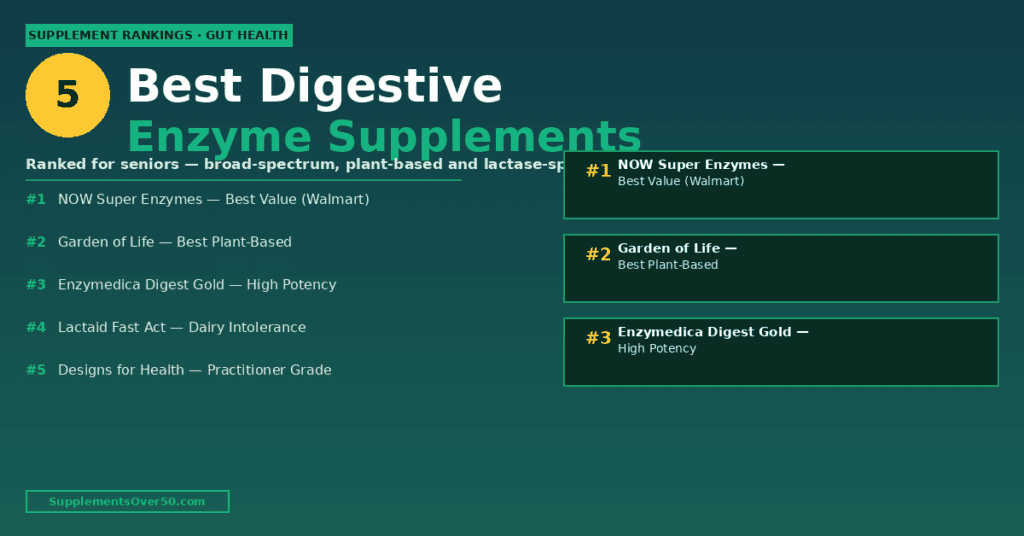
| ⚡ Quick Answer The 5 best digestive enzyme supplements for seniors ranked: (1) NOW Super Enzymes — best value broad-spectrum with betaine HCl at Walmart, (2) Garden of Life Dr. Formulated Enzymes — best certified plant-based formula, (3) Enzymedica Digest Gold — best high-potency for significant symptoms, (4) Lactaid Fast Act — best for dairy-specific intolerance only, and (5) Designs for Health Digestzymes — best practitioner-grade for confirmed insufficiency. Stomach acid drops 30-40% by age 60, making enzyme supplementation one of the most impactful yet underutilised interventions for seniors. |
Why Digestive Enzymes Matter After 60
- Stomach acid (HCl) declines 30–40% by age 60 — reducing activation of pepsin and absorption of B12, calcium, magnesium, and zinc
- Pancreatic enzyme output drops ~25% between ages 40 and 70 — meaning less protease, lipase, and amylase reach the small intestine
- Lactose intolerance affects up to 70% of adults over 60 — even in those who tolerated dairy well for decades
- Enzyme insufficiency contributes to ‘subclinical malabsorption’ — eating adequately but extracting fewer nutrients from every meal
- Declining stomach acid is the primary reason vitamin B12 deficiency is so prevalent in adults over 60 — without adequate HCl, B12 cannot be released from food proteins. For the full picture on B12 deficiency signs and supplementation: Signs of Vitamin B12 Deficiency in Adults Over 60 — And What to Do.
- A broad-spectrum enzyme supplement taken at the start of each main meal addresses all four major enzyme deficits simultaneously
The 5 Best Digestive Enzyme Supplements for Seniors — Ranked
This guide covers the enzyme layer of digestive health. For the complete five-part gut health protocol covering enzymes, probiotics, prebiotics, collagen and L-glutamine together: 5 Best Gut Health Supplements for Seniors — Probiotics, Prebiotics and More.
| #1 — BEST OVERALL VALUE NOW Super Enzymes — Walmart / Amazon NOW Super Enzymes is the best starting point for most seniors — it combines betaine HCl (to support declining stomach acid), bromelain, ox bile, and pancreatin in a single tablet that covers protease, lipase, and amylase simultaneously. The betaine HCl component is particularly valuable for seniors because it directly addresses the 30-40% decline in HCl production, helping all other enzymes work more effectively. Take one tablet at the very start of each main meal. 📖 Deep dive: Digestive Enzymes for Seniors — Full Evidence Guide 💰 Best product: NOW Super Enzymes 90 tablets (Walmart ~$15–20) · ~$0.17–0.22/serving |
| #2 — BEST PLANT-BASED Garden of Life Dr. Formulated Enzymes — Amazon / iHerb For seniors who prefer plant-based or certified organic supplements, Garden of Life delivers a 17-enzyme blend derived from aspergillus fermentation — active across a wider pH range than animal-derived enzymes, making it well-suited to the variable stomach acid levels of older adults. USDA Organic certified and Non-GMO Project Verified. The broader pH activity range is a genuine advantage for seniors with inconsistent stomach acid production. Digestive enzymes address the upper digestive tract — the stomach and small intestine. For the lower gut strategy covering probiotics and prebiotics that restore the colon microbiome: 5 Best Probiotics for Seniors — Ranked by Strain and CFU Count. 📖 Deep dive: 5 Best Gut Health Supplements for Seniors 💰 Best product: Garden of Life Dr. Formulated Enzymes 90 capsules (Amazon ~$28–35) · ~$0.31–0.39/serving |
| #3 — BEST HIGH-POTENCY Enzymedica Digest Gold — Amazon / iHerb Enzymedica Digest Gold uses Thera-blend technology — multiple enzyme strains active at different pH levels to cover the full digestive range from stomach to small intestine. For seniors with more pronounced digestive symptoms (significant bloating, discomfort after most meals, confirmed enzyme insufficiency), the higher enzyme activity per serving is worth the premium. The most potent over-the-counter option available without a prescription. 📖 Deep dive: Digestive Enzymes for Seniors — Full Guide with Product Comparison 💰 Best product: Enzymedica Digest Gold 90 capsules (Amazon ~$35–45) · ~$0.39–0.50/serving |
| #4 — BEST FOR DAIRY INTOLERANCE Lactaid Fast Act — Walmart / CVS If dairy is the specific trigger — bloating, cramping, or loose stools after milk, cheese, or ice cream — Lactaid Fast Act is the most targeted and cost-effective solution. At 9,000 FCC Lactase Units per caplet, it resolves lactose intolerance in most seniors when taken immediately before dairy consumption. An FDA-regulated OTC product with decades of safety data. Not suitable as a primary digestive enzyme for seniors with broader absorption concerns beyond dairy. 📖 Deep dive: Digestive Enzymes for Seniors — When Lactase Is the Priority 💰 Best product: Lactaid Fast Act 60 caplets (Walmart ~$10–14) · ~$0.17–0.23/serving |
| #5 — BEST PRACTITIONER GRADE Designs for Health Digestzymes — Amazon For seniors with confirmed significant enzyme insufficiency — diagnosed by a physician or gastroenterologist — Designs for Health Digestzymes provides the highest betaine HCl dose (750mg) and pharmaceutical-grade porcine pancreatin on this list. The combination of high-dose HCl support plus full-spectrum pancreatic enzymes addresses the two primary sites of enzyme decline after 60 simultaneously. Note: contains porcine-derived enzymes — not suitable for those avoiding pork products. 📖 Deep dive: Digestive Enzymes for Seniors — Practitioner-Grade Options 💰 Best product: Designs for Health Digestzymes 90 capsules (Amazon ~$40–50) · ~$0.44–0.56/serving |
For the complete digestive enzyme evidence guide: Digestive Enzymes for Seniors — Full Article · Prebiotics for Seniors · Best Probiotic for Seniors Over 60
Frequently Asked Questions
Who should take digestive enzyme supplements after 60?
Seniors experiencing any of the following benefit most: bloating or discomfort within 1-2 hours of eating, new or worsening dairy intolerance, feeling uncomfortably full after smaller meals, undigested food in stool, or confirmed deficiencies in B12, magnesium, or zinc despite supplementation. These are all signs of declining enzyme or stomach acid production — the most common nutritional shift after 60.
Are digestive enzymes the same as probiotics?
No — they work at different sites and through different mechanisms. Digestive enzymes break down food in the stomach and small intestine immediately at each meal. Probiotics replenish beneficial bacteria in the colon and work over weeks to months to rebuild the microbiome. Both address digestive decline after 60 but address different aspects. Most seniors benefit from both.
Can I take digestive enzymes every day long-term?
Yes — enzyme supplements do not cause dependence or reduce the body’s own enzyme production. Long-term daily use is safe and appropriate for seniors with chronic insufficiency. Unlike acid-suppressing medications (PPIs), enzyme supplements work with the body’s existing acid rather than suppressing it.
Are digestive enzymes the same as probiotics?
No — they work at completely different locations in the digestive tract and through different mechanisms. Digestive enzymes are biological catalysts that break down food in the stomach and small intestine immediately at each meal — their effect is immediate and mechanical. Probiotics are live bacteria that travel to the large intestine (colon) and work over weeks to months to restore microbiome diversity. Most seniors benefit from both because they address different aspects of digestive decline after 60 — enzymes for the upper tract absorption problem, probiotics for the lower tract microbiome problem. Taking both together does not cause any interaction.
Can I become dependent on digestive enzyme supplements?
No — this is one of the most common misconceptions about enzyme supplementation. Unlike some medications, supplemental enzymes do not signal the pancreas to reduce its own production. The pancreas responds to food in the digestive tract, not to the presence of supplemental enzymes in the gut. You can start and stop digestive enzyme supplements at any time without any rebound effect or change in natural enzyme output. Long-term daily use is safe and appropriate for seniors with chronic enzyme insufficiency — which describes the majority of adults over 60 to some degree.
How do I know if I need digestive enzyme supplements?
The most reliable indicators in seniors are: feeling uncomfortably full after smaller meals than you used to eat, bloating or abdominal discomfort within 1–2 hours of eating particularly after protein-rich or fatty meals, new or worsening dairy intolerance, chronic deficiencies in B12, magnesium, or zinc confirmed by blood test despite supplementation, and low energy despite eating adequately. Any one of these is a reasonable reason to try a broad-spectrum enzyme supplement for 4–6 weeks — the improvement in post-meal comfort is usually noticeable within the first week if enzyme insufficiency is a contributing factor.
Should I take digestive enzymes before or after meals?
Take digestive enzymes at the very start of a meal — with the first few bites. Taking them before eating means there is nothing to act on. Taking them after the meal has started means digestion is already underway without enzyme support. The target is to have supplemental enzymes present in the stomach simultaneously with food arriving. For seniors who forget, taking them within the first 5 minutes of a meal still provides meaningful benefit compared to taking them mid-meal or after.
Do digestive enzymes interact with medications seniors commonly take?
Most digestive enzyme supplements have minimal drug interactions but two warrant attention. Betaine HCl — included in formulas like NOW Super Enzymes — should not be taken by anyone with active peptic ulcers or taking NSAIDs long-term as it increases stomach acidity and can worsen ulcer symptoms. Bromelain (pineapple-derived protease) may mildly enhance blood-thinning effects — disclose to your physician if on warfarin or other anticoagulants. Standard amylase, lipase, and lactase have no significant drug interactions at supplement doses.
Can digestive enzymes help with weight management in seniors?
Indirectly yes — by improving protein absorption efficiency. One of the mechanisms behind age-related muscle loss (sarcopenia) is declining protein digestion rather than inadequate protein intake. Seniors eating adequate protein but absorbing only 60–70% of it due to reduced proteases effectively have a protein deficiency at the cellular level. Improving protease availability through supplementation increases the amino acid yield from each protein-containing meal, supporting muscle protein synthesis. This is a secondary benefit rather than a weight loss mechanism — but it is clinically meaningful for seniors managing sarcopenia.
The Bottom Line
The best digestive enzyme supplement for most seniors is NOW Super Enzymes at Walmart — broad-spectrum coverage with betaine HCl support at ~$0.20/day. For plant-based certification, Garden of Life is the superior choice. For significant symptoms, step up to Enzymedica Digest Gold. Take at the very start of each main meal for maximum effect.