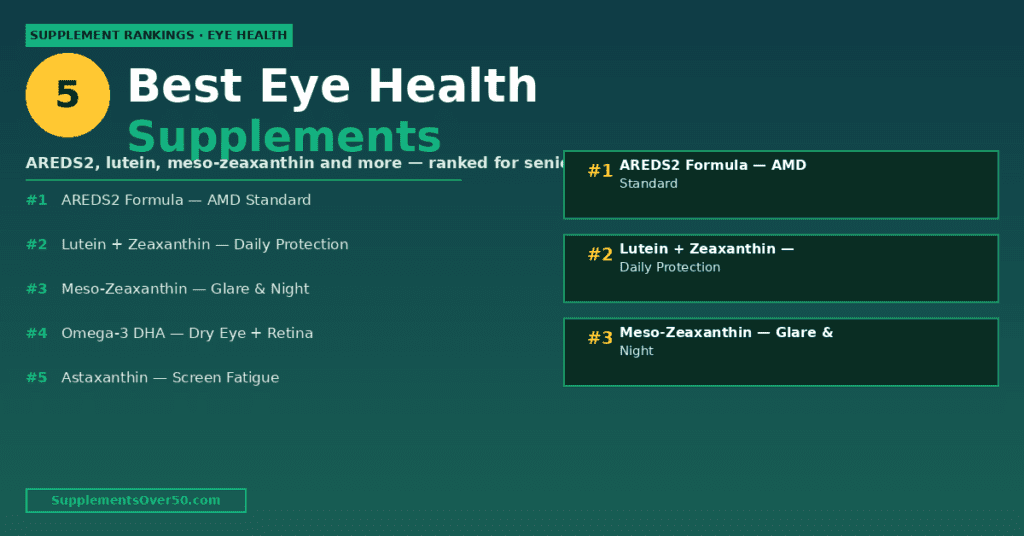
| ⚡ Quick Answer The 5 best eye health supplements for seniors ranked by evidence and use case: (1) AREDS2 Formula — the only NIH-validated formula for slowing macular degeneration progression, mandatory for anyone with intermediate or advanced AMD, (2) Lutein 10mg + Zeaxanthin 2mg — the dietary carotenoids that build macular pigment density and protect against blue light damage, (3) Meso-Zeaxanthin — the third macular carotenoid not found in the diet, specifically targeting glare disability and night vision, (4) Omega-3 DHA+EPA — reduces ocular surface inflammation (dry eye) and supports the structural integrity of photoreceptor cell membranes, and (5) Astaxanthin 6–12mg — the strongest natural antioxidant for eye fatigue, screen glare, and accommodative function. These five cover the full spectrum of age-related vision changes. |
Key Statistics — Vision After 60
- Age-related macular degeneration (AMD) is the leading cause of irreversible vision loss in adults over 60 in the US — affecting 11 million Americans
- The AREDS2 trial (4,203 participants) found the formula reduced progression from intermediate to advanced AMD by 25% over 5 years
- Macular pigment optical density (MPOD) declines with age — low MPOD is associated with increased glare sensitivity, reduced contrast sensitivity, and faster AMD progression
- Dry eye syndrome affects 5–30% of adults over 50 — omega-3 supplementation is one of the few non-prescription interventions with consistent RCT evidence for symptom relief
- Screen time among adults over 60 has tripled in the past decade — increasing demand for supplements that address eye strain and digital fatigue
The 5 Best Eye Health Supplements for Seniors — Ranked
| #1 — AMD PREVENTION — CLINICALLY MANDATED AREDS2 Formula — Daily as Directed The AREDS2 formula (vitamin C 500mg, vitamin E 400 IU, zinc 80mg, copper 2mg, lutein 10mg, zeaxanthin 2mg) is the only supplement formula validated by the National Eye Institute for slowing AMD progression. The landmark AREDS2 trial found it reduced progression from intermediate to advanced AMD by 25% over 5 years. It is specifically indicated for adults with intermediate or advanced AMD in at least one eye — not for prevention in those without diagnosed AMD. If you have not had a dilated eye exam recently, get one before starting AREDS2 — it is only beneficial for people with specific AMD findings on examination. The 80mg zinc in the AREDS2 formula requires copper supplementation (2mg) to prevent copper deficiency — zinc and copper compete for the same absorption pathway. This is why every legitimate AREDS2 product includes copper. For the broader context of how high-dose zinc from eye supplements interacts with your total supplement stack: Best Multivitamin for Men Over 60 — How to Avoid Exceeding Safe Zinc Limits. 📖 Deep dive: The AREDS2 Supplement — The NIH Eye Health Formula Most Seniors Have Never Heard Of 💰 Best product: PreserVision AREDS2 by Bausch + Lomb (Costco/Walmart/Amazon) — the original formula · ~$0.30–0.60/day |
| #2 — MACULAR PIGMENT — DAILY FOUNDATION Lutein 10mg + Zeaxanthin 2mg Lutein and zeaxanthin are the yellow carotenoids that accumulate in the macula — the central, high-resolution area of the retina. They act as a natural blue-light filter and antioxidant shield for photoreceptors. Higher macular pigment optical density (MPOD) is associated with better contrast sensitivity, reduced glare, and slower AMD progression. The AREDS2 formula already contains these at 10mg/2mg. For seniors without AMD who want macular protection, a standalone lutein/zeaxanthin supplement at these doses is the most evidence-supported preventive option. Get from foods where possible — kale, spinach, and eggs are the richest sources. Lutein and zeaxanthin require adequate fat for absorption — take AREDS2 and any carotenoid eye supplement with your largest meal of the day. For why fat-soluble nutrient absorption declines after 60 and what to do about it: Digestive Enzymes for Seniors — What to Take When Stomach Acid Drops After 60. 📖 Deep dive: AREDS2 — Full Guide to Eye Health Carotenoids for Seniors 💰 Best product: NOW Lutein 20mg (can be halved) or Life Extension Lutein + Zeaxanthin (Amazon) · ~$0.10–0.20/day |
| #3 — GLARE + NIGHT VISION — UNIQUE TARGET Meso-Zeaxanthin — 10mg Daily (in Triple Carotenoid Products) Meso-zeaxanthin is the third macular carotenoid — it concentrates at the very centre of the fovea where visual acuity is highest. Unlike lutein and zeaxanthin, it is not found in the human diet in meaningful amounts. The body is supposed to make it by converting lutein in the retina, but this conversion declines with age. The CREST trial found triple-carotenoid supplementation (lutein + zeaxanthin + meso-zeaxanthin) significantly reduced glare disability — meaning faster recovery from oncoming headlights and better contrast in low-light conditions. Best for seniors experiencing increased difficulty driving at night or sensitivity to headlights. 📖 Deep dive: Meso-Zeaxanthin for Night Vision After 60 — What the Science Says 💰 Best product: MacuHealth Triple Carotenoid Formula or EyePromise Vizual Edge (Amazon/EyePromise.com) · ~$0.60–1.20/day |
| #4 — DRY EYE + PHOTORECEPTOR STRUCTURE Omega-3 DHA+EPA — 1,000–2,000mg Daily The retina has the highest concentration of DHA of any tissue in the body — it makes up approximately 60% of the fatty acids in rod photoreceptor outer segments. DHA supplementation supports photoreceptor renewal and function. For dry eye syndrome — which affects up to 30% of adults over 50 — omega-3 supplementation reduces ocular surface inflammation and improves the lipid layer of the tear film. A 2019 meta-analysis of 17 RCTs confirmed significant improvements in dry eye symptoms and tear film stability with omega-3 supplementation. The same dose used for cardiovascular and brain health (1–2g EPA+DHA) covers eye health simultaneously. Omega-3 fish oil is a triple-threat supplement for seniors — heart, brain, and eyes — all addressed by the same 1,000–2,000mg EPA+DHA daily dose. For the full cardiovascular and cognitive evidence alongside the dry eye benefits: Can Omega-3s Really Slow Brain Decline After 60? What the 2025 Research Shows. 📖 Deep dive: Omega-3s After 60 — Brain, Heart and Eye Health Evidence 💰 Best product: Carlson Elite Omega-3 or Nordic Naturals Ultimate Omega (Amazon) · ~$0.20–0.40/day |
| #5 — SCREEN FATIGUE + EYE STRAIN Astaxanthin — 6–12mg Daily Astaxanthin is a marine carotenoid (from microalgae, concentrated in salmon and krill) with the highest antioxidant capacity of any naturally occurring compound — approximately 6,000 times stronger than vitamin C. For the eyes specifically, it accumulates in the ciliary body (the muscle that controls lens focusing) and reduces the oxidative fatigue that causes eye strain after prolonged screen use. A 2024 Japanese RCT found 12mg astaxanthin daily significantly improved accommodation (the ability of the eye to shift focus), reduced eye fatigue scores, and improved contrast sensitivity. Best for seniors experiencing eye strain, screen fatigue, or difficulty shifting focus between near and distant objects. 📖 Deep dive: AREDS2 — How Astaxanthin Complements the NIH Eye Health Formula 💰 Best product: Sports Research Astaxanthin 12mg (Costco) or BioAstin Hawaiian Astaxanthin (Amazon) · ~$0.30–0.80/day |
The Vision Trinity — How These Supplements Work Together
AMD risk or diagnosed AMD: AREDS2 formula (contains lutein/zeaxanthin) + omega-3 DHA. This is the NIH-recommended protocol.
Night vision and glare difficulty: Triple-carotenoid supplement with meso-zeaxanthin + omega-3. Best for seniors struggling with night driving.
Screen fatigue and eye strain: Astaxanthin 12mg + lutein/zeaxanthin. Best for seniors with high daily screen time.
Complete eye health protocol: AREDS2 + omega-3 + astaxanthin — covers AMD protection, photoreceptor structure, inflammation, and fatigue simultaneously.
Full guides: AREDS2 — Full Guide · Meso-Zeaxanthin for Night Vision
Frequently Asked Questions
Can eye supplements improve my vision or get rid of my glasses?
No — supplements like lutein, zeaxanthin, and the AREDS2 formula are designed to protect the macula and slow the progression of age-related diseases. They do not change the shape of the eye or correct refractive errors like nearsightedness or farsightedness. What they do: reduce the risk of AMD progressing from intermediate to advanced stage by 25% over 5 years (AREDS2 trial, 4,203 participants). Think of them as protection and maintenance — not restoration.
What is the difference between AREDS and AREDS2?
AREDS2 is the updated NIH formula and the current clinical standard. The original AREDS formula contained beta-carotene — a form of vitamin A that increases lung cancer risk in smokers and former smokers. AREDS2 replaced beta-carotene with lutein 10mg and zeaxanthin 2mg, which have a better safety profile and equivalent protective efficacy. AREDS2 also found that the original 80mg zinc dose could be reduced to a lower dose in some subgroups while remaining effective. If you are currently taking the original AREDS formula, switch to AREDS2 — particularly if you have any history of smoking.
Do I need an eye supplement if I don’t have macular degeneration?
The full AREDS2 formula is specifically indicated for adults with intermediate AMD or advanced AMD in one eye — it has not been shown to prevent AMD onset in healthy eyes. However, for seniors with a family history of AMD, significant lifetime sun exposure, or 5+ hours of daily screen time, a lower-dose preventive supplement of lutein 10mg and zeaxanthin 2mg daily provides meaningful macular pigment support without the high-dose zinc of the full AREDS2 formula. Get a dilated eye exam first — it is the only way to determine whether you need AREDS2 or a preventive-dose lutein/zeaxanthin supplement.
Should everyone over 60 take AREDS2?
No — AREDS2 is specifically indicated for adults with intermediate AMD (drusen in both eyes) or advanced AMD in one eye. The NEI does not recommend AREDS2 for people without diagnosed AMD, as it has not been shown to prevent AMD onset in healthy eyes. If you haven’t had a dilated eye exam, get one — it is the only way to determine if AREDS2 is appropriate for you.
What supplements help with dry eyes in seniors?
Omega-3 fish oil (1–2g EPA+DHA daily) has the strongest RCT evidence for dry eye — it reduces ocular surface inflammation and improves the lipid layer of the tear film. A 2019 meta-analysis of 17 RCTs confirmed significant symptom improvement. Astaxanthin may also help by reducing oxidative stress on the ocular surface. These complement rather than replace prescription dry eye treatments like Restasis or Xiidra.
Can eye supplements improve vision in seniors?
No supplement improves vision in the sense of correcting refractive error — that requires glasses or surgery. What eye supplements do: slow the progression of existing AMD (AREDS2), protect photoreceptors from oxidative damage (lutein/zeaxanthin, DHA, astaxanthin), reduce glare and improve low-light performance (meso-zeaxanthin), and reduce digital eye fatigue (astaxanthin). Think of them as protection and maintenance rather than restoration.
The Bottom Line
The 5 best eye health supplements for seniors cover the full spectrum of age-related vision changes: AREDS2 for AMD disease management, lutein/zeaxanthin for daily macular protection, meso-zeaxanthin for glare and night vision, omega-3 for dry eye and photoreceptor structure, and astaxanthin for screen fatigue. If you have diagnosed AMD, AREDS2 + omega-3 is the evidence-mandated starting point. If your primary concern is preventive protection for healthy eyes, lutein/zeaxanthin + omega-3 + astaxanthin covers the most ground.