| ⚕️ Supplement Disclosure This article reviews fish oil supplements for informational purposes only. Adults taking anticoagulant medications (warfarin, apixaban), aspirin therapy, or other blood-thinning medications should consult their physician before taking high-dose fish oil, as omega-3s have mild antiplatelet effects. Adults with fish or shellfish allergies should use algae-derived omega-3 supplements instead. This article does not constitute medical advice. |
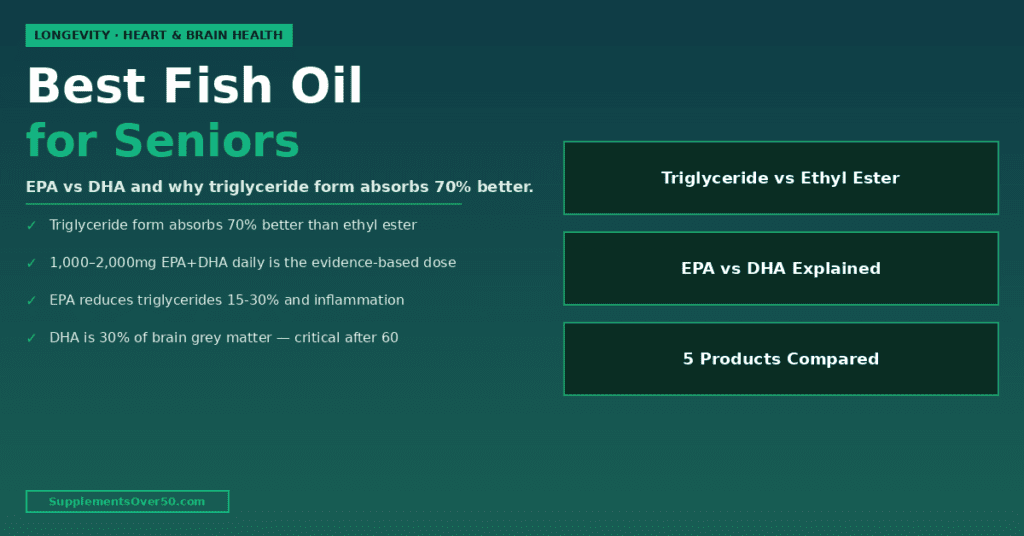
| ⚡ Quick Answer The best fish oil for seniors delivers 1,000–2,000mg combined EPA+DHA per day in triglyceride form — not ethyl ester. The form difference matters: triglyceride fish oil absorbs approximately 70% better than the ethyl ester form that dominates most discount supplements. EPA reduces cardiovascular inflammation and triglycerides; DHA is the primary structural fat in brain cells. After 60, both decline and both need replenishment. The five best options for seniors in 2026 range from $0.15/day (Kirkland at Costco) to $0.80/day (premium molecular-distilled products) — and the form of the oil matters more than the brand name. |
Why Fish Oil Is Different After 60
Fish oil is not a single supplement — it is a delivery vehicle for two distinct fatty acids that serve different biological functions and decline for different reasons after 60.
EPA (Eicosapentaenoic Acid): Primarily an anti-inflammatory fatty acid. EPA competes with arachidonic acid for the same enzymes, reducing the production of pro-inflammatory prostaglandins and leukotrienes. After 60, chronic low-grade inflammation (‘inflammaging’) accelerates cellular aging across every organ system. EPA is the primary omega-3 component that directly addresses this. EPA also reduces triglycerides — a cardiovascular risk factor that rises progressively with age.
DHA (Docosahexaenoic Acid): Primarily a structural fatty acid. DHA makes up approximately 30% of the fatty acids in the brain’s grey matter and 60% of the fatty acids in rod photoreceptor outer segments in the retina. It maintains the fluidity and signalling efficiency of neural cell membranes. After 60, DHA levels in neural tissue decline as dietary intake falls and conversion from plant-based ALA becomes less efficient. Low DHA is consistently associated with faster cognitive decline and higher dementia risk.
Most fish oil supplements provide both — but the ratio matters for specific health goals. For cardiovascular focus: look for higher EPA. For brain and eye health focus: look for higher DHA. For general senior health: a balanced 2:1 EPA:DHA ratio (common in most quality supplements) covers both. DHA makes up approximately 60% of the fatty acids in retinal photoreceptors — making the same 1,000–2,000mg EPA+DHA dose used for cardiovascular and brain health simultaneously the most evidence-supported dry eye and retinal protection intervention available: 5 Best Eye Health Supplements for Seniors — AREDS2, Lutein and More.
For the complete omega-3 brain health evidence, see our full guide: Can Omega-3s Really Slow Brain Decline After 60? What the 2025 Research Shows
Key Statistics — Omega-3 and Seniors
- The REDUCE-IT trial (8,179 patients) found high-dose EPA (icosapentaenoic acid) at 4g/day reduced major cardiovascular events by 25% compared to placebo in adults with elevated triglycerides
- Omega-3 DHA makes up approximately 30% of the fatty acids in brain grey matter — low DHA is consistently associated with faster cognitive decline in adults over 60
- Triglyceride-form fish oil absorbs approximately 70% better than ethyl ester form — yet ethyl ester dominates discount supplement products because it is cheaper to produce
- Meta-analyses confirm fish oil supplementation at 1–2g EPA+DHA daily reduces triglycerides by 15–30% and CRP (inflammatory marker) significantly in adults over 55
- An estimated 90% of US adults consume less than the recommended omega-3 intake — the gap is largest in adults over 65 who eat less fatty fish
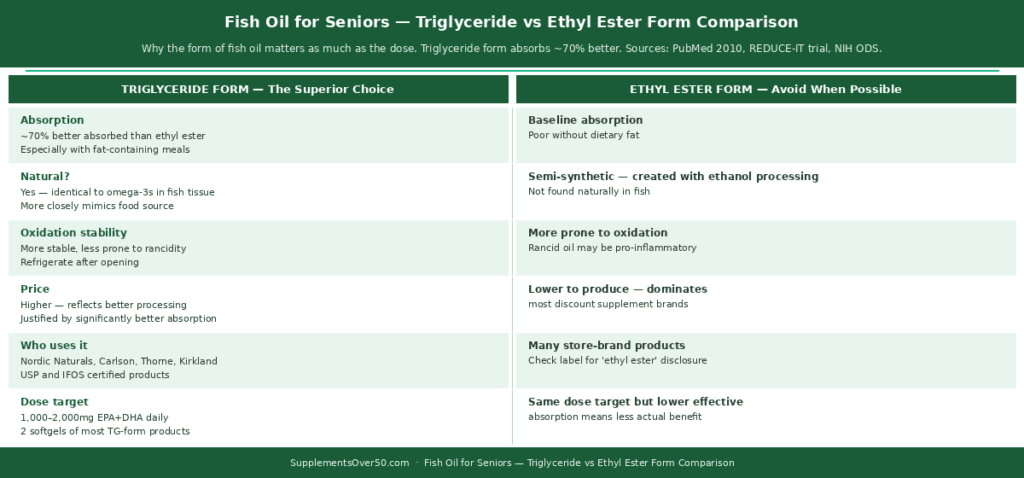
Triglyceride vs Ethyl Ester — The Most Important Decision in Fish Oil
| Factor | Triglyceride (TG) Form | Ethyl Ester (EE) Form |
| Absorption | ~70% better absorbed — especially when taken with a fat-containing meal | Baseline absorption — poor without dietary fat |
| Natural form? | Yes — identical to omega-3s found in fish tissue | No — semi-synthetic, created by processing fish oil with ethanol |
| Stability | More stable at room temperature; less prone to oxidation | More prone to oxidation; requires careful storage |
| Price | Higher — reflects the additional processing to maintain TG form | Lower — cheaper to produce, dominates discount products |
| Common products | Nordic Naturals, Carlson, Thorne | Many store-brand supplements, most budget products |
| Bottom line | The right choice for seniors — higher cost justified by significantly better absorption | Not recommended when TG-form is available at reasonable price |
| ⚠️ How to Check the Form on Your Current Fish Oil Look at the Supplement Facts panel. If it says ‘Fish Oil Concentrate’ or lists ‘EPA as Ethyl Esters’ or ‘DHA as Ethyl Esters’ — that’s the inferior form. If it says ‘Natural Fish Oil’ or ‘Triglyceride Form’ or uses the re-esterified triglyceride (rTG) designation — that’s the superior form. Many popular Costco products (Kirkland) have upgraded to triglyceride form in recent years — check the current label. |
How Much EPA+DHA Do Seniors Actually Need?
| Goal | Daily EPA+DHA Target | Notes |
| General health maintenance | 1,000mg (1g) EPA+DHA | Minimum for meaningful benefit; adequate for most healthy seniors |
| Cardiovascular protection | 1,000–2,000mg EPA+DHA | The dose range used in most successful cardiovascular RCTs |
| Triglyceride reduction | 2,000–4,000mg EPA+DHA | Higher doses needed for significant triglyceride lowering; discuss with physician above 3g |
| Cognitive protection / brain focus | 1,000–2,000mg DHA specifically | Higher DHA ratio preferred; some research suggests DHA-dominant formulas for cognitive goals |
| Anti-inflammatory (general aging) | 1,000–2,000mg EPA specifically | Higher EPA ratio preferred for systemic inflammation reduction |
| Safe upper limit (self-directed) | 3,000mg total | Above 3g/day, consult physician — blood-thinning effect becomes more significant |
5 Best Fish Oil Supplements for Seniors — US Pricing 2026
1. Kirkland Signature Omega-3 — Costco — Best Value
Best for: seniors who shop at Costco and want pharmaceutical-grade triglyceride-form fish oil at the lowest cost per gram of EPA+DHA.
| Formula | 1,200mg fish oil per softgel delivering 684mg EPA + 276mg DHA (960mg total omega-3) in triglyceride form |
| Price (2026) | ~$20–24 for 400 softgels at Costco (~$0.05–0.06 per serving at 1 softgel) |
| Third-Party Tested | USP Verified — one of the highest certifications available; confirmed triglyceride form |
| Best For | Seniors wanting confirmed triglyceride form at the lowest possible daily cost — the best value on this list |
| Notes | Two softgels daily = 1,920mg EPA+DHA — the clinically studied cardiovascular dose at ~$0.10–0.12/day |
2. Carlson Elite Omega-3 — Amazon / iHerb — Best Mid-Range
Best for: seniors wanting a premium triglyceride-form fish oil with excellent purity credentials at a mid-range price.
| Formula | 1,600mg omega-3 per serving (2 softgels): 800mg EPA + 600mg DHA in natural triglyceride form |
| Price (2026) | ~$28–35 for 90 softgels (~$0.62–0.78 per 2-softgel serving) |
| Third-Party Tested | IFOS 5-Star certified — International Fish Oil Standards, the most rigorous third-party certification for purity, potency and oxidation |
| Best For | Seniors who want verified purity credentials above all else — IFOS certification is the gold standard |
| Notes | Lemon flavoured to minimise fishy aftertaste; store in the refrigerator after opening to further reduce oxidation |
3. Nordic Naturals Ultimate Omega — Amazon / iHerb — Best Purity
Best for: seniors who want the most widely clinically researched fish oil brand with consistent quality across decades of products.
| Formula | 1,280mg omega-3 per serving (2 softgels): 650mg EPA + 450mg DHA in triglyceride form |
| Price (2026) | ~$35–45 for 90 softgels (~$0.78–1.00 per 2-softgel serving) |
| Third-Party Tested | IFOS certified; non-GMO; Friend of the Sea certified (sustainable sourcing) |
| Best For | Seniors who prioritise third-party quality assurance and sustainable sourcing; widely recommended by cardiologists and dietitians |
| Notes | Nordic Naturals is the most-researched fish oil brand in clinical trials — many RCTs cited in scientific literature used their products |
4. Nature Made Fish Oil 1,200mg — Walmart — Best Accessible Option
Best for: seniors who want a widely available, USP-verified option at Walmart without a Costco membership.
| Formula | 1,200mg fish oil per softgel: 360mg EPA + 240mg DHA (600mg total omega-3) |
| Price (2026) | ~$15–20 for 100 softgels at Walmart (~$0.15–0.20 per serving) |
| Third-Party Tested | USP Verified — confirms potency, purity and label accuracy |
| Best For | Budget-conscious seniors without Costco access; a reliable baseline entry point |
| Notes | At 600mg omega-3 per softgel, seniors need 2 softgels daily to reach the 1,000mg EPA+DHA minimum target — check if this is ethyl ester or triglyceride on current packaging |
5. Thorne Super EPA — Thorne.com / Amazon — Best Practitioner Grade
Best for: seniors referred to a practitioner-grade product by a physician or seeking the highest available purity standards.
| Formula | 900mg EPA + 400mg DHA per serving (2 softgels) = 1,300mg total omega-3 in natural triglyceride form |
| Price (2026) | ~$45–55 for 90 softgels (~$1.00–1.22 per 2-softgel serving) |
| Third-Party Tested | NSF Certified for Sport; manufactured in Thorne’s TGA-approved facility (Australian pharmaceutical standard) |
| Best For | Seniors who want the highest available manufacturing standard; high-EPA formula suits cardiovascular focus |
| Notes | Thorne NSF Certified for Sport means tested for 200+ banned substances — also confirms extraordinary purity for any adult |
How to Take Fish Oil After 60 — Timing and Tips
- Always take fish oil with your largest fat-containing meal of the day — fat dramatically increases absorption of all omega-3 forms
- Refrigerate after opening to slow oxidation — rancid fish oil is not only unpleasant but may be pro-inflammatory rather than anti-inflammatory
- The ‘burp test’ — if you experience fishy burps, the oil may be oxidised or of low quality. Switch products or try enteric-coated capsules
- Give it 6–8 weeks before assessing cardiovascular effects; triglyceride reduction is measurable at 4 weeks with consistent daily use
- Do not take fish oil within 2 hours of aspirin or blood thinners — discuss timing with your physician if on anticoagulants
Fish Oil vs Algae Omega-3 — For Seniors Who Don’t Eat Fish
Algae-derived omega-3 (primarily DHA, some EPA) is the direct source that fish themselves use — fish accumulate omega-3 by eating algae. For seniors with fish or shellfish allergies, or those following a plant-based diet, algae omega-3 supplements provide the same active fatty acids without the fish source. Brands: iwi Life, Ovega-3, Nature’s Way Algae Omega-3. Typically 400–500mg DHA per serving — slightly lower EPA than fish oil, so a higher dose may be needed for cardiovascular goals. Omega-3 EPA addresses vascular inflammation and triglycerides — the complementary cardiovascular role is blood pressure and rhythm support through magnesium. For how these two supplements work together as a cardiovascular pair: Magnesium for Heart Health and Blood Pressure After 50 — Full Evidence Guide.
Fish oil provides systemic anti-inflammatory protection for joints while collagen provides the structural scaffold of cartilage — the two supplements address different aspects of joint decline after 60 and are directly complementary: 5 Best Collagen Supplements for Seniors — Ranked by Type and Use Case.
Related Articles on SupplementsOver50.com
• Can Omega-3s Really Slow Brain Decline After 60? What the 2025 Research Shows
• Heart Health Supplement Stack for Seniors — CoQ10, Omega-3 and Magnesium
• Best Magnesium for Heart Health and Blood Pressure After 50
• Ubiquinol vs CoQ10 — Is the More Expensive Form Worth It After 60?
• 5 Best Heart Health Supplements for Seniors — Ranked by Evidence
• Best Supplements for Adults Over 60 — The Essential 7
References
1. NEJM 2018: REDUCE-IT trial — EPA 4g/day reduced cardiovascular events by 25% (8,179 patients)
3. PMC: Omega-3 fatty acids and cognitive decline — systematic review of RCTs in older adults
4. NIH ODS: Omega-3 Fatty Acids — Health Professional Fact Sheet (updated 2024)
Frequently Asked Questions
What is the best fish oil for seniors over 60?
Kirkland Signature Omega-3 at Costco is the best value — USP-verified triglyceride form at approximately $0.10/day for 2 softgels delivering ~1,900mg EPA+DHA. For those without Costco access, Nature Made at Walmart at $0.15/day is the next best value. For the highest purity certification, Nordic Naturals Ultimate Omega or Carlson Elite are the standard-bearers with IFOS 5-Star certification. The form matters most — always choose triglyceride form over ethyl ester regardless of brand.
How much fish oil should a senior take per day?
1,000–2,000mg combined EPA+DHA daily covers the evidence base for cardiovascular and cognitive protection in adults over 60. This is 1–2 softgels of a quality 1,000mg omega-3 product, or 2 softgels of a standard 600mg product. Above 3,000mg daily, consult your physician due to the increased blood-thinning effect. Many seniors find 2 softgels of a quality product (delivering ~1,500–2,000mg EPA+DHA) is the optimal daily dose.
Is fish oil safe to take with blood pressure or heart medications?
Fish oil at 1–2g EPA+DHA daily is generally safe alongside most heart medications. The main caution is with anticoagulants (warfarin, apixaban): omega-3s have a mild antiplatelet effect that can enhance blood-thinning medication. At 1–2g daily this effect is modest but should be disclosed to your cardiologist. At doses above 3g daily, close monitoring of INR is recommended for warfarin users. Discuss timing with your physician — many recommend taking fish oil at a different time of day from blood-thinning medications.
Why do I get fishy burps from fish oil?
Fishy burps typically indicate one of three things: the oil is oxidised (rancid), the product is low-quality ethyl ester form, or you are taking the supplement on an empty stomach. Solutions: switch to a triglyceride-form product, store fish oil in the refrigerator after opening, always take with your largest meal of the day, or try an enteric-coated capsule that dissolves in the small intestine rather than the stomach. High-quality triglyceride-form products like Nordic Naturals and Carlson rarely cause burping when taken with food.
Can I get enough omega-3 from diet alone without supplements?
In theory yes — 2–3 servings of fatty fish per week (salmon, mackerel, sardines, herring) provides approximately 1,500–2,500mg EPA+DHA. In practice, most US adults over 60 eat far less than this. The NHANES data consistently shows omega-3 intake in US adults averages only 100–200mg daily — far below the 1,000mg minimum associated with health benefits. If you eat fatty fish twice per week reliably, a supplement may not be necessary. If you don’t, supplementation is the most practical solution.
Is krill oil better than fish oil for seniors?
Each has genuine advantages for different priorities. Krill oil delivers omega-3s in phospholipid form — the same form found in cell membranes — which improves absorption at lower doses, and it naturally contains astaxanthin, a potent antioxidant that protects the omega-3s from oxidation and provides independent eye health benefits. However krill oil provides significantly less EPA+DHA per dollar — typically 150–250mg per capsule versus 500–900mg in quality fish oil. For seniors prioritising maximum EPA+DHA at lowest cost, triglyceride-form fish oil is the better value. For seniors with sensitive stomachs who experience fish burps or GI discomfort from fish oil, krill oil is frequently better tolerated and worth the premium.
Can fish oil interfere with blood thinners like Warfarin?
At standard doses of 1–2g EPA+DHA daily, fish oil’s antiplatelet effect is mild and generally manageable alongside warfarin with appropriate INR monitoring. At doses above 3g daily the effect becomes more clinically significant. The key action: disclose fish oil supplementation to your anticoagulation clinic — they cannot monitor for an interaction they do not know about. Most cardiologists are comfortable with 1–2g daily alongside anticoagulant therapy with standard monitoring. Never increase fish oil dose without informing your prescribing physician. The same caution applies to direct oral anticoagulants (Eliquis, Xarelto) — disclose to your physician before starting.
How do I know if my fish oil is rancid?
Three reliable indicators: smell, taste, and certification. Cut open a softgel and smell it directly — fresh quality fish oil has a mild oceanic smell. Rancid oil has a sharp, unpleasant, almost paint-like odour beyond a mild fishiness. Significant fishy burps with a foul aftertaste rather than a mild flavour also indicate oxidation. For independent verification, look for IFOS 5-Star certification on the brand’s website — the International Fish Oil Standards programme tests for TOTOX (total oxidation) scores, with values below 26 considered fresh and safe. Refrigerating fish oil after opening dramatically slows oxidation regardless of brand and is the single most effective quality preservation step.
What is the difference between EPA and DHA in fish oil for seniors?
EPA and DHA serve different primary functions and the ratio matters for specific health goals. EPA (eicosapentaenoic acid) is primarily anti-inflammatory — it reduces prostaglandin E2 and leukotriene B4 production, lowers triglycerides by 15–30%, and reduces CRP. It is the cardiovascular-dominant fatty acid. DHA (docosahexaenoic acid) is primarily structural — it makes up 30% of brain grey matter fatty acids and 60% of retinal photoreceptor fatty acids. It maintains neural membrane fluidity and is the cognitive and eye-health dominant fatty acid. For seniors with a cardiovascular focus, higher EPA ratios are preferable. For seniors with a brain and eye focus, higher DHA ratios are preferable. A balanced 2:1 EPA:DHA formula covers both simultaneously for seniors without a specific single priority.
How much fish oil should seniors take daily?
The evidence-supported dose for cardiovascular and cognitive protection in adults over 60 is 1,000–2,000mg combined EPA+DHA daily — not total fish oil weight. These are different numbers. A standard 1,200mg fish oil softgel provides only 360mg EPA + 240mg DHA (600mg total omega-3). To reach 1,000mg EPA+DHA you need 2 of these softgels daily. Always read the Supplement Facts panel for the EPA and DHA amounts specifically — not the total fish oil or total omega-3 figure. Above 3,000mg EPA+DHA daily, consult your physician due to the increased antiplatelet effect.
Should seniors take fish oil in the morning or evening?
The most important timing factor is taking fish oil with your largest fat-containing meal of the day — not the specific time. Fat in the meal significantly improves absorption of all omega-3 forms, particularly the ethyl ester form. Most seniors find this is dinner or lunch. Morning is equally effective if that meal contains fat. Splitting the dose across two meals (one softgel at lunch, one at dinner) is a valid approach that some research suggests may improve absorption efficiency compared to taking both together. The priority is consistency — the same meal daily — over optimising the clock time.
The Bottom Line
The best fish oil for seniors delivers 1,000–2,000mg EPA+DHA per day in triglyceride form. The form matters more than the brand — triglyceride fish oil absorbs 70% better than ethyl ester. Kirkland at Costco is the best-value option with USP verification; Nordic Naturals and Carlson are the purity leaders with IFOS 5-Star certification.
Fish oil is the third leg of the cardiovascular foundation trio alongside magnesium and CoQ10 — and one of two omega-3 supplements with the strongest brain health evidence alongside vitamin B12. Start at 1,000mg EPA+DHA daily with your largest meal and increase to 2,000mg after 4 weeks if well tolerated.