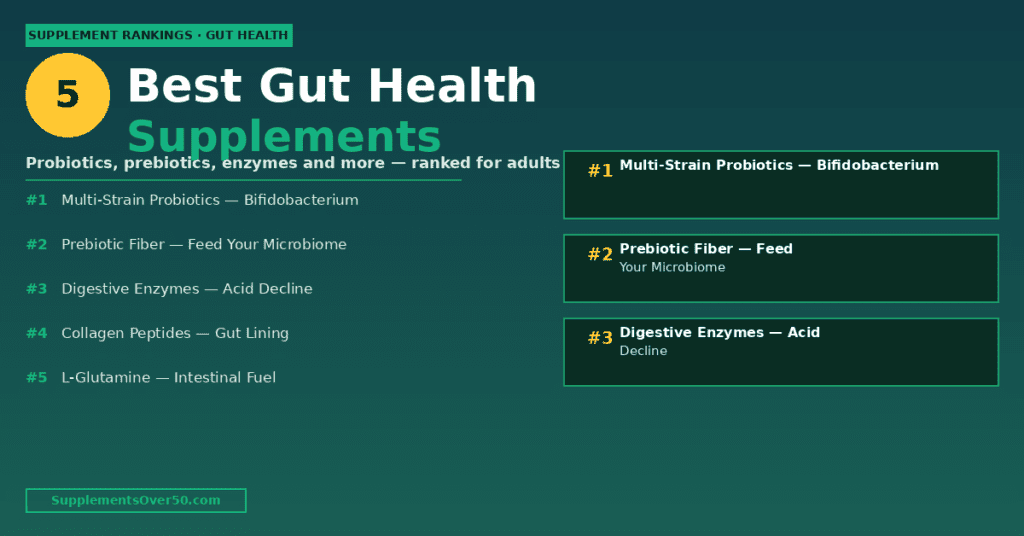
| ⚡ Quick Answer The 5 best gut health supplements for seniors ranked by evidence: (1) Multi-Strain Probiotics — Bifidobacterium is the most critical strain after 60 and declines fastest with age, (2) Prebiotic Fiber (Inulin or FOS) — feeds the Bifidobacterium you already have, producing butyrate that protects the gut lining, (3) Digestive Enzymes — stomach acid and enzyme production drop ~30% by age 60, making protein and fat digestion increasingly difficult, (4) Collagen Peptides — provide glycine and proline that support intestinal lining integrity, and (5) L-Glutamine — the primary fuel source for intestinal epithelial cells, supporting gut barrier function. Together these address the four major gut health shifts that occur after 60: microbiome decline, acid reduction, lining integrity loss, and fermentation capacity. |
Key Statistics — Gut Health After 60
- Gut microbiome diversity declines measurably after 60 — Bifidobacterium populations drop by up to 1,000-fold in some studies
- Stomach acid (HCl) production declines 30–40% by age 60 — reducing protein digestion, B12 absorption, and calcium absorption simultaneously
- Intestinal permeability (‘leaky gut’) increases with age — allowing bacterial products to enter the bloodstream and drive systemic inflammation
- A 2025 meta-analysis (29 RCTs, 1,633 adults aged 60+) found prebiotic supplementation increased Bifidobacterium abundance with an effect size nearly 3x stronger than probiotics alone
- The gut produces 90% of the body’s serotonin — gut microbiome shifts after 60 directly affect mood, sleep quality, and cognitive clarity through the gut-brain axis
The 5 Best Gut Health Supplements for Seniors — Ranked
| #1 — MICROBIOME RESTORATION Multi-Strain Probiotics — 10–50 Billion CFU Daily After 60, Bifidobacterium and Lactobacillus populations decline while inflammatory species fill the void. A quality multi-strain probiotic directly replenishes these populations. Look for strains specifically studied in older adults: Bifidobacterium longum, B. animalis, and Lactobacillus acidophilus. A 2025 meta-analysis confirmed probiotic supplementation significantly increases Bifidobacterium in adults over 60. Refrigerated or enteric-coated products preserve viability through the harsh stomach environment. Take with food — the buffering effect of a meal significantly improves strain survival to the colon. 📖 Deep dive: Best Probiotic for Seniors Over 60 — Which Strains Actually Work and Why 💰 Best product: Garden of Life Dr. Formulated 50+ Probiotic or Culturelle (Walmart/Amazon) · ~$0.50–1.50/day |
| #2 — FEED WHAT YOU HAVE — MOST UNDERUSED Prebiotic Fiber (Inulin or FOS) — 5–10g Daily Prebiotics are non-digestible fibers that selectively feed beneficial bacteria — particularly Bifidobacterium — producing short-chain fatty acids (especially butyrate) as a fermentation byproduct. Butyrate is the primary fuel for intestinal lining cells and a potent anti-inflammatory compound. The 2025 meta-analysis cited above found prebiotics increased Bifidobacterium with an effect size (SMD 1.09) nearly three times stronger than probiotics alone — making prebiotics the higher-leverage intervention for most seniors. Start at 3–5g and increase slowly over 2–3 weeks to avoid the gas and bloating that accompany rapid fiber increases. 📖 Deep dive: Prebiotics for Seniors — Best Types, Benefits and Dosing After 60 💰 Best product: NOW Inulin Pure Powder or Heather’s Tummy Fiber (Walmart/Amazon) · ~$0.04–0.15/day |
| #3 — DIGESTION — THE OVERLOOKED PROBLEM Digestive Enzymes — With Main Meals Stomach acid (HCl) and digestive enzyme production decline 30–40% by age 60. The practical result: protein from meat and fish is increasingly poorly digested, fats cause more GI discomfort, and bloating after meals becomes more common. Digestive enzymes — particularly proteases (for protein), lipases (for fat), and amylases (for starch) — compensate for this decline by providing the enzymes the body no longer makes efficiently. For seniors who experience bloating, discomfort, or undigested food in stool, a comprehensive digestive enzyme supplement taken at the start of each main meal is often more immediately beneficial than probiotics. 📖 Deep dive: Best Probiotic for Seniors — How Enzymes and Probiotics Work Together 💰 Best product: NOW Super Enzymes or Garden of Life Dr. Formulated Enzymes (Walmart/Amazon) · ~$0.30–0.60/day |
| #4 — GUT LINING SUPPORT Collagen Peptides — 10–15g Daily The intestinal lining renews every 3–5 days — one of the fastest cellular renewal rates in the body. This process requires glycine and proline, two amino acids that are abundant in collagen but often low in modern diets (which provide little connective tissue from animal sources). Collagen peptides provide these building blocks for intestinal cell renewal and tight junction integrity — the molecular seals between intestinal cells that prevent ‘leaky gut.’ The gut lining benefit of collagen is separate from its joint and bone benefits, making it one of the most multi-purpose supplements for seniors. 📖 Deep dive: Best Collagen Supplement After 50 — Full Evidence Guide 💰 Best product: Vital Proteins Collagen Peptides (Costco) or Great Lakes Collagen (Amazon) · ~$0.50–1.20/day |
| #5 — INTESTINAL LINING FUEL L-Glutamine — 5–10g Daily L-Glutamine is the primary energy source for intestinal epithelial cells — the cells lining the gut wall. When glutamine levels are low, intestinal barrier integrity deteriorates, leading to increased permeability and systemic inflammation. While L-Glutamine is conditionally essential (your body makes it), production can be insufficient during stress, illness, or aging. Multiple clinical studies in GI conditions confirm glutamine supplementation significantly improves intestinal barrier function. For healthy seniors, 5g daily in water is a low-cost intervention for gut lining support that complements probiotics and prebiotic fiber. 📖 Deep dive: Prebiotics for Seniors — The Role of the Gut Lining in Aging 💰 Best product: NOW L-Glutamine or Thorne L-Glutamine (Walmart/Amazon) · ~$0.10–0.20/day |
The Synbiotic Approach — Why Probiotics and Prebiotics Work Better Together
A synbiotic is a combination of probiotics (live bacteria) and prebiotics (their food). The rationale: adding new strains via probiotics without providing their preferred food source (prebiotic fiber) reduces colonisation rates and persistence. Think of it as planting seeds in unprepared soil. The optimal sequence: start prebiotics for 4–6 weeks first to prepare the gut environment, then add probiotics for the most effective colonisation.
Full gut health guides: Prebiotics for Seniors · Best Probiotic for Seniors Over 60 · Probiotics for Menopause
Frequently Asked Questions
Should seniors take probiotics every day?
Yes — daily consistency is important for probiotics because most strains do not permanently colonise the gut. They need to be replenished regularly to maintain their therapeutic effect. Unlike medications, there is no risk of dependence — stopping simply returns the microbiome to its pre-supplementation state over time. Daily use at 10–50 billion CFU is safe for healthy seniors without immune-compromising conditions.
What is the difference between probiotics and prebiotics?
Probiotics are live bacteria that you add to your gut. Prebiotics are non-digestible plant fibers that feed the bacteria already in your gut — particularly Bifidobacterium. Think of the probiotic as seeds and the prebiotic as fertiliser. Both are valuable, but a 2025 meta-analysis found prebiotics produce nearly three times the Bifidobacterium increase that probiotics alone do — making them the higher-leverage starting point for most seniors.
Do digestive enzymes interfere with probiotics?
No — digestive enzymes and probiotics work in different areas of the digestive tract and do not interfere with each other. Enzymes work in the stomach and upper small intestine to break down macronutrients. Probiotics are delivered to the colon. They can safely be taken together and address complementary aspects of digestive decline after 60.
The Bottom Line
The gut health shifts of aging — microbiome decline, reduced stomach acid, increased permeability, and declining enzyme production — each require a different supplement. Start with prebiotics (most impact per dollar), add probiotics for microbiome replenishment, digestive enzymes if experiencing meal-time symptoms, and collagen + L-glutamine for lining support. This five-part approach addresses every major gut health change that occurs after 60.