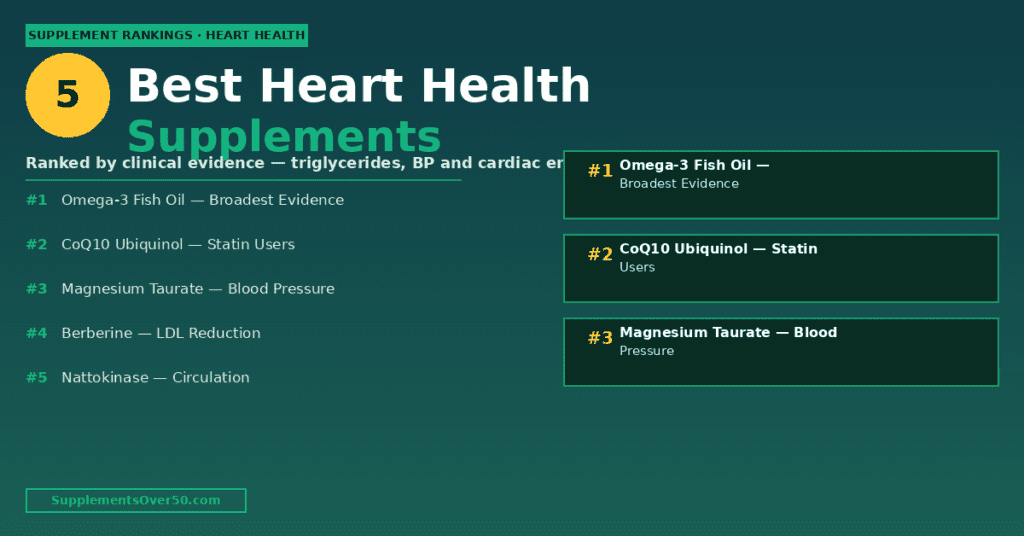
| ⚡ Quick Answer The 5 best heart health supplements for seniors ranked by clinical evidence: (1) Omega-3 Fish Oil 1,000–2,000mg EPA+DHA — reduces triglycerides 15–30%, lowers inflammatory markers, and is the most evidence-supported cardiovascular supplement available without prescription, (2) CoQ10 Ubiquinol 100–200mg — cardiac energy production and essential for the 50%+ of seniors on statins that deplete CoQ10, (3) Magnesium Taurate 300–400mg — the most cardiovascular-targeted magnesium form with documented blood pressure reduction, (4) Berberine 500mg twice daily — reduces LDL cholesterol by 20–25mg/dL through a different mechanism than statins, clinically equivalent to low-dose metformin for metabolic health, and (5) Nattokinase 2,000 FU — supports healthy blood viscosity and circulation but requires physician approval for anyone on blood thinners. |
Key Statistics — Cardiovascular Health After 60
- Cardiovascular disease is the #1 cause of death in US adults over 65 — responsible for 1 in 3 deaths
- Over 50% of men and women over 60 take a statin — statins deplete CoQ10 by up to 40%, making ubiquinol supplementation relevant for the majority of this age group
- A 2016 meta-analysis of 34 RCTs found magnesium supplementation significantly reduced systolic blood pressure by an average of 4.18 mmHg — comparable to the effect of a low-dose antihypertensive
- Omega-3 at 4g/day (prescription Vascepa) is FDA-approved for cardiovascular risk reduction in high-triglyceride patients — the lower 1–2g dose used in supplements produces meaningful but smaller benefits
- Berberine reduces LDL cholesterol by 20–25mg/dL in multiple RCTs — through PCSK9 inhibition, a mechanism completely different from statins
- The calcium-without-K2 problem is one of the most underappreciated cardiovascular risks in seniors — for the complete bone-and-heart K2 protocol, see our full guide: K2, D3 and Boron for Post-Menopausal Bone Density — Why K2 Must Accompany Every Calcium Supplement.
The 5 Best Heart Health Supplements for Seniors — Ranked
| #1 — BROADEST EVIDENCE BASE Omega-3 Fish Oil — 1,000–2,000mg EPA+DHA Daily Omega-3 EPA+DHA is the most evidence-supported cardiovascular supplement available without a prescription. EPA reduces triglycerides (15–30% reduction at 1–2g), lowers inflammatory markers including CRP and IL-6, reduces platelet aggregation, and improves endothelial function. DHA maintains the structural integrity of heart cell membranes. The REDUCE-IT trial (8,179 patients) found high-dose EPA reduced cardiovascular events by 25% compared to placebo. For supplemental (not prescription) doses: 1–2g EPA+DHA daily is the appropriate target. Always choose triglyceride-form oil — it absorbs approximately 70% better than ethyl ester. 📖 Deep dive: Omega-3s After 60 — Brain and Heart Evidence Guide 💰 Best product: Carlson Elite Omega-3 or Nordic Naturals Ultimate Omega (Amazon) · ~$0.20–0.40/day |
| #2 — STATIN USERS — NON-NEGOTIABLE CoQ10 Ubiquinol — 100–200mg Daily CoQ10 is the energy currency of mitochondria — most critically the cardiac mitochondria that power the heart 100,000 times per day. Statin medications block the same biosynthetic pathway that produces CoQ10, reducing levels by up to 40%. The result is measurable in many patients: muscle aches (especially cardiac muscle fatigue), reduced exercise tolerance, and low energy. Ubiquinol is the correct form after 60 — the conversion enzyme (NQO1) activity drops by ~50% with age, making the pre-converted ubiquinol form significantly more effective than standard ubiquinone CoQ10. For a full comparison of ubiquinol vs standard CoQ10 and why the form matters after 60, see: Ubiquinol vs CoQ10 — Is the More Expensive Form Worth It After 60? 📖 Deep dive: Ubiquinol vs CoQ10 — Is the More Expensive Form Worth It After 60? 💰 Best product: Qunol Ultra CoQ10 100mg (Costco) or Doctor’s Best Ubiquinol (Amazon) · ~$0.50–1.00/day |
| #3 — BLOOD PRESSURE — MOST TARGETED Magnesium Taurate — 300–400mg Daily Magnesium taurate combines magnesium with taurine — an amino acid with independent cardiovascular benefits: it stabilises cardiac electrical rhythm, supports arterial relaxation, and has antioxidant effects on the vascular wall. The combination produces greater cardiovascular benefit than either component alone. A 2016 meta-analysis confirmed magnesium supplementation at 300mg+ significantly reduced systolic and diastolic blood pressure. For seniors whose primary cardiovascular concern is hypertension, taurate is the most targeted magnesium form — more cardiovascular-specific than glycinate or citrate. For the complete breakdown of every magnesium form by use case — including why taurate is the most cardiovascular-targeted form — see our dedicated guide: 5 Best Magnesium Supplements for Seniors — Ranked by Form and Use Case. 📖 Deep dive: Magnesium for Heart Health and Blood Pressure After 50 — Full Guide 💰 Best product: Cardiovascular Research Magnesium Taurate or Doctor’s Best (iHerb/Amazon) · ~$0.20–0.40/day |
| #4 — LDL REDUCTION — DIFFERENT MECHANISM Berberine — 500mg Twice Daily with Meals Berberine is a plant alkaloid found in goldenseal and barberry with a remarkable evidence base for cardiovascular metabolic health. Its primary mechanism for cholesterol reduction: it increases LDL receptors on liver cells (through PCSK9 inhibition) — a completely different pathway from statins. This means it works complementarily with statins rather than redundantly. Clinical trials consistently show 20–25mg/dL LDL reduction at 1g/day. It also lowers triglycerides by 30–35% and improves fasting blood glucose — making it particularly valuable for seniors with metabolic syndrome. Critical note: berberine interacts with blood thinners and several antibiotics — physician disclosure is essential. 📖 Deep dive: Berberine Supplement for Adults Over 50 — Full Evidence Guide 💰 Best product: Thorne Berberine or NOW Berberine (Amazon/iHerb) · ~$0.30–0.60/day |
| #5 — CIRCULATION + BLOOD VISCOSITY Nattokinase — 2,000 FU Daily Nattokinase is a protease enzyme derived from natto (fermented Japanese soybeans) that has fibrinolytic activity — it breaks down fibrin, a protein involved in blood clot formation, and supports healthy blood viscosity. A 2022 RCT found nattokinase supplementation significantly reduced systolic blood pressure by 5.5 mmHg compared to placebo. IMPORTANT WARNING: nattokinase has blood-thinning effects that are additive with aspirin, warfarin, and other anticoagulants — do not combine without physician approval. For seniors not on blood thinners with a focus on circulation and blood pressure, it is a well-evidenced addition. 📖 Deep dive: Heart Health Supplement Stack for Seniors — Full Evidence Guide 💰 Best product: Doctor’s Best Nattokinase 2,000 FU or NOW Nattokinase (Amazon/iHerb) · ~$0.30–0.60/day |
| ⚠️ Critical Safety Note for Heart Supplement Users All five supplements in this list can interact with common cardiovascular medications. Omega-3 and nattokinase enhance blood-thinning effects of warfarin. Magnesium and berberine can compound the effects of antihypertensives. CoQ10 may enhance blood-pressure-lowering effects. Always disclose all supplements to your cardiologist and pharmacist. Do not start or stop supplements without informing your prescribing physician. |
Full guides: Heart Health Supplement Stack for Seniors · Ubiquinol vs CoQ10 · Berberine for Adults Over 50
Frequently Asked Questions
Can I take heart health supplements if I am on blood thinners like Eliquis or Warfarin?
Extreme caution is required — disclose every supplement to your cardiologist before starting. Omega-3 fish oil has a mild antiplatelet effect that is additive with both warfarin and direct oral anticoagulants (Eliquis, Xarelto). High-dose curcumin above 1g daily also has mild blood-thinning properties. Nattokinase has direct fibrinolytic activity and should not be combined with any blood thinner without physician guidance. Magnesium taurate and CoQ10 are generally the safest options for seniors on anticoagulation — but always confirm with your anticoagulation clinic before adding anything new.
Will CoQ10 help the muscle pain I get from my statin?
Clinical evidence is promising though not conclusive across all trials. Statins block the mevalonate pathway — the same biochemical route that produces both cholesterol and CoQ10 — depleting CoQ10 levels by up to 40%. Multiple trials and substantial clinical experience confirm that 100–200mg of Ubiquinol (the pre-converted active form, superior to standard CoQ10 for adults over 60) significantly reduces statin-associated muscle symptoms in a meaningful proportion of patients. It is safe to try alongside your statin and worth discussing with your prescribing physician — many cardiologists proactively recommend it for statin users experiencing myalgia.
Is Red Yeast Rice a safe natural alternative to statins for seniors?
Red Yeast Rice is not truly a natural alternative — it contains monacolin K, which is chemically identical to lovastatin (a prescription statin drug). It can lower LDL by 15–25mg/dL but carries the same side effects as a low-dose statin: muscle pain, liver enzyme elevation, and CoQ10 depletion. Because it acts pharmacologically like a drug, it requires the same medical oversight as a prescription statin — not self-directed supplementation. Berberine is a genuinely different non-statin option for LDL reduction, working through PCSK9 inhibition rather than the statin pathway, and is covered in our full heart health stack guide.
What heart supplements can seniors take with statins?
CoQ10 ubiquinol (100–200mg) is specifically recommended for statin users to replace the CoQ10 statins deplete. Omega-3 fish oil is safe and complementary with statins. Magnesium is generally safe. Berberine is complementary but discuss with your cardiologist as the combination may allow statin dose reduction over time. Avoid red yeast rice if on a statin — it contains lovastatin (a natural statin) and doubles the statin load.
Can these supplements lower blood pressure enough to reduce medication?
For mildly elevated blood pressure, the combination of magnesium taurate, omega-3, and berberine can produce clinically meaningful reductions — in some cases sufficient to reduce medication dose. However, never reduce blood pressure medication without physician guidance and monitoring. These supplements work best as complements to medication and lifestyle changes, not as replacements.
Is red yeast rice a good alternative to statins?
Red yeast rice contains monacolin K — chemically identical to lovastatin (a prescription statin). It reduces LDL by 15–25mg/dL but carries the same risks as low-dose statin use: muscle pain, liver stress, and CoQ10 depletion. If you want a statin, a physician-prescribed statin is more accurately dosed and monitored. Berberine is a better non-statin LDL alternative with a completely different mechanism and no statin-equivalent side effect profile.
The Bottom Line
The 5 best heart health supplements for seniors address cardiovascular risk through five distinct and complementary mechanisms: omega-3 for triglycerides and inflammation, CoQ10 for cardiac energy (especially statin users), magnesium taurate for blood pressure, berberine for LDL receptor upregulation, and nattokinase for blood viscosity. No supplement replaces medication for diagnosed cardiovascular disease — but for prevention and complementary support, this stack has the strongest combined evidence base available without a prescription.