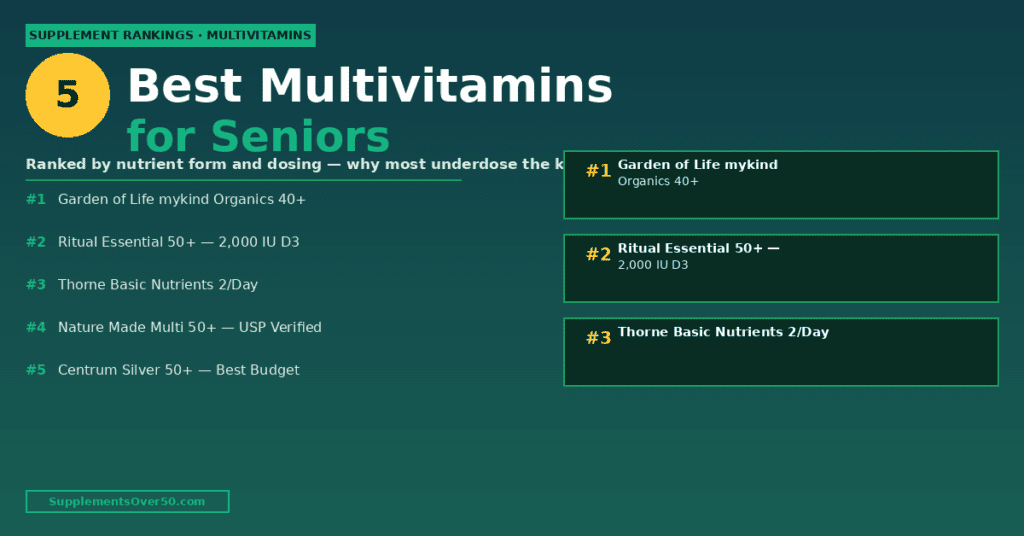
| ⚡ Quick Answer The 5 best multivitamin for seniors ranked: (1) Garden of Life mykind Organics Men’s/Women’s 40+ — best certified organic formula with active nutrient forms, (2) Ritual Essential for Women/Men 50+ — best subscription option with transparent ingredient sourcing, (3) Thorne 2/Day Basic Nutrients — best practitioner-grade comprehensive formula, (4) Nature Made Multi for Her/Him 50+ — best USP-verified mainstream option at Walmart, and (5) Centrum Silver Men/Women 50+ — best budget widely available option. The critical caveat: no multivitamin provides therapeutic doses of vitamin D, magnesium, or B12 — use a multivitamin as a nutritional safety net alongside targeted individual supplements. |
The Honest Truth About Multivitamins for Seniors
- Most multivitamins contain only 400–600 IU vitamin D — the evidence-supported dose for seniors is 2,000 IU daily
- Magnesium in most multivitamins is oxide form at 50–100mg — absorbs at only 4% bioavailability; glycinate or malate at 300mg+ is the evidence-based dose
- B12 in most multivitamins is cyanocobalamin — the synthetic form that requires conversion to methylcobalamin; seniors with reduced methylation capacity absorb it less efficiently
- Iron-free formulations are essential for men and post-menopausal women — excess iron is pro-inflammatory and associated with increased cardiovascular risk in this population
- A multivitamin is best used as a nutritional safety net for micronutrients — not as a replacement for targeted D3, magnesium, omega-3, and B12 supplementation
The 5 Best Multivitamins for Seniors — Ranked
| #1 — BEST CERTIFIED ORGANIC Garden of Life mykind Organics — Amazon / Whole Foods Garden of Life mykind Organics is the only mainstream multivitamin on this list made entirely from certified organic whole foods — providing nutrients in their natural food-matrix form which may improve absorption and cofactor availability. Available in Men’s 40+ and Women’s 40+ formulations. Contains methylfolate and methylcobalamin (active B forms), iron-free men’s formula, and provides D3 from organic lichen. USDA Organic, Non-GMO Project Verified, and NSF certified. 📖 Deep dive: Best Multivitamin for Women Over 60 — Which Nutrients Actually Matter 💰 Best product: Garden of Life mykind Organics 60–120 tablets (Amazon ~$24–45) · ~$0.80–1.20/day |
| #2 — BEST TRANSPARENT SOURCING Ritual Essential for Women/Men 50+ — ritual.com / Amazon Ritual is built around radical transparency — every ingredient lists its exact source, form, and why it was chosen. The 50+ formula provides methylated B12 and folate, D3 at 2,000 IU (one of the few multivitamins at the evidence-supported senior dose), magnesium at 30mg (still low but in a bioavailable chelated form), and omega-3 DHA from microalgae. Subscription-based at approximately $1.00/day — more expensive than mainstream options but significantly better nutrient forms. 📖 Deep dive: Best Multivitamin for Men Over 60 — Prostate, Heart and Brain Nutrients 💰 Best product: Ritual Essential 50+ subscription (ritual.com ~$30/month) · ~$1.00/day |
| #3 — BEST PRACTITIONER GRADE Thorne 2/Day Basic Nutrients — Thorne.com / Amazon Thorne’s Basic Nutrients 2/Day is the practitioner-grade choice — used in clinical settings and recommended by integrative medicine physicians. Two capsules daily provide methylated B vitamins, vitamin D3 at 2,000 IU, highly bioavailable mineral forms, and no artificial colours, flavours, or preservatives. NSF Certified for Sport. The most comprehensively formulated multivitamin on this list in terms of nutrient form quality — magnesium as bisglycinate, B12 as methylcobalamin, folate as methylfolate. 📖 Deep dive: Best Supplements for Adults Over 60 — Why a Multivitamin Isn’t Enough Alone 💰 Best product: Thorne Basic Nutrients 2/Day 60 capsules (Thorne.com / Amazon ~$27–33) · ~$0.90–1.10/day |
| #4 — BEST MAINSTREAM USP-VERIFIED Nature Made Multi for Her/Him 50+ — Walmart For seniors who want a widely available, USP-verified multivitamin at Walmart pricing, Nature Made 50+ is the most credible mainstream option. USP Verification confirms the product contains what it claims and dissolves properly. Iron-free formulations available for both men and women (check the label). D3 at 1,000 IU — better than Centrum’s 400 IU but still below the 2,000 IU senior recommendation. B12 as cyanocobalamin rather than methylcobalamin. 📖 Deep dive: Best Multivitamin for Women Over 60 — Full Product Comparison 💰 Best product: Nature Made Multi 50+ 80 tablets (Walmart ~$8–14) · ~$0.10–0.15/day |
| #5 — BEST BUDGET ACCESSIBLE Centrum Silver Men/Women 50+ — Walmart / Costco Centrum Silver remains the most widely purchased senior multivitamin in the US — and it is a reasonable nutritional safety net at approximately $0.05–0.10/day. The critical limitations: vitamin D at only 400 IU (vs 2,000 IU evidence-supported), magnesium as oxide (4% absorption), and B12 as cyanocobalamin. As a standalone multivitamin it underdoses the most important nutrients. As a base alongside targeted D3, magnesium glycinate, and methylcobalamin B12 supplements, it provides adequate micronutrient coverage for the remaining vitamins and minerals. 📖 Deep dive: Best Supplements for Adults Over 60 — Why a Multivitamin Complements But Doesn’t Replace 💰 Best product: Centrum Silver 50+ 200 tablets (Walmart / Costco ~$10–18) · ~$0.05–0.10/day |
| ⚠️ What No Multivitamin Replaces Regardless of the multivitamin you choose, supplement separately with: Vitamin D3 2,000 IU (most multivitamins provide only 400-1,000 IU), Magnesium Glycinate 300-400mg (most multivitamins provide poorly-absorbed oxide at 50-100mg), and Omega-3 EPA+DHA 1,000-2,000mg (virtually no multivitamin provides a therapeutic omega-3 dose). These three gaps exist in every multivitamin on this list. The three most critical gaps in every multivitamin — Vitamin D3, Magnesium, and Omega-3 — each require dedicated supplementation at therapeutic doses. For ranked product recommendations covering all three gaps: Best Supplements for Adults Over 60 — The Essential 7 Ranked by Evidence. For seniors who want to understand how a multivitamin fits into the broader supplement protocol — and which individual supplements it cannot replace regardless of quality: The 5 Essentials — Supplements Every Adult Over 60 Should Know. |
Full gender-specific guides:
Best Multivitamin for Women Over 60 ·
Best Multivitamin for Men Over 60 ·
The Essential 7 — Complete Senior Supplement Guide
For men over 60 the multivitamin priorities shift toward prostate health, testosterone support, and iron-free formulations — for the complete men’s guide: Best Multivitamin for Men Over 60 — Prostate, Heart and Brain Nutrients Compared. For women over 60 the priorities shift toward bone matrix, hormonal balance, and menopause-specific nutrients: Best Multivitamin for Women Over 60 — Which Nutrients Actually Matter.
Frequently Asked Questions
Is Centrum Silver good for seniors?
Centrum Silver is a reasonable nutritional safety net — it covers many micronutrients that seniors can be short on. The critical limitations are vitamin D at only 400 IU (vs the evidence-supported 2,000 IU), magnesium as poorly-absorbed oxide, and synthetic cyanocobalamin B12. If Centrum Silver is your only supplement, add separate D3 2,000 IU and magnesium glycinate at minimum. Used alongside targeted supplements, Centrum Silver provides adequate background micronutrient coverage at very low cost.
Do seniors need a gender-specific multivitamin?
Yes in one important area: iron. Post-menopausal women and men over 50 do not menstruate and therefore do not need the supplemental iron found in standard women’s multivitamins. Excess iron in this population is pro-inflammatory and associated with increased cardiovascular risk. Always choose iron-free formulations for adults over 50 — check the label specifically, as some senior formulas still include iron.
Can a multivitamin replace individual supplements for seniors?
No — multivitamins serve a different purpose. They provide broad coverage of trace minerals and B vitamins that individual supplements typically don’t include. But they rarely provide therapeutic doses of the most critical nutrients for seniors: vitamin D, magnesium, omega-3, and B12. The ideal approach is a quality multivitamin as a nutritional insurance policy plus targeted individual supplements for the four nutrients where dose and form matter most.
Why don’t multivitamins have enough Vitamin D for seniors?
Two reasons — regulatory and practical. Most multivitamins are formulated to meet the official RDA of 600–800 IU, which was established to prevent rickets and osteomalacia in the general population — not to support immune function, testosterone availability, muscle strength, and cardiovascular health in adults over 60. Meeting the evidence-supported 2,000 IU dose in a multivitamin would require a significantly larger softgel or an additional capsule, increasing both manufacturing cost and pill burden for consumers. The result: virtually every mainstream multivitamin underdoses vitamin D for seniors by 60–75%. This is not a flaw in specific brands — it is a structural limitation of the multivitamin format that makes separate D3 supplementation essential regardless of which multivitamin you choose.
Should I take my multivitamin on an empty stomach?
No — always take your multivitamin with your largest fat-containing meal of the day. The fat-soluble vitamins A, D, E, and K all require dietary fat for absorption through the intestinal wall. Taking them on an empty stomach means a significant portion passes through unabsorbed. Additionally, minerals including zinc, magnesium, and iron can cause nausea and GI discomfort when taken without food. The specific fat content of the meal matters more than the time of day — any meal containing healthy fats (eggs, olive oil, avocado, nuts, fish) provides adequate fat for optimal fat-soluble vitamin absorption.
Can I take a multivitamin if I am on blood thinners?
Yes with monitoring — but disclose the specific multivitamin to your anticoagulation clinic. The key concern is vitamin K, which directly counteracts warfarin’s mechanism. Most standard multivitamins contain 25–80mcg of vitamin K — not enough to cause major problems, but enough to affect INR if your intake changes significantly between refills. The critical rule for warfarin users: keep your total daily vitamin K intake consistent rather than avoiding it entirely. If your multivitamin contains vitamin K, take it every day without skipping doses. Alternatively, ask your anticoagulation clinic about vitamin K-free formulas. Direct oral anticoagulants (Eliquis, Xarelto) are less sensitive to vitamin K and have fewer multivitamin interaction concerns.
Is Centrum Silver good enough for seniors or should I buy something better?
Centrum Silver is a reasonable nutritional safety net at approximately $0.05–0.10/day — but it has three significant limitations for seniors. Vitamin D at only 400 IU versus the evidence-supported 2,000 IU. Magnesium as poorly-absorbed oxide rather than glycinate or malate. B12 as cyanocobalamin rather than methylcobalamin. If Centrum Silver is your only supplement, add a separate Vitamin D3 2,000 IU and magnesium glycinate 300mg at minimum. Used as a background micronutrient foundation alongside those targeted supplements, Centrum Silver provides adequate coverage of trace minerals and B vitamins at the lowest cost of any option on this list.
Do seniors need a gender-specific multivitamin?
Yes — in one critical area. Iron. Men over 50 and post-menopausal women do not menstruate and therefore do not need supplemental iron. Excess iron in this population is pro-inflammatory, promotes oxidative stress, and is associated with increased cardiovascular risk. Standard women’s multivitamins often contain 18mg iron — the premenopausal recommendation. Always choose an iron-free formulation explicitly labelled for adults over 50 regardless of gender. Beyond iron, men’s formulations typically emphasise zinc and lycopene for prostate health while women’s formulations emphasise calcium and additional vitamin D for bone density. These differences are useful but secondary to the iron-free requirement.
Can a multivitamin replace eating vegetables and whole foods?
No — and this is one of the most important limitations to understand. Multivitamins provide isolated micronutrients but cannot replicate the thousands of phytonutrients, fibre, antioxidants, and food-matrix compounds found in whole plant foods. Studies consistently show that isolated nutrients in supplement form do not produce the same health outcomes as those same nutrients consumed through food. The appropriate mental model: a multivitamin fills specific nutritional gaps that diet misses, particularly for nutrients where age-related absorption decline makes dietary intake insufficient (B12, vitamin D, magnesium). It is a targeted nutritional safety net — not a substitute for dietary quality.
The Bottom Line
The best multivitamin for seniors is Garden of Life mykind Organics for certified organic quality, Ritual 50+ for transparent sourcing and 2,000 IU D3, or Thorne Basic Nutrients 2/Day for practitioner-grade nutrient forms. Centrum Silver at Walmart is a reasonable budget foundation. Whatever you choose, add separate D3 2,000 IU and magnesium glycinate — no multivitamin provides these at therapeutic doses.