| ⚕️ Supplement Disclosure This article reviews probiotics as dietary supplements for informational purposes only. Adults with immune system conditions, those recovering from surgery, or taking immunosuppressant medications should consult their doctor before starting any probiotic. Probiotics are generally safe for healthy older adults but individual responses vary. |
Best probiotic for seniors is not a question with a single universal answer — because the gut microbiome changes that occur after 60 are specific, measurable and different from those of younger adults, and the strains that address those specific changes are not always the ones most heavily marketed. This guide cuts through the generic probiotic marketing and focuses on what the 2025 clinical evidence specifically shows works for adults over 60.
The gut microbiome after 60 is a fundamentally different environment from the one that existed at 40. Bifidobacterium — the genus most associated with gut health, immune function and cognitive support — declines sharply with age. Opportunistic bacteria that drive inflammation increase. Microbial diversity — the measure most strongly associated with healthy aging and longevity — decreases. These are not minor changes. They affect nutrient absorption, immune response, inflammation levels, cognitive function, and even how effectively other supplements work.
A 2025 systematic review and meta-analysis published in Nutrition Journal covering 29 randomised controlled trials and 1,633 participants aged 60 or older found that probiotic supplementation significantly enhanced microbial diversity and increased Bifidobacterium abundance in older adults. That is the strongest evidence base for any gut health intervention in this age group. This guide explains what it means practically and which products deliver the right strains.
| The single most important insight for seniors choosing a probiotic: Bifidobacterium supplementation matters more after 60 than at any other life stage — because natural Bifidobacterium levels decline most sharply in this decade. A probiotic that is heavy on Lactobacillus strains and light on Bifidobacterium addresses the wrong part of the aging gut equation. Look for products with at least two Bifidobacterium strains prominently listed. |
What Happens to the Gut After 60 — and Why It Matters
Bifidobacterium decline — the most significant age-related microbiome change
Bifidobacterium is the genus of bacteria most strongly associated with health in both infants and older adults — and the one that declines most predictably with age. By the time most adults reach their 60s, Bifidobacterium levels have fallen to a fraction of their peak. This matters because Bifidobacterium strains are responsible for producing short-chain fatty acids that feed the gut lining, modulating immune responses, supporting B vitamin synthesis, and competing against opportunistic pathogens.
The 2025 meta-analysis in Nutrition Journal found that probiotic supplementation specifically increased Bifidobacterium abundance in adults over 60, with a standardised mean difference of 0.40 — a clinically meaningful effect. Prebiotics showed even stronger Bifidobacterium increases (SMD 1.09), which is why synbiotic products combining probiotics and prebiotic fibres outperform standalone probiotics for this specific outcome.
Reduced microbial diversity — the longevity signal
Research on centenarians — adults who live to 100 or beyond while remaining healthy — consistently finds one gut microbiome characteristic: higher microbial diversity than age-matched peers. Studies of frail older adults show the opposite pattern — reduced diversity, lower Bifidobacterium and Lactobacillus levels, higher Proteobacteria (a phylum containing many harmful bacteria). The 2025 meta-analysis confirmed probiotic supplementation enhanced the Shannon diversity index (SMD 0.76) in adults over 60 — a meaningful improvement in overall microbiome health.
Declining gastric acid — the absorption consequence
Reduced hydrochloric acid production after 60 — the same mechanism that drives B12 deficiency (see our B12 deficiency guide) — also reduces the digestive efficiency that enables proper nutrient absorption. A compromised gut barrier increases intestinal permeability, allowing bacterial endotoxins into circulation and contributing to the chronic low-grade inflammation (‘inflammageing’) that underlies most age-related disease. Probiotic supplementation specifically helps restore epithelial barrier integrity and reduce this leaky gut pattern.
Gut microbiome health also determines how effectively phytoestrogens from herbs like shatavari are absorbed and activated — gut bacteria are responsible for metabolising plant-based compounds into their bioactive forms. Women taking shatavari for menopause symptoms will absorb it more effectively with a healthy microbiome. See our Shatavari for Menopause guide for the full hormonal support protocol.
The cognitive connection — the gut-brain axis after 60
A 2025 meta-analysis found Bifidobacterium supplementation significantly improved cognitive function scores in older adults (MMSE weighted mean difference 2.26). A 2024 crossover study found a combination of Lactobacillus rhamnosus and Bifidobacterium lactis at 3.3 billion CFU per day improved cognitive function, mood and attention in adults 55 and older over 10 weeks. The gut-brain axis — the bidirectional communication pathway between gut bacteria and the central nervous system — is increasingly recognised as a key target for cognitive health in seniors.
The gut-brain axis also affects how well cognitive supplements perform — the inflammation-driven disruption of the gut-brain signalling pathway is one reason why caffeine-free nootropic stacks work more effectively when chronic gut inflammation is addressed first. See our guide on the Best Nootropic Stack for Seniors for the full cognitive support protocol.”
The Strains That Matter Most After 60
| Strain | Primary Benefit After 60 | Evidence Summary |
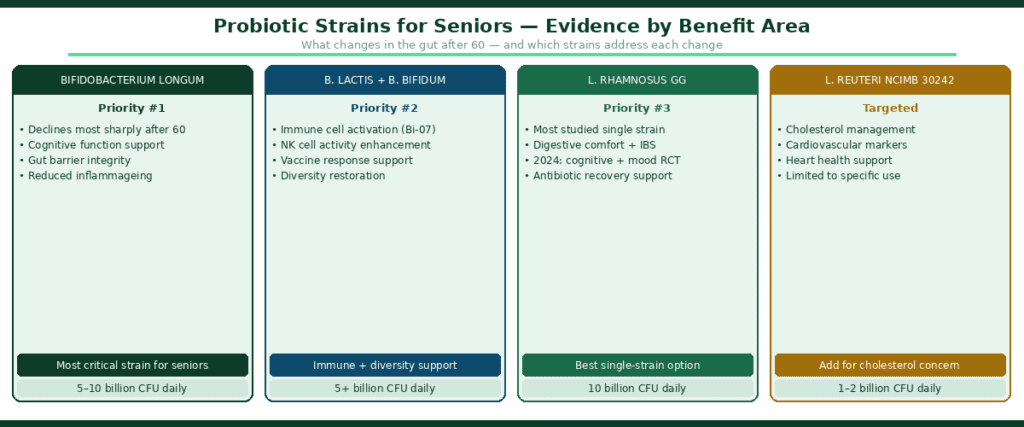
| Bifidobacterium longum | Gut barrier integrity, cognitive support, reduced inflammation — the single most important strain for seniors | 2025 meta-analysis: significant MMSE improvement. Declines most sharply with age — supplementation most impactful here |
| Bifidobacterium lactis (Bi-07) | Immune enhancement — monocyte and granulocyte phagocytic activity | Crossover RCT: significantly enhanced immune cell activity in healthy elderly. Supports vaccine response |
| Lactobacillus rhamnosus (GG) | Digestive health, antibiotic-associated diarrhoea prevention, cognitive support | Most studied Lactobacillus strain — extensive RCT evidence. 2024 cognitive study: improved mood and attention in adults 55+ |
| Lactobacillus acidophilus | Gut flora balance, constipation relief, immune support | Widely studied across age groups — well-tolerated and effective baseline strain for seniors |
| Bifidobacterium bifidum | Immune modulation, IBS symptom management, gut microbiome diversity | RCT evidence for microbiome diversity improvement in elderly — pairs well with B. longum |
| Lactobacillus plantarum | Cholesterol support, gut motility, anti-inflammatory | Randomised clinical trials confirm cholesterol-lowering effects — relevant for cardiovascular health in seniors |
| Lactobacillus reuteri NCIMB 30242 | Cholesterol management, heart health | RCT evidence for maintaining healthy cholesterol and reducing cardiovascular inflammation markers in seniors |
| The two most important strains for adults over 60 specifically: Bifidobacterium longum (addresses the most significant age-related gut change) and Bifidobacterium lactis (immune enhancement). If a probiotic product contains both of these alongside a Lactobacillus rhamnosus strain, it covers the three most evidence-supported targets for the aging gut. |
CFU Count — How Much Is Enough?
CFU (colony-forming units) is the measure of live bacteria per serving. More is not automatically better — what matters is strain quality, whether the bacteria survive transit through stomach acid to the intestine, and whether the formula is designed for seniors specifically.
| CFU range | What it means for seniors |
| 1–5 billion CFU | Effective entry-level dose for general gut maintenance — suitable for seniors with no specific digestive concerns |
| 5–25 billion CFU | Mid-range — appropriate for seniors with digestive symptoms, irregular bowel habits or those recovering from antibiotic use |
| 25–50 billion CFU | Higher dose — appropriate for rebuilding gut flora after illness or antibiotic treatment. Not necessary for daily maintenance |
| 50+ billion CFU | High dose — generally unnecessary for daily use in healthy seniors. More relevant for specific conditions under medical guidance |
The most important factor is not CFU count but delivery system — whether the bacteria survive stomach acid. Look for delayed-release or enteric-coated capsules, or products that specify acid-resistance testing. Refrigerated probiotics generally maintain higher live cell counts than shelf-stable products, though modern freeze-drying technology has narrowed this gap significantly.
5 Best Probiotic Supplements for Seniors Over 60 — US Pricing 2026
1. Culturelle Daily Probiotic (Walmart / Amazon) — Best Mainstream Single-Strain Option
Culturelle uses Lactobacillus rhamnosus GG — the most studied probiotic strain in the world with 1,000+ published clinical trials. While not Bifidobacterium-heavy, it is the most reliable single-strain option for general digestive health and immune support in seniors. Available at Walmart and Amazon for approximately $18–24 for 30 capsules (~$0.60–0.80 per day).
- Strain: L. rhamnosus GG — 10 billion CFU
- Price per day: ~$0.70 (Walmart/Amazon)
- Certification: Non-GMO, gluten-free
- Best for: Seniors wanting the most-studied probiotic strain for digestive and immune support
2. Garden of Life Dr. Formulated Probiotics 50 Billion (Amazon) — Best Multi-Strain Senior Formula
Garden of Life’s 50 Billion formula is specifically formulated for adults over 50 — contains 16 probiotic strains including Bifidobacterium longum, B. lactis, B. bifidum and multiple Lactobacillus strains. Delayed-release capsules for acid resistance. Available on Amazon for approximately $38–48 for 30 capsules (~$1.27–1.60 per day).
- Strains: 16 strains — 50 billion CFU including B. longum, B. lactis, B. bifidum
- Price per day: ~$1.43 (Amazon)
- Certification: Non-GMO, gluten-free, no refrigeration needed
- Best for: Seniors who want the most comprehensive multi-strain senior-specific formula
3. Align Probiotic (Walmart / Amazon) — Best for Digestive Comfort
Align uses Bifidobacterium 35624 — a strain specifically studied for digestive comfort, bloating reduction and IBS symptom management. Widely recommended by gastroenterologists. Available at Walmart and Amazon for approximately $28–36 for 28 capsules (~$1.00–1.29 per day).
- Strain: Bifidobacterium 35624 — 1 billion CFU
- Price per day: ~$1.14 (Walmart/Amazon)
- Certification: Gastroenterologist recommended, gluten-free
- Best for: Seniors whose primary concern is digestive discomfort, bloating or irregular bowel habits
4. Kirkland Signature Daily Probiotic (Costco) — Best Value Certified Option
Costco’s house-brand probiotic contains Lactobacillus acidophilus and Bifidobacterium lactis — two of the most evidence-supported strains for seniors — at an exceptional value. Available at Costco for approximately $18–22 for 200 capsules (~$0.09–0.11 per day — extraordinary value).
- Strains: L. acidophilus + B. lactis — 10 billion CFU
- Price per day: ~$0.10 (Costco — exceptional value)
- Certification: USP-quality standard
- Best for: Budget-conscious Costco members wanting a reliable two-strain formula at the lowest daily cost
5. Renew Life Ultimate Flora (Amazon / Walmart) — Best for Post-Antibiotic Recovery
Renew Life’s high-potency formula contains 30 probiotic strains at 50 billion CFU with a strong Bifidobacterium profile — specifically useful for seniors rebuilding gut flora after antibiotic courses, which deplete microbiome diversity rapidly. Available at Amazon and Walmart for approximately $32–42 for 30 capsules (~$1.07–1.40 per day).
- Strains: 30 strains — 50 billion CFU
- Price per day: ~$1.23 (Amazon/Walmart)
- Certification: Non-GMO, gluten-free, delayed-release capsule
- Best for: Seniors recovering from antibiotic treatment or with significant digestive disruption
One special case worth knowing: Saccharomyces boulardii (sold as Florastor at Walmart and Amazon, approximately $0.67 per day for 30 capsules) is a yeast-based probiotic rather than a bacterial one. Because it is a yeast, antibiotics do not affect it — meaning it can be taken simultaneously with antibiotic courses rather than spaced apart. It is the most evidence-supported option specifically for preventing antibiotic-associated diarrhoea, which affects seniors disproportionately due to heavier antibiotic use in this age group.
Probiotics vs Probiotic Foods — Which Is Better?
Fermented foods — yogurt, kefir, sauerkraut, kimchi, miso — deliver probiotic bacteria alongside their natural food matrix and are an excellent complement to supplementation. However, they have two limitations for seniors specifically: the strains present are variable and often not the Bifidobacterium strains most depleted in aging, and the CFU count is inconsistent across products and batches.
Probiotic supplements provide strain specificity and consistent dosing — you know exactly which bacteria you are getting and how many. For seniors specifically targeting Bifidobacterium restoration, a targeted supplement is more reliable than relying on fermented foods alone. The ideal approach is both — fermented foods as part of a diet pattern, targeted supplements for specific strain support.
For seniors also taking vitamin C — see our Vitamin C for Seniors guide — vitamin C supports the gut epithelial barrier directly, making it a natural complement to probiotic therapy for gut health.
Frequently Asked Questions
What is the best probiotic strain for adults over 60?
Bifidobacterium longum is the single most important strain for adults over 60 — it is the genus that declines most sharply with age and is most strongly associated with cognitive function, immune health and reduced inflammageing. A 2025 meta-analysis found Bifidobacterium supplementation significantly improved cognitive scores in older adults. Bifidobacterium lactis Bi-07 is the second most important for immune enhancement specifically. Look for a product containing both alongside at least one Lactobacillus rhamnosus strain. Culturelle (L. rhamnosus GG) covers the Lactobacillus side; Garden of Life 50 Billion covers the Bifidobacterium side comprehensively.
How long does it take for probiotics to work in seniors?
Digestive comfort improvements — reduced bloating, more regular bowel movements — typically appear within 1 to 2 weeks. Immune function improvements are documented in RCTs at 4 to 8 weeks. Cognitive function improvements in the 2024 crossover study appeared at 10 weeks of consistent daily use. Microbiome diversity changes require the most time — meaningful diversity shifts are typically measured at 8 to 12 weeks. The consistent message across trials: allow at least 4 weeks before evaluating digestive results, and 8 to 12 weeks for systemic benefits.
Should seniors take probiotics with or without food?
With food or immediately before a meal is the standard recommendation — food buffers stomach acid, improving bacterial survival through the digestive tract. Specifically, taking probiotics 30 minutes before a meal or with the first bites of a meal maximises the number of bacteria that reach the intestine alive. Avoid taking probiotics with hot beverages, which can kill bacteria. If you take antibiotics, space probiotic supplementation at least 2 hours away from the antibiotic dose.
Can probiotics help with constipation in seniors?
Yes — this is one of the most consistently supported benefits in the senior probiotic literature. Multiple RCTs confirm that probiotic supplementation improves stool frequency and consistency in older adults with constipation. Bifidobacterium lactis HN019 specifically showed significant improvement in functional constipation in a 2024 JAMA Network Open randomised clinical trial. A synbiotic approach — combining a probiotic with a prebiotic fibre like inulin or psyllium husk — produces stronger constipation relief than either alone.
Do probiotics interact with medications common in seniors?
For most medications, probiotics are safe. The main precaution is timing with antibiotics — take probiotics at least 2 hours apart from any antibiotic dose, as antibiotics kill probiotic bacteria. For seniors on immunosuppressant medications (organ transplant, autoimmune conditions), consult your doctor before starting probiotics — rare cases of infection have been reported in severely immunocompromised individuals. Probiotics do not interact with blood pressure medications, statins, thyroid medication or diabetes medications at standard doses.
The Bottom Line
Best probiotic for seniors over 60 means prioritising Bifidobacterium strains — the genus that declines most sharply with age and has the strongest evidence for cognitive, immune and digestive benefits in this population.
A 2025 meta-analysis of 29 RCTs confirmed probiotic supplementation increases Bifidobacterium abundance and microbial diversity in adults over 60. The practical takeaway: choose a formula with Bifidobacterium longum and Bifidobacterium lactis prominently listed, in a delayed-release capsule, at 5–25 billion CFU for daily maintenance.
Kirkland Signature at Costco ($0.10/day) is the best-value option covering both key strains. Garden of Life 50 Billion ($1.43/day) is the most comprehensive senior-specific formula. Culturelle ($0.70/day) is the best single-strain option for digestive and immune support with the broadest evidence base.
References
1. Nutrition Journal / Springer Nature (2025). Effects of probiotics, prebiotics and synbiotics on gut microbiota in older adults: systematic review and meta-analysis of 29 RCTs. View on PMC
2. Probiotics and Antimicrobial Proteins (2024). Cognitive and emotional effect of multi-species probiotic containing L. rhamnosus and B. lactis in healthy older adults.
3. JAMA Network Open (2024). Eight-week supplementation with Bifidobacterium lactis HN019 and functional constipation: a randomised clinical trial.
4. PMC. The Effect of Probiotics on Health Outcomes in the Elderly: A Systematic Review of Randomized, Placebo-Controlled Studies. View on PMC