⚡ Quick Answer The 5 best probiotics for seniors ranked:
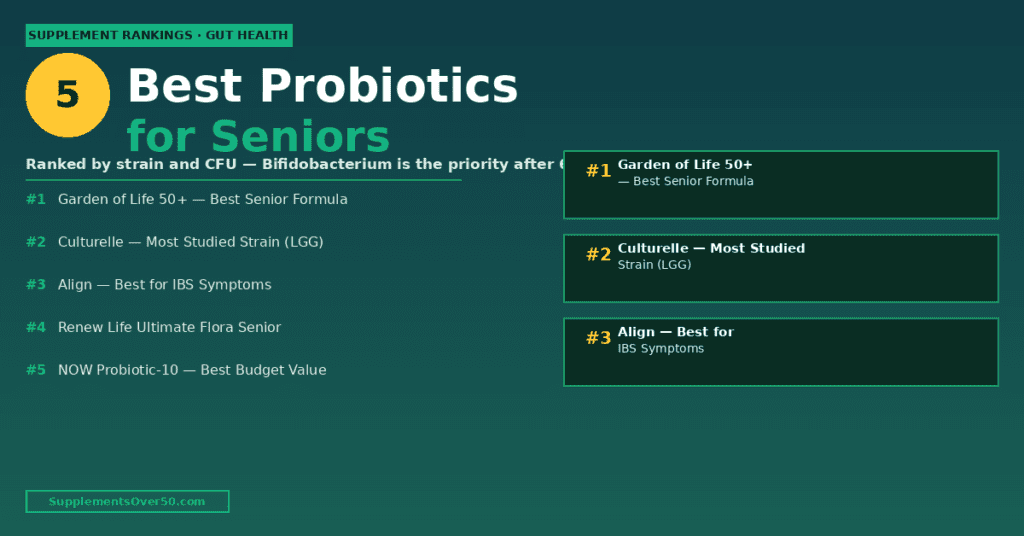
(1) Garden of Life Dr. Formulated 50+ Probiotic — the most targeted senior formula with Bifidobacterium priority strains, (2) Culturelle Digestive Daily — best single-strain evidence for Lactobacillus rhamnosus GG, the most studied strain in clinical trials, (3) Align Probiotic — best for IBS-related symptoms with specific Bifidobacterium infantis research, (4) Renew Life Ultimate Flora Senior — best high-CFU multi-strain formula for seniors, and (5) NOW Probiotic-10 — best value broad-spectrum at Walmart.
Bifidobacterium is the most important genus after 60 — it declines fastest and has the strongest clinical evidence.
The Most Important Probiotic Fact for Seniors
Bifidobacterium populations decline by up to 1,000-fold between ages 20 and 70 — this is the single most significant microbiome shift of aging
A 2025 meta-analysis (29 RCTs, 1,633 adults aged 60+) found prebiotic supplementation increased Bifidobacterium with an effect size nearly 3x stronger than probiotics alone — use both together
Not all probiotic strains are equal — the genus, species, and strain designation all matter. ‘Lactobacillus acidophilus’ and ‘Lactobacillus rhamnosus GG’ are completely different strains with different evidence profiles
CFU count (colony-forming units) matters but delivery to the colon matters more — look for enteric-coated or refrigerated products that protect strains through stomach acid
Probiotics work best when combined with prebiotic fiber — the fiber feeds the bacteria you’re adding, dramatically improving colonisation rates
The 5 Best Probiotics for Seniors — Ranked
#1 — MOST TARGETED FOR SENIORS 50+ Garden of Life Dr. Formulated 50+ Probiotic — Walmart / Amazon Garden of Life Dr. Formulated Probiotics for Adults 50+ is specifically formulated for the microbiome changes of aging — prioritising Bifidobacterium longum, B. lactis, and L. acidophilus strains with the strongest evidence for seniors. 50 billion CFU from 16 strains. Includes prebiotic fiber (organic acacia). Shelf-stable formulation removes the refrigeration requirement. The most comprehensively designed senior-specific probiotic at mainstream US retail.
#2 — MOST CLINICALLY STUDIED STRAIN Culturelle Digestive Daily — Walmart / Amazon Culturelle uses Lactobacillus rhamnosus GG — the single most clinically studied probiotic strain in the world, with over 1,000 published studies. At 10 billion CFU per capsule it is a lower count than some competitors, but the strain specificity and evidence base is unmatched. Particularly well-evidenced for traveller’s diarrhoea, antibiotic-associated diarrhoea, and general digestive resilience. Available in every Walmart and CVS in the US.
#3 — BEST FOR IBS SYMPTOMS Align Probiotic — Walmart / Amazon Align contains Bifidobacterium longum 35624 — a specific strain with multiple dedicated RCTs showing significant reduction in IBS symptoms including bloating, abdominal pain, and bowel habit irregularities. For seniors whose primary concern is IBS-related digestive discomfort rather than general microbiome support, Align’s strain-specific evidence is the strongest available OTC. Gastroenterologist-recommended and widely available. One capsule daily.
#4 — BEST HIGH-CFU MULTI-STRAIN Renew Life Ultimate Flora Senior — Amazon / iHerb Renew Life Ultimate Flora Senior Formula delivers 30 billion CFU from 10 strains specifically selected for the 50+ microbiome — with a higher Bifidobacterium ratio than most generic multi-strain products. Delayed-release capsule technology ensures strains survive stomach acid and reach the colon intact. For seniors wanting maximum strain diversity at a clinically meaningful CFU count, Renew Life’s senior formula is the most targeted high-CFU option. Probiotics address the lower gut microbiome — for the complete five-part gut health protocol covering enzymes, prebiotics, collagen and L-glutamine alongside probiotics: 5 Best Gut Health Supplements for Seniors — Probiotics, Prebiotics and More.
#5 — BEST BUDGET BROAD-SPECTRUM NOW Probiotic-10 — Walmart / Amazon NOW Probiotic-10 delivers 10 strains at 25 billion CFU per capsule in an enteric-coated vegetarian capsule at approximately $0.25–0.35/serving — the best value broad-spectrum probiotic available at Walmart. The 10-strain formula includes both Lactobacillus and Bifidobacterium genera. GMP certified and IGEN Non-GMO tested. For seniors who want broad microbiome coverage at the lowest possible cost, NOW Probiotic-10 is the best budget option on this list.
Probiotics and Vitamin D3 work through complementary immune regulation pathways — D3 modulates the adaptive immune response while Bifidobacterium regulates innate immunity through SCFA production. For the complete immune health vitamin D protocol: 5 Best Vitamin D Supplements for Seniors — Ranked by Form and Value. Digestive enzymes handle the upper gut — breaking down protein, fat and carbohydrates in the stomach and small intestine. Probiotics handle the lower gut — restoring the colon microbiome. Both decline after 60 and both are addressed in: 5 Best Digestive Enzyme Supplements for Seniors — Ranked for 2026.
How many CFU do seniors actually need in a probiotic?
More CFU is not automatically better. Clinical trials in seniors have shown benefits from as few as 1 billion CFU (specific strains) to as many as 450 billion CFU. The strain matters more than the count — Culturelle at 10 billion CFU with Lactobacillus rhamnosus GG has stronger evidence than generic products with 100 billion CFU of unstudied strains. For general senior gut health, 10–50 billion CFU from a multi-strain formula including Bifidobacterium species is a reasonable target.
Should seniors take probiotics with or without food?
Take probiotics with food — a meal provides buffering from stomach acid and significantly improves the survival of probiotic strains to the colon. Studies show probiotic survival rates improve when taken with meals containing some fat, which slows gastric emptying. Avoid taking with very hot beverages which can damage heat-sensitive strains.
How long before probiotics work for seniors?
Measurable changes in gut bacteria populations typically begin within 2–4 weeks of consistent daily use. Subjective digestive improvements — less bloating, more regular bowel habits, better post-meal comfort — are usually noticeable within 3–6 weeks. Immune-related benefits (reduced frequency of colds, better vaccine response) are most measurable at 8–12 weeks. Consistency is essential — probiotics need daily replenishment because most strains don’t permanently colonise the adult gut.
Why do seniors specifically need Bifidobacterium in their probiotic?
Bifidobacterium is the bacterial genus that declines most dramatically with age — dropping by up to 1,000-fold between ages 20 and 70 in some studies. It is the primary producer of short-chain fatty acids (SCFAs), particularly butyrate, which serves as the main fuel source for intestinal lining cells, strengthens the gut barrier against leaky gut, and directly regulates immune cell activity. When Bifidobacterium declines, butyrate production drops, gut permeability increases, and systemic inflammation rises — contributing to the chronic low-grade inflammation that accelerates aging across every organ system. A senior-specific probiotic must prioritise Bifidobacterium longum, B. animalis, and B. lactis strains — not just high CFU counts of generic Lactobacillus.
When is the best time for a senior to take a probiotic?
Take probiotics with a meal — ideally one containing some dietary fat. Food buffers stomach acid and slows gastric emptying, giving probiotic strains more time to transit through the hostile acidic environment of the stomach and reach the colon intact. Studies show probiotic survival rates improve significantly when taken with meals versus on an empty stomach. The specific meal timing matters less than consistency — the same meal daily (breakfast or dinner) is more important than optimising the exact time. For seniors taking antibiotics simultaneously, space the probiotic at least 2 hours after the antibiotic dose to prevent the antibiotic from immediately destroying the bacteria you are introducing.
Can I take probiotics while on antibiotics?
Yes — and it is specifically recommended to reduce antibiotic-associated diarrhoea, which is common in older adults. Take your probiotic 2–4 hours after each antibiotic dose rather than simultaneously. Saccharomyces boulardii is the most antibiotic-resilient probiotic strain — it is a yeast rather than a bacterium, making it naturally unaffected by antibacterial antibiotics. Lactobacillus rhamnosus GG (Culturelle) also has strong evidence specifically for antibiotic-associated diarrhoea prevention in older adults. Continue the probiotic for at least 2 weeks after finishing the antibiotic course to help restore the microbiome that the antibiotic has disrupted.
How many CFU do seniors actually need in a probiotic?
CFU count is far less important than strain selection — yet it dominates most probiotic marketing. Clinical trials in seniors have shown meaningful benefits from as few as 1 billion CFU of a specific studied strain to as many as 450 billion CFU of generic strains with no effect. The strain identity matters more than the number. For general senior gut health, 10–50 billion CFU from a multi-strain formula specifically including Bifidobacterium longum and B. animalis is a reasonable evidence-based target. Ignore products competing solely on CFU count without disclosing specific strain designations — high CFU of unstudied strains has no proven benefit.
What is the difference between prebiotics and probiotics for seniors?
Probiotics are live bacteria you add to your gut — they provide immediate microbiome reinforcement but most strains do not permanently colonise the adult gut and require daily replenishment. Prebiotics are non-digestible plant fibres that selectively feed the beneficial bacteria already living in your gut — particularly Bifidobacterium — stimulating them to multiply and produce more protective short-chain fatty acids. A 2025 meta-analysis of 29 RCTs found prebiotics increased Bifidobacterium abundance with an effect size nearly three times stronger than probiotics alone. The most powerful approach is synbiotic — prebiotics plus probiotics together — where the prebiotic acts as fertiliser for the probiotic bacteria you are introducing.
Do probiotics help with bloating and gas in seniors?
Yes — but the mechanism depends on the cause. If bloating is driven by dysbiosis (imbalanced gut bacteria fermenting food abnormally), restoring Bifidobacterium through probiotics typically reduces it within 3–6 weeks. If bloating is driven by enzyme insufficiency (undigested food fermenting in the small intestine), digestive enzymes address the problem more directly. Many seniors have both issues simultaneously — in which case the combination of a digestive enzyme with meals plus a daily probiotic addresses both the upper and lower gut contributors to bloating. Expect 4–6 weeks of consistent probiotic use before assessing whether bloating improvement is meaningful.
The Bottom Line
The best probiotic for most seniors is Garden of Life Dr. Formulated 50+ — specifically designed for the senior microbiome with Bifidobacterium priority strains. For the most evidence-based single strain, Culturelle with Lactobacillus rhamnosus GG. For IBS symptoms specifically, Align with B. longum 35624. For budget-conscious seniors, NOW Probiotic-10 at Walmart. Pair any probiotic with a prebiotic fiber supplement for dramatically better colonisation results