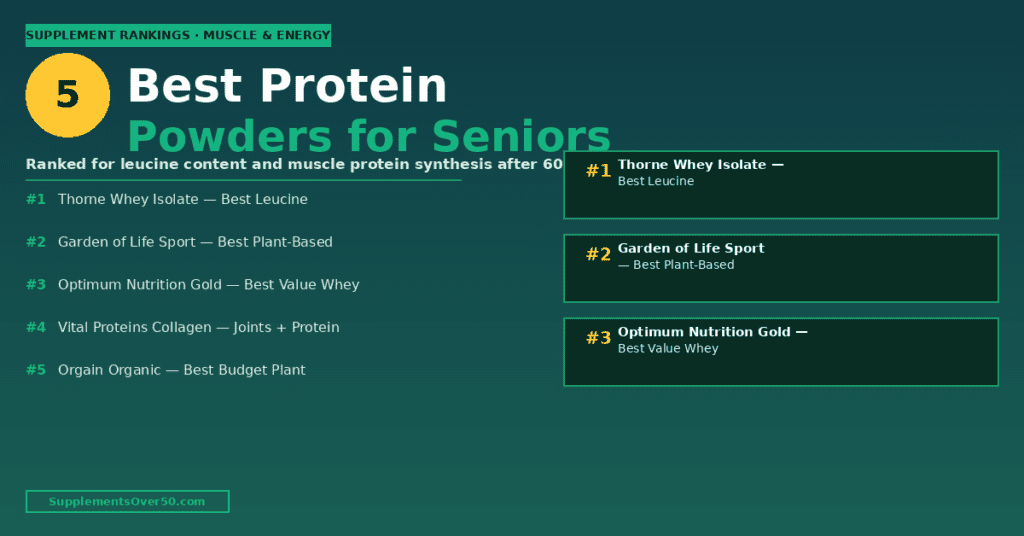
| ⚡ Quick Answer The 5 best protein powder for seniors ranked: (1) Thorne Whey Protein Isolate — best overall for leucine content and purity, (2) Garden of Life Sport Organic Plant-Based Protein — best plant-based option for seniors who avoid dairy, (3) Optimum Nutrition Gold Standard 100% Whey — best value whey with 24g protein per serving at Costco pricing, (4) Vital Proteins Collagen Peptides — best for seniors who want joint and bone support alongside protein, and (5) Orgain Organic Protein — best budget plant-based option at Walmart. The leucine threshold is the key variable after 60 — most seniors need 2.5–3g leucine per serving to trigger muscle protein synthesis. |
Why Protein Needs Change After 60
- Muscle mass declines 3–8% per decade after age 30, accelerating after 60 — sarcopenia affects an estimated 10–15% of adults over 60 and up to 50% over 80
- The leucine threshold — the minimum amount of leucine needed to trigger muscle protein synthesis — rises with age. Adults over 60 need approximately 2.5–3g leucine per meal vs 1.5–2g in younger adults
- Protein absorption efficiency declines after 60 due to reduced stomach acid and digestive enzyme production — meaning seniors need more protein intake to absorb the same amount of amino acids. Protein absorption efficiency declines after 60 due to reduced stomach acid and protease production — the same enzyme decline covered in our guide to digestive support: 5 Best Digestive Enzyme Supplements for Seniors — Ranked for 2026.
- The RDA of 0.8g protein per kg bodyweight was designed to prevent deficiency in young adults — most geriatric nutrition researchers recommend 1.2–1.6g/kg for adults over 60 to preserve muscle mass
- GLP-1 medications (Ozempic, Wegovy) dramatically reduce appetite — seniors on these medications are at highest risk of inadequate protein intake and must supplement deliberately
- Vitamin D3 directly regulates muscle fibre development and protein synthesis efficiency — deficient seniors absorb less benefit from protein supplementation regardless of dose. For the complete vitamin D protocol: How Much Vitamin D Should a 60-Year-Old Take Daily? — Full Evidence Guide.
The 5 Best Protein Powders for Seniors — Ranked
| #1 — BEST OVERALL — HIGHEST LEUCINE Thorne Whey Protein Isolate Thorne Whey Protein Isolate delivers 21g protein and approximately 2.8g leucine per serving — crossing the leucine threshold that triggers muscle protein synthesis in adults over 60. NSF Certified for Sport — the highest manufacturing standard available. Whey isolate is lower in lactose than concentrate, making it better tolerated by seniors with some dairy sensitivity. Mixes easily, minimal chalky texture. Available in chocolate and vanilla. 📖 Deep dive: Whey vs Plant Protein for Sarcopenia After 60 — Which Actually Rebuilds Muscle? 💰 Best product: Thorne Whey Protein Isolate 30 servings (Thorne.com / Amazon ~$45–60) · ~$1.50–2.00/serving |
| #2 — BEST PLANT-BASED Garden of Life Sport Organic Plant-Based Protein — Amazon / Whole Foods For seniors who avoid dairy or prefer plant-based supplements, Garden of Life Sport is the most evidence-aligned option — 30g protein per serving from a blend of pea, sprouted brown rice, and lentil protein, delivering approximately 2.3g leucine. USDA Organic, NSF Certified for Sport, and Non-GMO Project Verified. The multi-source protein blend is important because individual plant proteins have incomplete amino acid profiles — blending corrects this. 📖 Deep dive: Whey vs Plant Protein — Why the Blend Matters for Seniors 💰 Best product: Garden of Life Sport Plant Protein 20–30 servings (Amazon ~$40–55) · ~$1.80–2.20/serving |
| #3 — BEST VALUE WHEY Optimum Nutrition Gold Standard 100% Whey — Costco / Amazon Optimum Nutrition Gold Standard is the most widely purchased whey protein in the US — and at Costco pricing it delivers 24g protein per serving at approximately $0.80–1.00/serving. Informed Choice certified for purity. The primary blend of whey isolate and concentrate provides ~2.5g leucine per serving — near the senior threshold. Available in a large variety of flavours. For cost-conscious seniors who tolerate dairy well, this is the best-value complete whey option. 📖 Deep dive: Best Protein Powder for Seniors on GLP-1 Medications 💰 Best product: Optimum Nutrition Gold Standard 5lb (Costco ~$55–65, ~60 servings) · ~$0.80–1.00/serving |
| #4 — BEST FOR JOINTS + PROTEIN Vital Proteins Collagen Peptides — Costco / Amazon For seniors whose primary goals are joint health, bone matrix support, and skin alongside protein intake — not muscle building specifically — Vital Proteins Collagen Peptides at 18g protein per serving is a versatile daily addition to coffee, smoothies, or any beverage. Not a muscle-building protein (low leucine, incomplete amino acid profile) but excellent as a connective tissue support protein. At Costco it’s one of the best-value collagen options available. 📖 Deep dive: 5 Best Collagen Supplements for Seniors — Ranked by Type 💰 Best product: Vital Proteins Collagen Peptides 907g (Costco ~$39, ~60 servings) · ~$0.65/serving |
| #5 — BEST BUDGET PLANT-BASED Orgain Organic Protein — Walmart / Amazon Orgain Organic Protein is the most accessible plant-based protein at Walmart — 21g protein per serving from a pea and brown rice blend, USDA Organic certified, and widely available in single-serve bottles for seniors who want portability. At approximately $1.00–1.50/serving at Walmart it’s the lowest-cost plant-based option on this list. Leucine content is approximately 1.8–2.0g — slightly below the senior threshold, so pairing with a leucine-rich meal is recommended. 📖 Deep dive: Weight Loss Supplements for Women Over 50 — Why Protein Comes First 💰 Best product: Orgain Organic Protein 2lb (Walmart ~$25–30, ~16–20 servings) · ~$1.00–1.50/serving |
Full guides:
Whey vs Plant Protein for Sarcopenia After 60
Best Protein for Seniors on GLP-1 Medications
Creatine for Seniors — The Muscle + Brain Companion
Creatine monohydrate is the most evidence-supported companion supplement to protein for muscle preservation after 60 — working through a completely different mechanism that is additive rather than overlapping: Creatine for Seniors — Brain, Muscle and Energy Benefits.
Frequently Asked Questions
How much protein do seniors over 60 actually need?
Most geriatric nutrition researchers recommend 1.2–1.6g of protein per kg of bodyweight per day for adults over 60 — significantly more than the standard RDA of 0.8g/kg designed for young adults. For a 70kg (154lb) senior, that means 84–112g protein daily. Many seniors fall well short of this through diet alone, particularly those with reduced appetite, on GLP-1 medications, or following plant-based diets.
Is whey protein safe for seniors with lactose intolerance?
Whey protein isolate — not concentrate — is very low in lactose because the filtration process removes most of the lactose along with the fat. Most seniors with mild-to-moderate lactose intolerance tolerate whey isolate well. For confirmed significant lactose intolerance, plant-based protein (pea + rice blend) is the cleaner option without any lactose concerns.
When is the best time for seniors to take protein?
Within 30–60 minutes after resistance exercise is the optimal window for muscle protein synthesis. For seniors not doing structured exercise, distributing protein evenly across three meals (30–40g per meal) is more effective than consuming most protein at dinner — which is the typical pattern in older adults. Morning and lunchtime protein are often chronically under-consumed.
Is whey protein safe for seniors over 70?
Yes — whey protein is not only safe but actively recommended for adults over 70 as one of the most evidence-supported interventions for sarcopenia prevention. Whey isolate is particularly effective because its rapid absorption rate and high leucine content (approximately 2.5–3g per 25g serving) reliably crosses the leucine threshold needed to trigger muscle protein synthesis in older adults. For seniors with lactose intolerance — which affects up to 70% of adults over 60 — whey isolate is significantly lower in lactose than whey concentrate and is well-tolerated by most. The only contraindication is confirmed dairy allergy (different from lactose intolerance) where plant-based protein is the appropriate alternative.
Can protein powder replace a meal for seniors?
As an occasional convenience, yes — as a regular habit, no. Whole food meals provide dietary fibre, micronutrients, phytonutrients, and eating satisfaction that protein powder cannot replicate. The appropriate use is as a targeted protein top-up — adding a scoop to breakfast oatmeal, a mid-morning smoothie, or a post-exercise recovery drink to close the gap between actual dietary protein intake and the 1.2–1.6g per kg bodyweight target. For seniors on GLP-1 medications (Ozempic, Wegovy) with dramatically reduced appetite, protein powder becomes more critical as a nutrient-dense, low-volume protein source that protects muscle mass during calorie restriction.
What is the best time for a senior to take protein powder?
Three windows produce the best outcomes. First, within 30–60 minutes after resistance exercise — the post-exercise anabolic window is real and maximises the muscle protein synthesis response to training. Second, at breakfast — the meal most commonly low in protein for seniors who default to toast or cereal. Third, before bed — a casein or blend protein at bedtime provides slow-release amino acids during the overnight fasting period when muscle protein breakdown otherwise predominates. The most important timing principle for seniors: distribute protein evenly across three meals at 25–35g each rather than concentrating it at dinner, which is the typical pattern and the least effective for muscle preservation.
Does protein powder damage kidneys in seniors?
For seniors with healthy kidneys, high protein intake including from supplements does not cause kidney damage — this is one of the most persistent myths in nutrition. Multiple systematic reviews confirm that protein intakes up to 2.0g per kg bodyweight daily do not impair kidney function in adults with no pre-existing kidney disease. The important caveat: seniors with confirmed Stage 3 or higher chronic kidney disease (CKD) should follow physician and dietitian guidance on protein targets, as impaired kidneys process protein waste less efficiently. If you have normal kidney function on blood tests, protein supplementation at 1.2–1.6g per kg daily is safe and beneficial.
What is the leucine threshold and why does it matter for seniors?
The leucine threshold is the minimum amount of leucine — the most anabolic branched-chain amino acid — needed to fully activate the mTOR pathway that triggers muscle protein synthesis. In young adults this threshold is approximately 1.5–2g leucine per meal. In adults over 60, anabolic resistance raises this threshold to approximately 2.5–3g leucine per meal. Most cheap protein powders providing 15–20g total protein do not reach this threshold. Whey isolate at 25g provides approximately 2.8g leucine — crossing the threshold. This is why dose and source both matter: 20g of a low-leucine plant protein may not trigger muscle synthesis regardless of total protein content.
How much protein do seniors actually need per day?
The standard RDA of 0.8g protein per kg bodyweight was established to prevent deficiency in young healthy adults — not to preserve muscle mass in aging adults. Current geriatric nutrition research consistently recommends 1.2–1.6g per kg bodyweight daily for adults over 60 to maintain muscle mass. For a 70kg (154lb) senior, that is 84–112g protein daily — approximately 30–40% more than the standard RDA. Most seniors fall significantly short of this through diet alone, particularly those with reduced appetite, dental problems, or on GLP-1 medications. Protein powder is the most practical way to close this gap without dramatically increasing food volume.
The Bottom Line
The best protein powder for most seniors is Thorne Whey Protein Isolate for maximum leucine and purity, or Optimum Nutrition Gold Standard at Costco for the best-value whey. Plant-based seniors should choose Garden of Life Sport for the complete multi-source amino acid profile. Pair protein supplementation with creatine for the most evidence-based muscle preservation combination available to seniors.