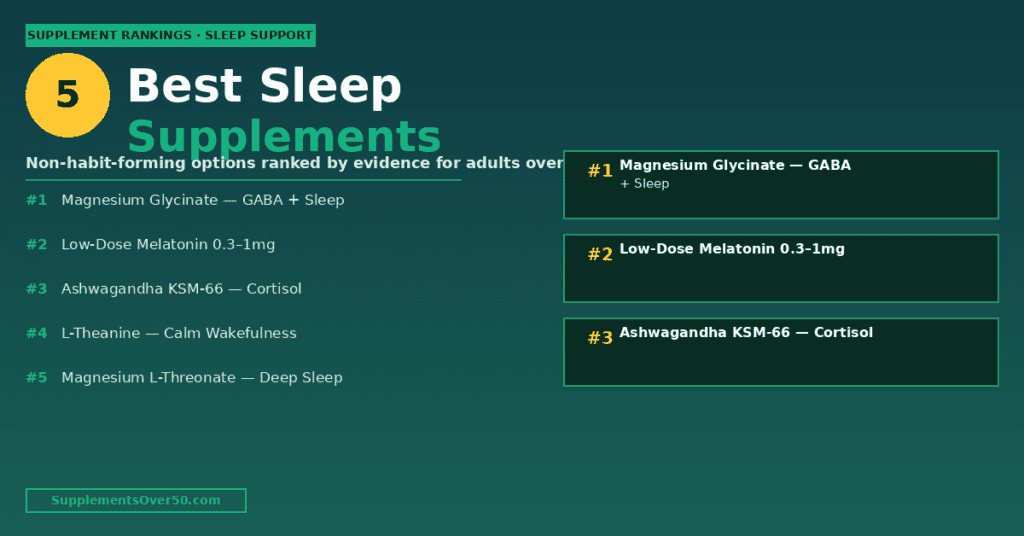
| ⚡ Quick Answer The 5 best sleep supplements for seniors ranked by evidence: (1) Magnesium Glycinate 300–400mg — addresses the most common nutritional cause of poor sleep in seniors and works within 1–2 weeks, (2) Low-Dose Melatonin 0.3–1mg — not the 10mg dose in commercial products which causes morning grogginess in older adults due to slower clearance, (3) Ashwagandha (KSM-66) 300–600mg — reduces cortisol and anxiety that cause the racing mind at bedtime, (4) L-Theanine 200mg — promotes alpha brain wave activity for calm wakefulness that transitions naturally to sleep, and (5) Magnesium L-Threonate 2g — targets brain magnesium specifically, improving sleep architecture not just sleep onset. None of these are habit-forming. |
Key Statistics — Sleep After 60
- 50% of adults over 60 report some degree of sleep difficulty — the most common health complaint in this age group after joint pain
- Melatonin production declines ~70% between ages 20 and 70 — but the 10mg commercial dose produces blood levels 5–10x above physiological peak in seniors with slower liver clearance
- Magnesium deficiency directly impairs GABA receptor function — the primary inhibitory neurotransmitter system that allows the brain to ‘switch off’ at night
- Adults over 60 spend less time in slow-wave (deep) sleep and REM sleep — supplements that improve sleep architecture are more valuable than those that simply increase total sleep time
- Prescription sleep medications (benzodiazepines, Z-drugs) are listed on the Beers Criteria as potentially inappropriate for older adults due to fall risk, cognitive impairment, and dependence
The 5 Best Sleep Supplements for Seniors — Ranked
| #1 — FOUNDATIONAL — MOST IMPACT Magnesium Glycinate — 300–400mg at Bedtime Magnesium is required for GABA receptor function — the primary brain system that inhibits neuronal firing and enables sleep. Magnesium deficiency, which affects nearly half of US seniors, directly impairs this system, making the brain unable to quiet down at night. Glycinate is the preferred form: it binds to glycine, itself a calming neurotransmitter, and absorbs well without the laxative effect of citrate. Clinical trials show improvements in sleep quality, sleep efficiency, and morning cortisol levels within 4–8 weeks. This is the supplement to start with before trying anything else. 📖 Deep dive: Best Magnesium Supplement for Sleep After 50 — Full Guide 💰 Best product: Doctor’s Best Magnesium Glycinate 200mg — take 2 tablets at bedtime (Walmart) · ~$0.10–0.20/day |
| #2 — CIRCADIAN SIGNAL — USE THE RIGHT DOSE Melatonin 0.3–1mg — 30–60 Min Before Bed The 10mg melatonin gummies at every pharmacy are the wrong dose for seniors. Aging slows melatonin clearance — a 10mg dose produces blood levels 5–10 times higher than physiological peak and lingers until morning, causing the grogginess many seniors report. Clinical trials in adults over 55 show significant sleep latency improvement at 0.3–1mg — a dose range that mimics physiological production rather than overwhelming the system. Melatonin works as a chronobiotic (circadian signal) not a sedative — consistent timing matters as much as dose. 📖 Deep dive: Melatonin for Seniors — Why Lower Doses Work Better After 60 💰 Best product: Life Extension Melatonin 300mcg or NOW 1mg (Amazon/Walmart) · ~$0.08–0.12/day |
| #3 — CORTISOL + RACING MIND Ashwagandha KSM-66 — 300–600mg Daily The most common cause of sleep difficulty in seniors is a racing mind at bedtime — driven by elevated evening cortisol. Ashwagandha’s primary mechanism is cortisol reduction through HPA axis modulation. A 2019 RCT in Medicine found 300mg KSM-66 ashwagandha for 8 weeks significantly improved sleep quality, sleep latency, and morning alertness in adults with self-reported sleep difficulty. Unlike melatonin, it does not directly induce sleep — it removes the hormonal barrier to sleep by calming the stress response that keeps the brain activated at night. 📖 Deep dive: Ashwagandha for Women Over 50 — Sleep, Anxiety and Menopause Evidence 💰 Best product: KSM-66 Ashwagandha by Jarrow or Himalaya (the specific clinically-studied extract) (Amazon) · ~$0.20–0.40/day |
| #4 — CALM WAKEFULNESS → NATURAL SLEEP L-Theanine — 200mg at Bedtime L-Theanine is an amino acid found naturally in green tea that promotes alpha brain wave activity — the brain state associated with calm, relaxed wakefulness that naturally transitions to sleep. Unlike sedatives, it does not force sleep or cause grogginess. It works particularly well for seniors whose sleep problem is the inability to wind down rather than staying asleep once there. A 2019 RCT found 200mg L-Theanine before bed significantly improved sleep latency and sleep quality without next-day impairment. Pairs excellently with low-dose melatonin (together they become the core non-magnesium sleep stack). 📖 Deep dive: Best Nootropic Stack for Seniors — Focus Without Caffeine 💰 Best product: NOW L-Theanine 200mg or Suntheanine (the research-backed branded form) (Walmart/Amazon) · ~$0.10–0.20/day |
| #5 — SLEEP ARCHITECTURE + BRAIN RECOVERY Magnesium L-Threonate — 2g Daily While glycinate improves sleep onset, magnesium L-Threonate (Magtein) targets the quality of sleep itself — specifically slow-wave (deep) sleep, which is where physical restoration and memory consolidation occur. By raising brain magnesium levels (which standard supplements cannot do efficiently), it improves synaptic plasticity and the brain’s ability to cycle through proper sleep stages. Best for seniors who fall asleep fine but wake feeling unrefreshed — a sign of poor sleep architecture rather than poor sleep onset. More expensive than glycinate but addresses a different problem. 📖 Deep dive: Best Magnesium for Sleep — Glycinate vs L-Threonate Explained 💰 Best product: Magtein by Life Extension or NOW (Amazon) · ~$0.60–1.20/day |
| ⚠️ When Supplements Are Not Enough If sleep problems are chronic (more than 3 months), consistent, and significantly impacting daily function, Cognitive Behavioural Therapy for Insomnia (CBT-I) has stronger evidence than any supplement — including prescription sleep medications. Ask your physician for a referral or search for digital CBT-I programs. Supplements work best for situational sleep difficulty, circadian disruption, and the normal sleep changes of aging — not for clinical insomnia disorder. |
See also: Shatavari for Menopause — Sleep and Hot Flash Evidence · Magnesium Glycinate vs Citrate
Frequently Asked Questions
What is the safest sleep supplement for seniors over 70?
Magnesium glycinate is the safest and most broadly appropriate sleep supplement for adults over 70. It is not sedating, not habit-forming, addresses a genuine nutritional deficiency, and has no significant drug interactions at standard doses. Low-dose melatonin (0.3mg) is also safe for most seniors but check for interactions with warfarin and nifedipine if applicable.
Can sleep supplements be taken with blood pressure medication?
Magnesium and ashwagandha may have additive blood-pressure-lowering effects — monitor blood pressure when starting either alongside antihypertensives. Melatonin specifically interacts with nifedipine (a calcium channel blocker) — 5mg doses raised blood pressure in one study, though the low 0.3mg dose carries much lower risk. Always disclose supplements to your physician and pharmacist.
Is it safe to take melatonin and magnesium together?
Yes — melatonin and magnesium glycinate work through different mechanisms and have no direct interaction. They are commonly taken together as the core of a non-habit-forming sleep stack. Adding L-Theanine makes the combination more effective for seniors whose primary problem is difficulty switching off at bedtime.
The Bottom Line
The 5 best sleep supplements for seniors are non-habit-forming and address the specific sleep changes of aging: magnesium deficiency impairing GABA function, melatonin decline (corrected at 0.3mg — not 10mg), elevated evening cortisol (addressed by ashwagandha), inability to wind down (L-theanine), and poor sleep architecture (magnesium L-Threonate). Start with magnesium glycinate and add low-dose melatonin if needed — this combination addresses the two most common sleep problems in adults over 60 for under $0.30/day combined.