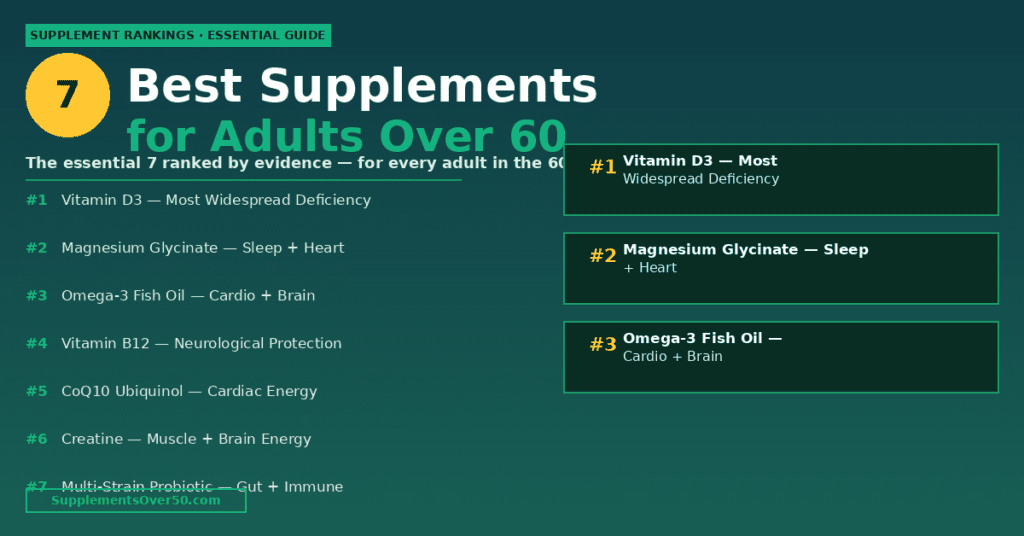
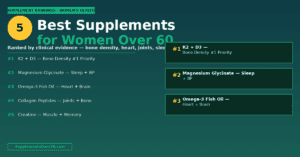
⚡ Quick Answer The 7 best supplements for adults over 60 ranked by clinical evidence are: (1) Vitamin D3 2,000 IU — the most widespread deficiency in this age group with impacts on bone, immunity, and muscle, (2) Magnesium glycinate 300–400mg — supports sleep, blood pressure and muscle function, (3) Omega-3 fish oil 1,000–2,000mg EPA+DHA — cardiovascular and brain protection, (4) Vitamin B12 500–1,000mcg methylcobalamin — neurological protection against the absorption decline that affects 20–40% of adults over 60, (5) CoQ10 Ubiquinol 100–200mg — cardiac energy and mitochondrial support, especially for statin users, (6) Creatine monohydrate 3–5g — muscle and brain energy, the most underused supplement in this age group, (7) Probiotics (multi-strain) — gut microbiome diversity drops significantly after 60 affecting immunity, absorption, and mood.
Key Statistics — What Changes After 60 That Makes Supplementation More Important
Stomach acid production declines 30–40% by age 60 — directly reducing absorption of B12, magnesium, calcium, zinc, and iron from food
Skin synthesis of vitamin D drops ~75% between ages 20 and 70 — making dietary and supplement sources critical
20–40% of adults over 60 have clinically low or borderline vitamin B12 — often missed because symptoms resemble normal aging
Gut microbiome diversity declines measurably after 60 — linked to reduced immune function, increased inflammation, and slower nutrient absorption
Muscle loss (sarcopenia) accelerates after 60 at 3–8% per decade — creatine and protein are the two most evidence-supported countermeasures
The Essential 7 — Best Supplements for Adults Over 60
#1 — MOST WIDESPREAD DEFICIENCY Vitamin D3 — 2,000 IU Daily Vitamin D3 is the foundational supplement for adults over 60 because the problem it solves — widespread deficiency — is almost universal in this age group. Skin synthesis drops by ~75% between ages 20 and 70. The consequences extend far beyond bone: vitamin D regulates immune cell activation, muscle fibre contraction, blood pressure, and mood. The official RDA of 600–800 IU was designed only to prevent rickets. The Endocrine Society and multiple clinical trial protocols use 1,500–2,000 IU as the functional dose for older adults.
#2 — SLEEP + HEART + MUSCLE Magnesium Glycinate — 300–400mg Daily Magnesium is involved in over 300 enzymatic reactions and an estimated 48% of US adults are deficient. After 60, declining stomach acid reduces magnesium absorption while stress, diuretics, and PPI medications increase excretion. Glycinate is the preferred form: it binds to glycine (a calming amino acid), crosses the blood-brain barrier easily, and has a gentler effect on digestion than citrate. Effects are broad: better sleep onset, lower blood pressure, fewer muscle cramps, and stronger bone matrix (35% of bone is magnesium-dependent).
#3 — HEART + BRAIN PROTECTION Omega-3 Fish Oil — 1,000–2,000mg EPA+DHA Daily Omega-3 fatty acids are the most studied cardiovascular supplement with the broadest evidence base. EPA reduces inflammation and triglycerides; DHA is the primary structural fat in brain cell membranes. At 1–2g EPA+DHA daily, multiple meta-analyses confirm significant reductions in cardiovascular event risk, triglycerides (15–30%), and cognitive decline markers. Critically: choose triglyceride-form oil — it absorbs approximately 70% better than the cheaper ethyl ester form that dominates discount supplement shelves. 📖 Deep dive: Omega-3s for Brain Health After 60 — What the 2025 Research Shows 💰 Best product: Carlson Elite Omega-3 or Nordic Naturals Ultimate Omega (Amazon) · ~$0.20–0.40/day
#4 — NEUROLOGICAL PROTECTION Vitamin B12 — 500–1,000mcg Methylcobalamin Daily Vitamin B12 deficiency is one of the most common and most missed nutritional problems in adults over 60. The culprit is intrinsic factor decline — a protein the stomach produces to absorb B12 from food. Without it, dietary B12 passes through largely unused. 10–20% of adults over 60 have frank deficiency; up to 40% have borderline insufficiency. The consequences are serious: peripheral neuropathy, cognitive decline, and megaloblastic anaemia — all of which can be mistaken for normal aging. Methylcobalamin is the active form; at 500–1,000mcg the dose is sufficient to absorb passively without intrinsic factor.
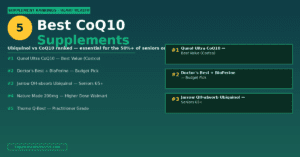
#5 — CARDIAC ENERGY (STATIN USERS) CoQ10 Ubiquinol — 100–200mg Daily CoQ10 is the energy currency of the mitochondria — the power plants in every cell, most critically heart muscle cells. Natural CoQ10 production peaks in your 20s and declines steadily with age. Statins — taken by more than half of adults over 60 — actively block CoQ10 synthesis by up to 40%. The result is measurable cardiac energy deficiency and the muscle aches and fatigue many statin users report. Ubiquinol (the active, reduced form) is superior to standard CoQ10 after 60 because the conversion enzyme efficiency drops by approximately 50% with age.
#6 — MUSCLE + COGNITIVE FUNCTION Creatine Monohydrate — 3–5g Daily Creatine is the most underused supplement in the over-60 population. The bodybuilding association is misleading — creatine’s strongest evidence in older adults is for functional outcomes: faster chair-stand speed, improved grip strength, and reduced fall risk. A 2023 meta-analysis confirmed significant lean mass and strength improvements in adults over 60 at 3–5g/day. For the brain: creatine increases phosphocreatine stores that fuel high-intensity cognitive tasks — processing speed, working memory, and verbal fluency all show improvements in older adult trials. No loading phase needed. Mixes invisibly into water or coffee.
#7 — GUT + IMMUNE FUNCTION Multi-Strain Probiotic — Daily Gut microbiome diversity declines measurably after 60 — Bifidobacterium and Lactobacillus populations drop while inflammatory species increase. The downstream effects are broad: reduced nutrient absorption, weaker immune surveillance, elevated systemic inflammation, and changes in mood and cognitive clarity through the gut-brain axis. A 2025 meta-analysis (29 RCTs, 1,633 adults aged 60+) confirmed that probiotic supplementation significantly increases Bifidobacterium abundance. Look for 10–50 billion CFU with at least 5 strains including Lactobacillus acidophilus and Bifidobacterium longum.
How to Add These to Your Routine Without Overwhelm
The most common mistake seniors make is starting everything at once and not knowing which supplement caused what effect. The phased approach works best:
Week 1–2: Vitamin D3 + Magnesium glycinate. These two address the most widespread deficiencies and have no interactions with each other or most medications.
Week 3–4: Add Omega-3 and B12. Take omega-3 with your largest meal; B12 can be taken any time.
Month 2: Add CoQ10 if on a statin, or probiotic if gut health is a concern.
Month 3: Add creatine — 3g daily, no loading phase, mix into any beverage.
Can I just take one multivitamin instead of all seven?
A multivitamin is a useful nutritional safety net but it rarely provides clinical doses for adults over 60. Most multivitamins contain 400 IU of vitamin D versus the evidence-supported 2,000 IU, and magnesium as poorly-absorbed oxide rather than glycinate. Think of a multivitamin as a nutritional snack and the Essential 7 as the main course targeted to the specific biological shifts of aging.
What is the single most important supplement after 60?
If forced to choose one: Vitamin D3 at 2,000 IU daily. Skin synthesis of vitamin D drops by approximately 75% between ages 20 and 70, making deficiency nearly universal in this age group regardless of diet. It affects bone density, muscle strength, immune function and testosterone availability simultaneously — more biological systems than any other single supplement.
Will these supplements interfere with blood pressure or cholesterol medication?
Most of the Essential 7 are safe alongside common medications with standard precautions. Omega-3 has a mild blood-thinning effect additive with warfarin — monitor INR if applicable. Magnesium should be taken 2 hours apart from certain antibiotics and bisphosphonates. CoQ10 may enhance the blood-pressure-lowering effects of antihypertensives. Always share your full supplement list with your physician and pharmacist — they cannot assess interactions they don’t know about.
What supplements should every adult over 60 be taking?
At minimum: Vitamin D3 (2,000 IU), Magnesium glycinate (300–400mg), and Omega-3 fish oil (1,000–2,000mg EPA+DHA). These three cover the most widespread deficiencies and the highest-impact health areas for the 60+ age group. Add B12 if you eat limited animal products or take a proton pump inhibitor (PPI), CoQ10 if on a statin, and creatine if muscle preservation is a priority.
Are supplements safe to take with prescription medications?
Most supplements in this list are safe alongside common medications with standard precautions. Key interactions to know: high-dose fish oil can enhance blood-thinning effects of warfarin; magnesium should be taken 2 hours apart from certain antibiotics and bisphosphonates; CoQ10 may enhance the blood-pressure-lowering effects of antihypertensives. Always disclose all supplements to your physician and pharmacist — they cannot assess interactions they don’t know about.
Is it worth taking a multivitamin instead of individual supplements?
A quality multivitamin is a useful nutritional safety net but it almost never provides therapeutic doses of the key nutrients that matter most after 60. D3 in most multivitamins: 400 IU vs the evidence-supported 2,000 IU. Magnesium: typically as oxide (poorly absorbed) rather than glycinate. B12: often as cyanocobalamin rather than methylcobalamin. Use a multivitamin as a complement, not a replacement, for the targeted supplements above.
The Bottom Line
The best supplements for adults over 60 address the specific physiological shifts of this decade: vitamin D deficiency from reduced skin synthesis, magnesium depletion from lower stomach acid, B12 malabsorption from intrinsic factor decline, and CoQ10 depletion from statin use. Creatine and omega-3 are the two supplements most consistently underused despite having the strongest evidence for quality-of-life outcomes in older adults.
Start with the foundation three — D3, magnesium, omega-3 — and build from there based on your specific situation. Every supplement in this list has a full evidence guide on this site linked above.