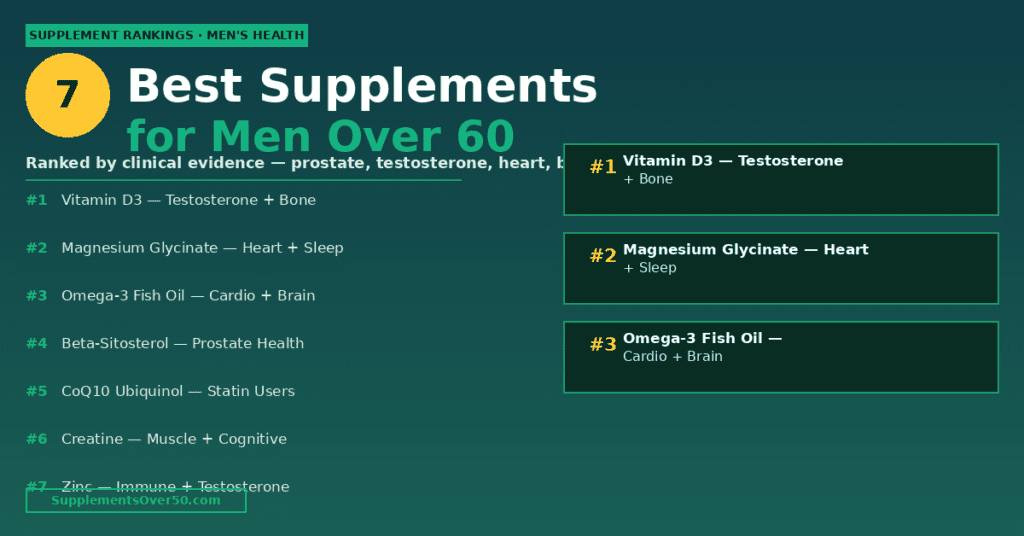
| ⚡ Quick Answer The 7 best supplements for men over 60 ranked by clinical evidence are: (1) Vitamin D3 2,000 IU for testosterone support and bone density, (2) Magnesium glycinate 300–400mg for heart health and sleep, (3) Omega-3 fish oil 1,000–2,000mg EPA+DHA for cardiovascular and brain protection, (4) Saw palmetto or beta-sitosterol for prostate urinary symptoms, (5) CoQ10 ubiquinol 100–200mg especially for men on statins, (6) Creatine monohydrate 3–5g for muscle preservation and brain energy, and (7) Zinc 15–30mg for immune function and testosterone. Full evidence and US pricing for each below. |
Key Statistics — Why Men Over 60 Need a Different Supplement Strategy
- Testosterone declines 1–2% per year after age 30 — by 60, most men have lost 30–40% of peak levels
- 42% of US adults are vitamin D deficient — the rate is higher in men over 60 who spend less time outdoors
- 1 in 2 men over 60 experience lower urinary tract symptoms (LUTS) related to prostate enlargement
- Statin use in men over 60 exceeds 50% — statins deplete CoQ10, making ubiquinol supplementation relevant for over half this audience
- Muscle mass declines 3–8% per decade after 30, accelerating after 60 — creatine and protein intake are the two most evidence-supported countermeasures
The 7 Best Supplements for Men Over 60 — Ranked
| #1 — BONE + TESTOSTERONE Vitamin D3 — 2,000 IU Daily Vitamin D3 is the single highest-impact supplement for men over 60 who haven’t tested their levels. It supports testosterone availability by reducing SHBG (the protein that binds testosterone), strengthens bone density, activates immune cells, and protects prostate cell health. The Endocrine Society recommends 1,500–2,000 IU for adults at risk — a category that includes nearly all men over 60 with limited sun exposure. 📖 Deep dive: Vitamin D3 for Men Over 60 — Full Evidence Guide 💰 Best product: Nature Made D3 2,000 IU (Walmart) or Kirkland D3 (Costco) · ~$0.02–0.05/day |
| #2 — HEART + SLEEP Magnesium Glycinate — 300–400mg Daily Magnesium deficiency affects an estimated 48% of US adults. For men over 60 it hits three critical areas simultaneously: blood pressure (a 2016 meta-analysis of 34 RCTs found significant reductions at 300mg+), sleep quality (magnesium glycinate crosses the blood-brain barrier to promote relaxation), and muscle cramp prevention. Glycinate is the preferred form — gentler on digestion than citrate and better absorbed than oxide. Since cardiovascular disease is the #1 cause of death in men over 60, pair this stack with our Heart Health Supplement Stack for comprehensive protection beyond muscle and prostate health. 📖 Deep dive: Magnesium Glycinate vs Citrate — Which Form Is Better for Seniors? 💰 Best product: Doctor’s Best Magnesium Glycinate (Amazon/Walmart) · ~$0.10–0.20/day |
| #3 — HEART + BRAIN Omega-3 Fish Oil — 1,000–2,000mg EPA+DHA Daily Omega-3s are the most studied cardiovascular supplement. At 1–2g EPA+DHA daily they reduce triglycerides by 15–30%, support endothelial function, and reduce inflammatory markers. For brain health, DHA is the primary structural fat in neural membranes — low DHA is consistently associated with faster cognitive decline after 60. Choose triglyceride-form fish oil for significantly better absorption than ethyl ester forms. 📖 Deep dive: Omega-3s for Brain Health After 60 — What the 2025 Research Shows 💰 Best product: Carlson Elite Omega-3 or Nordic Naturals Ultimate Omega (Amazon) · ~$0.20–0.40/day |
| #4 — PROSTATE Saw Palmetto or Beta-Sitosterol — For Urinary Symptoms Half of men over 60 deal with urinary symptoms from prostate enlargement — frequent urination, weak flow, nighttime trips to the bathroom. Beta-sitosterol has stronger clinical evidence than saw palmetto for improving urinary flow scores (IPSS reduction of 4–6 points in multiple RCTs). For men without diagnosed BPH, saw palmetto is a reasonable starting point. For men with measurable urinary symptoms, beta-sitosterol is the better-evidenced choice. For men specifically dealing with nighttime bathroom trips or weak urinary flow, our detailed Prostate Supplements — Saw Palmetto vs Beta-Sitosterol review covers the evidence in full. 📖 Deep dive: Prostate Supplements for Men Over 50 — Saw Palmetto vs Beta-Sitosterol Honestly Reviewed 💰 Best product: NOW Beta-Sitosterol Plant Sterols (Walmart/Amazon) · ~$0.30–0.60/day |
| #5 — HEART (STATIN USERS) CoQ10 Ubiquinol — 100–200mg Daily If you take a statin — and over half of men over 60 do — CoQ10 is not optional. Statins reduce the body’s natural CoQ10 production by up to 40%, depleting the fuel source for cardiac muscle cells and skeletal muscle mitochondria. The result is the muscle pain and fatigue many statin users report. Ubiquinol (the active, pre-converted form) is the right choice after 60 because the conversion from standard CoQ10 (ubiquinone) drops by roughly 50% with age. 📖 Deep dive: Ubiquinol vs CoQ10 — Is the More Expensive Form Worth It After 60? 💰 Best product: Qunol Ultra CoQ10 or Doctor’s Best Ubiquinol (Costco/Amazon) · ~$0.50–1.00/day |
| #6 — MUSCLE + BRAIN Creatine Monohydrate — 3–5g Daily Creatine is the most underrated supplement for men over 60. Most people associate it with bodybuilding — the reality is that it has stronger evidence for preserving muscle mass and strength in older adults than most other supplements in this list. A 2023 meta-analysis confirmed significant improvements in lean mass and upper body strength in men over 60 at 3–5g/day. Less known: creatine also increases brain phosphocreatine stores, improving processing speed and working memory. No loading phase needed at this dose. 📖 Deep dive: Creatine for Seniors — Brain, Muscle and Energy Benefits 💰 Best product: Thorne Creatine or NOW Creatine Monohydrate (Walmart/Amazon) · ~$0.05–0.10/day |
| #7 — IMMUNE + TESTOSTERONE Zinc — 15–30mg Daily Zinc is involved in over 300 enzymatic reactions and is the second most studied mineral for testosterone support after vitamin D. Deficiency — common in men over 60 due to reduced dietary intake and absorption — directly suppresses luteinising hormone (LH) production, the signal that tells the testes to make testosterone. Beyond hormones, zinc is critical for immune surveillance, wound healing, and taste and smell acuity. Take zinc picolinate or bisglycinate — both absorb significantly better than zinc oxide found in cheaper supplements. 📖 Deep dive: Best Multivitamin for Men Over 60 — Prostate, Heart and Brain Nutrients Compared 💰 Best product: Thorne Zinc Picolinate or NOW Zinc Bisglycinate (Amazon) · ~$0.08–0.15/day |
How to Build Your Stack — Sequencing for Men Over 60
Don’t start all 7 at once. The most effective approach is phased:
Month 1 — Foundation: Vitamin D3 + Magnesium glycinate. Test vitamin D levels before starting if possible.
Month 2 — Add Omega-3: Once foundation is established, add fish oil at the largest meal of the day.
Month 3 — Add Prostate / CoQ10: Add beta-sitosterol if urinary symptoms are present, or CoQ10 if on a statin.
Month 4+ — Add Creatine + Zinc: Round out the stack with creatine and zinc once the core supplements are routine.
For the complete men’s health picture, see our Natural Testosterone Support for Men Over 50 and Heart Health Supplement Stack guides.
Frequently Asked Questions
Will these supplements help with low testosterone?
These supplements are not hormone replacements, but Vitamin D3 and Zinc are essential co-factors for testosterone production. If you are deficient in either — which is common in men over 60 — your testosterone will be lower than your biology actually allows. Supplementing corrects the deficiency and helps unlock your body’s natural production. For a full breakdown of what works and what doesn’t, see our guide on Natural Testosterone Support for Men Over 50.
Can I take saw palmetto if I am already on prostate medication like Flomax?
Many men take both, but consult your urologist first. Saw palmetto and beta-sitosterol work on different pathways than alpha-blockers like Flomax — but they can occasionally produce additive effects on urinary flow or mask symptom changes your doctor needs to monitor. Never adjust or stop a prescribed prostate medication based on supplement use alone.
Does creatine cause kidney problems in older men?
For men with healthy kidneys, 3–5g of creatine daily is consistently shown to be safe in clinical research. One important caveat: creatine supplementation slightly raises creatinine levels on a blood test — the same marker doctors use to assess kidney function. If you start creatine, tell your physician so they do not misinterpret a mildly elevated creatinine reading as a kidney problem. Men with pre-existing kidney disease should consult their physician before supplementing.
What is the single most important supplement for men over 60?
Vitamin D3 — because nearly 42% of US adults are deficient and it supports testosterone availability, bone density, immune function, and prostate health simultaneously. Get a blood test first, then supplement at 2,000 IU daily with K2 MK-7 for cardiovascular safety.
Do men over 60 need different supplements than women?
Yes in two key areas: prostate health (saw palmetto or beta-sitosterol have no female equivalent) and testosterone support (zinc, vitamin D3, and ashwagandha target the male HPA-gonadal axis specifically). Core supplements like magnesium, omega-3, and CoQ10 are beneficial for both sexes.
Should men over 60 take a multivitamin instead of individual supplements?
A quality multivitamin covers nutritional gaps but typically underdoses the most impactful nutrients — D3 at 400 IU instead of 2,000 IU, magnesium as oxide rather than glycinate. The 7-supplement stack above is more targeted and evidence-based than any single multivitamin. If budget is a concern, see our Best Multivitamin for Men Over 60 guide for the top options that come closest to optimal dosing.
The Bottom Line
The 7 best supplements for men over 60 address the specific biological shifts that happen in the sixth decade: declining testosterone, prostate enlargement, CoQ10 depletion from statins, accelerating bone loss, and sarcopenia. Start with vitamin D3 and magnesium as the non-negotiable foundation, add omega-3 and prostate support next, then build out with CoQ10, creatine, and zinc.