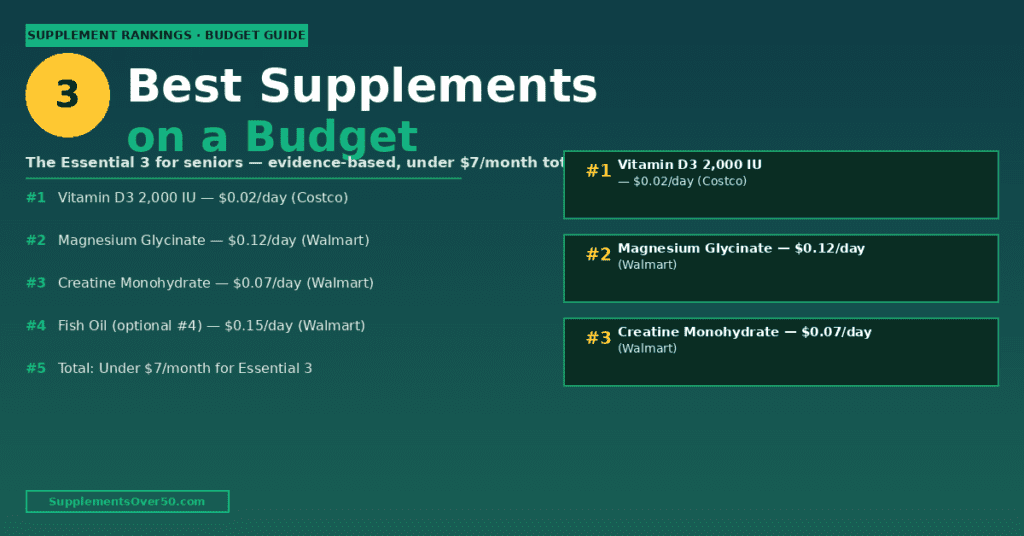
| ⚡ Quick Answer The three best supplements for seniors on a budget — delivering the highest clinical impact for the lowest monthly cost — are: (1) Vitamin D3 2,000 IU from Kirkland at Costco (~$0.02/day = $0.60/month), (2) Magnesium Glycinate from Doctor’s Best at Walmart (~$0.12/day = $3.60/month), and (3) Creatine Monohydrate from NOW Foods at Walmart (~$0.07/day = $2.10/month). Total cost: under $7/month. Add Nature Made Fish Oil at Walmart (~$0.15/day = $4.50/month) and the Essential 4 costs under $12/month — covering bone, sleep, heart, brain, and muscle health simultaneously. |
Key Statistics — Why These Three Are the Best Supplements for Seniors with Budget Priority
- 42% of US adults are vitamin D deficient — Kirkland D3 at Costco is $0.02/day, making it the highest-impact-per-cent supplement available
- 48% of US adults are magnesium deficient — Doctor’s Best Magnesium Glycinate at Walmart is $0.12/day for the most bioavailable form
- Creatine monohydrate is the most studied ergogenic supplement in the world — NOW Foods at Walmart costs $0.07/day for clinically validated benefits
- These three supplements combined address 5 of the 7 most important nutritional gaps after 60: bone density, sleep, heart, brain energy, and muscle preservation
- The supplement industry average monthly spend for US seniors is $55–80/month — this guide delivers comparable clinical impact for under $15/month
The Budget Essential 3 — Maximum Impact, Minimum Cost
| #1 — BONE + IMMUNITY + TESTOSTERONE Vitamin D3 2,000 IU — ~$0.60/Month Vitamin D3 is the single highest-impact supplement for any senior at any budget level — and at Kirkland Signature (Costco), it costs less than any other supplement on this list. A 600-tablet bottle costs approximately $12–14 and lasts over a year at one tablet per day. Nearly half of US adults are deficient. It supports bone density, immune function, testosterone availability, and cardiovascular health simultaneously — more biological systems than any supplement at any price point. Take with your largest meal for fat-soluble absorption. For a deep dive into how K2 MK-7 directs calcium into bone rather than arterial walls — and why this matters especially for seniors already supplementing calcium: K2, D3 and Boron for Post-Menopausal Bone Density — The Triple Threat Most Women Have Never Heard Of. 📖 Deep dive: How Much Vitamin D Should a 60-Year-Old Take Daily? — Full Guide 💰 Best product: Kirkland D3 2,000 IU (Costco, 600 tablets ~$13) or Nature Made D3 2,000 IU (Walmart, ~$8 for 250 softgels) · ~$0.02/day ($0.60/month) |
| #2 — SLEEP + BLOOD PRESSURE + MUSCLE Magnesium Glycinate 200–400mg — ~$3.60/Month Magnesium glycinate is the form that matters — not the oxide form in most cheap supplements. Doctor’s Best High Absorption Magnesium Glycinate at Walmart delivers pharmaceutical-grade glycinate at ~$0.12/day. Magnesium deficiency impairs GABA receptor function (preventing sleep), raises blood pressure, causes muscle cramps, and impairs vitamin D activation. Without adequate magnesium, the vitamin D supplement above cannot be fully converted to its active hormone form — making these two non-negotiable together. Not all magnesium supplements are equal — the form determines both absorption and the specific health benefit. For a complete breakdown by use case including sleep, heart health, brain and leg cramps: 5 Best Magnesium Supplements for Seniors — Ranked by Form and Use Case. 📖 Deep dive: Magnesium Glycinate vs Citrate — Which Form Is Better for Seniors? 💰 Best product: Doctor’s Best High Absorption Magnesium Glycinate 200mg (Walmart ~$14 for 120 tablets — take 2 per night) · ~$0.12/day ($3.60/month) |
| #3 — MUSCLE + BRAIN + ENERGY Creatine Monohydrate 3–5g — ~$2.10/Month Creatine monohydrate is the most underrated budget supplement for seniors. At NOW Foods from Walmart, a 500g container costs approximately $18 and lasts 3–4 months at 5g/day — under $0.07/day. The evidence: a 2023 meta-analysis confirmed significant lean mass and strength improvements in adults over 60. For the brain: creatine increases phosphocreatine stores improving processing speed and working memory. A 2022 RCT found 38% memory improvement in older women. Mixes invisibly into water, coffee, or any beverage. 📖 Deep dive: Creatine for Seniors — Brain, Muscle and Energy Benefits 💰 Best product: NOW Foods Creatine Monohydrate 500g (Walmart ~$18) or Thorne Creatine (Amazon ~$28 for 450g) · ~$0.07/day ($2.10/month) |
The Budget Essential 4 — Add Fish Oil for Under $12/Month Total
If budget allows one more supplement, fish oil at 1,000mg EPA+DHA daily rounds out the cardiovascular and brain protection picture at approximately $4.50/month:
Nature Made Fish Oil 1,200mg at Walmart (~$15–18 for 100 softgels at $0.15/day) — take 2 daily for 1,200mg EPA+DHA. USP-verified. For the full fish oil evidence, see: Best Fish Oil for Seniors — EPA vs DHA Guide
Total cost with fish oil: approximately $11–12/month for four supplements covering bone density, sleep, cardiovascular health, brain protection, and muscle preservation.
What’s Not on This Budget List — And Why
⚠️ Magnesium Oxide — Found in most store-brand ‘cheap’ magnesium supplements. Absorbs at only 4% bioavailability. Effectively worthless as a magnesium source despite being cheap. Always choose glycinate.
⚠️ Centrum Silver — A decent nutritional safety net but contains only 400 IU vitamin D (vs the evidence-supported 2,000 IU), magnesium as oxide, and B12 as cyanocobalamin. Use the targeted stack above instead.
⚠️ CoQ10 — Essential for statin users but at $15–30/month it’s not a budget item. Prioritise the Essential 3 first if cost is a significant constraint, then add CoQ10 ubiquinol if on statins. See: Ubiquinol vs CoQ10 — Is the More Expensive Form Worth It?
For seniors on statins — more than half of adults over 60 — understanding the difference between ubiquinol and standard CoQ10 is essential before purchasing: Ubiquinol vs CoQ10 — Is the More Expensive Form Worth It After 60?
Where to Buy for the Best Prices
| Supplement | Best Price Location | Monthly Cost | Notes |
| Vitamin D3 2,000 IU | Costco (Kirkland) | ~$0.60 | 600 tablets ~$13 — best per-tablet cost |
| Vitamin D3 2,000 IU (no Costco) | Walmart (Nature Made) | ~$1.50 | USP verified, widely available |
| Magnesium Glycinate | Walmart (Doctor’s Best) | ~$3.60 | 120 tablets ~$14 — take 2 nightly |
| Creatine Monohydrate | Walmart (NOW Foods) | ~$2.10 | 500g ~$18 — lasts 3-4 months at 5g/day |
| Fish Oil 1,200mg (optional) | Walmart (Nature Made) | ~$4.50 | 100 softgels ~$15–18 — take 2 daily |
| TOTAL (Essential 3) | — | ~$6.70/month | Under $7/month for core stack |
| TOTAL (Essential 4 with fish oil) | — | ~$11.20/month | Under $12/month for complete stack |
For the full evidence-based supplement guide: Best Supplements for Adults Over 60 — The Essential 7 · The 5 Essentials Hub
Frequently Asked Questions
What are the most important supplements for seniors on a tight budget?
Vitamin D3 (2,000 IU, ~$0.02/day at Costco) and Magnesium Glycinate (300–400mg, ~$0.12/day at Walmart) are the two highest-impact, lowest-cost supplements available. Together they address the two most widespread nutritional deficiencies in adults over 60 — and magnesium is essential for vitamin D activation, making them a natural pair. Add creatine at $0.07/day for muscle and brain benefits and the full Essential 3 costs under $7/month.
Is Centrum Silver worth it for seniors on a budget?
Centrum Silver is a reasonable nutritional safety net at approximately $8–12/month, but it underdoses the most critical nutrients — only 400 IU vitamin D (vs evidence-supported 2,000 IU), magnesium as poorly-absorbed oxide, and cyanocobalamin B12 rather than methylcobalamin. The targeted Essential 3 stack above delivers more clinical impact for less monthly cost. If you choose a multivitamin, add a separate D3 2,000 IU supplement at minimum.
Can I get the same benefits from food instead of supplements?
Theoretically yes for some nutrients — fatty fish twice per week provides meaningful omega-3, fortified milk provides some D3, and dark leafy greens provide magnesium. In practice, most US seniors over 60 do not consistently eat the quantities needed to reach clinical effect sizes. Blood testing for vitamin D and magnesium is the only way to confirm whether food alone is sufficient for you personally. Creatine is essentially impossible to get in therapeutic doses from food alone — supplementation is required.
Why do seniors need different supplements than younger adults?
Two age-related changes make supplementation more important after 60 than at any earlier life stage. First, absorption efficiency drops — stomach acid production declines 30–40% by age 60, directly impairing absorption of B12, magnesium, calcium, zinc, and iron from food. Second, certain nutritional requirements rise simultaneously — vitamin D synthesis from sunlight drops approximately 75% between ages 20 and 70, and muscle protein synthesis requires higher leucine thresholds than in younger adults. Supplements for seniors address these specific absorption bottlenecks and increased requirements — not just nutritional gaps from diet.
Can I just take a one-a-day senior multivitamin instead?
A senior multivitamin is a useful nutritional safety net but it does not replace the 5 Essentials at therapeutic doses. Most generic multivitamins contain vitamin D at only 400–600 IU versus the evidence-supported 2,000 IU for seniors. Magnesium is typically present as poorly-absorbed oxide rather than glycinate. B12 is often cyanocobalamin rather than methylcobalamin. CoQ10 is absent entirely. Use a quality multivitamin as a background micronutrient foundation — not as a replacement for targeted supplementation of the nutrients where dose and form determine the outcome.
Which supplement is most important for preventing falls in seniors?
Vitamin D3 at 2,000 IU daily has the strongest evidence for fall prevention — not solely through bone density but through a direct effect on muscle spindle function and neuromuscular coordination. A 2011 meta-analysis of 8 RCTs found vitamin D supplementation reduced fall risk by 19% in older adults. The mechanism: vitamin D receptors are expressed in muscle tissue and directly regulate the fast-twitch muscle fibre response needed for balance recovery. Magnesium is the second most important — it supports muscle contractility and neuromuscular transmission, and deficiency is associated with increased fall risk independent of vitamin D status.
How do I know which of the 5 Essentials I am actually deficient in?
Blood testing is the only reliable way to confirm deficiency for vitamin D (25-hydroxyvitamin D test) and B12 (serum B12 and ideally methylmalonic acid). Magnesium deficiency is harder to confirm — serum magnesium is often normal even when cellular stores are depleted, so symptoms (muscle cramps, poor sleep, fatigue) are often a better indicator than blood tests alone. CoQ10 and omega-3 blood tests exist but are rarely ordered by primary care physicians. A practical starting point: assume vitamin D and magnesium deficiency are likely (affects 40–48% of US adults) and test for B12 if you have neurological symptoms or take a PPI medication.
Is it safe to take all 5 Essentials together?
Yes — the 5 Essentials are safe to take together for most healthy adults over 60. The most important timing consideration: take fat-soluble supplements (D3+K2, CoQ10, omega-3) with your largest fat-containing meal for optimal absorption. Magnesium glycinate is best taken 1 hour before bed. B12 methylcobalamin can be taken any time. The one combination to monitor: if you take blood thinners, disclose omega-3 supplementation to your physician as it has mild antiplatelet effects at higher doses.
How long before I notice benefits from the 5 Essentials?
Timeline varies significantly by supplement and outcome. Magnesium improvements in sleep quality and muscle cramps: 2–4 weeks. CoQ10 improvements in energy and reduced statin muscle pain: 4–8 weeks. Vitamin D improvements in mood and immune function: 6–8 weeks with bone benefits measurable at 6–12 months. Omega-3 cardiovascular benefits: most measurable at 12 weeks with triglyceride reduction. B12 neurological improvement in confirmed deficiency: variable, 1–6 months depending on severity. Set a 90-day evaluation window before deciding whether the stack is working.
The Bottom Line
The best supplements for seniors on a budget are the ones with the highest evidence-to-cost ratio — and that means Vitamin D3, Magnesium Glycinate, and Creatine Monohydrate. All three are available at Walmart or Costco for a combined total under $7/month. Add fish oil to reach the Essential 4 for under $12/month.
The most expensive supplement mistake seniors make is buying branded, multi-ingredient formulas with impressive packaging — when the clinical evidence supports simple, cheap single-ingredient supplements at much lower cost.