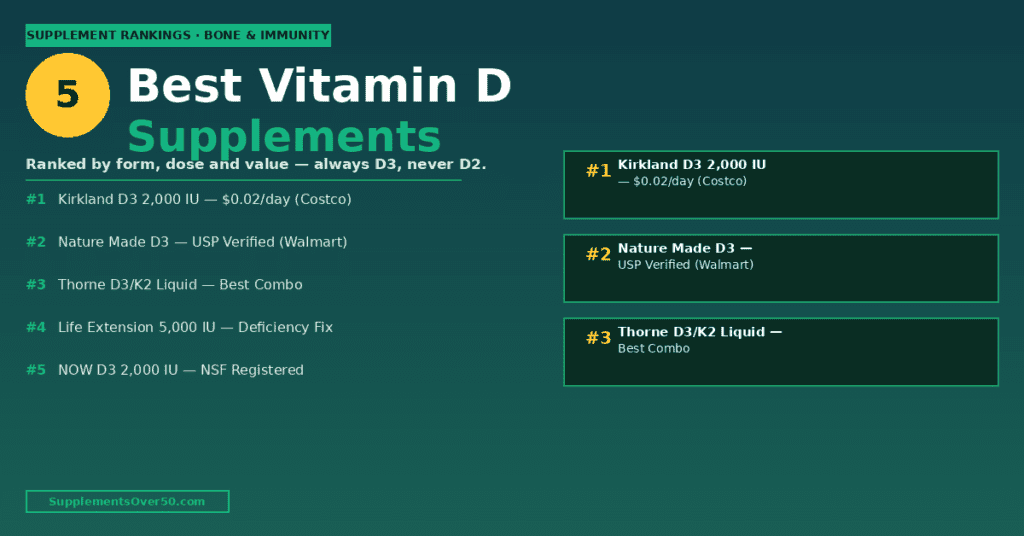
| ⚡ Quick Answer The 5 best vitamin D supplement for seniors ranked: (1) Kirkland Vitamin D3 2,000 IU at Costco — the best value at $0.02/day with USP-equivalent quality, (2) Nature Made D3 2,000 IU at Walmart — USP Verified, widely accessible, (3) Thorne D3/K2 Liquid — best D3+K2 combo for seniors wanting both in one product, (4) Life Extension Vitamin D3 5,000 IU — best for confirmed deficiency correction under physician guidance, and (5) NOW Vitamin D3 2,000 IU — best mid-range NSF-registered option. Always choose D3 over D2 — D3 raises blood levels more effectively and maintains them longer. |
Why Vitamin D Is the #1 Priority Supplement After 60
- 42% of US adults are vitamin D deficient — the rate is higher in adults over 60 who spend less time outdoors and have reduced skin synthesis efficiency (~75% less than age 20)
- The official RDA of 600-800 IU was designed only to prevent rickets — not to support immune function, testosterone availability, muscle strength, or cardiovascular health in older adults.Vitamin D3 directly regulates muscle fibre development and the fast-twitch neuromuscular response needed for balance recovery — making it an essential partner to protein supplementation for sarcopenia prevention: 5 Best Protein Powders for Seniors — Ranked for Muscle and Absorption.
- The Endocrine Society recommends 1,500–2,000 IU for adults at risk — which includes virtually all seniors with limited sun exposure
- The BEST-D trial (adults 65+) found 4,000 IU daily is required to reach blood levels (>90 nmol/L) associated with lowest disease risk — 2,000 IU achieves adequate but lower levels
- Vitamin D3 (cholecalciferol) is significantly more effective than D2 (ergocalciferol) at raising and maintaining 25-hydroxyvitamin D blood levels — always choose D3
The 5 Best Vitamin D Supplements for Seniors — Ranked
| #1 — BEST VALUE — COSTCO Kirkland Vitamin D3 2,000 IU — Costco A 600-tablet bottle of Kirkland Signature Vitamin D3 costs approximately $13–15 at Costco — making it $0.02/day, the lowest cost per IU of D3 available at any major US retailer. The softgel format (soybean oil base) significantly improves absorption over tablet forms. Quality meets USP standards. For seniors with Costco access, this is simply the best vitamin D purchase available. A single bottle lasts over 18 months at one tablet daily. At $0.02/day, Vitamin D3 is the highest-impact-per-cent supplement in the entire Essential 3 budget stack — see how it fits alongside magnesium glycinate and creatine for under $7/month total: Best Supplements for Seniors on a Budget — The Essential 3 for Under $15/Month. 📖 Deep dive: How Much Vitamin D Should a 60-Year-Old Take Daily? — Full Evidence Guide 💰 Best product: Kirkland D3 2,000 IU 600 softgels (Costco ~$13–15) · ~$0.02/day |
| #2 — BEST WALMART — USP VERIFIED Nature Made D3 2,000 IU — Walmart Nature Made D3 2,000 IU is USP Verified — one of the most credible third-party certifications confirming the product contains what it claims, free from contaminants, and dissolves properly. At approximately $8–12 for 250 softgels at Walmart, it’s $0.03–0.05/day — the best-value USP-verified D3 for seniors without Costco access. Take with your largest fat-containing meal for maximum fat-soluble vitamin absorption. 📖 Deep dive: Vitamin D3 for Men Over 60 — Testosterone, Bone and Immune Health 💰 Best product: Nature Made D3 2,000 IU 250 softgels (Walmart ~$8–12) · ~$0.03–0.05/day |
| #3 — BEST D3+K2 COMBO Thorne D3/K2 Liquid — Thorne.com / Amazon For seniors supplementing D3 at 2,000 IU or above daily, pairing with Vitamin K2 MK-7 is strongly recommended — D3 increases calcium absorption and K2 directs that calcium into bone rather than arterial walls. Thorne’s liquid formula delivers 1,000 IU D3 + 200mcg K2 MK-4 per drop, allowing precise dose adjustment. NSF Certified for Sport. The most convenient D3+K2 combination for seniors who want both in one product without taking two separate supplements. 📖 Deep dive: K2, D3 and Boron for Post-Menopausal Bone Density — Why K2 Must Accompany D3 💰 Best product: Thorne D3/K2 Liquid 30ml (Thorne.com / Amazon ~$28–34) · ~$0.93–1.13/day (2 drops) |
| #4 — BEST FOR DEFICIENCY CORRECTION Life Extension Vitamin D3 5,000 IU — Amazon For seniors with confirmed vitamin D deficiency (below 20 ng/mL on a blood test), Life Extension’s 5,000 IU softgel provides a corrective dose to rebuild depleted stores faster than 2,000 IU alone. Use only if a blood test confirms deficiency — retest after 3 months to confirm adequate correction, then reduce to 2,000 IU for maintenance. Non-GMO, olive oil base for good absorption. At $0.20–0.27/day it is more expensive than the 2,000 IU options but justified for active deficiency correction. 📖 Deep dive: How Much Vitamin D Should a Senior Take Daily? — Dosage Guide 💰 Best product: Life Extension D3 5,000 IU 60 softgels (Amazon ~$12–16) · ~$0.20–0.27/day |
| #5 — BEST NSF-REGISTERED MID-RANGE NOW Vitamin D3 2,000 IU — Walmart / iHerb NOW Vitamin D3 is IGEN Non-GMO Tested and manufactured in an NSF-registered GMP facility — a strong quality credential at a mid-range price. At $0.04–0.06/day from Walmart or iHerb it sits between the Kirkland value and premium branded options. Soy-free and non-GMO. A reliable choice for seniors who want NSF-level quality assurance without Costco access. 📖 Deep dive: Best Supplements for Adults Over 60 — Vitamin D3 as #1 Priority 💰 Best product: NOW D3 2,000 IU 240 softgels (Walmart / iHerb ~$10–14) · ~$0.04–0.06/day |
| ⚠️ Always Pair D3 with K2 at 2,000 IU or Above Vitamin D3 increases calcium absorption from food and supplements. Without adequate Vitamin K2 MK-7 (100–200mcg daily), that absorbed calcium can deposit in arterial walls rather than bone. This is the vascular calcification risk associated with long-term D3 supplementation without K2. See our full K2+D3 guide for the complete bone and cardiovascular protection protocol. The K2 pairing requirement at doses of 2,000 IU or above is covered in full detail in our dedicated bone density protocol — including why K2 MK-7 specifically is required over K2 MK-4: K2, D3 and Boron for Post-Menopausal Bone Density — The Triple Threat Most Women Have Never Heard Of. |
Full guides: How Much Vitamin D for Women Over 60? · Vitamin D3 for Men Over 60 · K2, D3 and Boron for Bone Density
Frequently Asked Questions
Is D3 or D2 better for seniors?
D3 (cholecalciferol) is significantly superior for seniors. Multiple studies confirm D3 raises blood levels of 25-hydroxyvitamin D more effectively and maintains those levels longer than D2 (ergocalciferol). D2 is derived from plants; D3 is derived from lanolin or lichen and is the form the human body produces naturally from sunlight. Always choose D3.
How do I know if I’m vitamin D deficient?
Request a 25-hydroxyvitamin D blood test from your physician — it’s the standard test for vitamin D status and is covered by most insurance. Deficiency is below 20 ng/mL; insufficiency is 20-29 ng/mL; optimal for seniors is 40-60 ng/mL. Many seniors test below 20 ng/mL without any obvious symptoms — the consequences accumulate slowly over years.
Can I take too much vitamin D?
Yes — vitamin D toxicity (hypervitaminosis D) causes hypercalcemia and can damage kidneys, heart, and blood vessels. The safe self-directed upper limit is 4,000 IU/day per the NIH. Toxicity is very rare below 10,000 IU/day and has not been reported at 4,000 IU in clinical trials. Men with kidney disease, hyperparathyroidism, or sarcoidosis face higher risk at lower doses and should consult their physician before supplementing above 1,000 IU.
Why do seniors need more Vitamin D than younger adults?
Two compounding factors make vitamin D deficiency nearly universal in adults over 60. First, skin synthesis efficiency declines approximately 75% between ages 20 and 70 — the same sun exposure that produces adequate vitamin D in a 25-year-old produces only a quarter of that amount in a 70-year-old due to reduced 7-dehydrocholesterol in aging skin. Second, seniors typically spend significantly less time outdoors and when outside often have more skin covered. The combined effect means that even seniors living in sunny climates with regular outdoor activity commonly test deficient. Supplementation at 2,000 IU daily is not optional for most adults over 60 — it is the only realistic way to reach adequate blood levels.
Should I take Vitamin D with food?
Yes — always take vitamin D3 with your largest fat-containing meal of the day. Vitamin D is fat-soluble, meaning it requires dietary fat for absorption through the intestinal wall. A 2010 study found taking vitamin D with a high-fat meal increased absorption by approximately 50% compared to taking it on an empty stomach. Olive oil, avocado, nuts, eggs, or any meal containing natural fats all provide sufficient fat for optimal absorption. The timing matters less than the fat pairing — morning or evening with a fat-containing meal produces equivalent blood level outcomes.
What is the difference between Vitamin D2 and D3?
Vitamin D3 (cholecalciferol) is the form the human body produces naturally from UVB sunlight exposure and is found in animal sources including fatty fish, egg yolks, and liver. Vitamin D2 (ergocalciferol) is derived from plants and fungi. Multiple clinical trials and meta-analyses confirm D3 is significantly more effective than D2 at raising and sustaining 25-hydroxyvitamin D blood levels — D3 is approximately 87% more potent per unit and maintains higher blood levels for longer after supplementation stops. Always choose D3. The only exception is strict vegans who cannot source D3 from lichen-derived supplements, in which case higher doses of D2 may be used under physician guidance.
What blood level of Vitamin D should seniors aim for?
The 25-hydroxyvitamin D test measures vitamin D status. Clinical deficiency is below 20 ng/mL (50 nmol/L). Insufficiency is 20–29 ng/mL. The NIH considers 20 ng/mL adequate for bone health but most functional medicine physicians and the Endocrine Society recommend a target of 40–60 ng/mL for optimal musculoskeletal, immune, and cardiovascular benefits in adults over 60. Many seniors supplementing at 1,000 IU daily still test below 30 ng/mL — 2,000 IU is the dose most consistently needed to reach 40+ ng/mL in adults over 60 with limited sun exposure. Retest after 3–4 months of supplementation to confirm your level.
Can you take too much Vitamin D3?
Yes — vitamin D toxicity (hypervitaminosis D) causes hypercalcaemia which can damage kidneys, heart, and blood vessels. However, toxicity is rare at doses below 10,000 IU daily and has not been reported at 4,000 IU in long-term clinical trials. The NIH safe upper limit for self-directed supplementation is 4,000 IU daily. The 2,000 IU dose recommended for most seniors is well below this ceiling. Men with granulomatous diseases (sarcoidosis, tuberculosis), hyperparathyroidism, or kidney disease face higher risk at lower doses and should have physician guidance before supplementing above 1,000 IU.
Should seniors get their Vitamin D from sunlight instead of supplements?
Ideally both — but supplementation is essential regardless of sun exposure after 60. The 75% decline in skin synthesis efficiency means that even 30 minutes of midday summer sun on a 70-year-old’s skin produces only a fraction of what the same exposure produced at age 25. Sunscreen, clothing, window glass, and air pollution further reduce synthesis. Sensible sun exposure (10–20 minutes of direct midday sun on arms and face without sunscreen, when practical) provides a modest contribution — but cannot substitute for daily D3 supplementation in most seniors living above 35 degrees latitude or spending significant time indoors.
The Bottom Line
The best vitamin D supplement for most seniors is Kirkland D3 2,000 IU at Costco at $0.02/day — USP-quality at the lowest possible cost. Without Costco access, Nature Made at Walmart is the USP-verified alternative. Always choose D3 over D2. Always pair with K2 MK-7 at doses of 2,000 IU or above. Get a blood test before and after 3-4 months to confirm you’re reaching the 40-60 ng/mL optimal range.