
| ⚕️ Supplement DisclosureThis article reviews creatine as a dietary supplement and is for informational purposes only. It does not constitute medical advice. If you have kidney disease, are on dialysis, or have been advised to limit protein intake, speak with your doctor before adding any creatine supplement to your routine. |
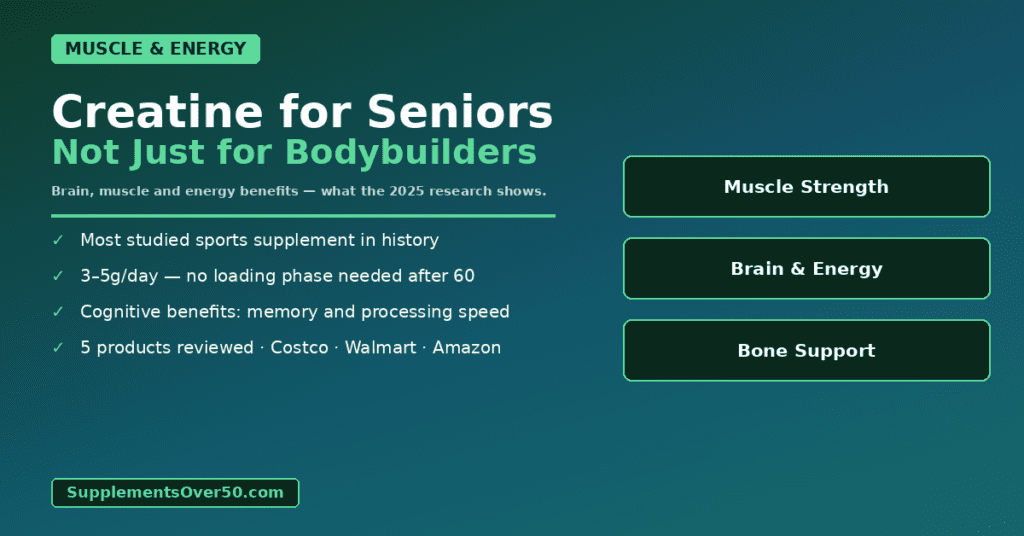
Creatine for seniors over 60 is one of the most underrated and misunderstood supplements on the market. Ask most people what creatine is for and they will picture a 25-year-old gym enthusiast loading up on powder before a bench press session. The reality is almost the opposite: the older you are, the more you stand to benefit from creatine supplementation.
Creatine is a compound your body produces naturally from the amino acids arginine, glycine and methionine. It is stored primarily in muscle tissue and used as a rapid energy source during physical activity. The problem is that natural creatine production declines with age — and dietary intake from meat and fish, the main food sources, often falls as appetite decreases in older adults.
The result is that many adults over 60 are walking around with lower creatine stores than they had at 40 — at precisely the age when maintaining muscle, energy and mental sharpness matters most.
| Creatine monohydrate is the single most clinically studied sports supplement in history. It has been researched in adults across every age group, including specifically in adults over 60 — and the results for older adults are consistently positive for muscle strength and lean mass when combined with any form of resistance exercise. |
What Creatine Actually Does for Muscle After 60
Creatine works by replenishing phosphocreatine (PCr) in muscle cells, which the body uses to regenerate ATP — the primary energy molecule used during physical effort. When you have more creatine stored in muscle, you can sustain effort for longer before fatigue sets in. Over time, this allows you to get more out of exercise sessions, which translates into better muscle maintenance.
For adults over 60 specifically, a 2025 narrative review published in Frontiers in Nutrition examined creatine supplementation combined with exercise across aging populations and found that creatine, particularly when combined with resistance training, significantly improves muscle strength, lean body mass and functional capacity in older adults. A separate 2024 meta-analysis on PMC, which included 1,093 participants with an average age in the senior range, confirmed that creatine combined with exercise training produced a statistically significant improvement in one-repetition maximum strength.
The loading phase — do seniors need it?
Traditional creatine protocols include a loading phase: taking 20g per day for 5–7 days to saturate muscles quickly, followed by a maintenance dose of 5g per day. For older adults, research consistently shows the loading phase is not necessary. Starting directly at 3–5g per day produces the same muscle saturation results within 3–4 weeks. Skipping the loading phase also avoids the water retention and mild GI discomfort that some people experience during high-dose loading.
| For seniors: start at 3–5g of creatine monohydrate per day from day one. No loading phase needed. Mix it into a protein shake, smoothie or juice — it is tasteless and odourless in small amounts. |
The Brain Health Angle — Less Known, Well Supported
The brain accounts for approximately 20% of the body’s total energy consumption despite representing only 2% of body weight. Like muscle, brain cells rely on the phosphocreatine system to maintain ATP during periods of high cognitive demand. This is why creatine is increasingly studied as a brain supplement — not just a muscle one.
A 2024 systematic review and meta-analysis published in Frontiers in Nutrition (PMC) examined randomised controlled trials published between 1993 and 2024 and concluded that creatine monohydrate supplementation may produce beneficial effects on cognitive function in adults, particularly in the domains of memory, attention and information processing speed.
A 2025 systematic review published in Nutrition Reviews focused specifically on creatine and cognition in older adults (aged 55+). Reviewing studies across eight electronic databases, the authors concluded that current evidence suggests creatine may be associated with benefits for cognition in generally healthy older adults — particularly in memory and processing speed.
Why older adults respond differently from younger people
Younger adults who eat meat regularly already have relatively full creatine stores in both muscle and brain. Supplementation adds only a modest additional amount. Older adults — particularly those who eat less red meat, are vegetarian, or have reduced digestive efficiency — are more likely to have lower baseline creatine levels. This means supplementation produces a more meaningful top-up and a stronger observed response in older populations compared to younger ones.
| Vegetarians and vegans over 60 have the lowest baseline creatine levels of any group and consistently show the strongest cognitive and physical response to creatine supplementation in clinical trials. |
Creatine and Bone Density — What the Evidence Actually Shows
This is an area where it is important to be honest rather than overclaim. Creatine’s effect on bone is more nuanced than its effect on muscle.
A 2024 review published in Current Osteoporosis Reports described creatine’s bone effects as more ‘hype than hope’ in isolation — meaning creatine alone does not appear to significantly increase bone mineral density. However, the same review noted that creatine combined with resistance training ‘provides some anti-sarcopenic benefits’ and that the exercise stimulus creatine enables may indirectly support bone health over time.
The practical takeaway: don’t buy creatine expecting it to be a bone density supplement. Buy it for muscle and energy — and understand that the improved strength and exercise capacity it enables does carry indirect bone benefits through better load-bearing activity.
Creatine Monohydrate vs Creatine HCL — Which Should Seniors Choose?
Walk into any supplement store and you will find creatine in a dozen different forms — monohydrate, HCL, ethyl ester, buffered, micronised. For seniors, the choice is straightforward:
| Factor | Creatine Monohydrate | Creatine HCL |
|---|---|---|
| Research depth | 100+ clinical trials in older adults | Limited — mostly younger populations |
| Dose per serving | 5g standard | 1–2g (more concentrated) |
| Water solubility | Moderate (micronized dissolves better) | High — mixes very easily |
| GI tolerance | Good at 3–5g; some bloating at higher doses | Gentler — good if monohydrate causes bloating |
| Cost | Very low — $0.11–0.25/serving | 3–5x more expensive |
| Verdict for seniors | First choice — most evidence, lowest cost | Valid alternative if GI sensitivity is an issue |

The short version: creatine monohydrate has over 100 clinical trials behind it specifically in older adults. Creatine HCL has a handful. If you have sensitive digestion and monohydrate causes bloating, HCL is a legitimate alternative — but for the vast majority of seniors, micronised monohydrate at 3–5g per day is the right choice. Micronised simply means the particles are smaller, which improves solubility and reduces the gritty texture some people notice.
Is Creatine Safe for Seniors? The Kidney Question Answered
The most common concern older adults raise about creatine is kidney safety. This concern comes from the fact that creatine metabolism produces creatinine as a byproduct — and creatinine is one of the markers doctors measure when checking kidney function. Some people see elevated creatinine on a blood test after starting creatine and worry it means kidney damage.
The research is clear on this point: in adults with normal or mildly reduced kidney function, creatine supplementation at standard doses (3–5g/day) does not cause kidney damage. The rise in creatinine is a normal physiological response to increased creatine intake, not a sign of harm. The 2025 PMC review on creatine monohydrate for older adults and clinical populations confirmed that no adverse kidney or liver function events have been associated with doses of 5–7g per day in older adult studies.
| One important exceptionIf you have been diagnosed with chronic kidney disease (CKD), are on dialysis, or have been told by your doctor to restrict protein or nitrogen intake, speak with your doctor before starting creatine. This does not apply to the general over-60 population with normal kidney function — it applies specifically to people with an existing kidney diagnosis. |
How to Take Creatine After 60 — Practical Guide
| Question | Answer |
|---|---|
| How much? | 3–5g per day. No loading phase needed. 3g is sufficient for many seniors; 5g is the most studied maintenance dose. |
| When? | Any time of day — consistency matters more than timing. Many seniors find it easiest to mix into a morning protein shake or smoothie. |
| With or without food? | Either works. Some people find taking it with a meal reduces any mild GI sensitivity. |
| Do I need to cycle it? | No. Creatine does not require cycling. Taking it every day at a consistent dose is the recommended approach. |
| What to mix it with? | Water, juice, a protein shake or smoothie. It is unflavoured and essentially tasteless in small amounts. |
| How long before results? | Most people notice improved energy during exercise within 2–3 weeks. Measurable strength improvements typically appear after 4–8 weeks of consistent use with exercise. |
| Most tubs include a scoop, but if you can’t find it, a level teaspoon holds approximately 5g. Creatine works best as a team player. Pairing it with any form of resistance exercise — bodyweight movements, resistance bands, light weights, or gym machines — multiplies the results. The exercise provides the muscle signal; the creatine provides the energy to train harder and recover faster. |
Best Creatine Supplements for Seniors — US Pricing (2026)
Five products selected for purity, dose accuracy, third-party testing, and value. All pricing from Costco, Walmart, and Amazon as of early 2026.
1. Orgain Micronized Creatine Monohydrate (Costco) — Best Value
Costco’s flagship creatine product and the best value option in the US market. One ingredient: micronised creatine monohydrate. No fillers, no artificial flavours, no sweeteners. Delivers 5g of pure creatine monohydrate per scoop with 135 servings per tub. Vegan, gluten-free, soy-free, non-GMO and banned substance tested. Available at Costco for approximately $14.99–$19.99 per tub (watch for member sale pricing).
- Creatine per serving: 5g
- Price per serving: ~$0.11–$0.15
- Certification: Banned Substance Tested
- Best for: Seniors who want the purest, cheapest daily creatine from a trusted retailer
2. Optimum Nutrition Micronized Creatine (Costco Exclusive) — Most Trusted Brand
Optimum Nutrition is the most recognised name in sports nutrition and their Costco-exclusive 675g tub offers exceptional value. 135 servings at approximately $19.99 — that’s 675g of pure unflavoured creatine monohydrate with no additives. ON has decades of quality consistency and is Informed Sport certified, meaning every batch is independently tested for banned substances and label accuracy. Available at Costco in store and online.
- Creatine per serving: 5g
- Price per serving: ~$0.15
- Certification: Informed Sport
- Best for: Seniors who want a globally recognised brand with strong quality track record
3. Thorne Creatine — Best Purity Certification
For seniors who want the highest level of independent testing, Thorne’s creatine carries NSF Certified for Sport — the most rigorous certification available, used by professional sports leagues. Pure creatine monohydrate, 5g per serving, no additives. Available on Amazon for approximately $40–45 for 90 servings (~$0.50 per serving).
- Creatine per serving: 5g
- Price per serving: ~$0.50
- Certification: NSF Certified for Sport
- Best for: Seniors who prioritise the absolute gold standard in third-party purity testing
4. NOW Sports Creatine Monohydrate (Walmart / Amazon) — Best Budget with Testing
A solid mid-range option widely available at Walmart and Amazon. NOW Foods has a long track record in the supplement industry and their creatine is Informed Sport certified. Available in a 2.2 lb tub (~200 servings) for approximately $40–45 at Walmart, which works out to around $0.20–0.25 per serving — competitive for a certified product.
- Creatine per serving: 5g
- Price per serving: ~$0.20–0.25 (Walmart)
- Certification: Informed Sport
- Best for: Seniors who want a certified option outside of Costco at a mid-range price
5. Klean Athlete Creatine (Amazon) — Best for Athletes on Tested Programmes
NSF Certified for Sport with a clean, minimal formula specifically marketed to adults who want the strictest testing standard. Less relevant if you are not in a competitive environment, but worth noting for seniors who are in masters athletics or triathlon programmes where supplement purity documentation matters. Available on Amazon at approximately $35–40 for 60 servings (~$0.55 per serving).
- Creatine per serving: 5g
- Price per serving: ~$0.55
- Certification: NSF Certified for Sport
- Best for: Competitive senior athletes who need documented third-party certification
| # | Product | Type | Creatine/Serve | Price/Serve | Certification | Best For |
|---|---|---|---|---|---|---|
| 1 | Orgain Micronized Creatine (Costco) | Monohydrate | 5g | ~$0.11–0.15 | Banned Substance Tested | Best value — pure & clean |
| 2 | Optimum Nutrition Micronized Creatine (Costco) | Monohydrate | 5g | ~$0.15 | Informed Sport | Most trusted brand |
| 3 | Thorne Creatine | Monohydrate | 5g | ~$0.50 | NSF Certified for Sport | Best purity certification |
| 4 | NOW Sports Creatine Monohydrate (Walmart/Amazon) | Monohydrate | 5g | ~$0.20–0.25 | Informed Sport | Budget with 3rd-party testing |
| 5 | Klean Athlete Creatine (Amazon) | Monohydrate | 5g | ~$0.55 | NSF Certified for Sport | Premium certified option |
Related Articles on SupplementsOver50.com
• Best Protein Powder for Seniors on GLP-1 Medications (Ozempic and Wegovy)
• Whey vs Plant Protein for Sarcopenia After 60 — Which Actually Rebuilds Muscle?
• Creatine for Women Over 60 — Benefits Beyond the Gym
Frequently Asked Questions
Is creatine safe for seniors over 60 to take every day?
Yes, for adults with normal kidney function. Research consistently shows that 3–5g of creatine monohydrate per day is safe for long-term daily use in healthy older adults. Multiple clinical trials in adults aged 60–80 have found no adverse effects on kidney or liver function at these doses. If you have an existing kidney condition, check with your doctor first.
Does creatine for seniors really help with brain function as well as muscle?
The evidence is promising. A 2024 meta-analysis of randomised controlled trials found that creatine supplementation may improve memory, attention and processing speed in adults. A 2025 systematic review focused specifically on adults aged 55 and over found similar positive signals for cognition. The effect appears strongest in people with lower baseline creatine levels — including vegetarians and those who eat little red meat — which describes many adults over 60.
Post-menopausal women are another group that consistently shows a strong response to creatine supplementation — lower estrogen levels reduce the body’s natural creatine synthesis, making dietary supplementation more impactful.
Do seniors need to do a creatine loading phase?
No. The loading phase — taking 20g per day for 5–7 days — is designed to saturate muscles quickly, but research shows that starting at 3–5g per day produces the same saturation within 3–4 weeks without the water retention or GI discomfort that high loading doses sometimes cause. For seniors, a straight maintenance dose from day one is the recommended approach.
What is the best creatine to buy at Costco for seniors?
Orgain Micronized Creatine Monohydrate is the top pick for value — approximately $14.99 to $19.99 for 135 servings at Costco, which works out to about $0.11 to $0.15 per serving. It is pure creatine monohydrate with no fillers or additives and is banned substance tested. Optimum Nutrition’s Costco-exclusive 675g tub at $19.99 is an equally strong option if you prefer a more globally established brand.
Can I take creatine at the same time as my protein powder?
Yes, absolutely. Mixing creatine directly into a protein shake is one of the most common and convenient approaches. There is no interaction between creatine and protein powder — in fact, taking them together with carbohydrates may slightly improve creatine uptake into muscle cells. If you are using a whey or plant protein supplement for muscle support, adding 3–5g of creatine to the same shake is a practical and evidence-backed combination.
The Bottom Line
Creatine for seniors over 60 is one of the most affordable, well-researched, and genuinely useful supplements available to older adults — and one of the most overlooked because of its association with gym culture.
The evidence is strong for muscle strength and lean mass when creatine is combined with any resistance exercise. The evidence for cognitive benefits is promising and growing — particularly for adults with lower dietary creatine intake such as vegetarians and those eating less red meat. The bone density evidence is more modest; creatine supports bone health indirectly through better exercise capacity rather than as a direct bone supplement.
For most adults over 60, Orgain Micronized Creatine at Costco is the best starting point — pure monohydrate, no additives, exceptional value at under $0.15 per day. If you want the strongest third-party certification, Thorne or Klean Athlete carry NSF Certified for Sport status. If you prefer a widely available certified option outside Costco, NOW Sports at Walmart is a solid mid-range choice.
Start at 3–5g per day, mix it into whatever you are already drinking in the morning, and pair it with any form of resistance activity — even bodyweight exercises at home. That combination, sustained consistently over 8–12 weeks, is what the clinical research actually supports for older adults.
References and Further Reading
1. Frontiers in Nutrition (2025). Creatine supplementation and exercise in aging: a narrative review of the muscle–brain axis and its impact on cognitive and physical health. View article
2. PMC / Journal of the International Society of Sports Nutrition (2025). Creatine monohydrate supplementation for older adults and clinical populations. View on PMC
3. PMC (2025). Impact of creatine supplementation and exercise training in older adults: a systematic review and meta-analysis. View on PMC
4. Frontiers in Nutrition / PMC (2024). The effects of creatine supplementation on cognitive function in adults: a systematic review and meta-analysis. View on PMC
5. Nutrition Reviews (2025). Creatine and Cognition in Aging: A Systematic Review of Evidence in Older Adults. View on PubMed
6. Current Osteoporosis Reports (2024). Effects of Creatine Monohydrate Supplementation on Muscle, Bone and Brain — Hope or Hype for Older Adults? View on PubMed
7. PMC / Journal of Clinical Medicine. Effectiveness of Creatine Supplementation on Aging Muscle and Bone: Focus on Falls Prevention and Inflammation. View on PMC

Pingback: Omega 3 Brain Health Seniors — Can It Really Slow Decline After 60?
Pingback: Magnesium Glycinate vs Citrate — Which Form Is Better for Seniors After 50?
Pingback: Ubiquinol vs CoQ10 Seniors — Is the More Expensive Form Worth It After 60?
Pingback: Prostate Supplements Men Over 50 — Saw Palmetto vs Beta-Sitosterol Honestly Reviewed