⚕️ Supplement Disclosure This article reviews digestive enzyme supplements for informational purposes only. Adults with active peptic ulcers, pancreatitis, Crohn’s disease, or those taking blood thinners, PPIs, or diabetes medications should consult their physician before starting digestive enzyme supplements. Some enzyme supplements contain ingredients derived from pork (porcine pancreatin) — inform your physician of all supplements. This article does not constitute medical advice.
⚡ Quick Answer Digestive enzymes for seniors address the 30–40% decline in stomach acid and enzyme production that occurs by age 60. The four most important enzymes are: (1) Protease — breaks down protein; critical because protein digestion efficiency drops the most with age, (2) Lipase — breaks down dietary fat; declining lipase causes the bloating and discomfort many seniors experience after fatty meals, (3) Amylase — breaks down carbohydrates and starch, and (4) Lactase — breaks down lactose; lactose intolerance increases significantly after 60 even in people who tolerated dairy well for decades. A broad-spectrum enzyme supplement taken at the start of each main meal addresses all four simultaneously.
Why Digestive Enzyme Production Declines After 60
The digestive system is one of the most significantly affected systems in the aging body — yet it receives far less attention than heart, brain, or bone health. By age 60, three interconnected changes have typically occurred that directly impair nutrient extraction from food:
Stomach acid (hydrochloric acid / HCl) production declines 30–40% — reducing the activation of pepsin (the main protein-digesting enzyme in the stomach) and impairing the absorption of B12, iron, calcium, magnesium, and zinc that depend on an acid environment
Pancreatic enzyme output declines — the pancreas produces protease, lipase, and amylase in reduced quantities, meaning less enzymatic activity reaches the small intestine where most nutrient absorption occurs
Bile production and flow from the gallbladder slows — bile is essential for emulsifying dietary fats before lipase can act on them; reduced bile flow is a major contributor to post-meal bloating and fat malabsorption
The practical result is a phenomenon researchers call ‘subclinical malabsorption’ — the person is eating adequate food but extracting significantly fewer nutrients from it. This contributes to deficiencies in B12, magnesium, zinc, and fat-soluble vitamins (D, E, K, A) even in seniors eating a reasonable diet.
This is directly connected to why Vitamin B12 deficiency is so prevalent after 60 — it’s not just about diet, it’s about the declining acid environment needed to release B12 from food proteins.
Key Statistics — Digestive Decline After 60
Stomach acid production declines 30–40% by age 60 — directly reducing activation of pepsin and absorption of key minerals
An estimated 20–30% of adults over 60 have atrophic gastritis — chronic stomach lining inflammation that further reduces HCl and intrinsic factor production
Pancreatic enzyme secretion declines approximately 25% between ages 40 and 70 in healthy adults — more in those with chronic health conditions
Lactose intolerance affects up to 70% of adults over 60 even in populations where it was rare in youth — declining lactase production accelerates with age
Fat malabsorption in older adults contributes to deficiencies in vitamins D, E, K, and A — all fat-soluble vitamins that require adequate lipase and bile for absorption
The Four Enzymes Seniors Need Most
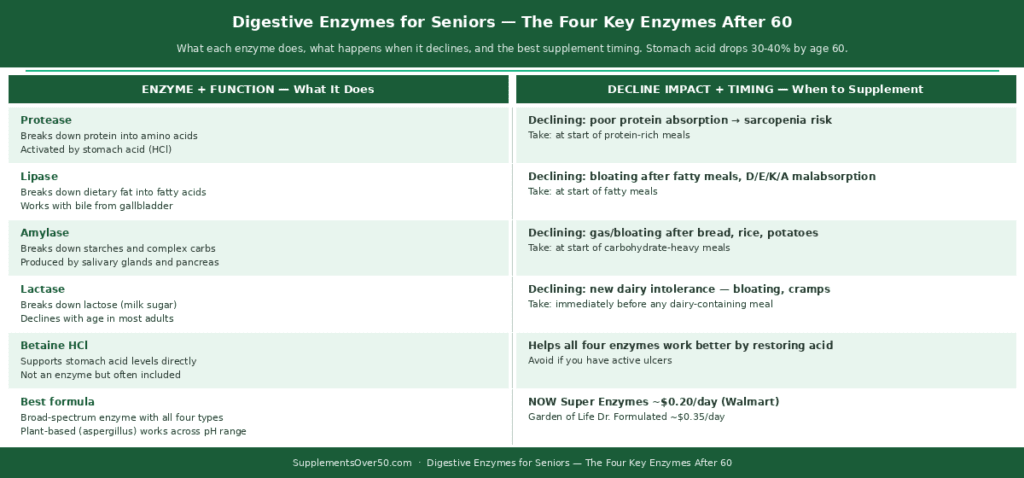
1. Protease — Protein Digestion
Protease enzymes break peptide bonds in protein molecules. The stomach’s pepsin (activated by HCl) starts protein digestion; pancreatic proteases (trypsin, chymotrypsin) complete it in the small intestine. As both HCl and pancreatic output decline with age, protein digestion becomes measurably less efficient — meaning seniors need to consume more protein to absorb the same amount of amino acids.
This has direct implications for sarcopenia (age-related muscle loss). Even seniors eating adequate protein may not be absorbing the leucine threshold needed to stimulate muscle protein synthesis. Supplemental protease at meals helps close this gap. The protein-protease combination is the most underappreciated anti-sarcopenia stack available to seniors — adequate protein intake means nothing if protease insufficiency prevents its absorption. For the protein side of the equation: 5 Best Protein Powders for Seniors — Ranked for Muscle and Absorption.
Lipase breaks down dietary triglycerides into fatty acids and glycerol for absorption. Without adequate lipase and bile, fats pass through the digestive tract partially undigested, causing the bloating, discomfort, and loose stools many seniors notice after fatty meals. Fat-soluble vitamins (D, E, K, A) also require lipase activity and bile to be absorbed — lipase deficiency directly contributes to vitamin D malabsorption even in seniors supplementing D3.
Declining stomach acid is the primary driver of vitamin B12 deficiency in adults over 60 — without adequate HCl to release B12 from food proteins, even a good diet cannot prevent deficiency. For the full B12 deficiency picture: Signs of Vitamin B12 Deficiency in Adults Over 60 — And What to Do.
Critical connection: if you’re supplementing Vitamin D3 but not absorbing fat properly, your D3 supplement may be far less effective than expected.
3. Amylase — Carbohydrate and Starch Digestion
Amylase is produced by both the salivary glands and the pancreas to break down starches into simple sugars. Pancreatic amylase decline after 60 means complex carbohydrates — bread, rice, potatoes, legumes — are less completely digested in the small intestine and arrive in the colon where gut bacteria ferment them, producing gas and bloating. This is often mistaken for food intolerance when it is actually enzyme insufficiency.
4. Lactase — Dairy Digestion
Lactase breaks down lactose (milk sugar) into glucose and galactose. Lactase production declines with age in most adults — and the rate of decline accelerates after 60. Many seniors who tolerated dairy comfortably throughout adulthood begin experiencing bloating, cramping, and diarrhea from dairy products in their 60s. This is not a new allergy — it is lactase insufficiency. A lactase supplement or a broad-spectrum enzyme containing lactase taken before dairy-containing meals resolves this in most cases.
The four enzymes seniors need most after 60 — and what happens when each declines. Stomach acid and pancreatic output both drop 25-40% by age 60, making enzyme supplementation one of the most impactful yet underutilised interventions in senior nutrition.
Digestive Enzymes vs Probiotics vs Prebiotics — Where Each Fits
Supplement
What It Does
Best For
When to Take
Digestive Enzymes
Breaks down food into absorbable nutrients
Bloating after meals, protein/fat malabsorption, lactose intolerance
Long-term microbiome diversity, gut lining protection
Any time, build up slowly
All three together
The Gut Trinity — complete gut support
Seniors with multiple digestive concerns
See sequencing guidance below
The practical sequencing: digestive enzymes provide immediate relief at each meal. Prebiotics and probiotics work over weeks to months to rebuild the underlying microbiome environment. Most seniors benefit from all three — but enzymes at mealtimes have the fastest and most noticeable impact.
Digestive enzymes address upper gut absorption — breaking down food in the stomach and small intestine. Probiotics address the lower gut microbiome in the colon. For the complete lower gut protocol that works alongside enzyme supplementation: 5 Best Probiotics for Seniors — Ranked by Strain and CFU Count.
Seniors who prefer plant-based supplements or have dietary restrictions (vegan, kosher)
Notes
Plant-derived enzymes are active across a wider pH range than animal-derived enzymes — better suited to the variable stomach acid levels of older adults
3. Enzymedica Digest Gold — Amazon / iHerb — Best High-Potency Formula
Best for: seniors with significant digestive symptoms who need higher enzyme activity per serving.
Formula
Thera-blend enzyme technology — protease, amylase, lipase, cellulase at high activity levels
Price (2026)
~$35–45 for 90 capsules (~$0.39–0.50 per serving)
Third-Party Tested
Non-GMO; manufactured in NSF-registered facility; vegan certified
Best For
Seniors with more pronounced digestive symptoms — particularly those with confirmed enzyme insufficiency
Notes
Uses Thera-blend — multiple enzyme strains active at different pH levels to cover the full digestive range from stomach to small intestine
4. Lactaid Fast Act — Walmart / CVS — Best for Lactose Intolerance Specifically
Best for: seniors who tolerate most foods but specifically struggle with dairy products.
Formula
Lactase enzyme 9,000 FCC Lactase Units per caplet
Price (2026)
~$10–14 for 60 caplets at Walmart (~$0.17–0.23 per serving)
Third-Party Tested
FDA-regulated OTC product; widely studied for safety and efficacy
Best For
Seniors with dairy-specific intolerance who don’t need a broad-spectrum formula
Notes
Take immediately before dairy-containing meals. Not suitable as a primary digestive enzyme for seniors with broader absorption concerns
5. Designs for Health Digestzymes — Amazon / Thorne.com — Best Practitioner-Grade
Best for: seniors who want the highest quality practitioner-grade formula available direct to consumer.
NSF certified; manufactured in FDA-registered facility; third-party tested for potency and purity
Best For
Seniors referred to this product by a physician or dietitian; those with confirmed pancreatic insufficiency
Notes
Contains porcine-derived pancreatin — not suitable for those avoiding pork products. Highest betaine HCl dose of any product on this list
How to Take Digestive Enzymes — Practical Guide
Question
Answer
When to take them?
At the very start of a meal or with the first few bites — not before (nothing to act on) and not after (digestion already underway)
How many to take?
Start with one capsule per main meal. Increase to two if symptoms persist after 2 weeks
Do I need them at every meal?
Focus on main meals — particularly those containing protein and fat. Light snacks typically don’t require enzyme support
How long before results?
Immediate improvement in post-meal comfort is common within the first week. Nutrient absorption improvements take 4–8 weeks to reflect in blood levels
Can I take them long-term?
Yes — enzyme supplements do not cause dependency or reduce the body’s own enzyme production. Long-term daily use is safe and appropriate for seniors with chronic insufficiency
Any drug interactions?
Discuss with physician if taking warfarin (some enzymes mildly affect clotting), diabetes medications, or PPIs (which further suppress stomach acid and may affect enzyme timing)
⚠️ When to See a Doctor First Significant or sudden changes in digestion — severe bloating, unexplained weight loss, steatorrhea (oily floating stools), or new abdominal pain — should be evaluated by a physician before starting enzyme supplements. These can indicate conditions including pancreatic insufficiency, celiac disease, or inflammatory bowel disease that require medical diagnosis and may need prescription-strength enzyme replacement therapy (Creon) rather than OTC supplements.
Yes — for seniors with reduced enzyme production, which applies to most adults over 60 to some degree. Clinical evidence confirms that supplemental digestive enzymes reduce post-meal bloating, improve protein digestion efficiency, and enhance fat-soluble vitamin absorption when enzyme production is insufficient. The results are most dramatic for seniors with significant symptoms — bloating, discomfort after meals, dairy intolerance. For seniors with mild symptoms, benefits are more subtle but nutritional absorption improvements accumulate over time.
What is the difference between digestive enzymes and probiotics?
Digestive enzymes work at the top of the digestive tract — in the stomach and small intestine — to physically break down food into absorbable components. They act immediately at each meal. Probiotics work at the bottom of the digestive tract — in the colon — to populate beneficial bacteria that support immunity, reduce inflammation, and produce butyrate for gut lining health. They work over weeks to months. Both address different aspects of digestive decline after 60 and are complementary rather than competing.
Can digestive enzymes help with B12 deficiency?
Partially. B12 deficiency after 60 is primarily caused by intrinsic factor decline — a protein the stomach produces that’s essential for B12 absorption. Digestive enzymes don’t replace intrinsic factor. However, betaine HCl (often included in comprehensive enzyme formulas) supports stomach acid levels that help release B12 from food proteins, which is the first step in the absorption process. For confirmed B12 deficiency, methylcobalamin supplementation at 500–1,000mcg daily (which absorbs passively without intrinsic factor) is the most direct solution.
Are digestive enzyme supplements safe to take with medications?
Most digestive enzyme supplements are safe alongside common medications with standard precautions. Key interactions: betaine HCl should not be taken by anyone with active peptic ulcers or taking NSAIDs long-term. Some bromelain-containing formulas may mildly enhance the effects of blood thinners — discuss with your physician if on warfarin. PPI medications (Nexium, Prilosec) suppress stomach acid production and may partially counteract the benefits of betaine HCl — discuss timing with your physician.
Should I take digestive enzymes with every meal?
Focus supplementation on main meals — particularly those containing significant protein and fat. Digestive enzymes provide the most benefit during the largest digestive load of the day. Light snacks, fruit, or simple carbohydrate meals typically don’t require enzyme support. Most seniors find once or twice daily with main meals provides adequate coverage without excessive cost.
Why do I get bloated after eating fatty meals as I get older?
Post-meal bloating after fatty foods is one of the most reliable signs of declining lipase production and reduced bile flow — both of which worsen progressively after 60. Without adequate lipase, dietary fats pass through the small intestine only partially broken down, arriving in the colon where gut bacteria ferment them and produce gas. Reduced bile flow from the gallbladder compounds this — bile is required to emulsify fats into droplets small enough for lipase to act on. A broad-spectrum enzyme supplement containing lipase taken at the start of fatty meals typically resolves this within the first week of use. If bloating persists despite enzyme supplementation, ask your physician about bile acid support or gallbladder function assessment.
Can I take digestive enzymes if I am on a PPI like Nexium or Prilosec?
Yes — with one important caveat. PPIs suppress stomach acid production, which impairs the activation of pepsin (the stomach’s primary protein-digesting enzyme) and reduces B12 absorption. Supplemental digestive enzymes work downstream in the small intestine and are not affected by the reduced stomach acid PPIs create — they are complementary. The caveat: formulas containing Betaine HCl (such as NOW Super Enzymes) increase stomach acidity, which partially counteracts the PPI’s acid-suppressing effect. For seniors on PPIs who want enzyme support without interfering with their medication, choose a plant-based enzyme formula without Betaine HCl — Garden of Life Dr. Formulated Enzymes is the best option in this case.
How soon before a meal should I take digestive enzymes?
Take digestive enzymes at the very start of your meal — with the first few bites or immediately before eating. Taking them 15–20 minutes before a meal means the enzymes are in the stomach before food arrives, which is actually less effective than having them present simultaneously with food. Taking them mid-meal or after means digestion has already begun without enzyme support. The practical rule: open the bottle at the table and take your enzyme supplement as you sit down to eat. For seniors who forget, taking them within the first 5 minutes of a meal still provides meaningful benefit. Consistency at every main meal matters more than precise pre-meal timing.
Do digestive enzymes help with lactose intolerance in seniors?
Yes — lactase is the specific enzyme that breaks down lactose (milk sugar), and lactase production declines with age in most adults. Many seniors who tolerated dairy comfortably throughout adulthood begin experiencing bloating, cramping, and loose stools from dairy in their 60s — not from a new allergy but from lactase insufficiency. A lactase supplement or broad-spectrum enzyme formula containing lactase taken immediately before dairy-containing meals resolves symptoms in the majority of cases. Lactaid Fast Act at Walmart is the most targeted option for dairy-specific intolerance. A broad-spectrum formula like NOW Super Enzymes covers lactase alongside protease, lipase, and amylase simultaneously.
Is there a difference between digestive enzymes for seniors and regular digestive enzymes?
The primary difference is the inclusion of Betaine HCl in senior-focused formulas. Standard digestive enzyme supplements typically provide pancreatic enzymes (protease, lipase, amylase) that work in the small intestine. Senior-focused formulas add Betaine HCl to address the 30–40% decline in stomach acid that impairs pepsin activation and B12 release in the stomach before food even reaches the small intestine. For most adults under 60 with normal stomach acid, Betaine HCl is unnecessary. For adults over 60 with symptoms of low stomach acid — bloating, feeling full quickly, undigested food in stool, chronic B12 or zinc deficiency — it is the most important addition to a comprehensive enzyme formula.
Can digestive enzymes improve energy levels in seniors?
Indirectly but meaningfully yes — through two mechanisms. First, improved protein absorption increases the amino acid supply available for mitochondrial energy production and neurotransmitter synthesis. Second, improved fat absorption ensures adequate uptake of fat-soluble vitamins D, E, K, and A that are essential for energy metabolism and immune function. Seniors experiencing chronic low energy despite eating adequately often have subclinical malabsorption as a contributing factor — the body is receiving food but extracting fewer nutrients per meal. Enzyme supplementation addresses this extraction problem rather than simply adding more input.
The Bottom Line
Digestive enzymes for seniors address one of the most overlooked contributors to nutritional decline after 60 — the 30–40% reduction in stomach acid and enzyme production that impairs protein, fat, and carbohydrate digestion simultaneously. A broad-spectrum enzyme supplement taken at the start of each main meal is one of the most immediately impactful changes a senior can make for their nutritional health.
Start with NOW Super Enzymes at Walmart (~$0.17/day) for the best-value broad-spectrum option, or Garden of Life Dr. Formulated for plant-based certification. Pair with a prebiotic and probiotic for the complete Gut Trinity approach — enzymes for the upper digestive tract, prebiotics and probiotics for the microbiome below.