
| ⚕️ Supplement Disclosure This article reviews magnesium as a dietary supplement and is for informational purposes only. Adults with kidney disease or those taking medications that affect magnesium levels should speak with their doctor before supplementing. |
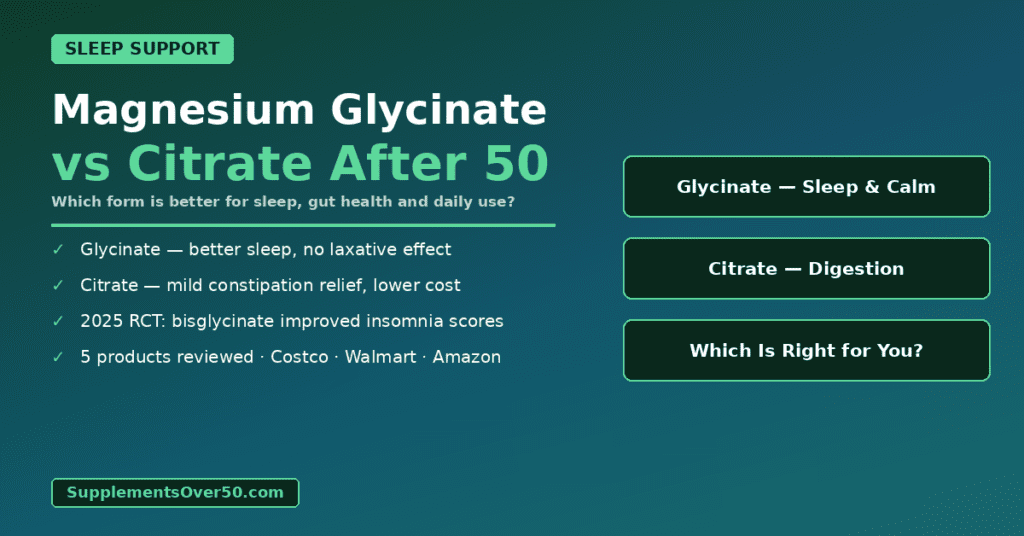
Magnesium glycinate vs citrate is one of the most common questions in the supplement aisle — and for good reason. Both forms are popular, both are effective, but they work differently in the body and are suited to different goals. Get the choice wrong and you either end up with interrupted sleep from an unexpected bathroom trip at 2am (citrate) or paying more than you need to for a benefit you would have gotten from the cheaper version anyway.
For adults over 50 specifically, the distinction matters more than it does for younger people. Digestive sensitivity increases with age, magnesium deficiency becomes more common as absorption declines, and the reasons most older adults are reaching for magnesium in the first place — poor sleep, muscle cramps, anxiety — map directly to which form is the right choice.
This article covers the difference clearly, with the research behind it, and recommends specific products with US pricing so you can make an informed purchase today.
| Quick answer: Magnesium glycinate is the better choice for sleep, daily supplementation, and anyone with a sensitive digestive system. Magnesium citrate is effective when you also want mild digestive regularity support — but its laxative effect can backfire at night, which is exactly when most seniors take magnesium. |
What’s the Difference Between Magnesium Glycinate and Citrate?
Both are organic forms of magnesium — meaning the magnesium is bound to an organic molecule to improve absorption. This already puts them ahead of the cheap, poorly absorbed forms like magnesium oxide that still dominate many supermarket shelves.
Magnesium glycinate (also called magnesium bisglycinate)
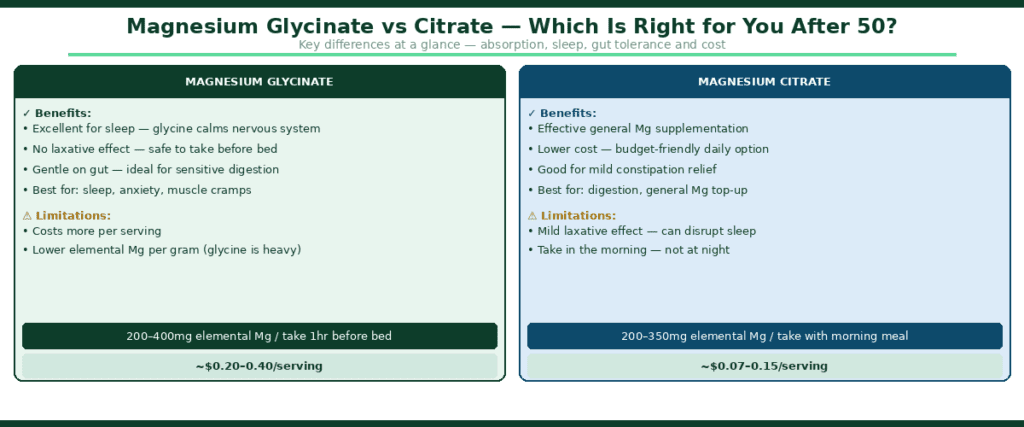
Magnesium bound to glycine, an amino acid. The glycine acts as a transport carrier, helping magnesium cross the intestinal wall efficiently without drawing water into the gut. This is why glycinate is known as the ‘gentle’ form — it does not produce the laxative effect that troubles many seniors with other magnesium types.
Glycine itself is also an inhibitory neurotransmitter with mild calming properties. It acts on GABA receptors and glycine receptors in the nervous system, which is why magnesium glycinate is consistently recommended for sleep and anxiety — the glycine delivers a dual benefit alongside the magnesium.
Magnesium citrate
Magnesium bound to citric acid. Highly water-soluble and well absorbed, but it draws water into the intestines through an osmotic mechanism. At moderate doses this produces a mild laxative effect — sometimes useful, sometimes disruptive. At higher doses it can cause cramping, loose stools, or diarrhoea. It is also the least expensive of the two high-bioavailability forms, making it the sensible choice if digestive regularity is part of your goal.
Head-to-Head Comparison
| Factor | Magnesium Glycinate | Magnesium Citrate |
| Bioavailability | High — amino acid chelation improves absorption | High — organic acid form, highly water-soluble |
| GI tolerance | Excellent — no laxative effect, gentle daily use | Moderate — mild laxative effect at standard doses |
| Sleep support | Best choice — glycine has independent calming properties | Not ideal — laxative effect can disrupt sleep |
| Constipation relief | No | Yes — effective at drawing water into bowel |
| Muscle cramps | Effective | Effective |
| Anxiety / relaxation | Best choice — glycine acts on GABA pathways | Less targeted for this purpose |
| Elemental Mg per 100mg | ~14mg (glycine takes up most of the molecule weight) | ~16mg (citrate is a smaller molecule) |
| Typical dose for seniors | 200–400mg elemental Mg/day | 200–400mg elemental Mg/day |
| Cost | Higher (~$0.15–0.40/serving) | Lower (~$0.07–0.15/serving) |
| Best for | Sleep, daily use, sensitive digestion | Constipation, general Mg supplementation |
The Sleep Evidence — Why Glycinate Wins for Seniors
A 2025 randomised, double-blind, placebo-controlled trial published in Nature and Science of Sleep (PMC) enrolled 155 adults with self-reported poor sleep quality and tested magnesium bisglycinate at 250mg elemental magnesium daily. The trial found a statistically significant reduction in Insomnia Severity Index (ISI) scores, with most improvement occurring within the first 14 days. Importantly, side effects occurred less frequently in the magnesium bisglycinate group than in the placebo group — confirming its exceptional tolerability profile.
A separate 2024 randomised crossover pilot trial published in the Medical Research Archives found that 1,000mg of magnesium daily significantly improved sleep quality, deep sleep, sleep efficiency and mood in adults with poor sleep quality.
The key mechanism: magnesium regulates GABA receptors, which are the brain’s primary ‘off switches’ for neural activity. Low magnesium means those receptors are understimulated, which translates to difficulty falling asleep and staying asleep — a problem that worsens with age as magnesium absorption naturally declines.
| Why not magnesium citrate for sleep? The laxative effect of citrate at standard doses can trigger bowel movement 30 minutes to 6 hours after ingestion. For many seniors, taking it before bed means a disruptive bathroom trip at 2–3am. Glycinate produces no such effect, making it the clear choice when sleep is the primary goal. |
Which Form Is Right for You?
| Your primary goal | Which form to choose |
| Better sleep | Magnesium glycinate — take 200–400mg elemental magnesium 1 hour before bed |
| Muscle cramps at night | Magnesium glycinate — it works for cramps AND won’t wake you with GI urgency |
| Anxiety and relaxation | Magnesium glycinate — glycine provides additional calming effect |
| Mild constipation relief | Magnesium citrate — the osmotic effect is what you want here |
| General magnesium top-up on a budget | Magnesium citrate — take in the morning to avoid nighttime disruption |
| Sensitive stomach or IBS | Magnesium glycinate — gentler than any other form at comparable doses |
| Both sleep and occasional constipation | Nature’s Truth Magnesium Blend (Costco) — contains glycinate + citrate + aspartate in one capsule |
Dosing Guide for Adults Over 50
Understanding elemental magnesium vs total magnesium on a label is critical — and most seniors get this wrong.
| The number that matters is ‘elemental magnesium’ — the actual magnesium your body uses. The total weight of the supplement (e.g., 500mg magnesium glycinate) includes the glycine molecule. Always read the Supplement Facts panel for the elemental magnesium amount, not the headline number on the front label. | |
| Question | Answer |
| How much elemental magnesium per day? | The NIH sets the tolerable upper intake level for supplemental magnesium at 350mg elemental magnesium per day for adults. Start at 100–200mg and build up to assess tolerance. Most seniors benefit from 200–350mg daily. |
| When to take glycinate? | 1 hour before bed for sleep benefits. The glycine component builds in the system over 30–60 minutes. |
| When to take citrate? | Morning or early afternoon — NOT before bed if you want uninterrupted sleep. Take with food to reduce GI effects. |
| Can I split the dose? | Yes — splitting into two doses (morning and evening for glycinate, or morning only for citrate) reduces any GI sensitivity and improves overall absorption. |
| How long before I notice results? | Sleep improvements from glycinate typically occur within 1–2 weeks of consistent nightly use. Cramp reduction may take 2–4 weeks of daily supplementation. |
Best Magnesium Supplements for Seniors — US Pricing (2026)
Five products covering both forms, with pricing from Costco, Walmart, and Amazon as of early 2026.
1. Nature’s Bounty Magnesium Glycinate 240mg (Costco) — Best Glycinate Value
Costco’s dedicated magnesium glycinate option. Each two-capsule serving delivers 240mg of magnesium glycinate (approximately 14–15% elemental magnesium — so ~34mg elemental per two capsules; take 3–4 capsules for 200mg elemental daily). No soy, gluten, lactose, or artificial additives. Available at Costco for approximately $18–22 for 180 capsules.
- Magnesium glycinate per serving: 240mg (2 capsules)
- Elemental magnesium: ~34mg per 2-cap serving — take 3–4 caps for therapeutic dose
- Price per serving: ~$0.20–0.25 (Costco)
- Certification: No artificial additives, gluten-free
- Best for: Seniors who primarily want sleep and relaxation support from a trusted Costco brand
2. Nature’s Truth Magnesium Blend 250mg (Costco) — Best All-in-One
A smart three-in-one formula containing magnesium citrate, magnesium glycinate and magnesium aspartate plus vitamin B12 as methylcobalamin. Each two-capsule serving delivers 250mg total magnesium blend. Ideal for seniors who want both the sleep benefits of glycinate AND the digestive benefits of citrate without buying two separate products. Available at Costco for approximately $16–20 for 180 capsules.
- Blend: Citrate + Glycinate + Aspartate + B12
- Total magnesium per serving: 250mg (blend)
- Price per serving: ~$0.18–0.22 (Costco)
- Certification: Non-GMO, vegetarian, gluten-free
- Best for: Seniors who want the benefits of multiple magnesium forms in one convenient capsule
3. Kirkland Signature Magnesium Citrate 250mg (Costco) — Best Budget Citrate
Costco’s house-brand magnesium citrate. USP Verified, 250mg per two-softgel serving, 270 softgels per bottle. Available at Costco for approximately $18.99 for 270 softgels — working out to roughly $0.14 per serving. Take in the morning. Do not take before bed.
- Elemental magnesium per serving: ~47mg (citrate form)
- Price per serving: ~$0.14 (Costco)
- Certification: USP Verified
- Best for: Budget-conscious seniors who want a certified, affordable magnesium citrate — take in the morning
4. Doctor’s Best High Absorption Magnesium (Walmart / Amazon) — Best Glycinate Mid-Range
Uses TRAACS chelated magnesium glycinate lysinate — one of the most clinically studied chelated magnesium forms. Each two-tablet serving delivers 100mg elemental magnesium. Widely available at Walmart for approximately $14–18 for 120 tablets (~$0.23–0.30 per serving) and on Amazon in larger counts.
- Elemental magnesium per 2 tablets: 100mg (take 2–4 tablets for full daily dose)
- Price per serving (2 tabs): ~$0.23–0.30 (Walmart)
- Certification: TRAACS chelated — Albion Minerals standard
- Best for: Seniors who want a well-studied chelated glycinate outside of Costco
5. NOW Foods Magnesium Citrate with Glycinate & Malate (Walmart) — Best Blended Budget
A blended formula combining magnesium citrate with chelated glycinate and malate for improved absorption and tolerability compared to citrate alone. Available at Walmart for approximately $14–18 for 180 softgels (~$0.23–0.30 per 3-softgel serving). NPA GMP certified.
- Magnesium blend: citrate + glycinate + malate
- Price per serving: ~$0.23–0.30 (Walmart)
- Certification: NPA GMP Certified
- Best for: Seniors who want a citrate base softened by glycinate — best of both forms at Walmart pricing
Related Articles on SupplementsOver50.com
• Best Magnesium Supplement for Sleep and Leg Cramps After 50
• Creatine for Seniors — Brain, Muscle and Energy Benefits
• Can Omega-3s Really Slow Brain Decline After 60?
Frequently Asked Questions
Is magnesium glycinate or citrate better for sleep after 50?
Magnesium glycinate is the better choice for sleep. The glycine component has independent calming properties — it acts on GABA and glycine receptors in the nervous system to promote relaxation. A 2025 randomised controlled trial confirmed that magnesium bisglycinate significantly improved insomnia scores in adults with poor sleep quality. Magnesium citrate’s laxative effect can also disrupt sleep if taken at night.
What is the right dose of magnesium for seniors over 60?
The NIH sets the tolerable upper intake level for supplemental magnesium at 350mg elemental magnesium per day for adults. Most seniors benefit from 200–350mg elemental magnesium daily. Always read the Supplement Facts panel for the elemental magnesium amount — not just the total supplement weight. Start at 100–200mg and build up gradually to assess your tolerance.
Can I take magnesium glycinate and citrate together?
Yes. Taking glycinate in the evening for sleep and citrate in the morning for general magnesium support and digestive regularity is a practical combination. Alternatively, the Nature’s Truth Magnesium Blend at Costco combines both forms in a single capsule. Just stay within the 350mg elemental magnesium daily upper limit across all forms combined.
What is the best magnesium at Costco for sleep?
Nature’s Bounty Magnesium Glycinate 240mg at approximately $18–22 for 180 capsules is the dedicated glycinate option at Costco. The Nature’s Truth Magnesium Blend at approximately $16–20 for 180 capsules combines glycinate, citrate and aspartate in one formula — a good choice if you want multiple forms. Both are available at Costco in store and online.
Why does magnesium citrate cause diarrhoea?
Magnesium citrate draws water into the intestines through an osmotic mechanism — similar to how some laxatives work. At standard supplement doses this effect is usually mild, producing loose stools or increased bowel frequency. At high doses it becomes a pronounced laxative effect. This is why magnesium citrate is sometimes used intentionally for constipation relief, but should generally be taken in the morning rather than before bed.
The Bottom Line
Magnesium glycinate vs citrate comes down to your primary goal and digestive tolerance.
For sleep, anxiety, muscle cramps and general daily supplementation without digestive disruption: choose magnesium glycinate. The 2025 clinical evidence confirms its sleep benefits are real, its tolerability is excellent, and the glycine component provides a genuine bonus for nighttime relaxation. Nature’s Bounty Magnesium Glycinate at Costco is the best value standalone glycinate option.
For general magnesium supplementation when mild digestive regularity is also a goal: choose magnesium citrate or a blend. The Kirkland Signature Magnesium Citrate at Costco is the best-value certified citrate option at $0.14 per serving — just take it in the morning. The Nature’s Truth Magnesium Blend at Costco gives you both forms plus B12 in one capsule for similar pricing.
Whichever form you choose, look for the elemental magnesium amount on the label and aim for 200–350mg daily. That is the range supported by clinical evidence for sleep improvement, muscle function and general magnesium replenishment in adults over 50.
References and Further Reading
1. PMC / Nature and Science of Sleep (2025). Magnesium Bisglycinate Supplementation in Healthy Adults Reporting Poor Sleep: A Randomized, Placebo-Controlled Trial. View on PMC
2. MDPI Antioxidants (2025). Unlocking the Power of Magnesium: A Systematic Review and Meta-Analysis Regarding Its Role in Oxidative Stress and Inflammation. View article
3. NIH Office of Dietary Supplements. Magnesium Fact Sheet for Health Professionals. View on NIH

Pingback: Ubiquinol vs CoQ10 Seniors — Is the More Expensive Form Worth It After 60?
Pingback: Citicoline vs Phosphatidylserine — Which Brain Supplement Is Better After 60?