| ⚕️ Supplement Disclosure This article reviews melatonin as a dietary supplement for informational purposes only. Adults taking blood thinners (warfarin), immunosuppressants, diabetes medications, or the calcium channel blocker nifedipine should consult their physician before taking melatonin, as it can interact with each of these medications. Melatonin may cause drowsiness — do not drive or operate heavy machinery within 4–5 hours of taking it. This article does not constitute medical advice and does not replace evaluation by a sleep specialist for chronic insomnia. |
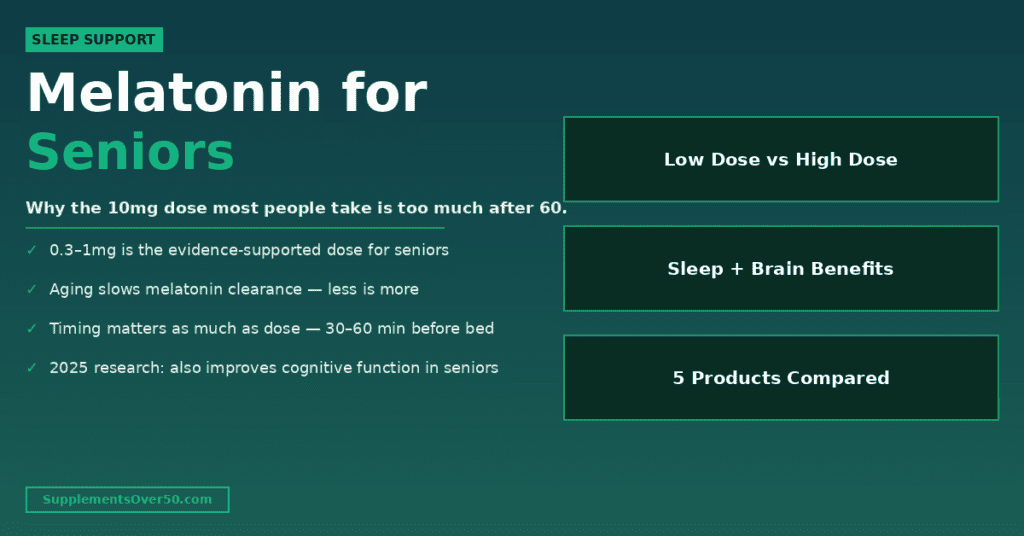
Melatonin for seniors is one of the most misunderstood supplements in the entire sleep category. Walk into any Walmart or CVS and the most prominent melatonin products are 5mg, 10mg, and even 20mg gummies — marketed as the solution for poor sleep. But for adults over 60, these doses are not just unnecessary. Research suggests they actively work against the way aging changes melatonin sensitivity and clearance.
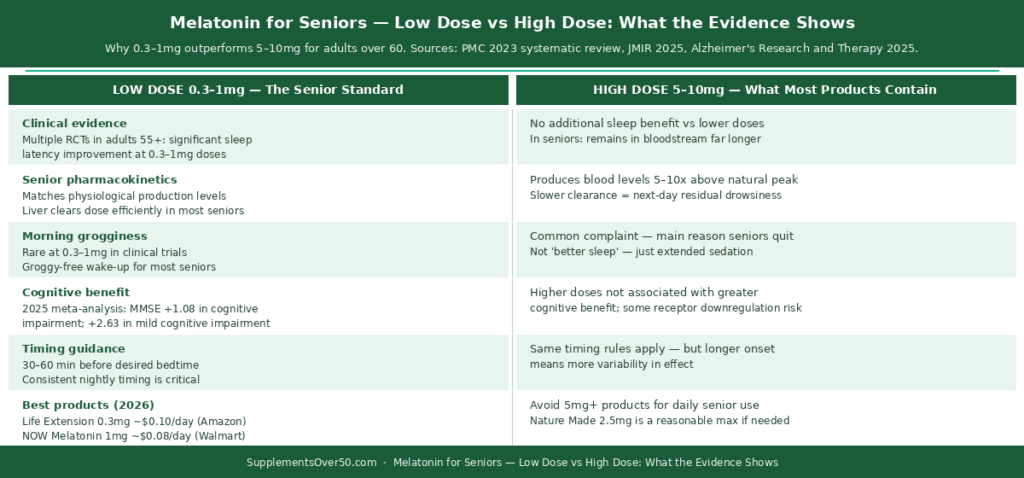
The counter-intuitive truth: adults over 60 need less melatonin, not more. The reason is pharmacokinetic — aging slows the liver’s ability to break down and clear melatonin from the bloodstream. A 5mg dose in a 65-year-old produces blood melatonin levels 5–10 times higher than what the body naturally produces at peak, remains elevated for longer than intended, and leaves residual drowsiness the next morning. Meanwhile, doses of 0.3–0.5mg — closer to physiological levels — have been shown in multiple clinical trials to improve sleep latency in older adults without the next-day grogginess associated with higher doses.
This guide explains the science, the correct dose range for seniors, the timing, the drug interactions you need to know about, and five products at US retailers with 2026 pricing.
| The Clinical Story in Brief Multiple RCTs in adults over 55 show modest but significant improvements in sleep latency and subjective sleep quality at doses of 0.3–1mg melatonin — doses far below what most commercial products provide. A 2025 JMIR study found both 0.5mg and 3mg melatonin improved sleep vs placebo in a personalised N-of-1 crossover trial. A 2025 meta-analysis in Alzheimer’s Research and Therapy found melatonin significantly improved cognitive function in adults with mild cognitive impairment (MMSE improvement of 1.08 points), suggesting benefits beyond sleep for the senior population. |
Why Melatonin for Seniors Changes Levels After 60 — The Aging Pineal Gland
Melatonin is produced by the pineal gland in the brain, triggered by darkness and suppressed by light. Production naturally peaks in young adults at around 80–100 pg/mL in the bloodstream and declines steadily with age. By age 70, many adults produce only 20–30% of the melatonin they did at 30 — a phenomenon directly linked to the pineal gland’s calcification and reduced sensitivity over time.
The practical effects of this decline are well-recognised: later sleep onset, more fragmented sleep, earlier waking, and reduced total sleep time. Adults over 60 are disproportionately affected by insomnia — an estimated 50% report some degree of sleep difficulty compared to 30% in younger adults.
The problem with high-dose melatonin supplements is twofold. First, aging also reduces the liver’s melatonin clearance rate — so a 10mg dose lingers in the bloodstream far longer than intended. Second, chronic exposure to supraphysiological melatonin levels can downregulate the body’s own melatonin receptors over time, potentially making the underlying problem worse. The therapeutic window for melatonin in older adults is much narrower than in younger people, and it sits at a much lower dose than most commercial products provide.
What the Research Shows — Dose, Timing and Effects
The Dose Evidence
A systematic review in PMC confirms that several smaller trials in adults over 55 show modest but significant improvements in sleep latency and subjective sleep quality with melatonin doses of 0.3–1mg. At higher doses, the evidence does not show proportionally better outcomes — and side effects (next-day drowsiness, headache, dizziness) increase.
A 2025 personalised N-of-1 crossover trial in JMIR Formative Research compared 0.5mg, 3mg, and placebo in adults with poor sleep. Both melatonin doses improved sleep vs placebo, but the improvement was not significantly greater at 3mg than at 0.5mg — suggesting that for most adults, the lowest effective dose is also the best dose. Sleep is when the brain activates the glymphatic system to clear amyloid and tau proteins — the structural integrity of this system depends in part on adequate DHA in neural cell membranes. For the omega-3 brain health evidence: Can Omega-3s Really Slow Brain Decline After 60? What the 2025 Research Shows.
For the specific application of sleep phase shifting — helping seniors who fall asleep too early or wake too early due to advanced sleep phase syndrome — doses as low as 0.3–0.5mg taken at a specific clock time are more effective than higher doses for phase adjustment.
The Timing Evidence
Timing is as important as dose for melatonin. The supplement works as a chronobiotic — a signal that tells the body what time it is — rather than as a sedative. This means taking melatonin at the right clock time relative to desired sleep onset matters significantly:
- For difficulty falling asleep: take 30–60 minutes before desired bedtime
- For early morning waking: lower doses (0.3mg) taken earlier in the evening (8–9pm) can shift the sleep phase forward
- For jet lag or shift work: timing shifts based on destination time zone
- A 2025 meta-analysis found melatonin administered between 20:30 and 21:00 produced the strongest cognitive effects in adults with mild cognitive impairment
Consistency of timing matters as much as the dose itself. Taking melatonin at the same time each night reinforces the circadian signal — irregular timing undermines its effectiveness.
Beyond Sleep — The Cognitive Connection
A 2025 meta-analysis in Alzheimer’s Research and Therapy reviewed 8 RCTs (518 participants) and found melatonin supplementation significantly improved cognitive function in adults with cognitive impairment — MMSE improvement of 1.08 points overall, and 2.63 points in adults with mild cognitive impairment specifically. The strongest effects were seen at 13–24 weeks of supplementation, suggesting melatonin’s neuroprotective effects are cumulative.
The mechanism is likely melatonin’s antioxidant properties — it is one of the most potent naturally occurring antioxidants in the brain, capable of crossing the blood-brain barrier and neutralising free radicals in neural tissue. For seniors managing both sleep and cognitive concerns, melatonin’s dual role is clinically meaningful. Melatonin signals the brain that it is time to sleep — magnesium prepares the nervous system to actually wind down by activating GABA receptors. The two supplements address complementary aspects of sleep and work better together than either alone: Best Magnesium Supplement for Sleep After 50 — Glycinate vs L-Threonate Explained.
For the complete non-habit-forming sleep supplement protocol covering melatonin, magnesium, ashwagandha, and L-theanine ranked by evidence: 5 Best Sleep Supplements for Seniors — Ranked by Evidence (Non-Habit-Forming).
Melatonin Drug Interactions — What Seniors Must Know
| Medication | Interaction | Action Required |
| Warfarin (blood thinner) | Melatonin may increase prothrombin time / INR | Monitor INR closely; discuss with prescribing physician before starting |
| Nifedipine (BP medication) | 5mg melatonin raised systolic BP by 6.5 mmHg in one trial | Monitor blood pressure; may need dose adjustment of BP medication |
| Immunosuppressants | Melatonin has immunomodulatory effects — may interfere | Consult prescribing physician; particularly relevant post-transplant |
| Diabetes medications | Melatonin may affect blood glucose regulation | Monitor blood glucose when starting; discuss with physician |
| Sedatives / benzodiazepines | Additive sedation — increased fall risk in seniors | Do not combine without physician guidance; fall risk is serious |
| Caffeine | Caffeine delays melatonin onset — counteracts supplement | Avoid caffeine after 2pm for best melatonin effectiveness |
| ⚠️ Fall Risk Warning Any sedating supplement increases fall risk in seniors, particularly at night when getting up to use the bathroom. At low doses (0.3–1mg), next-day drowsiness is minimal. At doses of 5mg or above, residual sedation in older adults is significant due to slower clearance — increasing the risk of night-time falls. Keep the dose at 0.5–1mg and ensure the path to the bathroom is well lit. |
5 Best Melatonin Supplements for Seniors — US Pricing 2026
1. Life Extension Melatonin 300mcg (0.3mg) — LifeExtension.com / Amazon — Best Low Dose
Best for: seniors who want the most physiologically appropriate dose with the highest quality standard.
| Formula | 0.3mg (300mcg) melatonin per capsule — closest to the research-recommended dose for seniors |
| Price (2026) | ~$8–12 for 100 capsules (~$0.08–0.12/day) — excellent value |
| Third-Party Tested | Non-GMO; manufactured in Life Extension’s NSF-registered facility; Certificate of Analysis available |
| Best For | Seniors new to melatonin, those with high medication sensitivity, or anyone who has experienced grogginess on higher doses |
| Notes | 0.3mg is the dose used in the foundational low-dose senior sleep trials. Start here before trying higher doses. |
2. NOW Foods Melatonin 1mg — Walmart / Amazon — Best Budget 1mg
Best for: seniors who want a step up from 0.3mg at a very low price point.
| Formula | 1mg melatonin per tablet — scored tablet can be halved to 0.5mg if needed |
| Price (2026) | ~$6–10 for 100 tablets at Walmart (~$0.06–0.10/day) |
| Third-Party Tested | NOW IGEN Non-GMO; GMP certified; NSF registered facility |
| Best For | Budget-conscious seniors who find 0.3mg insufficient but want to stay in the low-dose range |
| Notes | Scored tablet allows easy halving to 0.5mg — useful for finding the minimum effective dose |
3. Natrol Melatonin 1mg Fast Dissolve — Walmart / Amazon — Best for Fast Onset
Best for: seniors who struggle to swallow tablets or want faster absorption.
| Formula | 1mg melatonin per fast-dissolve tablet — strawberry flavour, dissolves under tongue |
| Price (2026) | ~$8–12 for 90 tablets at Walmart (~$0.09–0.13/day) |
| Third-Party Tested | Non-GMO; Natrol is one of the most established melatonin brands in the US |
| Best For | Seniors with swallowing difficulty; sublingual absorption may produce faster onset than standard tablets |
| Notes | Fast-dissolve format is convenient but check for added sugars if managing blood glucose |
4. Solgar Melatonin 1mg — iHerb / Amazon — Best Premium 1mg
Best for: seniors who want a premium, clean-label melatonin at a mid-range price.
| Formula | 1mg melatonin per nugget — vegetarian, gluten-free, dairy-free |
| Price (2026) | ~$12–16 for 60 nuggets (~$0.20–0.27/day) |
| Third-Party Tested | Informed Sport certified; free from all major allergens; Kosher certified |
| Best For | Seniors with multiple dietary restrictions who want clean-label assurance |
| Notes | Higher per-unit cost but excellent purity standards; Solgar has 75+ years of supplement manufacturing history |
5. Nature Made Melatonin 2.5mg — Walmart / Amazon — Best for Moderate Dose Seniors
Best for: seniors who have tried 1mg without sufficient effect and want to step up cautiously.
| Formula | 2.5mg melatonin per tablet — USP Verified |
| Price (2026) | ~$8–12 for 90 tablets at Walmart (~$0.09–0.13/day) |
| Third-Party Tested | USP Verified — the highest OTC supplement certification for purity and potency accuracy |
| Best For | Seniors who found 1mg insufficient; 2.5mg is a reasonable step before going to 5mg |
| Notes | Still well below the 5–10mg doses in most commercial products; USP verification ensures accurate labelling |
Practical Guide — How to Use Melatonin After 60
| Question | Evidence-Based Answer |
| Starting dose? | 0.3–0.5mg. If insufficient after 2 weeks, increase to 1mg. Only go above 1mg if clearly needed. |
| When to take it? | 30–60 minutes before desired sleep time. Consistent timing nightly is more important than the exact time. |
| How long to use it? | Short-term (2–4 weeks) for acute sleep disruption. Long-term use is common but discuss with physician for chronic insomnia. |
| Can I take it every night? | Yes — melatonin is not habit-forming and does not cause withdrawal. Daily use at low doses is safe in most healthy seniors. |
| What to avoid? | Bright screens and artificial light in the 1–2 hours before taking melatonin — light exposure suppresses endogenous melatonin and reduces supplement effectiveness. |
| What if it doesn’t work? | Melatonin works best for circadian rhythm disruption, not structural insomnia. If sleep problems persist, see a sleep specialist — CBT-I (cognitive behavioural therapy for insomnia) has stronger evidence than any supplement for chronic insomnia. |
Related Articles on SupplementsOver50.com
• Best Magnesium Supplement for Sleep After 50: Glycinate vs L-Threonate
• Best Magnesium for Leg Cramps and Sleep After 50
• Ashwagandha for Women Over 50 — Menopause Symptoms, Anxiety, Sleep and the Evidence
• Magnesium Glycinate vs Citrate — Which Form Is Better for Seniors After 50?
• The 5 Essentials — Supplements Every Adult Over 60 Should Know
References
4. PMC 2019: Should melatonin be used as a sleeping aid for elderly people? Systematic review
5. PMC 2012: Melatonin pharmacokinetics in older adults — low dose vs high dose formulations
Frequently Asked Questions
What is the correct melatonin dose for seniors over 60?
The evidence-supported dose range for adults over 60 is 0.3–1mg taken 30–60 minutes before bedtime. Multiple clinical trials in adults over 55 show significant sleep improvements at doses of 0.3–1mg — far below the 5–10mg doses found in most commercial products. Aging slows melatonin clearance from the bloodstream, meaning older adults experience higher and longer-lasting blood levels from the same dose as younger adults. Start at 0.3–0.5mg and only increase to 1mg if clearly insufficient after 2 weeks.
Why does melatonin cause morning grogginess in older adults?
High-dose melatonin (5–10mg) lingers in the bloodstream of older adults for much longer than in younger people because liver clearance slows with age. A 10mg dose can produce blood melatonin levels 5–10 times higher than natural peak production, remaining elevated well into the next morning. This residual melatonin causes the drowsiness, brain fog, and slow start many seniors report after taking commercial melatonin products. Switching to 0.3–1mg typically eliminates this problem entirely.
Can melatonin interact with blood pressure medications?
Yes — one notable interaction is with nifedipine (a calcium channel blocker). A study found that 5mg of melatonin for four weeks in nifedipine users raised systolic blood pressure by 6.5 mmHg and diastolic by 4.5 mmHg. Blood pressure monitoring is recommended when starting melatonin alongside any antihypertensive medication. Melatonin also interacts with warfarin (blood thinners), immunosuppressants, and sedatives — inform your physician and pharmacist of all supplements before starting.
Is melatonin habit-forming for seniors?
No — melatonin is not addictive and does not cause physical dependence or withdrawal. However, some people experience rebound insomnia for a few nights when stopping after prolonged high-dose use. At physiological doses of 0.3–1mg, this is rarely an issue. Melatonin can be stopped at any time without tapering. For chronic insomnia that requires ongoing supplementation, a sleep specialist evaluation and cognitive behavioural therapy for insomnia (CBT-I) is recommended alongside any supplement approach.
Does melatonin help with more than just sleep in seniors?
Yes — a 2025 meta-analysis in Alzheimer’s Research and Therapy found melatonin significantly improved cognitive function in adults with cognitive impairment, with an MMSE improvement of 1.08 points overall and 2.63 points in mild cognitive impairment specifically. The strongest effects appeared after 13–24 weeks. Melatonin is also a potent antioxidant that crosses the blood-brain barrier, and emerging research links low melatonin to increased neuroinflammation — suggesting a broader neuroprotective role in aging adul
What is the safest melatonin dose for someone over 65?
The research is clear on this: less is more for seniors. While most commercial melatonin products come in 5mg or 10mg doses, clinical trials in adults over 65 consistently show 0.3mg to 1mg is equally or more effective for sleep onset — with significantly fewer side effects. The reason: aging slows melatonin clearance by the liver, so a 5mg dose produces blood levels 5–10 times higher than physiological peak and lingers until morning, causing the grogginess and balance impairment that many seniors report. Look specifically for 0.3mg or 0.5mg products — Life Extension makes a 300mcg (0.3mg) option that delivers a physiological replacement dose rather than a pharmacological overdose.
Can melatonin cause falls in seniors?
Yes — at the wrong dose. Standard commercial doses of 5–10mg produce supraphysiological blood levels that persist into the following morning in seniors with slower liver clearance. This residual melatonin causes morning grogginess, impaired balance, and slower reaction times — all established fall risk factors. At the correct low dose of 0.3–1mg, this risk is dramatically reduced because the hormone clears overnight as it would physiologically. The Beers Criteria — the authoritative list of medications inappropriate for older adults — lists high-dose melatonin as a fall risk, while acknowledging that low-dose physiological replacement does not carry the same concern. Always start at 0.3mg and increase only if ineffective.
Does melatonin interact with blood pressure medication?
Yes — two interactions are clinically relevant for seniors. First, melatonin and calcium channel blockers (nifedipine, amlodipine) can interact — a study found that 5mg melatonin raised blood pressure in patients taking nifedipine, though the low 0.3mg dose carries much lower risk. Second, melatonin has mild antiplatelet effects additive with warfarin — monitor INR when starting. Additional interactions to disclose to your physician: melatonin may enhance the sedative effects of benzodiazepines and enhance blood glucose lowering with diabetes medications. Always disclose melatonin use to the physician managing your cardiovascular medications before starting.
When should seniors take melatonin for best results?
Timing is as important as dose for melatonin — it works as a circadian signal rather than a sedative, so timing relative to your target sleep time matters. Take melatonin 30–60 minutes before your intended sleep time consistently at the same clock time each night. Consistency of timing trains the circadian rhythm more effectively than variable timing. Do not take melatonin in the middle of the night after waking — it will delay your circadian phase and worsen next-night sleep. If you wake at 2–3am, magnesium glycinate (taken at bedtime) or L-theanine address middle-of-night waking through different mechanisms than melatonin.
Is long-term melatonin use safe for seniors?
The evidence on long-term use is reassuring but limited beyond 6 months in formal trials. No studies have shown melatonin causes dependence, tolerance, or suppression of natural melatonin production — unlike benzodiazepines which cause both. The most common concern with long-term use is dose creep — seniors who start at 0.5mg and gradually increase to 5mg over time experience the grogginess and balance risk associated with high doses. At physiological doses of 0.3–1mg, long-term daily use appears safe. A reasonable approach: use consistently for 3 months, then take a 2-week break to assess whether natural circadian function has improved with the support.
How is melatonin different from prescription sleep medications?
Melatonin works as a chronobiotic — a circadian timing signal that tells the brain it is nighttime, promoting natural sleep initiation without suppressing the central nervous system. Prescription sleep medications (benzodiazepines, Z-drugs like zolpidem/Ambien) are CNS depressants that force sedation regardless of circadian state. The Beers Criteria lists both benzodiazepines and Z-drugs as potentially inappropriate for older adults due to fall risk, cognitive impairment, dependence, and increased accident risk. Melatonin at physiological doses does not cause dependence, does not impair driving at low doses, and does not produce rebound insomnia on discontinuation — making it the safer first-line option for seniors with sleep difficulty.
The Bottom Line
Melatonin for seniors works — but not the way the 10mg gummies at the pharmacy would suggest. The optimal dose for adults over 60 is 0.3–1mg, taken 30–60 minutes before bedtime at a consistent time each night. Higher doses produce longer-lasting blood levels in older adults due to reduced clearance, causing next-day grogginess rather than better sleep.
Start with Life Extension 0.3mg or NOW 1mg (which can be halved to 0.5mg) — both are available at under $0.12/day and represent the clinically appropriate dose range. Avoid light exposure in the hour before taking it, be consistent with timing, and expect gradual improvement over 1–2 weeks rather than immediate effect. Pair with magnesium glycinate for the most comprehensive non-sedating sleep support protocol for seniors.