| ⚕️ Supplement Disclosure This article reviews supplements for natural testosterone support for informational purposes only. Men with diagnosed hypogonadism (clinically low testosterone confirmed by blood test) should discuss prescription testosterone replacement therapy with their doctor — supplements are not a substitute for medical treatment of confirmed hormonal deficiency. Men taking blood pressure medications, anticoagulants or medications affecting hormone levels should check with their doctor before adding supplements. |
Natural testosterone support for men over 50 is one of the most searched men’s health topics online — and one of the most aggressively marketed. The supplement industry sells billions of dollars worth of ‘testosterone booster’ products annually, many of which are built on inflated claims, excessive zinc doses and ingredients with no human trial evidence.
This guide takes the opposite approach: we start with the biology of age-related testosterone decline, identify the specific nutrient deficiencies that most commonly drive avoidable testosterone reduction in men over 50, review the honest clinical evidence for each intervention, and identify the products that deliver therapeutic doses without the hype or the risk.
The core finding from the research is both encouraging and sobering: correcting genuine nutritional deficiencies — particularly vitamin D and zinc — can meaningfully support testosterone levels in men who are deficient. Adaptogenic herbs like ashwagandha have real evidence for modest testosterone support and significant cortisol-reducing benefits. Most proprietary ‘T-booster’ formulas, however, contain ingredients at sub-therapeutic doses with limited evidence.
| The most important fact about testosterone and supplements: a 2019 PMC review of 50 testosterone booster supplements found only 24.8% of ingredients had published data showing a testosterone increase. More concerning — 10.1% of ingredients had data showing a testosterone decrease, and 61.5% had no published data on testosterone effect at all. This is the market you are navigating. |
Understanding Age-Related Testosterone Decline After 50
Testosterone levels in men decline gradually from around age 30 at approximately 1–2% per year. By age 60, most men have testosterone levels roughly 20–30% lower than their peak. This is a normal physiological process — not a disease. The clinical threshold for testosterone deficiency requiring medical treatment is confirmed low testosterone on blood test combined with symptoms including significant fatigue, loss of muscle mass, severe loss of libido or sexual dysfunction.
The important distinction for supplement purposes: there is a meaningful difference between normal age-related decline that supplements may support, and clinical hypogonadism that requires prescription testosterone replacement therapy (TRT). Supplements are not appropriate as a substitute for TRT in confirmed deficiency, but they can address the nutritional factors that contribute to avoidable testosterone reduction in otherwise healthy men over 50.
The Four Nutritional Drivers of Avoidable Testosterone Decline
Research consistently identifies four correctable nutritional deficiencies that contribute to lower-than-expected testosterone in older men:
- Vitamin D deficiency — affects an estimated 40% of US adults over 60 and is directly associated with lower testosterone levels
- Zinc deficiency — essential for androgen synthesis; even mild deficiency reduces circulating testosterone
- Magnesium deficiency — affects testosterone bioactivity and free testosterone levels
- Chronically elevated cortisol — stress hormone is inversely associated with testosterone production; the cortisol-testosterone seesaw is a primary mechanism
Addressing these four factors through targeted supplementation is the evidence-based approach to natural testosterone support. The elaborate ‘booster’ formulas with 20+ ingredients typically address the same four deficiencies — they just add expensive botanical extras around the same core.
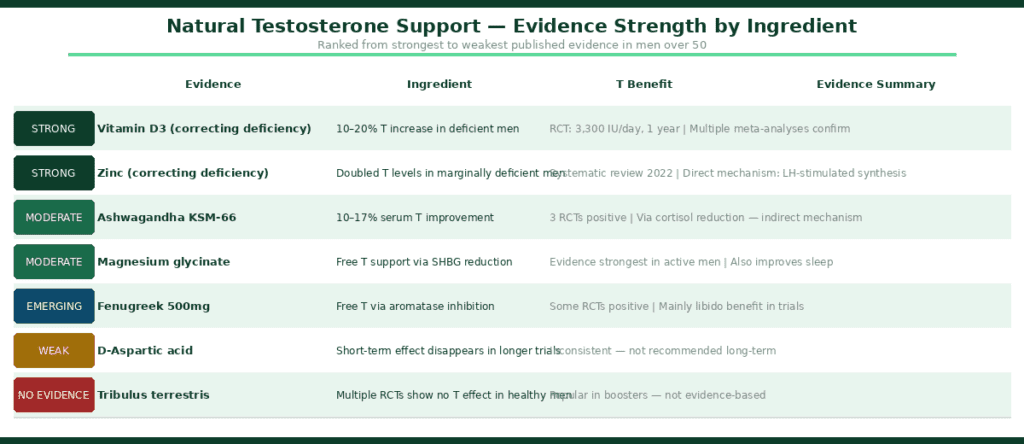
Not all testosterone support ingredients are equal — most are not supported by published human trial evidence at all. Vitamin D3 and zinc show the strongest evidence when correcting confirmed deficiency. Ashwagandha KSM-66 produces real but indirect testosterone support via cortisol reduction. Tribulus terrestris appears in the majority of T-booster formulas despite consistent null results in randomised trials. Sources: USC PMC review of 50 testosterone supplements 2019, Hormone and Metabolic Research 2011, systematic review of zinc and testosterone 2022.What the 2024–2025 Evidence Shows — Ingredient by Ingredient
Vitamin D3 — Strongest evidence base
A yearlong RCT cited on WebMD found 65 men taking 3,300 IU of vitamin D daily increased testosterone levels by 20% over those who did not supplement. Meta-analyses confirm that correcting vitamin D deficiency at 2,000–5,000 IU daily can raise total testosterone 10–20% over three months in deficient men. The mechanism is direct — vitamin D receptors are found in the testes and Leydig cells responsible for testosterone production.
Critical caveat: the effect is most significant in men who are deficient. Men with adequate vitamin D levels see minimal testosterone benefit from additional supplementation. Get a blood test for 25(OH)D levels before supplementing — deficiency is below 20 ng/mL, insufficiency is 20–30 ng/mL.
Zinc — Well-evidenced for deficient men
A 2022 systematic review confirmed that zinc supplementation significantly increases testosterone levels in men with zinc deficiency. The mechanism is direct — zinc is essential for LH-stimulated androgen synthesis in Leydig cells. However, the same dose-dependence caveat applies: the benefit is strongest in men who are deficient. Excess zinc above 40mg daily is counterproductive — it depletes copper, impairs immune function and may have adverse effects.
Therapeutic dose for testosterone support: 25–30mg elemental zinc daily for deficient men. For maintenance in men with adequate zinc: 11–15mg from a multivitamin is appropriate. Food sources: oysters are the richest source, followed by beef, pumpkin seeds and legumes.
Excessive zinc in aggressive T-booster formulas is also a prostate concern — zinc is concentrated in prostate tissue and the dose relationship is delicate. See our Prostate Supplements for Men Over 50 guide for the safe upper limits and how zinc interacts with saw palmetto and beta-sitosterol.
Magnesium — Supports free testosterone
Magnesium influences testosterone bioactivity by reducing sex hormone-binding globulin (SHBG) — the protein that binds testosterone and renders it unavailable. Lower SHBG means more free testosterone available to tissues. Research shows magnesium supplementation may support both total and free testosterone levels, particularly in active men. The effect is modest but meaningful for men who are the very common ‘subclinically deficient’ in magnesium.
Therapeutic dose: 200–350mg elemental magnesium daily from glycinate or citrate. Most men over 60 are under-consuming magnesium — the average US dietary intake is below the 420mg RDA for men over 51.
Not all magnesium forms are equal for free testosterone support — glycinate absorbs significantly better than oxide and avoids the laxative effect of citrate at higher doses. See our full breakdown in Magnesium Glycinate vs Citrate for Seniors to choose the right form and dose.”
Ashwagandha KSM-66 — Cortisol reduction drives testosterone support
Three published randomised controlled trials found significant increases in testosterone levels in men taking specific ashwagandha formulations — particularly KSM-66 — compared to placebo. The primary mechanism is cortisol reduction: ashwagandha’s HPA axis modulation lowers chronically elevated cortisol, which is inversely associated with testosterone production. As cortisol drops, testosterone rises through the same adrenal pathway. A 2022 RCT published in PMC found standardised ashwagandha root extract significantly improved testosterone levels, well-being and sexual performance in adult males.
The honest framing: ashwagandha’s testosterone effect is indirect (via cortisol reduction) and modest — typically 10–17% improvement in serum testosterone levels. The more robust and consistent benefits are stress reduction, sleep quality improvement and overall vitality — which are genuinely meaningful for men over 50 experiencing stress-related testosterone suppression.
Therapeutic dose: 300–600mg KSM-66 extract daily. Allow 8–12 weeks minimum for testosterone-related effects.
Fenugreek — Supports free testosterone via enzyme inhibition
Fenugreek (500–600mg standardised extract daily) appears to support free testosterone by inhibiting aromatase — the enzyme that converts testosterone to oestrogen. As men age, aromatase activity increases, which can contribute to lower free testosterone. Fenugreek’s inhibitory effect on this conversion pathway represents a different mechanism from the vitamin D and zinc approaches. Evidence from several RCTs shows improvements in libido and modest improvements in free testosterone measures.
DHEA — Prescription-territory caution
DHEA is a hormone precursor that converts to both testosterone and oestrogen. While a meta-analysis of dozens of clinical trials confirmed DHEA supplements do increase blood testosterone levels in men, DHEA operates at the prescription-adjacent edge of supplementation. Men considering DHEA should discuss it with their doctor and confirm baseline DHEA-S blood levels first. It is not appropriate for self-supplementation without medical guidance.
What does NOT work — despite the marketing
| Ingredient | Marketing Claim | Honest Evidence Summary |
| Tribulus terrestris | Increases testosterone naturally | Multiple RCTs show no significant effect on testosterone in healthy men. Popular in boosters but not evidence-based. |
| D-aspartic acid (DAA) | Boosts LH and testosterone | Short-term studies show modest effects; longer trials show the effect disappears or reverses. Inconsistent evidence. |
| Maca root | Traditional testosterone support | Evidence primarily for libido and energy — not consistently shown to raise testosterone levels in human trials. |
| Proprietary blends | Synergistic formula | USC review found 61.5% of ingredients in T-booster supplements had NO published data on testosterone effect. Proprietary blends hide sub-therapeutic doses. |
| The clearest signal of a low-quality testosterone booster: a proprietary blend that lists ingredients without individual doses. This is almost always used to hide the fact that each ingredient is present at a fraction of the dose used in clinical trials — providing label appeal without therapeutic effect. |
5 Best Natural Testosterone Support Products — US Pricing 2026
1. Physician’s Choice KSM-66 Ashwagandha 1,000mg (Walmart) — Best Single-Ingredient Cortisol + T Support
For men whose primary testosterone suppression mechanism is chronic stress and elevated cortisol — the most common pattern in men over 50 — a high-quality KSM-66 ashwagandha is the most targeted single-ingredient intervention. 1,000mg KSM-66 standardised to 5% withanolides per serving. Available at Walmart for approximately $22–28 for 60 capsules (~$0.37–0.47 per day).
- KSM-66: 1,000mg (5% withanolides) per serving
- Price per day: ~$0.42 (Walmart)
- Best for: Men whose low energy and mood are stress-driven — best first-line natural testosterone support
2. Life Extension Zinc 50mg (Amazon / Walmart) — Best Targeted Zinc Supplementation
For men with confirmed or suspected zinc deficiency — frequent alcohol consumption, vegetarian diet, high physical activity, use of acid-reducing medications — a standalone zinc supplement at a controlled dose is more effective and safer than a high-dose T-booster formula. Life Extension Zinc 50mg delivers a precise dose with no other variables. Available at Amazon and Walmart for approximately $8–12 for 90 capsules (~$0.09–0.13 per day).
- Zinc: 50mg as zinc citrate (well absorbed)
- Price per day: ~$0.11 (Amazon/Walmart)
- Important: Do not take 50mg zinc daily long-term without medical guidance — take with copper supplement or cycle with periods of 11–15mg maintenance dose
- Best for: Men who have identified zinc deficiency as a likely cause of low testosterone
Your daily multivitamin zinc dose counts toward your total — see our Best Multivitamin for Men Over 60 guide to confirm whether your current formula delivers the right 11–15mg baseline without pushing you toward the 40mg upper limit when combined with a testosterone support supplement.
3. NOW Vitamin D3 5,000 IU (Amazon / Walmart) — Best Vitamin D3 for Deficient Men
For men with confirmed vitamin D deficiency (25(OH)D below 20 ng/mL), correcting deficiency at 5,000 IU daily for 3 months before maintaining at 2,000 IU is the most evidence-supported single intervention for testosterone support. NOW D3 5,000 IU is USP-equivalent quality at an exceptionally low price. Available at Amazon and Walmart for approximately $12–16 for 240 softgels (~$0.05–0.07 per day).
- Vitamin D3: 5,000 IU per softgel
- Price per day: ~$0.06 (Amazon/Walmart — exceptional value)
- Protocol: 5,000 IU for first 3 months if deficient, retest blood level, maintain at 2,000 IU once sufficient
- Best for: Men with confirmed vitamin D deficiency — the highest-evidence natural testosterone support intervention
4. Doctor’s Best Magnesium Glycinate 200mg (Amazon) — Best Magnesium for Free Testosterone
Magnesium glycinate at 200–350mg elemental magnesium is the most under-utilised testosterone support intervention — and one of the most evidence-supported. It also improves sleep quality and reduces muscle cramps, providing multi-system benefits alongside its SHBG-reducing effect on free testosterone. Available on Amazon for approximately $18–24 for 120 tablets (~$0.15–0.20 per day).
- Magnesium glycinate: 200mg elemental per 2-tablet serving
- Price per day: ~$0.17 (Amazon)
- Certification: Non-GMO, gluten-free, vegan
- Best for: Men who want free testosterone support alongside sleep and muscle health benefits
5. Nature’s Bounty Testosterone Support with Fenugreek (Amazon / Walmart) — Best Evidence-Based Combination Formula
For men who prefer a combination formula over individual supplements, Nature’s Bounty offers a conservative, evidence-based stack of zinc, B6 and fenugreek at reasonable doses without the excessive zinc or proprietary blends of the aggressive T-booster category. Available at Amazon and Walmart for approximately $14–20 for 60 tablets (~$0.23–0.33 per day).
- Contains: Zinc + B6 + Fenugreek extract at disclosed doses
- Price per day: ~$0.28 (Walmart)
- Certification: Non-GMO, no artificial additives
- Best for: Men who want a modest, safe combination formula without excessive doses of any individual ingredient
Honest Realistic Expectations — What Supplements Can and Cannot Do
| Intervention | Realistic Testosterone Benefit | Timeline |
| Correcting vitamin D deficiency | 10–20% increase in total testosterone in deficient men — strongest evidence | 3 months at 2,000–5,000 IU daily |
| Correcting zinc deficiency | Meaningful restoration in deficient men — zinc doubled levels in marginally deficient older men in one study | 6–8 weeks at 25–30mg daily |
| Magnesium supplementation | Modest improvement in free testosterone via SHBG reduction — most notable in active men | 6–8 weeks at 200–350mg daily |
| Ashwagandha KSM-66 | 10–17% improvement in serum testosterone via cortisol reduction — strongest for stressed men | 8–12 weeks at 300–600mg daily |
| Fenugreek extract | Modest improvement in free testosterone via aromatase inhibition — mainly libido benefit in trials | 8 weeks at 500mg daily |
| Generic T-booster formula (proprietary blend) | Unpredictable — majority of ingredients have no testosterone evidence; some have negative evidence | Not recommended |
The lifestyle factors that produce larger testosterone improvements than any supplement: resistance training 3x weekly (consistently shown to raise testosterone significantly), adequate sleep at 7–9 hours per night (testosterone is produced primarily during deep sleep — sleep deprivation dramatically reduces production), and reducing excess alcohol consumption (even moderate drinking suppresses testosterone synthesis).
Related Articles
• Prostate Supplements for Men Over 50 — Saw Palmetto vs Beta-Sitosterol
• Best Multivitamin for Men Over 60 — Prostate, Heart and Brain Nutrients Compared
• Creatine for Seniors — Brain, Muscle and Energy Benefits
Frequently Asked Questions
Can supplements actually raise testosterone in men over 50?
Yes — but specifically by correcting deficiencies that are suppressing testosterone below your natural baseline, not by elevating testosterone above it. Correcting vitamin D deficiency at 2,000–5,000 IU daily has raised total testosterone by 10–20% in deficient men in published RCTs. Correcting zinc deficiency has shown even stronger effects in marginally deficient older men. Ashwagandha KSM-66 has produced 10–17% improvements in serum testosterone via cortisol reduction across multiple trials. These are real and meaningful effects — but they are restoring normal function, not adding supraphysiological testosterone.
What is the most effective natural testosterone booster for men over 50?
Get a blood test first. If your vitamin D is below 20 ng/mL, correcting that deficiency is likely the single highest-impact intervention — one yearlong study found 3,300 IU daily increased testosterone by 20% in deficient men. If stress and elevated cortisol are primary concerns, KSM-66 ashwagandha at 300–600mg daily addresses the cortisol-testosterone seesaw directly. If zinc deficiency is suspected, 25–30mg daily for 6–8 weeks can restore levels significantly. Combining D3 correction, KSM-66 and magnesium glycinate is the most evidence-based natural stack for men over 50.
Is low testosterone normal after 50 or should I see a doctor?
Both. A gradual 1–2% annual decline from age 30 is normal physiology and does not require treatment. However, confirmed clinical hypogonadism — testosterone below 300 ng/dL on blood test combined with significant symptoms including severe fatigue, loss of muscle mass, sexual dysfunction or depression — warrants a doctor’s evaluation for testosterone replacement therapy. If your symptoms are mild and your testosterone is in the low-normal range, lifestyle optimisation and targeted supplementation are appropriate first steps. Do not self-supplement to address symptoms that may actually be caused by a treatable medical condition.
How long before I see results from testosterone support supplements?
Expect 8–12 weeks of consistent use before evaluating results. Vitamin D correction effects on testosterone typically appear over 3 months. Zinc supplementation effects emerge within 6–8 weeks. Ashwagandha KSM-66 testosterone effects are documented at 8–12 weeks in clinical trials, though the cortisol reduction and improved sleep quality often appear within 2–4 weeks. Track your energy levels, sleep quality and morning erections as proxy measures of improvement — these are more sensitive indicators of testosterone optimisation than waiting for a blood test.
Are testosterone booster supplements safe for men over 60?
It depends entirely on the specific formula. Targeted supplementation with D3, zinc at controlled doses, magnesium glycinate and KSM-66 ashwagandha is safe for most healthy men over 60. The risk comes from aggressive proprietary ‘T-booster’ formulas with excessive zinc doses (some exceed the 40mg upper tolerable limit), high-dose B6 (above 100mg associated with peripheral neuropathy at sustained high doses), and DHEA or hormone precursors without medical supervision. Choose supplements with disclosed individual ingredient doses, stay within published safe ranges, and check for interactions with any medications you take.
The Bottom Line
Natural testosterone support for men over 50 is real and evidence-based — when it focuses on correcting the genuine nutritional deficiencies and hormonal mechanisms that suppress testosterone below your natural level.
Start with the fundamentals: get a blood test for vitamin D and zinc status. If deficient, correct D3 at 2,000–5,000 IU and zinc at 25–30mg. Add magnesium glycinate at 200–350mg for free testosterone support and sleep quality. If stress and cortisol are significant factors, add KSM-66 ashwagandha at 300–600mg daily. That four-supplement stack costs roughly $0.70–1.00 per day total and targets every evidence-supported mechanism for natural testosterone support.
Skip the proprietary T-booster formulas with hidden doses and ingredient lists built for marketing rather than clinical evidence. The simple targeted approach — fix your deficiencies, reduce cortisol, support magnesium — consistently outperforms the complex booster formulas in actual clinical trials.
References
1. PMC. ‘Testosterone Boosting’ Supplements Composition and Claims Are Not Supported by the Academic Literature. USC review of 50 T-booster supplements. View on PMC
2. PMC (2022). Effect of standardized root extract of ashwagandha on well-being and sexual performance in adult males. View on PMC
3. GoodRx / NIH sources (2025). Supplements that increase testosterone — zinc, DHEA, ashwagandha, vitamin D evidence review. View article
4. Hormone and Metabolic Research (2011). Effect of vitamin D supplementation on testosterone levels in men. Pilz S et al.
5. NIH Office of Dietary Supplements. Zinc Fact Sheet for Health Professionals. View on NIH