
| ⚕️ Supplement Disclosure This article reviews omega-3 fatty acids as dietary supplements and is for informational purposes only. It does not constitute medical advice. If you are taking blood thinners or other medications, or have a bleeding disorder, speak with your doctor before adding a high-dose omega-3 supplement to your routine. |
Omega 3 brain health seniors is one of the most searched supplement topics for adults over 60 — and also one of the most confusing. You have probably seen headlines swinging between “fish oil protects the brain” and “fish oil study finds no benefit.” Both headlines can be technically accurate. The difference almost always comes down to two things: who was studied and how much DHA they actually took.
The honest answer is that omega-3 supplementation does appear to support brain health after 60 — but with important conditions attached. It works best in people who are genuinely low in omega-3s (which describes most adults eating a typical Western diet), at doses that most cheap fish oil supplements simply do not provide, and over a timeframe measured in months rather than weeks.
This article cuts through the noise. We look at what the 2025 clinical evidence actually says, explain the DHA dose gap that most supplement labels hide, and compare five specific products with US pricing so you can make an informed choice.
| The single most important thing to know before buying any fish oil for brain health: most standard fish oil supplements contain only 250–500mg of combined EPA and DHA per serving. Clinical trials showing cognitive benefits typically use 1,000–2,000mg of DHA alone. Reading the label carefully before purchasing is essential. |
Omega 3 Brain Health Seniors – Why Omega-3 Fatty Acids Matter for the Aging Brain
DHA — docosahexaenoic acid — is the primary structural omega-3 fatty acid in the brain. It makes up approximately 30 to 40 percent of the fatty acids in the brain’s grey matter and is concentrated in the cell membranes of neurons. DHA maintains the fluidity of those membranes, which directly affects how efficiently neurons communicate, how receptors function, and how well the brain clears metabolic waste.
The problem is that the human body cannot efficiently produce DHA on its own. It must come from food — primarily oily fish like salmon, mackerel, sardines and herring — or from supplements. Adults over 60 face a compounding challenge: they tend to eat less fish than recommended, their digestive efficiency in absorbing fats may decrease, and their brains are accumulating the wear of decades of lower-than-ideal DHA intake.
An 8-year longitudinal cohort study published in 2025 in the Journal of Dairy Science found that long-term omega-3 supplementation — specifically four or more years of consistent use — produced statistically significant improvements in memory domain scores in older adults. The study also noted a critical pharmacokinetic reason for this: the half-life of DHA in the human brain is approximately 2.5 years, meaning it takes several years of consistent supplementation to meaningfully raise brain DHA levels and see sustained cognitive effects.
| DHA has a 2.5-year half-life in brain tissue. This means omega-3 supplementation is a long-term investment — not a quick fix. Most clinical trials that show no benefit run for only 6–12 months with too low a dose. Most trials that show clear benefit run 12–24 months at higher DHA doses. |
Neuroinflammation is one of the primary drivers of cognitive decline after 60. Pairing a high-DHA fish oil with a curcumin supplement provides a two-pronged approach — omega-3s for structural support, turmeric for the inflammatory environment. See our comparison of [Turmeric vs Boswellia for Joint and Brain Inflammation].
What the 2025 Clinical Evidence Actually Shows
The dose-response relationship — the key finding most articles miss
A 2025 systematic review and dose-response meta-analysis published in Scientific Reports analysed 58 randomised controlled trials and found that each additional 2,000mg per day of omega-3 supplementation was associated with significant improvements in attention (SMD: 0.98) and perceptual speed (SMD: 0.50). Critically, this was a dose-response relationship — meaning more omega-3 produced greater cognitive benefit up to a threshold. Studies using low doses consistently showed weaker or no effects.
The 26,881-participant overview
A 2025 overview of systematic reviews published in Nutrients (PMC) examined clinical data from 26,881 individuals aged 40 and over. Seven out of nine systematic reviews included in the analysis reported improvements in MMSE cognitive scores in the omega-3 intervention groups compared to controls. The review found consistent positive signals particularly in adults with mild cognitive impairment — and notably weaker effects in those who were already cognitively healthy with no omega-3 deficiency.
The postmenopausal women finding
A 2025 randomised controlled trial highlighted in a Neuropsychiatric Disease and Treatment review found that 2,500mg of DHA per day for two months improved working memory and reduced cognitive decline in postmenopausal women. The review noted that lower estrogen levels after menopause reduce the body’s natural DHA metabolism, making supplementation particularly impactful for this group. This is an important finding for the large portion of the senior women’s audience.
Where the evidence is weaker
A 2025 meta-analysis published in Clinical and Translational Neuroscience found no significant effect of omega-3 supplementation on global cognition in adults who were already cognitively healthy and had no omega-3 deficiency. This is an important qualifier: if you eat oily fish two or more times per week and already have adequate omega-3 status, supplementation is unlikely to produce dramatic cognitive improvements. The benefit is strongest for those who are actually deficient — which describes most adults on a Western diet who eat little to no fish.
| The honest bottom line on the research Omega-3 supplementation for brain health after 60 works best for: adults who eat little to no oily fish (the majority of US adults); postmenopausal women with lower DHA metabolism; adults supplementing consistently for 12 months or more; and adults taking at least 1,000mg of DHA per day. If you eat salmon or sardines twice a week and your diet is otherwise healthy, supplementation will add modest additional benefit at best. |
DHA vs EPA — Which One Actually Matters for the Brain?
Most fish oil labels show ‘EPA + DHA combined’ and advertise the total as the selling point. For brain health specifically, the ratio matters — and DHA is the primary driver.
| Fatty Acid | Role in the Brain | Brain Health Evidence |
| DHA (docosahexaenoic acid) | Primary structural component of brain cell membranes. Maintains membrane fluidity and neuronal communication. | Strongest evidence for cognitive benefit. Clinical trials specifically targeting brain health use high-dose DHA. |
| EPA (eicosapentaenoic acid) | Anti-inflammatory role. Reduces neuroinflammation which contributes to cognitive ageing. | Strong evidence for mood and depression. Supporting role in brain health alongside DHA. |
| ALA (alpha-linolenic acid) | Plant-based omega-3 (flaxseed, walnuts). The body converts ALA to EPA and DHA — but conversion is very inefficient in older adults (under 5%). | Poor brain bioavailability in seniors. Not a reliable substitute for direct DHA/EPA supplementation. |
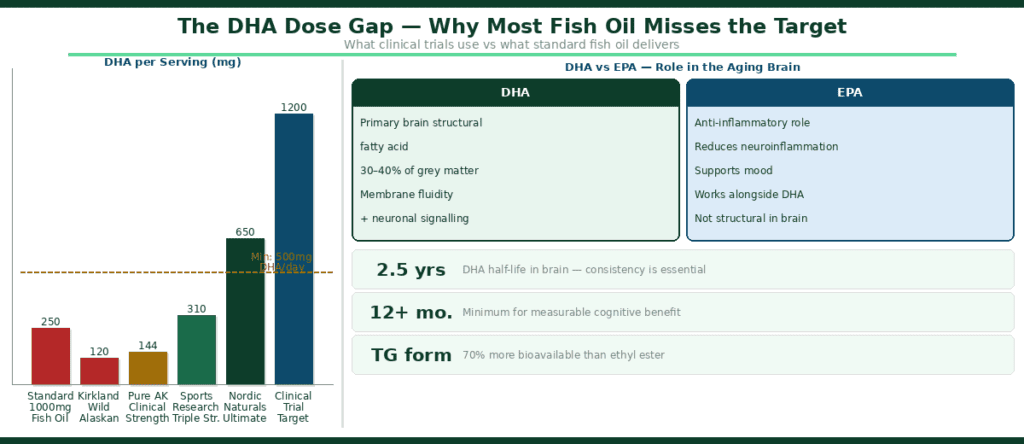
Why most fish oil misses the brain health target — DHA per serving across popular products vs what clinical trials actually use. Sources: Scientific Reports 2025, PMC, ScienceDirect 2025.The practical takeaway: when comparing fish oil supplements for brain health, look at the DHA number specifically — not just the combined omega-3 total. A product showing ‘1,000mg omega-3’ on the front label may contain only 200mg of DHA. That is too low to replicate the doses used in positive clinical trials.
The Label Problem — Why Most Fish Oil Is Under-Dosed for Brain Health
This is the section most supplement reviews skip entirely. Understanding it could save you from buying an ineffective product.
| Product Type | Typical EPA+DHA per Serving | What That Means for Brain Health |
| Standard fish oil (1,000mg softgel) | ~250–300mg combined | Far below clinical trial doses. Fine for general heart health but insufficient for the DHA levels shown to benefit cognition. |
| Concentrated / triple-strength fish oil | ~900–1,100mg combined | Approaching the range used in brain health trials. One softgel per day may be adequate. |
| High-DHA specific formula | 1,000–1,500mg DHA alone | Matches or exceeds doses used in positive cognitive trials. Most effective for brain health goals specifically. |
| What clinical trials typically use | 1,200–2,500mg DHA per day | The benchmark. Most standard OTC fish oils require 4–10 softgels per day to match this — at which point a concentrated formula is far more practical. |
| Quick label check before buying: find ‘DHA’ specifically on the Supplement Facts panel — not just ‘total omega-3’ or ‘fish oil.’ For brain health after 60, aim for a product delivering at least 500mg DHA per serving. Products listing only total omega-3 without breaking out DHA and EPA separately should be skipped. |
While omega-3s support the structural integrity of brain cells, magnesium L-threonate supports the signalling between them — making them an ideal dual-stack for cognitive aging. See our guide to the [Best Magnesium for Sleep and Brain Health After 50]
Best Omega-3 Supplements for Brain Health After 60 — US Pricing (2026)
Five products evaluated on DHA content specifically, third-party certification, and value. All pricing from Costco, Walmart, and Amazon as of early 2026.
1. Sports Research Triple Strength Omega-3 (Costco) — Best Brain Health Value
The strongest DHA-per-dollar option currently available at Costco. Each softgel delivers 690mg EPA + 310mg DHA = 1,000mg combined omega-3 in the preferred triglyceride form — more bioavailable than the cheaper ethyl ester form used in many budget fish oils. Sourced from wild-caught Alaska Pollock, MSC certified sustainable, burpless formula. Available at Costco for approximately $29.99 for 150 softgels.
- DHA per serving: 310mg | EPA: 690mg | Combined: 1,000mg
- Price per serving: ~$0.20 (Costco)
- Form: Triglyceride — better bioavailability than ethyl ester
- Certification: MSC Certified Sustainable, third-party tested
- Best for: Seniors wanting strong omega-3 potency at Costco pricing
2. Nordic Naturals Ultimate Omega — Best Premium Pick
The most consistently recommended fish oil by registered dietitians and the benchmark against which other products are compared. Delivers 1,280mg combined EPA+DHA per serving (two softgels) from wild-caught sardines and anchovies in triglyceride form. Lemon flavoured to eliminate fishy aftertaste. Certificates of analysis published publicly for every batch. Available on Amazon for approximately $44–50 for 60 servings (~$0.75–0.85 per serving).
- DHA per serving: ~650mg | EPA: ~630mg | Combined: 1,280mg
- Price per serving: ~$0.75–0.85 (Amazon)
- Form: Triglyceride
- Certification: Third-party tested, COA publicly available
- Best for: Seniors who want the most trusted brand with the highest quality documentation
3. Kirkland Signature Wild Alaskan Fish Oil 1400mg (Costco) — Best Budget Option
Costco’s house-brand fish oil. USP Verified — which confirms label accuracy, purity and potency. Each softgel contains 330mg total omega-3 with 230mg combined EPA+DHA. This is lower than the clinical brain health dose, but at approximately $0.07–0.09 per softgel, taking two per day (460mg EPA+DHA) is an affordable entry point. 230 softgels at Costco for approximately $16–20.
- DHA per 2 softgels: ~120mg | EPA+DHA combined: ~460mg (2 softgels)
- Price per 2 softgels: ~$0.14–0.18 (Costco)
- Form: Natural triglyceride form — good bioavailability
- Certification: USP Verified
- Best for: Budget-conscious seniors wanting a certified baseline option — take 2–3 daily for brain health dosing
4. Pure Alaska Omega-3 Clinical Strength (Costco) — Best Mid-Range Concentration
A concentrated option available at Costco delivering 356mg EPA + 144mg DHA per mini softgel (500mg combined). 180 mini softgels — smaller, easier to swallow than standard fish oil capsules, which matters for older adults. Made in the USA from Wild Alaska Pollock. Available at Costco for approximately $19.99–24.99 for 180 softgels.
- DHA per serving: 144mg | EPA: 356mg | Combined: 500mg
- Price per serving: ~$0.11–0.14 (Costco)
- Form: Ethyl ester — note this is less bioavailable than triglyceride form; take with a fat-containing meal
- Certification: Made in USA, third-party tested
- Best for: Seniors who want a Costco mid-range option in a smaller, easier-to-swallow capsule
5. Thorne Super EPA (Amazon) — Best NSF Certified Option
For seniors who want the strongest third-party certification, Thorne’s fish oil carries NSF Certified for Sport status and delivers approximately 450mg EPA + 150mg DHA per softgel. Four rounds of testing per product. Available on Amazon for approximately $38–42 for 90 softgels (~$0.42–0.47 per serving).
- DHA per serving: ~150mg | EPA: ~450mg | Combined: 600mg
- Price per serving: ~$0.42–0.47 (Amazon)
- Certification: NSF Certified for Sport — highest available standard
- Best for: Seniors who prioritise purity certification above all else
| # | Product | EPA+DHA/Serve | DHA/Serve | Price/Serve | Certification | Form |
| 1 | Sports Research Triple Strength (Costco) | 1,000mg | 310mg | ~$0.20 | MSC Certified | Triglyceride |
| 2 | Nordic Naturals Ultimate Omega | 1,280mg | ~650mg | ~$0.80 | 3rd-party COA | Triglyceride |
| 3 | Kirkland Wild Alaskan 1400mg (Costco) | 460mg (×2) | ~120mg (×2) | ~$0.16 | USP Verified | Triglyceride |
| 4 | Pure Alaska Clinical Strength (Costco) | 500mg | 144mg | ~$0.13 | US-made, tested | Ethyl ester |
| 5 | Thorne Super EPA (Amazon) | 600mg | ~150mg | ~$0.45 | NSF Certified | Triglyceride |
| ⚡ Brain health recommendation in one line If budget is not a concern: Nordic Naturals Ultimate Omega — 1,280mg combined, triglyceride form, highest DHA per serving, best documented quality. If you shop at Costco: Sports Research Triple Strength — 1,000mg combined, triglyceride form, strong value at $0.20 per softgel. Both deliver doses closer to what clinical trials actually use. |
How to Take Omega-3 for Brain Health — Practical Guide
| Question | Answer |
| How much? | For brain health specifically: aim for at least 500mg DHA per day. The most consistent clinical benefits appear at 1,000mg+ DHA daily. For general wellness and heart health, 500mg combined EPA+DHA is the minimum recommended intake. |
| When to take it? | Always take with a fat-containing meal. Omega-3 is a fat-soluble nutrient — bioavailability increases significantly when taken with food. Taking on an empty stomach also increases the chance of fishy aftertaste. |
| How long before results? | Brain DHA accumulation is slow — the half-life of DHA in brain tissue is approximately 2.5 years. Expect measurable cognitive benefit only after 6–12 months of consistent use. Short-term trials (under 3 months) consistently show little to no effect. |
| Triglyceride vs ethyl ester form? | Triglyceride form is 70% more bioavailable than ethyl ester in fasting conditions. In a fed state (taken with food), the difference narrows but triglyceride still absorbs better. If your product says ‘marine oil concentrate’ or ‘fish oil concentrate,’ it is likely ethyl ester — take with your fattiest meal of the day. |
| Can I take it with other supplements? | Yes. Omega-3 combines well with creatine (both support brain energy metabolism), vitamin D (both fat-soluble, take together with a meal), and magnesium (supports neurotransmitter function). No significant interactions with standard fish oil at 1–3g doses. |
| Any side effects? | Fishy aftertaste or burps are the most common complaint — triglyceride form and refrigerating the softgels both reduce this. At doses above 3g combined EPA+DHA daily, mild blood-thinning effects may occur — relevant for anyone on blood-thinning medication. |
Related Articles on SupplementsOver50.com
• Creatine for Seniors — Brain, Muscle and Energy Benefits (Not Just for Bodybuilders)
• Natural Alternatives to Prevagen — Do Any of Them Actually Work?
• Whey vs Plant Protein for Sarcopenia After 60 — Which Actually Rebuilds Muscle?
Frequently Asked Questions
Does fish oil actually improve memory in seniors over 60?
The evidence is positive but conditional. A 2025 dose-response meta-analysis of 58 randomised controlled trials found significant improvements in attention and processing speed with omega-3 supplementation. The key conditions: the benefit is strongest in adults who eat little to no oily fish and are genuinely low in omega-3s, at doses of at least 1,000mg combined EPA+DHA daily, and taken consistently for 12 months or more. Short-term supplementation at low doses consistently shows weak or no effect in clinical trials.
How much DHA do seniors need for brain health?
Clinical trials showing cognitive benefits in older adults typically use between 1,000 and 2,500mg of DHA per day. Most standard fish oil supplements provide only 100–250mg DHA per softgel — far below this range. For practical brain health supplementation, look for a concentrated fish oil delivering at least 500mg DHA per serving, and consider taking it twice daily with meals. The Sports Research Triple Strength at Costco (310mg DHA per softgel) and Nordic Naturals Ultimate Omega (~650mg DHA per two-softgel serving) are both good options.
Is fish oil safe to take every day for seniors?
Yes, for most adults. Fish oil at 1–3g combined EPA+DHA daily has a strong safety record in older adult populations. The main precaution is for anyone taking blood-thinning medications such as warfarin — high-dose fish oil (above 3g/day) has mild anticoagulant effects. If you are on blood thinners, speak with your doctor about the appropriate dose. For everyone else, daily supplementation at standard doses is safe for long-term use.
What is the best fish oil at Costco for brain health?
Sports Research Triple Strength Omega-3 is the best pick at Costco for brain health specifically — it delivers 1,000mg combined EPA and DHA per softgel in triglyceride form at approximately $0.20 per serving. The Kirkland Signature Wild Alaskan Fish Oil is a more affordable option at around $0.07–0.09 per softgel, but at only 230mg combined EPA+DHA per softgel you would need to take two to three daily to approach a meaningful brain health dose.
Can omega-3 and creatine be taken together?
Yes — and this is actually a well-supported combination for brain health after 60. Creatine supports brain energy through the phosphocreatine system, while DHA maintains the structural integrity of neuron cell membranes. They work through complementary mechanisms and there are no known interactions between the two. Many seniors take both supplements as part of a brain health routine. A simple approach: mix creatine into a morning protein shake and take your fish oil softgel with the same meal.
The Bottom Line
Omega 3 brain health for seniors is genuinely supported by the 2025 clinical evidence — but the evidence comes with important caveats that most fish oil marketing ignores.
The benefits are real for adults who eat little oily fish, take an adequate dose of DHA (at least 500mg per day, ideally 1,000mg+), and supplement consistently over 12 months or more. The benefits are weaker for adults who already eat two or more servings of oily fish per week, or for those taking standard-dose fish oil that provides only 250mg combined EPA+DHA per day.
The most important purchase decision is to read the DHA number on the label — not just ‘total omega-3’ or ‘fish oil mg.’ For brain health specifically, DHA is the active compound. For Costco shoppers, Sports Research Triple Strength is the standout pick for its 1,000mg combined dose in bioavailable triglyceride form at just $0.20 per softgel. If you want the benchmark premium option, Nordic Naturals Ultimate Omega delivers the highest DHA dose with the most transparent quality documentation.
Pair your omega-3 with any fat-containing meal, be consistent daily, and think of it as a 12-month commitment rather than a short-term experiment. That is how the clinical evidence was produced — and that is how you replicate it.
Omega 3 brain health for seniors is genuinely supported by the 2025 clinical evidence — but the evidence comes with important caveats that most fish oil marketing ignores.
References and Further Reading
1. Scientific Reports (2025). A systematic review and dose-response meta-analysis of omega-3 supplementation on cognitive function. 58 RCTs included. View article
2. Nutrients / PMC (2025). Omega-3 Polyunsaturated Fatty Acids and Cognitive Decline in Adults with Non-Dementia or Mild Cognitive Impairment: An Overview of Systematic Reviews. 26,881 participants. View on PMC
3. ScienceDirect / Journal of Dairy Science (2025). Association Between Omega-3 Supplement Use and Cognitive Function in Korean Older Adults: An 8-Year Longitudinal Cohort Study. View article
4. Neuropsychiatric Disease and Treatment (2025). Omega-3 fatty acids in Alzheimer’s disease prevention among elderly — narrative review of 78 studies including postmenopausal women. View article
5. Clinical and Translational Neuroscience / MDPI (2025). Exploring the Preventive Effects of Omega-3 Supplementation on Global Cognition: A Systematic Review and Meta-Analysis of Cognitively Unimpaired Older Adults. View article
6. PMC (2025). Omega-3 fatty acids and Alzheimer’s disease: current evidence and emerging insights. Including 2025 DHA + MCT RCT data. View on PMC
7. Taylor & Francis / Expert Review of Neurotherapeutics (2024). An analysis of omega-3 clinical trials and a call for personalised supplementation for dementia prevention. View article

Pingback: Ubiquinol vs CoQ10 Seniors — Is the More Expensive Form Worth It After 60?
Pingback: Magnesium Glycinate vs Citrate — Which Form Is Better for Seniors After 50?
Pingback: Best Nootropic Stack Seniors Focus Without Caffeine Jitters (2026 Guide)
Pingback: Citicoline vs Phosphatidylserine — Which Brain Supplement Is Better After 60?