| ⚕️ Supplement Disclosure This article reviews phosphatidylserine for seniors as a dietary supplement for informational purposes only. PS does not treat, cure, or prevent Alzheimer’s disease or dementia. Seniors with a soy allergy should choose sunflower-derived PS. Those taking blood thinners (warfarin, Eliquis) should disclose PS supplementation to their physician as it may have mild anticoagulant properties at higher doses. This article does not constitute medical advice. |
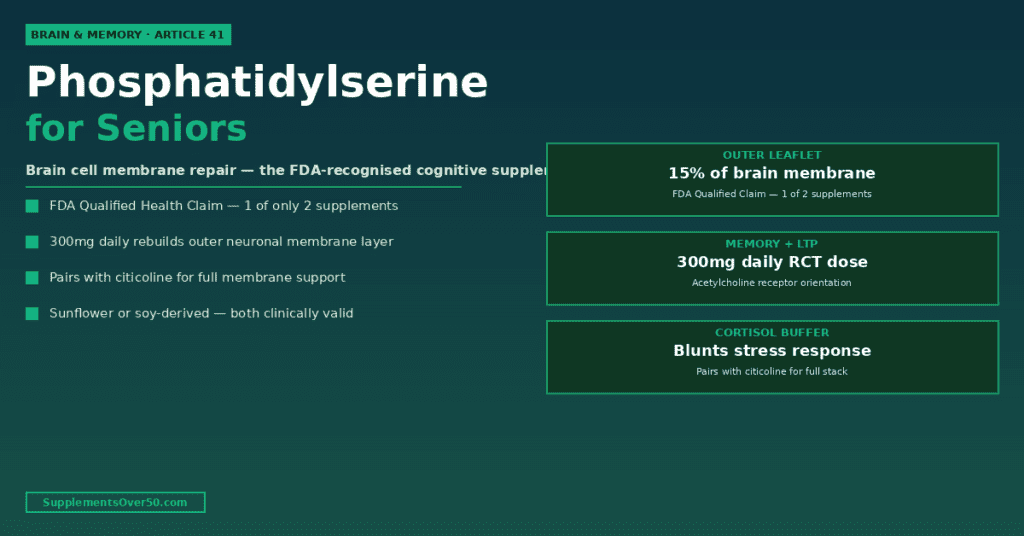
| ⚡ Quick Answer Phosphatidylserine (PS) is a phospholipid that makes up approximately 15% of all brain cell membrane phospholipids and is the most important structural fat in the outer layer of neurons. As PS declines with age, membrane fluidity drops, receptor function deteriorates, and cognitive processing slows. The FDA has granted PS a Qualified Health Claim for cognitive decline — one of only two supplements to receive this distinction. The evidence-supported dose is 100mg three times daily (300mg total) with meals. Sunflower-derived PS is preferred over soy-derived PS for adults with any soy sensitivity. PS works best in combination with citicoline — which rebuilds the inner membrane layer — and DHA omega-3, which maintains membrane fluidity. |
Why Phosphatidylserine for Seniors Matters Specifically After 60
Brain cell membranes are not static structures. They are dynamic, fluid bilayers that must maintain precise composition to allow neurotransmitter receptors to function, synaptic signals to transmit accurately, and neurons to communicate at speed. Phosphatidylserine is the dominant phospholipid on the outer leaflet of this membrane bilayer — it acts as the primary scaffold that keeps receptor proteins correctly oriented and functional.
After 60, two things happen simultaneously. First, dietary PS intake tends to decline as organ meat consumption drops — brain, liver, and kidney were historically the primary dietary sources of PS and are now rarely eaten. Second, the brain’s ability to synthesise PS from precursors becomes less efficient. The combined result is a measurable decline in neuronal membrane PS content that correlates with the cognitive changes most adults notice after 60: slower word retrieval, difficulty concentrating under distraction, and reduced learning speed.
This is the mechanism that earned PS its FDA Qualified Health Claim — a regulatory designation confirming there is credible scientific evidence for the claim that PS may reduce the risk of cognitive dysfunction in the elderly. Only two supplements have received this distinction from the FDA. PS is one of them.
For the full brain supplement comparison including PS, citicoline, omega-3 DHA, creatine and Lion’s Mane: 7 Best Brain Supplements for Seniors — Ranked by Clinical Evidence
Key Statistics — The Evidence Base
- A 2010 double-blind RCT in older adults with memory complaints found 300mg PS daily significantly improved memory and learning scores versus placebo over 6 months — with the strongest improvements in participants with the worst baseline memory
- A 2015 systematic review of 9 RCTs confirmed PS supplementation produces significant improvements in memory and cognitive function in older adults with mild cognitive impairment
- The FDA Qualified Health Claim states: ‘Consumption of phosphatidylserine may reduce the risk of cognitive dysfunction in the elderly’ — issued 2003, reaffirmed in updated guidance
- Brain PS content declines approximately 2% per decade after age 30 — by age 70, the average person has approximately 20% less PS in cortical neuron membranes than at age 30
- PS accelerates cortisol clearance after exercise — a secondary benefit relevant to men over 50 whose cortisol-testosterone seesaw is already disrupted by age-related HPA dysregulation
- Soy-derived PS was the original research form but sunflower-derived PS now shows equivalent bioavailability in comparative studies published in 2019 and 2022
How Phosphatidylserine Works — The Membrane Biology
Neuronal Membrane Composition and PS’s Role
Neuron cell membranes consist of a phospholipid bilayer — two layers of fatty molecules arranged tail-to-tail. The outer leaflet (facing extracellular space) is primarily phosphatidylcholine and phosphatidylserine. The inner leaflet is primarily phosphatidylethanolamine and phosphatidylcholine. PS on the outer leaflet performs three critical functions:
Popular Supplement Guides:

- Receptor orientation — PS’s negatively charged serine head group creates an electrostatic environment that keeps receptor proteins in their optimal functional orientation, particularly acetylcholine receptors relevant to memory
- Membrane fluidity regulation — PS influences the physical properties of the membrane bilayer, maintaining the flexibility required for synaptic vesicle fusion during neurotransmitter release
- Signal transduction — PS is the binding site for protein kinase C, an enzyme essential for long-term potentiation — the cellular mechanism of memory formation
When PS declines, these three functions degrade simultaneously. The clinical result is the pattern familiar to adults over 60: memory retrieval becomes slower, attention under distraction worsens, and new learning requires more repetition than it once did.
The Acetylcholine Connection
PS has a particularly strong relationship with the cholinergic system — the brain’s primary memory-related neurotransmitter network. PS supports acetylcholine receptor density and maintains the membrane environment required for choline uptake transporters to function at full efficiency. This is why PS and citicoline (which directly increases acetylcholine synthesis) work through complementary mechanisms that are stronger together than either alone.
For the complete comparison of PS versus citicoline — mechanisms, evidence, and which to prioritise for different cognitive concerns: Citicoline vs Phosphatidylserine — Which Brain Supplement Is Better After 60?
Cortisol Reduction — The Underappreciated Secondary Benefit
PS is one of the few supplements with clinical evidence for reducing cortisol responses. A series of studies in the 1990s and 2000s found PS supplementation blunted the cortisol spike following intense exercise and psychological stress. For men and women over 60 whose HPA axis is already dysregulated — producing elevated baseline cortisol that disrupts sleep, suppresses testosterone, and impairs memory consolidation — this cortisol-buffering effect adds meaningful secondary value beyond the membrane structural benefits. PS and ashwagandha KSM-66 address the cortisol-stress problem from different points in the HPA axis — PS blunts the downstream cortisol response while ashwagandha modulates the upstream HPA signalling. For men over 50 dealing with stress-driven testosterone suppression, the two together are more comprehensive than either alone: Ashwagandha for Men Over 50 — Testosterone, Stress and Sleep Evidence Reviewed.
PS vs Citicoline vs Phosphatidylcholine — Understanding the Differences
Seniors researching brain supplements frequently encounter all three of these phospholipid-related compounds and struggle to differentiate them. They address different parts of the same membrane system:
| Compound | Location in membrane | Primary mechanism | Best evidence for | Typical dose |
| Phosphatidylserine (PS) | Outer leaflet | Receptor orientation, LTP, cortisol buffering | Memory retrieval, learning speed, cognitive processing | 100mg three times daily |
| Citicoline (CDP-choline) | Inner leaflet precursor | Acetylcholine synthesis, phosphatidylcholine rebuilding | Attention, focus, brain energy | 250–500mg daily |
| Phosphatidylcholine (PC) | Both leaflets dominant | Structural membrane support, choline source | General membrane integrity, liver health | 900–1,200mg daily as lecithin |
| PS + Citicoline combination | Outer + inner leaflet | Complementary full-membrane rebuilding | Combined memory and attention | 300mg PS + 250–500mg citicoline |
The practical takeaway: PS and citicoline are not competing alternatives — they rebuild different layers of the same membrane system. PS addresses the outer leaflet and receptor function; citicoline addresses acetylcholine synthesis and inner leaflet phosphatidylcholine. Taking both produces additive cognitive benefit at a combined daily cost of approximately $0.80–1.20.
Dosing Guide for Seniors Over 60
| Goal | Dose | Timing | Form | Timeline |
| Memory and learning support | 100mg three times daily (300mg total) | With meals — fat improves absorption | Sunflower or soy PS | 4–8 weeks for initial effect, 3 months for full benefit |
| Cognitive maintenance (no active decline) | 100mg once daily (100mg total) | Morning with breakfast | Sunflower or soy PS | Ongoing maintenance — not a therapeutic dose |
| PS + citicoline combined stack | 100mg PS three times + 250mg citicoline once | PS with meals; citicoline morning | Both forms | 8–12 weeks for full assessment |
| Cortisol reduction priority | 400mg daily divided | Around stressful periods or exercise | Any standardised form | 2–4 weeks for cortisol effects |
| ⚡ Quick Answer — Dosing The clinical trial dose that generated FDA review was 300mg daily in three divided doses (100mg with breakfast, lunch, and dinner). Fat from meals significantly improves PS absorption — never take on an empty stomach. Consistent daily use for a minimum of 8 weeks before evaluating whether it is working. PS is a slow-acting structural supplement that rebuilds membrane composition gradually — not a stimulant with acute effects. |
Soy vs Sunflower PS — Which to Choose
The original research PS was soy-derived — this is the form referenced in the FDA Qualified Health Claim and used in the foundational clinical trials. However, bovine cortex PS (derived from cow brain) was the original research form before it was discontinued due to concerns about prion diseases. Soy-derived PS became the replacement standard in the 1990s.
Sunflower-derived PS has become increasingly common since 2015 due to growing soy allergy awareness and the desire for non-GMO options. A 2019 comparative study found sunflower PS produced equivalent phospholipid serum levels to soy PS at the same dose, confirming bioequivalence. The functional outcome evidence is primarily from soy-derived studies but sunflower PS is a scientifically sound alternative.
- Choose soy PS if: you have no soy sensitivity, you want the most extensively researched form, and you want the lowest cost per serving
- Choose sunflower PS if: you have any soy sensitivity or allergy, you prefer non-GMO ingredients, or you want to avoid soy phytoestrogens
- Avoid: bovine-derived PS — the original research form is no longer commercially available due to prion concerns
5 Best Phosphatidylserine Supplements for Seniors — US Pricing 2026
1. Jarrow Formulas PS-100 (Soy-derived) — Amazon / iHerb — Best Overall Value
Best for: seniors who want the most extensively researched form at reliable quality and low cost.
| Specification | Detail |
| PS source | Soy-derived phosphatidylserine — matches clinical trial form |
| Dose | 100mg per softgel |
| Protocol | 3 softgels daily with meals (100mg x 3 = 300mg clinical dose) |
| Price (2026) | ~$0.25–0.35/day (120 softgels at ~$30–42 on Amazon/iHerb) |
| Third-party tested | NSF registered facility; non-GMO soy; vegan-suitable softgel |
| Best for | Budget-conscious seniors who want confirmed soy PS at the clinical trial dose without premium branding markup |
2. NOW Sunflower Phosphatidylserine 100mg — Amazon / Walmart — Best Soy-Free
Best for: seniors with any soy sensitivity or who prefer non-GMO sourcing.
| Specification | Detail |
| PS source | Sunflower lecithin-derived — non-soy, non-GMO |
| Dose | 100mg per softgel |
| Protocol | 3 softgels daily with meals |
| Price (2026) | ~$0.30–0.45/day (120 softgels at ~$36–54 on Amazon) |
| Third-party tested | GMP certified; soy-free; no artificial ingredients |
| Best for | Seniors avoiding soy — equivalent bioavailability to soy PS with a cleaner allergen profile |
3. Life Extension Cognitex Elite — Amazon — Best Combined Brain Stack
Best for: seniors who want PS combined with other clinically validated brain nutrients in a single product.
| Specification | Detail |
| PS content | 100mg PS per serving (soy-derived) |
| Additional ingredients | Ashwagandha, phosphatidylcholine, wild blueberry — at disclosed doses |
| Dose | 2 softgels daily |
| Price (2026) | ~$0.60–0.80/day (60 softgels at ~$36–48 on Amazon) |
| Third-party tested | Non-GMO; tested for label accuracy |
| Best for | Seniors who want a multi-ingredient approach — note this provides 100mg PS not the full 300mg clinical dose; add standalone PS if targeting the therapeutic dose |
4. Doctor’s Best Sharp-PS Gold Sunflower — Amazon — Best Sunflower Premium
Best for: seniors who want the sunflower form with the highest quality credential.
| Specification | Detail |
| PS source | Sunflower-derived using Sharp-PS Gold branded extract |
| Dose | 100mg per softgel |
| Protocol | 3 softgels daily with meals |
| Price (2026) | ~$0.40–0.55/day (60 softgels at ~$24–33 on Amazon) |
| Third-party tested | Non-GMO; soy-free; no artificial colours or preservatives |
| Best for | Seniors who want branded sunflower PS with documented sourcing — Sharp-PS is used in academic research on sunflower PS bioavailability |
5. Thorne Memoractiv — Thorne.com / Amazon — Best Practitioner Grade
Best for: seniors under physician monitoring or who want the highest manufacturing credentials available.
| Specification | Detail |
| PS content | Sharp-PS sunflower PS in combination with additional cognitive nutrients |
| Dose | Disclosed individual doses per serving |
| Price (2026) | ~$1.20–1.60/day (Thorne.com / Amazon) |
| Third-party tested | NSF Certified for Sport — highest certification level; TGA-compliant manufacturing |
| Best for | Seniors who prioritise manufacturing quality above cost and want physician-grade PS alongside complementary nutrients at full therapeutic doses |
The PS + Citicoline + DHA Stack — Maximum Brain Membrane Support
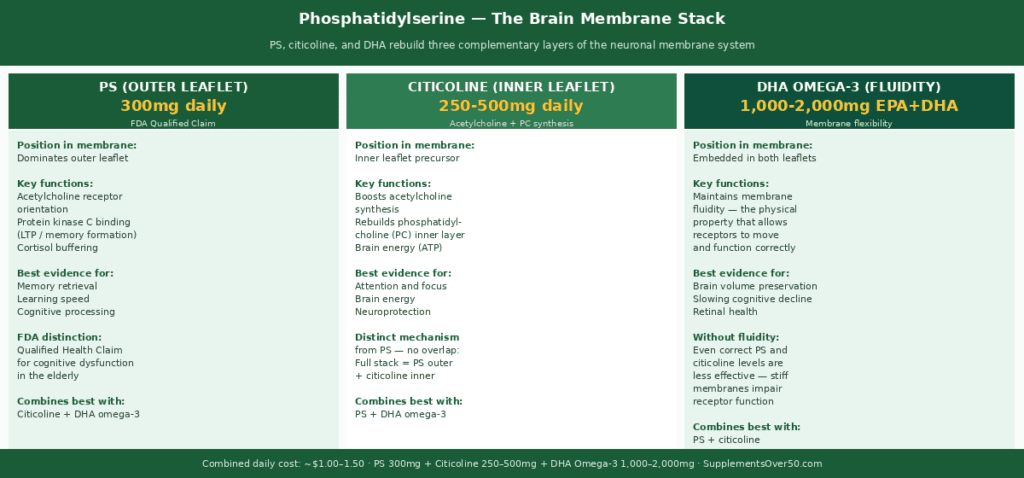
PS, citicoline, and DHA omega-3 rebuild the brain’s membrane system from three complementary angles that do not overlap. Combining all three provides the most comprehensive neuronal membrane support available through supplementation:
PS (300mg/day): Rebuilds outer leaflet — restores receptor orientation, LTP, cortisol buffering
Citicoline (250–500mg/day): Rebuilds inner leaflet precursor pool — increases acetylcholine synthesis, phosphatidylcholine content, brain energy
DHA Omega-3 (1,000–2,000mg EPA+DHA/day): Maintains membrane fluidity — the physical property that determines how well embedded receptors move and function
DHA omega-3 provides the membrane fluidity that makes PS signalling work — a stiff membrane impairs receptor function even when PS levels are adequate. For the full DHA and brain health evidence: Best Fish Oil for Seniors — EPA, DHA, IFOS Certification and 2026 Pricing. Total combined daily cost: approximately $1.00–1.50. This three-supplement combination addresses every measurable component of age-related neuronal membrane deterioration at a lower cost than most branded ‘brain health’ formulas — which typically contain one or two of the three at sub-therapeutic doses.
Phospholipid synthesis including PS requires adequate B-vitamins for the methylation pathways that build cell membrane components — a quality multivitamin providing methylcobalamin B12 and methylfolate supports this process: 5 Best Multivitamins for Seniors — Ranked by Form and Value.
For the omega-3 brain health evidence in full: Can Omega-3s Really Slow Brain Decline After 60? What the 2025 Research Shows
For Lion’s Mane as an additional NGF-stimulating complement to this stack: Lion’s Mane Mushroom for Cognitive Health After 60 — NGF, Memory and the Clinical Evidence
Safety and Drug Interactions
Phosphatidylserine has an excellent safety profile in published clinical research. The most common side effects — mild GI discomfort, nausea, insomnia at high doses — are rare at the standard 300mg daily dose and typically resolve within 1–2 weeks. Key interactions to be aware of:
- Blood thinners (warfarin, Eliquis, aspirin): PS may have mild anticoagulant properties — disclose to your physician before starting, particularly at doses above 300mg daily
- Cholinergic medications (Aricept/donepezil, Exelon): PS increases cholinergic activity through membrane support — the combination may enhance both benefit and side effects; discuss with your neurologist
- Anticholinergic medications: PS works in the opposite direction to anticholinergics — combination reduces the effectiveness of both; disclose to your physician
- Cognitive enhancers and nootropics: PS has no known negative interactions with other brain supplements and is commonly combined with citicoline, lion’s mane, creatine, and omega-3 safely
PS is generally very well tolerated in older adults. The most important precaution is disclosure to your physician if you take any blood-thinning or neurologically-active medication.
Related Articles on SupplementsOver50.com
• Citicoline vs Phosphatidylserine — Which Brain Supplement Is Better After 60?
• 7 Best Brain Supplements for Seniors — Ranked by Clinical Evidence
• Can Omega-3s Really Slow Brain Decline After 60? What the 2025 Research Shows
• Lion’s Mane Mushroom for Cognitive Health After 60
• Best Nootropic Stack for Seniors — Focus Without Caffeine
• The 5 Essentials — Supplements Every Adult Over 60 Should Know
References
3. FDA Qualified Health Claims — PS and cognitive dysfunction in the elderly (2003, updated)
4. PubMed 2000: Monteleone et al. — PS blunts neuroendocrine and cortisol responses to physical stress
Frequently Asked Questions
What does phosphatidylserine actually do for the brain?
PS is a structural phospholipid that makes up approximately 15% of all neuronal membrane phospholipids and dominates the outer leaflet of brain cell membranes. It maintains the precise membrane environment required for acetylcholine receptors to function correctly, supports protein kinase C — the enzyme essential for long-term potentiation (memory formation) — and maintains the membrane fluidity required for synaptic vesicle fusion during neurotransmitter release. When PS declines with age, all three functions degrade simultaneously, producing the slower memory retrieval, reduced concentration, and decreased learning speed that characterise normal cognitive aging after 60. Supplementation at 300mg daily has shown significant restoration of these functions in older adults with memory complaints in multiple RCTs.
How long does it take for phosphatidylserine to work?
PS is a slow-acting structural supplement — it works by gradually rebuilding neuronal membrane composition, not by acutely stimulating neurotransmitter release. Most clinical trials measuring cognitive outcomes use 12–24 week study periods. The earliest measurable improvements in the RCT literature appear at 4–8 weeks of consistent daily use at 300mg. Set a minimum 12-week evaluation window before deciding whether PS is producing benefit. Practical indicators to track: speed of word retrieval during conversation, ability to concentrate under distraction, and ease of learning new information — these are more sensitive to PS effects than memory tests for distant events.
Is phosphatidylserine the same as phosphatidylcholine?
No — they are related phospholipids that occupy different positions in the membrane bilayer and perform different functions. Phosphatidylserine dominates the outer leaflet and is primarily involved in receptor function, long-term potentiation, and cortisol regulation. Phosphatidylcholine dominates both leaflets and is the primary structural phospholipid. Citicoline (CDP-choline) generates phosphatidylcholine as part of its mechanism — which is why citicoline and PS are complementary rather than redundant. PS specifically targets the outer leaflet deficits associated with cognitive aging; phosphatidylcholine supplementation as lecithin addresses general membrane support and liver health.
Can phosphatidylserine improve memory in seniors with dementia?
PS should not be used as a treatment for dementia. The clinical evidence is for adults with age-related cognitive decline and mild cognitive impairment — not for diagnosed Alzheimer’s disease or other dementias. The FDA Qualified Health Claim specifically states the evidence is for reducing the risk of cognitive dysfunction in the elderly, not for treating existing dementia. Studies in patients with established Alzheimer’s disease have shown inconsistent results. Seniors with diagnosed dementia should follow their neurologist’s guidance rather than self-directing supplementation.
Should I take phosphatidylserine with food?
Yes — always. PS is a fat-soluble phospholipid and absorbs significantly better with dietary fat than on an empty stomach. The standard clinical trial protocol uses three divided doses with meals (100mg with breakfast, 100mg with lunch, 100mg with dinner) — this dosing schedule maximises absorption and maintains more stable blood and tissue PS levels throughout the day compared to a single large dose. The type of fat in the meal matters less than its presence — any fat-containing meal provides sufficient fat for optimal PS absorption.
Can phosphatidylserine be taken with citicoline?
Yes — this is the most evidence-supported combination in the brain supplement category. PS and citicoline work through non-overlapping mechanisms on the same membrane system: PS rebuilds the outer leaflet and receptor function while citicoline rebuilds inner leaflet phosphatidylcholine and acetylcholine synthesis. Multiple practitioners recommend this combination specifically for seniors experiencing both memory retrieval difficulty (PS’s primary target) and attention/focus difficulty (citicoline’s primary target). No negative interactions have been identified between the two. The combined daily cost is approximately $0.80–1.20 — making it one of the most cost-effective brain health interventions available.
Is phosphatidylserine better than Ginkgo Biloba for memory in seniors?
They work through different mechanisms and are not direct competitors. Ginkgo biloba is a vasodilator — it improves cerebral blood flow and has antiplatelet properties. Phosphatidylserine is a structural phospholipid — it rebuilds the outer neuronal membrane layer that receptor function depends on. For long-term memory retention and cognitive processing speed in older adults, PS has stronger and more consistent clinical evidence — the large NIH-funded GEM trial found ginkgo had no significant effect on dementia incidence over 6 years, while PS has multiple positive RCTs in adults with mild cognitive impairment. For short-term mental sharpness and circulation-related cognitive sluggishness, ginkgo may be more appropriate. For seniors primarily concerned with long-term memory maintenance, PS is the better-evidenced choice.
Can phosphatidylserine cause insomnia?
The effect is usually the opposite — PS lowers cortisol and most seniors find it supports rather than disrupts sleep. This is because cortisol’s PM elevation is a primary driver of the difficulty falling asleep and middle-of-the-night waking that is common in older adults. By blunting the evening cortisol spike through HPA axis modulation, PS often improves sleep onset and reduces waking. A small subset of users — perhaps 5–10% — report unusually vivid or lucid dreams in the first few weeks, which some find disruptive. If this occurs, move your PS dose to morning with breakfast rather than evening. The vivid dream effect typically resolves within 2–3 weeks as the body adjusts.
Is phosphatidylserine safe to take with blood thinners?
PS is generally considered safe but disclose it to your physician before starting if you take any anticoagulant medication. There is some evidence that PS has mild antiplatelet properties at higher doses — relevant for warfarin and Eliquis users who should monitor for increased bruising and have INR checked within the first month of supplementation. A more clinically significant interaction is with anticholinergic medications commonly prescribed to seniors for overactive bladder (oxybutynin, tolterodine) or COPD (tiotropium) — PS increases cholinergic activity while these drugs reduce it, meaning the two work in opposing directions and may reduce each other’s effectiveness. Disclose PS supplementation to the physician prescribing any anticholinergic medication.
What is the difference between phosphatidylserine and phosphatidylcholine?
Both are phospholipids in the neuronal membrane bilayer but they occupy different positions and serve different functions. Phosphatidylserine dominates the outer leaflet and governs receptor orientation, long-term potentiation (memory formation), and cortisol modulation. Phosphatidylcholine dominates both leaflets as the primary structural phospholipid and is the molecule that citicoline generates as part of its mechanism. The practical distinction: PS supplementation targets outer leaflet deficits associated with memory decline; phosphatidylcholine supplementation (as lecithin or through citicoline) addresses inner layer structural support and acetylcholine synthesis. They are complementary not interchangeable.
How much phosphatidylserine should seniors take daily?
The clinical trial dose that generated the FDA Qualified Health Claim review is 300mg daily — typically taken as 100mg with each of the three main meals. This divided dosing maintains more stable blood and tissue PS levels throughout the day compared to a single 300mg dose and maximises fat-assisted absorption at each meal. A lower maintenance dose of 100mg once daily is sometimes used for general cognitive support in adults without active memory complaints — but this is below the therapeutic dose used in memory improvement trials. Start at 300mg for the first 12 weeks to load membrane PS levels, then reassess whether a lower maintenance dose is sufficient.The clinical trial dose that generated the FDA Qualified Health Claim review is 300mg daily — typically taken as 100mg with each of the three main meals. This divided dosing maintains more stable blood and tissue PS levels throughout the day compared to a single 300mg dose and maximises fat-assisted absorption at each meal. A lower maintenance dose of 100mg once daily is sometimes used for general cognitive support in adults without active memory complaints — but this is below the therapeutic dose used in memory improvement trials. Start at 300mg for the first 12 weeks to load membrane PS levels, then reassess whether a lower maintenance dose is sufficient.
Can phosphatidylserine help with ADHD-like focus problems in seniors?
Yes — PS has specific evidence for attention and focus alongside its memory benefits. A 2014 study found PS combined with DHA significantly improved attention, working memory, and impulse control in children with ADHD — and the mechanism is relevant to adult attention difficulties as well. For seniors experiencing age-related attention difficulties — difficulty sustaining focus, being easily distracted, losing track of multi-step tasks — PS at 300mg daily addresses the underlying membrane receptor function that attention depends on. Combining PS with citicoline, which directly boosts acetylcholine synthesis, provides the most comprehensive cholinergic support for both memory and attention simultaneously.
The Bottom Line
Phosphatidylserine is the most structurally important brain supplement available for adults over 60 — and the only supplement alongside omega-3 to receive an FDA Qualified Health Claim for cognitive health. It addresses the root cause of age-related memory decline (outer leaflet membrane deterioration) rather than merely stimulating neurotransmitter release.
The protocol is straightforward: 100mg three times daily with meals, using either soy or sunflower-derived PS depending on allergy profile. Allow 12 weeks for full evaluation. Combine with citicoline 250–500mg and DHA-rich omega-3 for comprehensive membrane support across all three layers of neuronal function.
PS is not a dramatic overnight cognitive enhancer — it is a slow-acting structural intervention that gradually restores the membrane environment required for optimal brain function. The seniors who benefit most are those experiencing normal age-related cognitive slowing: slower word retrieval, reduced concentration under distraction, and decreased learning speed. These are the precise outcomes that 300mg PS daily has consistently improved across multiple published RCTs.
Start with Jarrow PS-100 at three softgels daily for the most cost-effective route to the clinical dose. Add citicoline when budget allows. Add DHA-rich fish oil if not already supplementing omega-3.
For how this phosphatidylserine protocol fits into the complete senior supplement framework: The 5 Essentials — Supplements Every Adult Over 60 Should Know
For the brain supplement comparison that covers PS alongside all other major cognitive interventions: 7 Best Brain Supplements for Seniors — Ranked by Clinical Evidence