| ⚕️ Supplement DisclosureThis article reviews shatavari as a dietary supplement for informational purposes only. Women who are pregnant, breastfeeding, have hormone-sensitive conditions (including oestrogen receptor-positive breast cancer history), or take hormone replacement therapy or anticoagulant medications should consult their doctor before using shatavari. Shatavari has phytoestrogenic activity and may interact with hormonal medications. |
Shatavari for menopause is one of the most underreported supplement topics in US women’s health — despite a cluster of high-quality randomised controlled trials published between 2024 and 2025 that show genuinely meaningful clinical results. Most Western women researching menopause supplements have heard of black cohosh, evening primrose oil and ashwagandha. Very few have heard of shatavari — yet the newest evidence positions it as potentially the most comprehensively effective botanical for the full constellation of menopause symptoms.
Shatavari (Asparagus racemosus) is an Ayurvedic herb with a 3,000-year history of use in women’s health. It is known in Sanskrit as the ‘Queen of Herbs’ and referred to as the plant ‘for women who have 100 husbands’ — a reference to its traditional use in supporting female reproductive vitality at every life stage. Modern science is now catching up with that traditional understanding.
In Article 21 on this site, we covered Ashwagandha for Women Over 50 — and shatavari was mentioned in one key study that tested the two herbs together. This article gives shatavari the dedicated coverage it deserves. The two herbs are the most commonly paired Ayurvedic botanicals for menopause, addressing different but complementary mechanisms: ashwagandha works primarily via cortisol reduction (the stress-hormone pathway), while shatavari works primarily via phytoestrogenic activity (the oestrogen-modulation pathway).
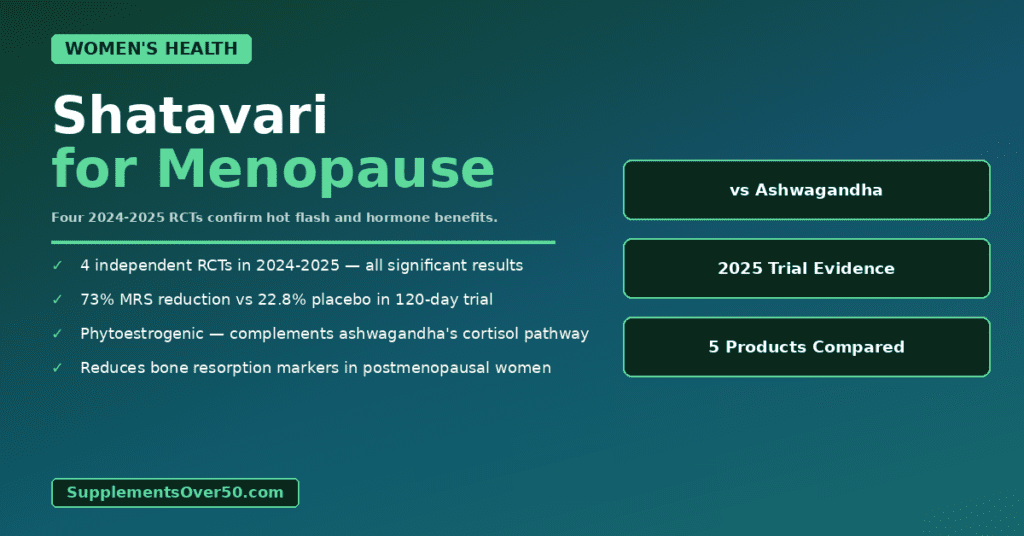
| The clinical story in brief: four independent randomised controlled trials published between 2024 and 2025, conducted across India, California and the Philippines, consistently find shatavari root extract significantly reduces total Menopause Rating Scale scores, hot flash frequency, night sweats, insomnia, anxiety and mood disruption compared to placebo — with improvements in estradiol levels and no significant adverse events reported. |
How Shatavari Works — The Phytoestrogenic Mechanism
Shatavari’s primary active compounds are steroidal saponins called shatavarins — particularly shatavarins I through IV. These compounds have demonstrated affinity for oestrogen receptors and appear to modulate gonadotropin levels (FSH and LH), producing effects that mimic the regulatory influence of declining oestrogen in the perimenopausal transition.
Unlike synthetic HRT which delivers exogenous oestrogen at fixed doses, shatavari’s phytoestrogenic activity is selective and modulatory — it is significantly weaker than endogenous oestrogen at the receptor level, which is both the reason for its safety profile and the reason it is appropriate for symptom management rather than full hormonal replacement.
The secondary mechanisms include antioxidant and anti-inflammatory activity from flavonoids including rutin and quercetin, adaptogenic stress modulation similar to (but weaker than) ashwagandha, and immunomodulatory activity through its polysaccharide content.
The clearest way to choose between the two herbs: if your primary symptoms are anxiety, sleep disruption and stress — start with ashwagandha. If your primary symptoms are hot flashes, night sweats, vaginal dryness or mood disruption tied to oestrogen decline — shatavari is the superior first choice. For the full picture on combining both, see our ashwagandha for women over 50 guide which covers the cortisol-testosterone seesaw mechanism in detail.”
| Mechanism | Shatavari | Ashwagandha (comparison) |
|---|---|---|
| Primary pathway | Phytoestrogenic — steroidal saponins (shatavarins) bind oestrogen receptors | HPA axis modulation — reduces cortisol via withanolides |
| Hormonal effect | Modulates FSH, LH and estradiol — addresses oestrogen decline directly | Raises testosterone and estradiol indirectly via cortisol reduction |
| Hot flash effect | Direct — phytoestrogenic activity reduces vasomotor symptoms | Indirect — cortisol reduction improves thermoregulation |
| Bone protection | Reduces bone resorption markers — direct phytoestrogenic effect on osteoclasts | Indirect via anti-inflammatory and cortisol-reducing pathways |
| Stress and anxiety | Secondary benefit — adaptogenic activity present but weaker than ashwagandha | Primary benefit — strongest evidence base for cortisol and anxiety |
| Best combined? | Yes — the two herbs address different pathways and show additive effects in clinical trials | Yes — complementary to shatavari’s oestrogen pathway |
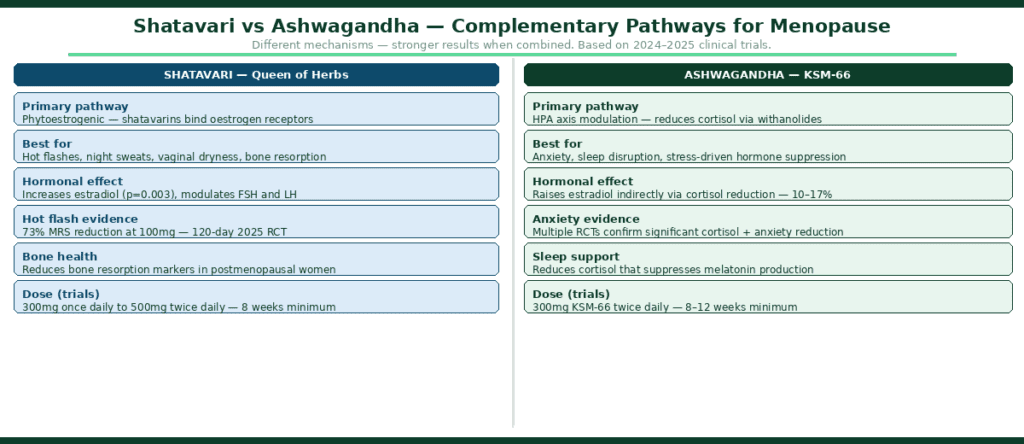
Shatavari and ashwagandha address menopause through different biological pathways — making them genuinely complementary rather than alternatives. Shatavari's phytoestrogenic shatavarins target the oestrogen-decline symptoms directly: hot flashes, night sweats, vaginal dryness and bone resorption. Ashwagandha's cortisol reduction targets the stress-driven symptoms: anxiety, sleep disruption and mood. A 2025 three-arm RCT found the combination produced stronger mood improvements than either herb alone. Sources: Frontiers in Reproductive Health 2025, IJWH PMC 2025, Journal of Menopausal Medicine 2025.The 2024–2025 Clinical Trial Evidence
Trial 1 — Frontiers in Reproductive Health (2025): Three-arm RCT
A 2025 three-arm randomised, double-blind, placebo-controlled trial published in Frontiers in Reproductive Health enrolled 135 women aged 45–65 with menopause symptoms. The trial compared shatavari root extract alone, shatavari combined with ashwagandha root extract, and placebo over 8 weeks. The study was conducted at D.Y. Patil Medical College, Navi Mumbai and the San Francisco Research Institute, California.
Results: Both the shatavari-alone and the combination arms showed significant improvements in total Menopause Rating Scale scores versus placebo. The combination arm showed particularly strong results for mood improvement (p=0.008) and esteem-related affect (p=0.025). Normal hormonal levels were maintained throughout. Adverse events were mild and rare — loose stools and dizziness in the combination arm, nausea in the shatavari monotherapy arm.
Trial 2 — International Journal of Women’s Health (2025): Perimenopause RCT
A 2025 randomised, double-blind, placebo-controlled study published in the International Journal of Women’s Health (PMC) enrolled 80 women with perimenopausal symptoms and tested shatavari root extract 300mg once daily for 8 weeks. Results: significant improvement in MRS somato-vegetative, psychological and urogenital domains (p<0.0001). Hot flashes improved significantly (p=0.002). Estradiol levels increased (p=0.003) and FSH levels improved (p=0.028). T3 thyroid hormone levels also increased (p=0.021). No adverse effects on liver or kidney function were observed.
Trial 3 — Cureus (2024): Hot flashes, night sweats and vaginal dryness RCT
A 2024 randomised, double-blinded, placebo-controlled study published in Cureus enrolled 70 women and tested a shatavari formulation versus placebo. Results showed significant positive effects on hot flashes, night sweats, insomnia, anxiety, nervousness, vaginal dryness and loss of libido. Utian Quality of Life scores improved significantly in the shatavari group. No significant adverse events were recorded.
Trial 4 — Functional Foods in Health and Disease (2025): Dose-response study
A 120-day trial published in Functional Foods in Health and Disease (July 2025) tested 50mg and 100mg daily of a standardised shatavari extract (Xeya Modern Shatavari, standardised to 15% shatavarins) in 75 perimenopausal women. Results: the 100mg group achieved a 73% reduction in MRS scores versus 22.8% for placebo. Hot flash frequency reduced by 39.81% in the 100mg group. Hormonal changes included increased ovarian follicle count and altered FSH, LH, AMH and estradiol levels — confirming direct endocrine modulation.
| The combined evidence from four independent 2024–2025 RCTs — three of them multi-centre, all double-blind and placebo-controlled — represents the strongest clinical evidence base for any Ayurvedic herb for menopause outside of ashwagandha. The consistency of results across hot flash reduction, mood improvement, hormonal modulation and quality of life scores across different trials and dose ranges is genuinely impressive. |
Shatavari vs Ashwagandha — Should You Take One or Both?
This is the practical question for most women over 50 considering this category. The short answer is that they are complementary rather than alternatives, addressing different mechanisms. But whether to take one or both depends on your primary symptom profile:
| Primary symptom | Best first choice | Consider adding |
|---|---|---|
| Hot flashes and night sweats | Shatavari — direct phytoestrogenic effect on vasomotor symptoms | Ashwagandha if also experiencing anxiety or sleep disruption |
| Anxiety and stress | Ashwagandha — strongest cortisol reduction evidence | Shatavari if also experiencing hot flashes or vaginal dryness |
| Sleep disruption | Ashwagandha — cortisol reduction directly improves sleep | Shatavari if hot flashes are the primary cause of waking |
| Mood and emotional symptoms | Either — both showed mood improvements in trials; combination showed stronger results | Consider both at 300mg each daily |
| Vaginal dryness and libido | Shatavari — phytoestrogenic effect on urogenital tissue is more direct | Ashwagandha as secondary support |
| Bone health concern | Shatavari — reduces bone resorption markers via phytoestrogenic pathway | Combine with K2, D3 and boron stack for comprehensive bone support |
5 Best Shatavari Supplements for Women Over 50 — US Pricing 2026
1. Banyan Botanicals Shatavari (Amazon) — Best Organic Standalone
Banyan Botanicals is one of the most respected Ayurvedic herb brands in the US market — USDA Organic, Non-GMO Project Verified, sustainably sourced. 500mg shatavari root powder per tablet, standardised using traditional Ayurvedic processing. Available on Amazon for approximately $22–28 for 90 tablets (~$0.24–0.31 per day).
- Shatavari: 500mg root per tablet
- Price per day: ~$0.27 (Amazon)
- Certification: USDA Organic, Non-GMO Project Verified
- Best for: Women who want a single-herb, organic shatavari at a mid-range price
2. Gaia Herbs Shatavari (Amazon) — Best Liquid Phyto-Cap
Gaia Herbs uses liquid phyto-cap technology for superior absorption — particularly relevant for women over 60 with reduced gastric acid production. Certified B Corp, organic, gluten-free. Contains concentrated shatavari root extract. Available on Amazon for approximately $22–30 for 60 capsules (~$0.37–0.50 per day).
- Shatavari: concentrated root extract in liquid phyto-cap
- Price per day: ~$0.43 (Amazon)
- Certification: Certified B Corp, organic, Non-GMO, gluten-free
- Best for: Women who prefer liquid herbal extract format for potentially better absorption
3. Organic India Shatavari (Amazon / Walmart) — Best Value Organic
USDA Organic, Fair Trade certified, Non-GMO — Organic India is India’s largest organic herb brand and sources shatavari from certified organic farms. 400mg standardised shatavari root per capsule. Available at Amazon and Walmart for approximately $16–22 for 90 capsules (~$0.18–0.24 per day).
- Shatavari: 400mg standardised root per capsule
- Price per day: ~$0.21 (Amazon/Walmart)
- Certification: USDA Organic, Fair Trade, Non-GMO
- Best for: Women who want certified organic quality at the best value price
4. Himalaya Shatavari (Amazon / Walmart) — Best Clinically Referenced Brand
Himalaya is one of the most clinically researched Ayurvedic herb companies — their standardised herbal formulas have been used in multiple peer-reviewed studies. Contains 250mg shatavari root extract per capsule with standardised saponin content. Available at Amazon and Walmart for approximately $14–20 for 60 capsules (~$0.23–0.33 per day).
- Shatavari: 250mg standardised extract per capsule
- Price per day: ~$0.28 (Amazon/Walmart)
- Certification: Non-GMO, GMP certified, clinically referenced formulas
- Best for: Women who want a brand with clinical research heritage
5. Nature’s Way Shatavari (Amazon / Walmart) — Best Mainstream Availability
The most widely available shatavari supplement in US mainstream retail — Nature’s Way distributes to Walmart, CVS, Walgreens and Amazon. 500mg shatavari root per capsule, TRU-ID certified for identity verification. Available at Walmart and Amazon for approximately $12–18 for 60 capsules (~$0.20–0.30 per day).
- Shatavari: 500mg root per capsule
- Price per day: ~$0.25 (Walmart/Amazon)
- Certification: TRU-ID certified for species identity, non-GMO
- Best for: Women who want to find shatavari in local stores rather than ordering online
Dosing and How Long to Expect Results
| Question | Evidence-Based Answer |
|---|---|
| Effective dose? | Clinical trials used 300mg once daily (perimenopause RCT) to 500mg twice daily. Most US products deliver 400–500mg per capsule. Start at 300–500mg daily; the 2025 dose-response study showed 100mg standardised extract (15% shatavarins) was more effective than 50mg. |
| When to take? | With food — reduces gastric irritation. Morning or evening dosing both used in trials. Consistency of timing matters more than specific timing. |
| How long to see results? | The 2025 perimenopause RCT showed hot flash improvement at week 4 with further improvement at week 8. The Frontiers 2025 trial measured results at 8 weeks. Allow 4–8 weeks minimum before evaluating — phytoestrogenic effects build gradually. |
| Can I take it with HRT? | Discuss with your doctor. Shatavari’s phytoestrogenic activity may add to HRT effects. It is generally used as an HRT alternative rather than alongside it, though mild supplemental use may be appropriate — always disclose to your prescribing doctor. |
| Can I combine with ashwagandha? | Yes — all four clinical trials found the combination safe. The 2025 Frontiers three-arm trial specifically tested the combination and found additive benefits for mood and stress reduction alongside shatavari’s hot flash benefits. |
Safety and Who Should Not Take Shatavari
| ⚠️ Important safety precautionsWomen with a history of oestrogen receptor-positive breast cancer or other hormone-sensitive cancers should not take shatavari without oncologist approval — its phytoestrogenic activity means it could theoretically stimulate hormone-sensitive tissue. Women on HRT should disclose shatavari use to their doctor. Women who are pregnant or breastfeeding should not use shatavari. Women with asparagus allergies may react to shatavari (it is in the asparagus family). Most clinical trials have run 8–16 weeks — long-term safety beyond this window has not been formally established in RCTs. |
Related Articles
• Ashwagandha for Women Over 50 — Menopause, Anxiety, Sleep and the 2025 Evidence
• K2, D3 and Boron for Post-Menopausal Bone Density — The Triple Threat
• Best Multivitamin for Women Over 60
Frequently Asked Questions
What does shatavari do for menopause?
Shatavari contains steroidal saponins called shatavarins that have affinity for oestrogen receptors, producing phytoestrogenic effects that address multiple menopause symptoms simultaneously. Four randomised controlled trials published in 2024 and 2025 found shatavari root extract significantly reduced total Menopause Rating Scale scores, hot flash frequency, night sweats, insomnia, anxiety, vaginal dryness and loss of libido compared to placebo. The 2025 perimenopause RCT also found increased estradiol levels (p=0.003) confirming direct hormonal modulation.
Is shatavari better than ashwagandha for menopause?
They are better together than either alone — and target different mechanisms. Shatavari works primarily through phytoestrogenic activity to directly address the oestrogen-decline symptoms: hot flashes, night sweats, vaginal dryness and bone resorption. Ashwagandha works primarily through cortisol reduction to address stress-driven symptoms: anxiety, sleep disruption and cortisol-mediated testosterone suppression. A 2025 three-arm RCT found the combination produced stronger results for mood improvement than either herb alone. If choosing one: shatavari for hot flashes and urogenital symptoms; ashwagandha for anxiety and sleep.
How long does shatavari take to work for hot flashes?
The 2025 perimenopause RCT found significant hot flash improvement at week 4 of 300mg daily supplementation. The 120-day dose-response study showed progressive improvement from week 4 through week 16. Allow a minimum of 4 weeks before evaluating results, and 8 weeks for a full picture. Unlike pharmaceutical interventions, phytoestrogenic effects build gradually as the herb modulates receptor activity over time — consistency of daily dosing is more important than dose timing.
Does shatavari affect bone density?
Yes — and this is one of the most exciting 2025 findings. The Journal of Menopausal Medicine 2025 study that tested shatavari alongside ashwagandha in postmenopausal women found that shatavari supplementation dose-dependently reduced bone resorption markers — the biochemical signals indicating that bone is being broken down faster than rebuilt. This is consistent with phytoestrogens’ known effect on osteoclast activity via oestrogen receptors in bone tissue. For comprehensive bone protection, combine shatavari with the K2, D3 and boron stack covered in our bone health guide.
Shatavari’s effect on bone resorption markers makes it an excellent partner to the bone protection stack covered in our K2, D3 and Boron for Post-Menopausal Bone Density guide — shatavari addresses the phytoestrogenic pathway on osteoclast activity while K2 and D3 handle calcium direction and mineralisation
Is shatavari safe for long-term use?
Clinical trials have confirmed safety over 8 to 16 weeks with no significant adverse events. The most common mild side effects reported across trials were occasional GI symptoms including nausea or loose stools. Long-term use beyond 6 months has not been formally evaluated in published RCTs, so a precautionary approach — 3-month cycles with brief breaks — is reasonable. Women with hormone-sensitive cancer history, those on HRT, and pregnant or breastfeeding women should not use shatavari. Always disclose to your doctor.
The Bottom Line
Shatavari for menopause is supported by four independent 2024–2025 randomised controlled trials showing significant reductions in hot flashes, night sweats, MRS total scores, mood disruption and vaginal dryness — with improvements in estradiol levels and no significant adverse events.
The evidence positions shatavari as the most comprehensively studied botanical for the full vasomotor and urogenital symptom profile of menopause — addressing the phytoestrogenic pathway that ashwagandha does not directly target. For women experiencing the complete constellation of menopause symptoms, the ashwagandha plus shatavari combination is the most evidence-supported natural protocol available.
Start with Organic India Shatavari at $0.21/day for best-value organic quality, or Nature’s Way at $0.25/day for maximum retail availability. Allow 4–8 weeks of consistent daily use at 300–500mg before evaluating results. For the complete women’s nutritional foundation, see our Best Multivitamin for Women Over 60 — the iron-free formula recommendations apply to women using shatavari as part of a broader hormonal support protocol.
References
1. Frontiers in Reproductive Health (2025). Shatavari root extract for menopausal symptoms: three-arm RCT. doi: 10.3389/frph.2025.1654503 View article
2. International Journal of Women’s Health / PMC (2025). Shatavari root extract 300mg for perimenopause: hot flashes, estradiol, MRS RCT. View on PMC
3. Cureus (2024). Efficacy and Safety of Shatavari for menopausal symptoms: RCT. View on PubMed
4. Functional Foods in Health and Disease (2025). CL22209 standardised shatavari extract: 73% MRS reduction at 100mg, 120-day trial.
5. Journal of Menopausal Medicine (2025). Shatavari and ashwagandha extracts reduce menopause symptoms, vascular dysfunction and bone resorption. View on PMC