Review Disclaimer: This article is for informational purposes only and does not constitute medical advice. Information is sourced from peer-reviewed research including PMC, PubMed, and ScienceDirect. Always consult your physician before starting any supplement, especially if you take blood thinners, NSAIDs, or medications for liver, kidney, or gastrointestinal conditions.
Knee pain is one of the most common complaints after 50. Osteoarthritis affects nearly 40% of US adults over 60, and many are looking for alternatives to NSAIDs like ibuprofen — which carry real risks for long-term use including GI bleeding, kidney strain, and cardiovascular effects in older adults.
Turmeric (curcumin) and boswellia are the two most researched natural anti-inflammatories for joint pain. Both have genuine clinical evidence behind them. But here is what most supplement articles miss: they work through completely different inflammatory pathways. That distinction matters — not just for understanding how they work, but because it’s why turmeric vs boswellia for knee pain after 50 isn’t really an either/or question. For many people, the combination outperforms either one alone.
This article covers the mechanism, the honest evidence, and five specific products with US pricing — including options at Costco, Walmart, and Amazon.
Quick Answer: Turmeric vs Boswellia for Knee Pain After 50
Both work — but through different mechanisms. Turmeric (curcumin) inhibits COX-2 and NF-kB inflammatory pathways; boswellia inhibits 5-LOX. Because they target different enzymes, the combination has shown better results than either alone in clinical trials. Best budget combined option: NOW Foods Boswellia + Turmeric (Amazon, ~$20 for 2 months). Best clinical-grade curcumin: Thorne Curcumin Phytosome (Meriva) (~$35 for 2 months). Best Costco option: Nature’s Lab Gold Herbal Complex (~$35 for 3 months).
Turmeric vs Boswellia for Knee Pain After 50: Why This Matters for Seniors
Knee osteoarthritis (OA) is the most common form of arthritis in the US. It occurs when the cartilage that cushions the knee joint gradually breaks down — causing pain, stiffness, and swelling. After 50, several factors accelerate this process:
- Natural cartilage loses its ability to repair itself as chondrocyte activity declines with age
- Chronic low-grade inflammation (“inflammaging”) drives cartilage degradation
- Estrogen decline in postmenopausal women accelerates both bone and cartilage loss
- Excess body weight adds mechanical stress — every pound adds roughly 4 lbs of force on the knee
Standard treatment is NSAIDs — but long-term NSAID use in adults over 60 carries significant risks. GI bleeding risk increases with age, and NSAIDs can worsen kidney function and raise blood pressure, particularly when combined with diuretics or ACE inhibitors that many seniors already take. This is why natural anti-inflammatories with good safety profiles have genuine clinical relevance — not as replacements for medical care, but as lower-risk adjuncts.
Important context: Neither turmeric nor boswellia is a cure for osteoarthritis or a substitute for medical evaluation. If you have significant joint pain, loss of function, or swelling, see your physician first. These supplements work best as part of a broader approach that includes weight management, appropriate exercise, and medical supervision.
The Mechanism Difference: Why Turmeric and Boswellia Are Complementary, Not Competing
This is the section most supplement articles skip — and it’s the most important one for understanding why the combination approach makes biological sense.
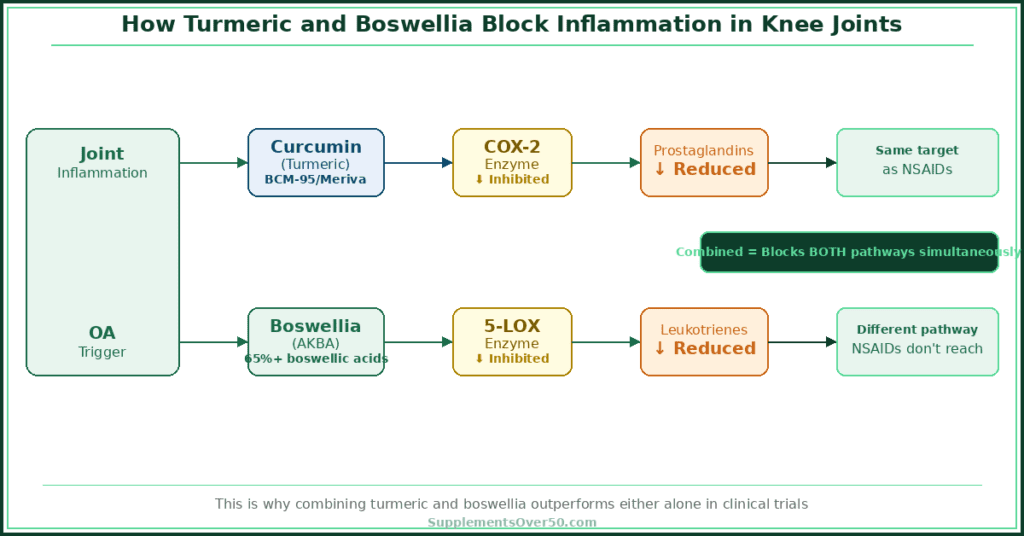
Inflammation in osteoarthritis is driven by multiple enzyme pathways simultaneously. Think of them as different roads leading to the same destination — joint damage. Block one road and traffic reroutes through another. Block both and the inflammatory signal is significantly reduced.
| Turmeric / Curcumin | Boswellia Serrata | |
|---|---|---|
| Primary target | COX-2 (cyclooxygenase-2) + NF-kB pathway | 5-LOX (5-lipoxygenase) pathway |
| What it blocks | Prostaglandins — the pain-signaling molecules targeted by ibuprofen/NSAIDs | Leukotrienes — inflammatory molecules that also degrade cartilage proteoglycans |
| Additional effects | Inhibits NF-kB (master inflammation regulator); antioxidant; may protect chondrocytes | Reduces leukocyte infiltration into joints; protects synovial lining; may improve joint fluid quality |
| Speed of action | Gradual — typically 4–8 weeks for pain benefit | Often faster for stiffness — some studies show improvement within 4 weeks |
| Bioavailability issue | Major — plain curcumin absorbs poorly; need enhanced form (BioPerine, Meriva, BCM-95) | Moderate — AKBA (the key boswellic acid) absorbs better with food/fat |
| Evidence quality | Strong — 17+ RCTs included in 2025 PMC meta-analysis | Strong — highest Bayesian ranking for pain/stiffness in 2025 network meta-analysis |
The key insight: Curcumin primarily targets COX-2 and NF-kB — the same pathways as ibuprofen. Boswellia targets 5-LOX — a completely different inflammatory enzyme that NSAIDs do not block. This is why combining them produces additive effects: they are not doing the same job, they are blocking different routes to the same inflammatory endpoint.
What the Research Shows — Honest Evidence Review
Turmeric (Curcumin) — What Is Established
A 2025 systematic review and network meta-analysis published in PMC (BMC Complementary Medicine and Therapies) analyzed 17 RCTs and found that all turmeric preparations significantly reduced WOMAC pain scores compared to placebo. The WOMAC (Western Ontario and McMaster Universities Arthritis Index) is the standard clinical measure for osteoarthritis severity.
A separate meta-analysis by Bannuru et al. (PMC) found curcuminoids were statistically significantly more effective than placebo for both pain relief and functional improvement — and showed no significant differences in efficacy compared to NSAIDs, while producing significantly fewer GI adverse events. For older adults who cannot tolerate NSAIDs, this is a clinically meaningful finding.
The critical caveat: plain curcumin from standard turmeric supplements has very low bioavailability. Studies estimate only 1–2% absorption without enhancement. This is why the form of curcumin you take matters enormously:
| Enhanced Form | How It Works | Notes |
|---|---|---|
| + BioPerine (black pepper extract) | Piperine inhibits CYP3A4 — slows metabolism of curcumin | Most common enhancement; increases absorption ~20x; inexpensive |
| Meriva (phospholipid complex) | Curcumin bound to phosphatidylcholine; absorbed with fats | Used in Thorne Curcumin Phytosome; multiple clinical trials specifically on Meriva |
| BCM-95 (turmeric essential oil) | Curcumin combined with turmeric volatile oil for enhanced uptake | Used in Terry Naturally CuraMed/Curamin; used in the combination RCT below |
| Longvida (lipid matrix) | Lipid particle encapsulation for sustained release | Used in 1MD CurcuminMD Plus; claimed 285x better absorption vs plain curcumin |
Boswellia — What Is Established
A 2025 network meta-analysis published in MDPI Nutrients compared seven nutritional supplements for knee OA across 39 RCTs (4,599 patients). Boswellia had the highest Bayesian probability of being most effective for both pain reduction and stiffness — outranking curcumin, collagen, glucosamine, ginger, krill oil, and eggshell membrane.
Key boswellia findings from clinical research:
- Improved WOMAC pain scores significantly vs placebo (mean difference 10.58 points, p<0.05) in the 2025 analysis
- Improved stiffness scores (MD 9.47, p<0.05) and function scores (MD 14.00, p<0.05)
- Beneficial effects on synovial fluid quality — may protect joint lining from leukocyte infiltration
- Generally faster onset than curcumin for stiffness — some benefit within 4 weeks
Look for a standardized extract specifying the percentage of boswellic acids. The most clinically relevant marker is AKBA (3-O-acetyl-11-keto-boswellic acid) content. Products standardized to at least 65% total boswellic acids are preferred.
The Combination — The Finding Most Articles Miss
A double-blind, placebo-controlled RCT published in PMC tested three groups in 201 osteoarthritis patients: curcumin alone (CuraMed), curcumin + boswellia combination (Curamin), and placebo — all for 12 weeks. Results: the combination group showed significantly greater pain reduction than either curcumin alone or placebo. The authors concluded the combination produces synergistic effects — likely because the two compounds block different inflammatory pathways simultaneously.
A second RCT using turmeric combined with Boswellia carteri extract reported highly significant decreases in pain on both active movement (p<0.001) and passive movement (p<0.001) after 3 months — with no significant changes in the placebo group.
Bottom line on evidence: Both turmeric/curcumin and boswellia have solid clinical evidence for knee OA pain relief. Boswellia may act faster and scores highest in comparative network analyses for pain and stiffness. Curcumin compares favorably to NSAIDs and has a superior GI safety profile. The combination consistently outperforms either alone in head-to-head trials.
Dosage Guide for Adults Over 50
| Supplement | Effective Dose | Timing | Key Requirement |
|---|---|---|---|
| Curcumin (enhanced form) | 500–1,500 mg curcuminoids/day | With a meal containing fat | Must use enhanced form — BioPerine, Meriva, or BCM-95 |
| Boswellia extract | 100–400 mg AKBA-standardized extract/day | With food for best absorption | Look for 65%+ boswellic acids standardization on label |
| Combination products | Follow product label | With meals | Verify both ingredients are at therapeutic doses, not token amounts |
Timeline expectation: Neither supplement works overnight. Most clinical trials showing benefit ran for 8–12 weeks. Give any turmeric or boswellia supplement at least 8 weeks of consistent daily use before assessing whether it is helping. Boswellia may produce some stiffness relief within 4 weeks; curcumin typically takes 6–8 weeks for pain reduction to become noticeable.
Fat absorption tip: Curcumin is fat-soluble. Always take curcumin supplements with a meal that contains some fat — not on an empty stomach. Even a tablespoon of olive oil or a handful of nuts is enough. This dramatically improves absorption for non-enhanced formulas and further boosts absorption for enhanced ones.
5 Best Turmeric and Boswellia Supplements After 50 — US Pricing
All five products below are available at US retailers. A mix of combination products and individual options is included for flexibility. Prices reflect current 2026 availability.
1. Thorne Curcumin Phytosome (Meriva) — Best Clinical-Grade Curcumin
Thorne’s Curcumin Phytosome uses Meriva — a patented phospholipid-bound curcumin with its own body of clinical research demonstrating significantly higher bioavailability than standard curcumin. NSF Certified for Sport, third-party tested, and manufactured in an NSF-registered facility. Ideal for seniors who want the most clinically studied curcumin form available. Each capsule delivers 500 mg Meriva (equivalent to ~133 mg curcuminoids with enhanced absorption). FSA/HSA eligible.
| Retailer | Size | Price (approx.) | Cost/Serving |
|---|---|---|---|
| Amazon | 60 capsules / 60 servings | ~$34–40 | ~$0.57–0.67 |
| Thorne.com | 60 capsules / 60 servings | ~$38 (FSA/HSA eligible) | ~$0.63 |
- Active ingredient: 500 mg Meriva Curcumin Phytosome per capsule (phospholipid-bound, sustained-release)
- Third-party tested: Yes — NSF Certified for Sport
- Certifications: NSF Certified, gluten-free, dairy-free, soy-free; FSA/HSA eligible
- Best for: Seniors wanting the most clinically studied enhanced curcumin form; women working with a physician
- Note: Take 1–2 capsules twice daily with meals for best results
2. Nature’s Lab Gold Whole Body Herbal Complex — Best Costco Combination
Nature’s Lab Gold at Costco combines 1,000 mg of Curcumin C3 Complex (standardized to 95% curcuminoids) with 100 mg Boswellia serrata (65% boswellic acids), plus BioPerine for enhanced curcumin absorption — alongside ginger, green tea, and rosemary in a single daily capsule. It’s the most accessible combination product for Costco members, providing both therapeutic ingredients at solid doses with a 90-day supply per bottle.
| Retailer | Size | Price (approx.) | Cost/Serving |
|---|---|---|---|
| Costco (online) | 180 capsules / 90 servings | ~$32–38 | ~$0.36–0.42 |
- Curcumin: 1,000 mg Curcumin C3 Complex (95% curcuminoids) + 5 mg BioPerine per serving
- Boswellia: 100 mg Boswellia serrata (65% boswellic acids) per serving
- Third-party tested: Yes
- Certifications: Non-GMO, vegetarian, gluten-free
- Best for: Costco members wanting a convenient one-capsule combination at warehouse pricing
3. NOW Foods Boswellia Extract 250 mg + Turmeric — Best Budget Option
NOW Foods is one of the most trusted affordable supplement brands in the US, carrying NSF and other quality certifications across their product range. Their Boswellia Extract with Turmeric combines 250 mg standardized boswellia with turmeric root extract in a vegetarian capsule — a clean, minimal-excipient formula at a price point accessible to almost everyone. At ~$0.17 per serving for 120 capsules, it’s the best entry-level combination on this list.
| Retailer | Size | Price (approx.) | Cost/Serving |
|---|---|---|---|
| Amazon | 120 capsules / 60 servings | ~$18–22 | ~$0.30–0.37 |
| Walmart | 120 capsules / 60 servings | ~$16–20 | ~$0.27–0.33 |
| iHerb | 120 capsules / 60 servings | ~$15–18 | ~$0.25–0.30 |
- Boswellia: 250 mg standardized Boswellia serrata extract per serving
- Turmeric: Turmeric root extract (standardized curcuminoids)
- Third-party tested: Yes — NOW Foods GMP certified, Informed Sport certified products available
- Certifications: Vegetarian, non-GMO, GMP certified facility
- Best for: Seniors on a fixed budget who want both ingredients without spending $40+/month
4. Terry Naturally Curamin Extra Strength — Best Clinically-Studied Combination
Curamin is the brand used in the head-to-head RCT proving combination superiority. It combines BCM-95 curcumin (a highly bioavailable form using turmeric essential oil) with BOS-10 boswellia plus DLPA (DL-phenylalanine, an amino acid that supports natural pain relief pathways) in a formula specifically designed for joint pain. It’s the most directly research-backed combination product on this list. More expensive per serving, but the clinical validation is stronger than any other combined formula.
| Retailer | Size | Price (approx.) | Cost/Serving |
|---|---|---|---|
| Amazon | 120 tablets / 40 servings | ~$42–52 | ~$1.05–1.30 |
| iHerb | 120 tablets / 40 servings | ~$38–45 | ~$0.95–1.13 |
- Active ingredients: BCM-95 curcumin + BOS-10 boswellia (65% boswellic acids, 10% AKBA) + DLPA
- Third-party tested: Yes — EuroPharma quality standards, non-addictive formula
- Certifications: Non-GMO, gluten-free, vegan
- Best for: Those who want the exact formula used in the published combination RCT
5. Doctor’s Best Curcumin with C3 Complex & BioPerine — Best Value Enhanced Curcumin
Doctor’s Best uses Curcumin C3 Complex (the same form as Nature’s Lab Gold) standardized to 95% curcuminoids, combined with BioPerine black pepper extract for enhanced absorption. At 1,000 mg curcuminoids per serving and 120 tablets per bottle, it offers one of the best cost-per-mg ratios for standardized curcumin on Amazon. A straightforward, well-verified curcumin option for those who prefer to take separate curcumin and boswellia products.
| Retailer | Size | Price (approx.) | Cost/Serving |
|---|---|---|---|
| Amazon | 120 tablets / 60 servings | ~$22–28 | ~$0.37–0.47 |
| Walmart | 120 tablets / 60 servings | ~$20–25 | ~$0.33–0.42 |
- Curcumin: 1,000 mg Curcumin C3 Complex (95% curcuminoids) + 5 mg BioPerine per serving
- Third-party tested: Yes — non-GMO, gluten-free, soy-free
- Certifications: Non-GMO, GMP certified
- Best for: Those who want a proven, budget-friendly curcumin to pair with a separate boswellia supplement
Quick Buyer’s Reference
| Your Priority | Best Choice | Why |
|---|---|---|
| Clinical-grade curcumin only | Thorne Curcumin Phytosome | Meriva — most clinically studied enhanced curcumin, NSF Certified |
| Best Costco combination | Nature’s Lab Gold Herbal Complex | Curcumin C3 Complex + Boswellia + BioPerine, 90-day supply ~$35 |
| Budget combination (Walmart/Amazon) | NOW Foods Boswellia + Turmeric | Both ingredients, ~$0.30/serving, widely available |
| Exact formula from the RCT | Terry Naturally Curamin Extra Strength | BCM-95 + BOS-10 — the combination proven superior in controlled trial |
| Budget curcumin to pair with separate boswellia | Doctor’s Best Curcumin C3 + BioPerine | 1,000 mg per serving, ~$0.37/serving on Amazon |
Who Should NOT Take Turmeric or Boswellia
People taking blood thinners (anticoagulants)
⚠️ Blood Thinner Warning — Read Before Taking Turmeric
Curcumin has antiplatelet properties and can amplify the blood-thinning effect of warfarin (Coumadin), apixaban (Eliquis), rivaroxaban (Xarelto), and clopidogrel (Plavix). If you take any anticoagulant medication, do not take high-dose curcumin supplements without consulting your prescribing physician first. At high doses, the combination could increase bleeding risk. This is the most important safety caution for turmeric supplementation in seniors.
People scheduled for surgery
Due to its antiplatelet effects, curcumin should be stopped at least 2 weeks before any scheduled surgery. Inform your surgeon if you have been taking curcumin supplements. Boswellia does not carry the same antiplatelet concern.
People with gallbladder disease or gallstones
Curcumin stimulates bile production. For most people this is beneficial for digestion, but for those with active gallstones or biliary obstruction, it may trigger gallbladder contractions and pain. If you have a history of gallstone attacks or biliary disease, consult your physician before taking curcumin.
People with iron deficiency or anemia
Curcumin can bind to iron in the gut and may reduce iron absorption. If you have diagnosed iron-deficiency anemia, take curcumin at a different time from iron supplements or iron-rich meals, and monitor iron levels with your physician.
People taking immunosuppressants or chemotherapy
Both curcumin and boswellia can modulate immune pathways. If you are taking immunosuppressant medications (for organ transplant, autoimmune disease, or cancer treatment), discuss supplementation with your specialist before starting.
Pregnancy
High-dose curcumin supplements should be avoided during pregnancy as curcumin may stimulate uterine contractions at supplemental doses. Culinary amounts of turmeric in food are considered safe.
Note on NSAIDs: If you are currently taking NSAIDs daily for joint pain, do not abruptly stop them to start turmeric or boswellia. These supplements take weeks to build up efficacy. Discuss any medication changes with your physician before transitioning.
What Else Supports Knee Health After 50
Turmeric and boswellia work best as part of a broader approach. Several other interventions have meaningful evidence for knee OA in seniors:
- Weight management: Every pound lost reduces knee joint force by approximately 4 lbs — the single most impactful intervention for knee OA
- Low-impact exercise: Swimming, cycling, and walking strengthen the muscles that support the knee, reducing cartilage stress
- How Much Vitamin D Should a 60-Year-Old Woman Take Daily?Vitamin D: Deficiency is associated with accelerated OA progression — see our Vitamin D guide for dosing
- Magnesium: Supports muscle function around the joint and reduces overall inflammatory load — see our magnesium article
- Glucosamine and chondroitin: Mixed evidence overall, but some subgroups (moderate-to-severe pain) show benefit in long-term trials
- Omega-3 fatty acids (fish oil): Anti-inflammatory via the AA/EPA pathway; may reduce cartilage degradation enzymes
Frequently Asked Questions
Q: How long does it take for turmeric to work for knee pain?
Most clinical trials showing benefit for knee OA ran for 8–12 weeks. Boswellia may produce some improvement in stiffness within 4 weeks. Curcumin typically takes 6–8 weeks for meaningful pain reduction. Give either supplement at least 8 weeks of consistent daily use before assessing efficacy. If you see no benefit after 12 weeks at a therapeutic dose, that supplement may not be the right fit for your specific inflammation profile.
Q: Can I take turmeric and boswellia together?
Yes — and the clinical evidence suggests this is the most effective approach. A published randomized controlled trial found the combination of curcumin (BCM-95) and boswellic acid (BOS-10) was significantly more effective than curcumin alone for osteoarthritis pain. Because they target different inflammatory enzymes (COX-2 vs 5-LOX), they are genuinely complementary rather than redundant.
Q: Can I take turmeric if I am on blood thinners?
This requires a conversation with your physician before starting. Curcumin has antiplatelet properties and can potentially amplify the blood-thinning effect of medications like warfarin (Coumadin), Eliquis, Xarelto, and Plavix. The risk depends on your specific medication, dose, and individual clotting profile. Do not make this decision without medical guidance.
Q: Is the turmeric in cooking the same as a supplement?
Not in terms of therapeutic dose. Ground turmeric spice contains roughly 2–5% curcumin by weight. A typical teaspoon of turmeric powder contains about 100–200 mg of total curcuminoids — versus 500–1,500 mg in a therapeutic supplement serving. Cooking with turmeric is beneficial for general health, but reaching the doses used in clinical trials requires supplementation. One exception: cooking turmeric with a fat source (like coconut oil or olive oil) does meaningfully improve the absorption of dietary curcumin.
Q: Does boswellia have side effects?
Boswellia is generally very well tolerated. The most common reported side effects are mild and GI-related — occasional nausea, acid reflux, or loose stools, typically at higher doses or when taken on an empty stomach. Taking boswellia with food resolves most GI side effects. No serious adverse events have been reported in clinical trials at standard doses (100–400 mg boswellic acid extract/day).
Q: What is the difference between turmeric and curcumin on a label?
Turmeric is the root plant (Curcuma longa). Curcumin is the active polyphenol within turmeric responsible for most of its anti-inflammatory effects — typically present at 2–5% in raw turmeric root. ‘Turmeric extract standardized to 95% curcuminoids’ means the product has been concentrated to contain 95% curcumin and related compounds by weight — this is what you want to see on a label. A ‘1,000 mg turmeric’ product with no standardization could contain as little as 20–50 mg of actual curcumin.
Sources & Citations
| # | Source | Type | URL |
|---|---|---|---|
| 1 | Wai et al. — Turmeric, Boswellia, and Combined Formulation for Knee OA: Systematic Review and Network Meta-Analysis, BMC Complementary Medicine and Therapies, PMC 2025 | Peer-Reviewed / Meta-analysis | pmc.ncbi.nlm.nih.gov/articles/PMC12309109/ |
| 2 | Bannuru et al. — Efficacy of Curcumin and Boswellia for Knee OA: Systematic Review and Meta-Analysis, PMC 2018 | Peer-Reviewed / Meta-analysis | pmc.ncbi.nlm.nih.gov/articles/PMC6131088/ |
| 3 | Haroyan et al. — Efficacy and Safety of Curcumin and Its Combination with Boswellic Acid in Osteoarthritis: RCT, PMC 2018 | Peer-Reviewed / RCT | pmc.ncbi.nlm.nih.gov/articles/PMC5761198/ |
| 4 | Bideshki et al. — Efficacy of Curcumin in Relieving Osteoarthritis: A Meta-Analysis of Meta-Analyses, Phytotherapy Research, PubMed 2024 | Peer-Reviewed / Meta-analysis | pubmed.ncbi.nlm.nih.gov/38576215/ |
| 5 | Comparative Effectiveness of Nutritional Supplements in KOA: Network Meta-Analysis, MDPI Nutrients 2025 | Peer-Reviewed / Network Meta-analysis | mdpi.com/2072-6643/17/15/2547 |
| 6 | ScienceDirect — Curcuma longa, Boswellia serrata, and Combined Formulation: Network Meta-Analysis, October 2025 | Peer-Reviewed | sciencedirect.com/science/article/pii/S0965229925001323 |
| 7 | Nature’s Lab Gold Whole Body Herbal Complex — Costco Product Page (Curcumin C3 Complex + Boswellia) | Retail Reference | costco.com |
| 8 | NOW Foods Boswellia Extract + Turmeric — Amazon Product Page | Retail Reference | amazon.com |
* These statements have not been evaluated by the Food and Drug Administration. These products are not intended to diagnose, treat, cure, or prevent any disease. Always consult your physician before starting any new supplement, especially if you take blood thinners or prescription medications.