| ⚕️ Supplement Disclosure This article reviews vitamin C as a dietary supplement for informational purposes only. Adults with kidney disease, a history of kidney stones or taking anticoagulant medications should consult their doctor before supplementing with vitamin C above 500mg daily. High-dose vitamin C can affect iron absorption and interact with certain medications. |
Vitamin C for seniors is consistently underestimated. Ask most people what vitamin C does and they will say ‘immune support.’ That is accurate but incomplete. For adults over 60, vitamin C’s most significant roles are actually in collagen synthesis, non-haem iron absorption, antioxidant protection against the increased oxidative stress of aging, and carnitine production for cellular energy — none of which appear on most supplement labels.
The standard RDA for vitamin C is 75mg daily for women and 90mg daily for men — achievable from diet for adults who eat vegetables and fruit regularly. The supplement question for seniors is more nuanced: whether there are age-specific reasons to supplement above RDA, which form delivers the best absorption, and whether the premium liposomal format is worth the cost difference over standard ascorbic acid.
This guide answers all three questions with the current evidence, explains the four overlooked roles of vitamin C after 60, and reviews five specific US products with 2026 pricing.
| The most important insight for seniors: vitamin C’s role as a co-factor for collagen synthesis means that even moderate deficiency — not just severe scurvy-level deficiency — can impair skin integrity, joint cartilage maintenance, wound healing and vascular wall strength. Adults over 60 already experience declining collagen production from age-related changes in fibroblast activity. Adequate vitamin C ensures that the collagen-producing machinery that remains active is not further limited by a co-factor shortage. |
The Four Overlooked Roles of Vitamin C After 60
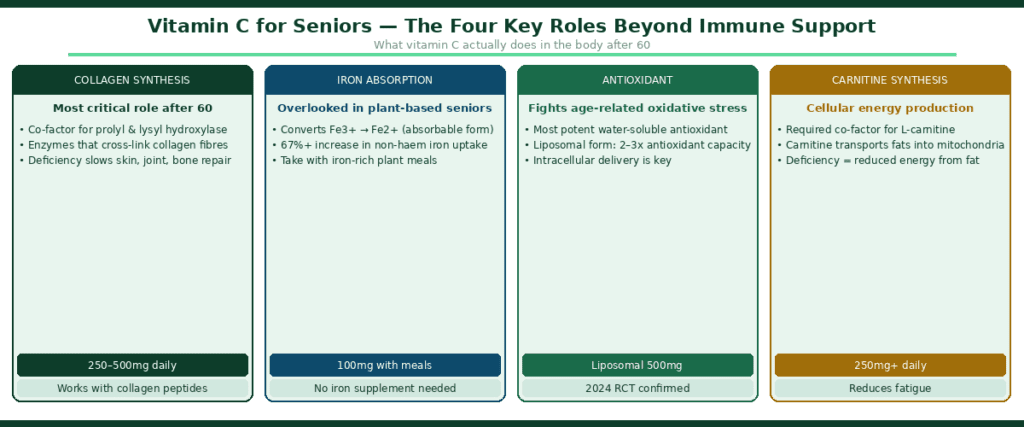
1. Collagen synthesis — the most underappreciated function
The NIH Office of Dietary Supplements confirms that vitamin C is required for the biosynthesis of collagen — it is an essential co-factor for the enzymes prolyl hydroxylase and lysyl hydroxylase, which are responsible for the cross-linking and stabilisation of collagen fibres. Without adequate vitamin C, these enzymes become auto-inactivated, and collagen synthesis slows or stops.
For adults over 60, this matters across four tissues simultaneously: skin (where collagen provides structural integrity and wound healing capacity), joint cartilage (where type II collagen forms the shock-absorbing matrix that degrades with age), blood vessel walls (where collagen maintains vascular integrity), and bone matrix (where collagen forms the protein scaffold that calcium and phosphorus mineralise onto).
A 2025 review in Frontiers in Nutrition covering over 60 clinical studies on collagen supplementation consistently identifies vitamin C as the essential co-factor — collagen peptide supplements work significantly better when vitamin C status is adequate because the body can process the amino acid precursors through the hydroxylation pathway that vitamin C enables.
This directly connects to Article 20 on this site — see Best Collagen Supplement After 50 for the full collagen supplementation guide. Vitamin C and collagen peptides form a natural stack.
2. Non-haem iron absorption — critical for seniors on plant-forward diets
Vitamin C dramatically enhances the absorption of non-haem iron — the form found in plant foods including leafy greens, legumes and fortified cereals. It converts ferric iron (Fe3+, poorly absorbed) to ferrous iron (Fe2+, readily absorbed) in the gut. Studies show that consuming 100mg of vitamin C alongside iron-rich plant foods can increase non-haem iron absorption by 67% or more.
For adults over 60 who eat less red meat, follow plant-forward diets, or experience the appetite reduction common in older adults, this interaction is clinically meaningful. Iron deficiency anaemia in seniors is commonly linked not to low iron intake but to low absorption efficiency — and vitamin C status is one of the key variables.
3. Antioxidant protection against age-related oxidative stress
Oxidative stress — the accumulation of reactive oxygen species that damage cells, DNA and proteins — increases with age and is a central mechanism in age-related disease. Vitamin C is one of the most potent water-soluble antioxidants available, donating electrons to neutralise free radicals in aqueous environments including blood plasma and the fluid inside cells.
The 2024 liposomal vitamin C study published in Nutraceuticals demonstrated that liposomal encapsulation increased antioxidant capacity by 2 to 3 times above standard ascorbic acid supplementation — the liposomal delivery system dramatically improves intracellular uptake where the antioxidant effect actually occurs.
4. Carnitine synthesis — cellular energy production
Vitamin C is a required co-factor for the synthesis of L-carnitine, the molecule responsible for transporting long-chain fatty acids into mitochondria where they are burned for energy. Inadequate vitamin C means reduced carnitine production and reduced capacity to generate energy from fat — contributing to the fatigue and reduced energy that many seniors experience. This mechanism is separate from and additive to the immune and antioxidant effects.
Standard vs Liposomal Vitamin C — The Absorption Debate
This is the most commercially contested area of vitamin C supplementation. Here is what the current evidence actually shows:
| Form | Absorption Evidence | Practical Verdict |
| Standard ascorbic acid | Well-absorbed up to 200mg per dose. Above 500mg absorption rate declines as intestinal transporters saturate. Excess excreted in urine. | Effective and sufficient for most seniors at 250–500mg daily in divided doses. No clinical downside. |
| Buffered vitamin C (sodium/calcium ascorbate) | Same absorption as ascorbic acid but gentler on stomach. Useful for seniors with gastric sensitivity. | Best standard choice for seniors with sensitive stomachs — same efficacy, better tolerance. |
| Liposomal vitamin C | 2024 European Journal of Nutrition study: higher plasma and leukocyte uptake vs standard. 2024 Nutraceuticals RCT: 55% higher serum levels after 2 hours, antioxidant capacity 2–3x higher. | Genuine absorption advantage — particularly for intracellular delivery. Worth the premium for seniors targeting antioxidant protection or collagen support. |
| Vitamin C with bioflavonoids | Bioflavonoids (rutin, quercetin, hesperidin) may enhance absorption and extend activity. Evidence is supportive but less definitive than liposomal data. | Reasonable addition — modest benefit, modest cost premium. A good middle ground. |
| The honest liposomal verdict: the 2024 absorption data is real and the premium is justified for seniors who want maximum antioxidant protection or who are using vitamin C to support collagen synthesis. However, standard buffered ascorbic acid at 250–500mg daily remains effective for general supplementation at a fraction of the cost. The clinical outcomes gap between the two forms has not yet been definitively established — most experts recommend liposomal if budget allows, standard if not. |
Dosing Guide for Adults Over 60
Important medication interactions: high-dose vitamin C above 1,000mg may affect INR values in warfarin users — disclose to your anticoagulant prescriber. Very high doses above 2,000mg have been associated with reduced statin efficacy in some studies. At 250–500mg daily these risks are minimal but disclosure is always recommended.
| Question | Answer |
| RDA for adults over 60? | 75mg daily for women, 90mg daily for men. Smokers need an additional 35mg. These are minimum requirements, not optimal supplementation levels. |
| Optimal supplementation dose? | 250–500mg daily for general antioxidant and collagen support. This is above the RDA but well within the safe upper limit. Divide doses — 250mg twice daily absorbs better than 500mg at once. |
| Upper tolerable limit? | 2,000mg daily for adults. Above this, GI side effects (diarrhoea, cramping) become likely. Men with kidney stone history should stay below 1,000mg. |
| When to take? | With meals — improves absorption and reduces gastric irritation. If taking with iron-rich food, the absorption enhancement is a bonus, not a concern. |
| Liposomal dose? | 500mg daily of liposomal vitamin C is equivalent to higher doses of standard ascorbic acid due to improved bioavailability. Most liposomal products recommend 500–1,000mg daily. |
Men who have experienced calcium-oxalate kidney stones should also cross-reference their multivitamin — see our Best Multivitamin for Men Over 60 guide for which formulas keep vitamin C within the safe range for stone-risk individuals.
5 Best Vitamin C Supplements for Seniors — US Pricing 2026
1. Nature’s Bounty Vitamin C 500mg (Walmart) — Best Budget Standard Option
The most widely available vitamin C supplement in US retail — USP-verified quality, 500mg per tablet, rose hip bioflavonoids included. Rose hips add natural quercetin and flavonoids that may enhance absorption. Available at Walmart for approximately $8–12 for 100 tablets (~$0.08–0.12 per day).
- Vitamin C: 500mg as ascorbic acid + rose hip bioflavonoids
- Price per day: ~$0.10 (Walmart — excellent value)
- Certification: USP Verified, non-GMO
- Best for: Seniors who want reliable quality at the lowest possible daily cost
2. NOW Buffered Vitamin C 500mg (Amazon / Walmart) — Best for Sensitive Stomachs
Calcium ascorbate is the buffered (non-acidic) form of vitamin C — same absorption as standard ascorbic acid but significantly gentler on the stomach. Ideal for seniors with gastric sensitivity, acid reflux or those taking the supplement without food. Available at Amazon and Walmart for approximately $12–18 for 100 tablets (~$0.12–0.18 per day).
- Vitamin C: 500mg as calcium ascorbate (buffered — non-acidic)
- Price per day: ~$0.15 (Amazon/Walmart)
- Certification: GMP certified, non-GMO, vegan
- Best for: Seniors with sensitive stomachs or who take vitamin C without food
3. NOW Liposomal Vitamin C 500mg (Amazon) — Best Liposomal Value
NOW’s liposomal formula uses PureWay-C in a fat-soluble liposomal delivery system — the form with clinical evidence for enhanced absorption, cellular uptake and retention. Combines the absorption advantage of liposomal delivery with NOW’s quality standards. Available on Amazon for approximately $22–28 for 60 capsules (~$0.37–0.47 per day).
- Vitamin C: 500mg as liposomal PureWay-C per 2 capsules
- Price per day: ~$0.42 (Amazon)
- Certification: GMP certified, vegan, non-GMO
- Best for: Seniors prioritising antioxidant protection and collagen support who want liposomal delivery at a moderate price
4. Garden of Life Vitamin C Whole Food (Amazon) — Best Whole-Food Sourced
Whole-food sourced vitamin C from organic acerola cherry and other organic fruits — contains the natural co-factors and bioflavonoids present in food-form vitamin C rather than synthetic ascorbic acid alone. USDA Organic, Non-GMO, NSF certified. Available on Amazon for approximately $18–24 for 60 tablets (~$0.30–0.40 per day).
- Vitamin C: whole-food sourced from organic acerola + fruit blend
- Price per day: ~$0.35 (Amazon)
- Certification: USDA Organic, NSF, Non-GMO, vegan
- Best for: Seniors who prefer nutrients in whole-food matrix form with natural co-factors
5. Kirkland Signature Vitamin C 1000mg (Costco) — Best Value High-Dose Option
Costco’s house-brand vitamin C at 1,000mg per tablet — USP quality at an exceptionally low price. At this dose, divide the tablet and take 500mg twice daily for better absorption. Available at Costco for approximately $10–16 for 500 tablets (~$0.02–0.03 per day — extraordinary value).
- Vitamin C: 1,000mg per tablet (take half twice daily for best absorption)
- Price per day: ~$0.02 (Costco — exceptional value)
- Certification: USP Verified
- Tip: Tablet is scored — break in half for two 500mg doses for better absorption than one 1,000mg dose
- Best for: Costco members who want maximum quantity at minimum cost
The Vitamin C + Collagen Stack
If you are already taking a collagen supplement — see our guide on Best Collagen Supplement After 50 — taking vitamin C at the same time significantly enhances the benefit. The collagen peptides provide the amino acid building blocks (glycine, proline, hydroxyproline). The vitamin C ensures the hydroxylation enzymes that assemble those building blocks into stable collagen fibres are fully active. Take 250–500mg vitamin C with your morning collagen supplement.
Similarly, for bone health — see our guide on K2, D3 and Boron for Bone Density — vitamin C supports the collagen protein scaffold onto which calcium mineralises. K2 and D3 direct calcium to the right location; vitamin C ensures the scaffold is in place to receive it. If you are already taking a collagen supplement, vitamin C is the missing co-factor that determines how effectively your body uses it — take 250–500mg with your morning collagen supplement for the most clinically supported stack.
Frequently Asked Questions
How much vitamin C should a person over 60 take daily?
The RDA is 75mg for women and 90mg for men — achievable from diet with adequate fruit and vegetable intake. For supplementation targeting collagen support and antioxidant protection, 250–500mg daily in divided doses is the evidence-supported range for seniors. Divide doses — 250mg twice daily absorbs significantly better than 500mg at once because intestinal transporters saturate above 200mg per dose. The upper tolerable limit is 2,000mg daily. Men with kidney stone history should stay below 1,000mg.
Is liposomal vitamin C worth the extra cost for seniors?
The absorption advantage is real. A 2024 study published in Nutraceuticals found liposomal vitamin C raised serum levels 55% higher than standard ascorbic acid two hours after dosing, and increased antioxidant capacity 2 to 3 times. A 2024 European Journal of Nutrition study confirmed higher plasma and leukocyte uptake with liposomal form. For seniors specifically targeting antioxidant protection or collagen support, the premium is justified. For general supplementation as a nutritional safety net, buffered standard ascorbic acid at 500mg daily remains effective at a fraction of the cost.
Does vitamin C help with collagen production after 60?
Yes — vitamin C is an essential co-factor for collagen synthesis that cannot be substituted. It prevents the auto-inactivation of prolyl hydroxylase and lysyl hydroxylase, the two key enzymes that cross-link and stabilise collagen fibres. Without adequate vitamin C, these enzymes fail and collagen synthesis slows regardless of amino acid availability. For seniors already taking collagen peptide supplements, ensuring adequate vitamin C status — at least 250mg daily — is an evidence-based way to improve the effectiveness of that supplementation.
Can vitamin C help seniors absorb iron better?
Yes, significantly. Vitamin C converts non-haem iron from the ferric form (poorly absorbed) to the ferrous form (well absorbed) in the gut. Consuming 100mg of vitamin C alongside iron-rich plant foods can increase non-haem iron absorption by 67% or more. For seniors who eat plant-forward diets or who experience fatigue that may be related to suboptimal iron absorption, taking vitamin C with iron-rich meals is a simple, cost-effective intervention — no iron supplementation needed.
For seniors whose fatigue may be linked to suboptimal iron absorption rather than low iron intake — a common pattern in adults over 60 who eat plant-forward diets — see our Vitamin B12 Deficiency guide which covers the overlapping fatigue symptoms of both B12 and iron insufficiency and how to distinguish them.
What is the difference between ascorbic acid and buffered vitamin C?
Both deliver the same absorbable vitamin C. Ascorbic acid is the standard acidic form — highly effective but can cause gastric irritation at doses above 500mg or when taken without food. Buffered vitamin C (typically calcium ascorbate or sodium ascorbate) is the same molecule bound to a mineral salt that neutralises the acidity. Absorption is equivalent. The buffered form is preferable for seniors with gastric sensitivity, acid reflux or those who need to take vitamin C on an empty stomach. At $0.12–0.18 per day vs $0.08–0.12 per day, the modest cost premium is usually worthwhile for comfort.
The Bottom Line
Vitamin C for seniors is not just about avoiding colds. For adults over 60, the collagen synthesis role — ensuring that prolyl and lysyl hydroxylase remain active — is arguably the most important and most overlooked function. Every tissue that depends on collagen: skin integrity, joint cartilage, vascular walls and bone matrix, depends on adequate vitamin C status.
For most seniors, 250–500mg daily of buffered ascorbic acid at $0.10–0.18 per day is effective and sufficient. If you are already taking a collagen supplement, take vitamin C at the same time — the combination is more effective than either alone. If antioxidant protection is the priority, liposomal vitamin C at $0.40–0.50 per day provides the most bioavailable form with 2024 clinical evidence behind it.
Start with Nature’s Bounty 500mg at Walmart for cost-conscious seniors, NOW Buffered C for sensitive stomachs, or NOW Liposomal C for maximum absorption.
References
1. NIH Office of Dietary Supplements. Vitamin C Health Professional Fact Sheet. Updated July 2025. View on NIH
2. Nutraceuticals (2024). Enhanced bioavailability and immune benefits of liposome-encapsulated vitamin C — McGarry SV et al. doi: 10.3390/nutraceuticals4040034
3. European Journal of Nutrition (2024). Liposomal vitamin C: higher plasma and leukocyte uptake vs nonliposomal control.
4. Frontiers in Nutrition (2025). Collagen supplementation and regenerative health. View article
5. PubMed. Effect of vitamin C on collagen synthesis and cross-linking by human fibroblasts. Pinnel SR et al.