| ⚕️ Supplement Disclosure This article reviews vitamin D3 as a dietary supplement for informational purposes only. Men with kidney disease, hyperparathyroidism, sarcoidosis, or a history of kidney stones should consult their physician before supplementing with vitamin D, as these conditions can be worsened by excess calcium absorption. Adults taking thiazide diuretics, digoxin, or certain anticonvulsants should also discuss vitamin D supplementation with their doctor. Get a blood test (25-hydroxyvitamin D) before starting supplementation above 2,000 IU daily. This article does not constitute medical advice. |
Vitamin D3 for men over 60 is one of the most clinically important and consistently underutilised supplements available. Vitamin D is not simply a bone nutrient — in men over 60, it functions as a steroid hormone precursor that influences testosterone production, immune cell activation, muscle strength, prostate cell regulation, and cardiovascular health.
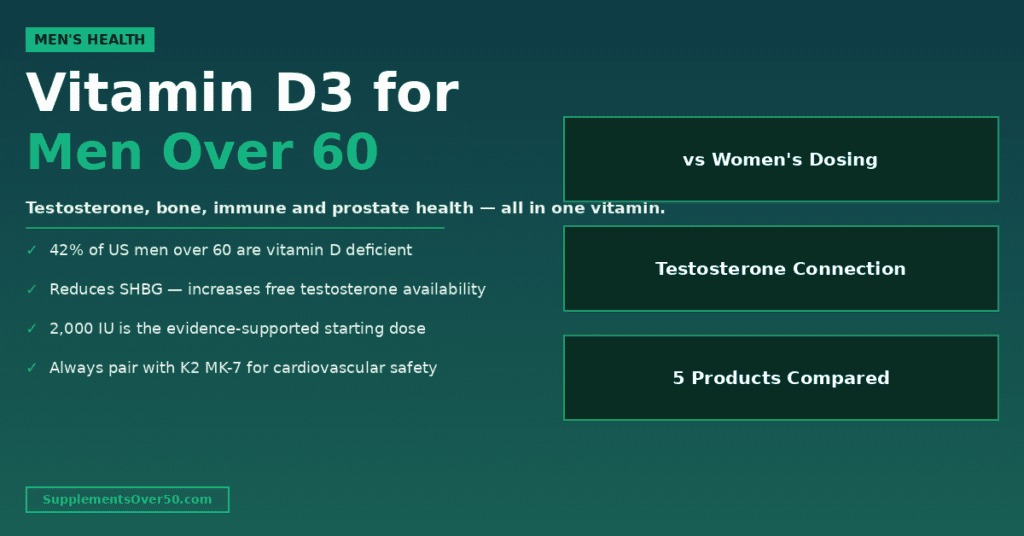
The problem: nearly 42% of US adults are vitamin D deficient, and the rate is substantially higher in men over 60. Skin synthesis of vitamin D from sunlight drops by approximately 75% between ages 20 and 70. Most men in this age group spend less time outdoors, use more sunscreen, have reduced kidney efficiency for converting vitamin D to its active form, and absorb less from dietary sources. The result is a widespread, silent deficiency with consequences that extend far beyond bone density.
This guide covers what vitamin D3 specifically does for men after 60 — the testosterone connection, the prostate evidence, the immune data — what dose makes sense, and five products available at US retailers with 2026 pricing.
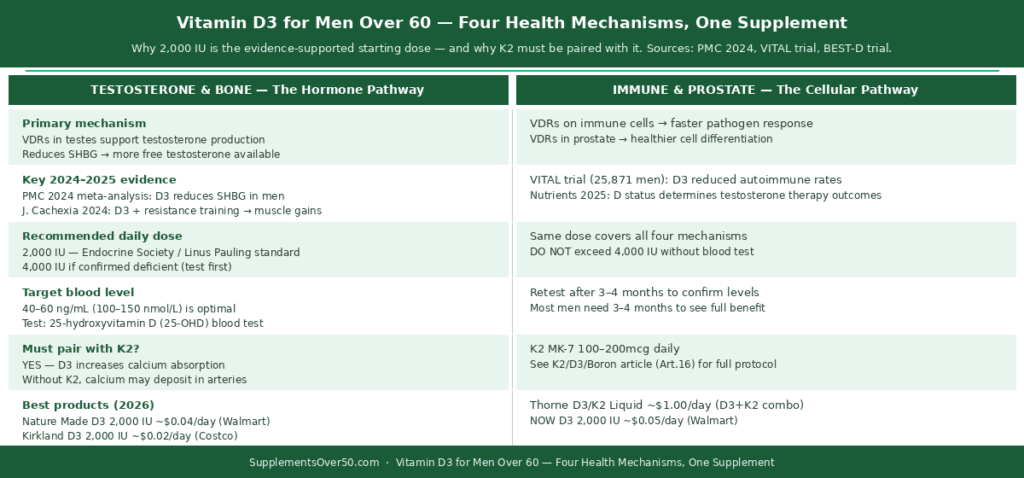
| The Clinical Story in Brief A 2024 meta-analysis in PMC (searching through July 2024, multiple RCTs) confirmed that vitamin D3 supplementation reduces SHBG (sex hormone-binding globulin) levels in men — increasing free testosterone availability even when total testosterone doesn’t change significantly. A 2025 MDPI study found vitamin D status directly determines the cardiometabolic benefits of testosterone therapy in men with hypogonadism. The VITAL trial (25,871 men, 2,000 IU/day, 5.3 years) confirmed significant cardiovascular and immune benefits. The BEST-D trial in adults 65+ found 4,000 IU/day is needed to achieve blood levels associated with lowest disease risk. |
Vitamin D3 for Men Over 60 is Different
1. The Testosterone Connection
Vitamin D receptors (VDRs) are found throughout the male reproductive system — including the testes, where testosterone is produced. The relationship is bidirectional: testosterone increases the enzyme that activates vitamin D, and vitamin D in turn supports testicular function. When vitamin D levels are low, the testes produce less testosterone.
The practical implication for men over 60: both testosterone and vitamin D decline with age simultaneously. A 2024 meta-analysis found that vitamin D3 supplementation significantly reduces SHBG — the protein that binds testosterone and renders it biologically inactive. Lower SHBG means more free testosterone available to tissues, even if total testosterone numbers don’t move dramatically. For men experiencing low energy, reduced muscle mass, and mood changes associated with declining testosterone, correcting vitamin D deficiency is a logical and underutilised first step before exploring other interventions. Vitamin D3 is one component of a comprehensive natural testosterone support protocol — for the complete evidence-based stack including zinc, magnesium, and ashwagandha KSM-66: Natural Testosterone Support for Men Over 50 — What the Evidence Actually Shows.
The evidence is honest about its limits: vitamin D supplementation is not a substitute for testosterone therapy in men with clinically diagnosed hypogonadism. But for the far larger population of men with vitamin D deficiency and suboptimal-but-not-clinically-low testosterone — which describes the majority of men over 60 — optimising vitamin D is a meaningful lever.
Related: Natural Testosterone Support for Men Over 50 — What the Evidence Actually Shows
2. Bone Density and Fall Prevention
The bone health case for vitamin D in men is well-established. Vitamin D is essential for calcium absorption — without adequate D3, calcium passes through the intestinal tract largely unused regardless of dietary intake. In men over 60, bone loss accelerates and fracture risk rises substantially. The Journal of Cachexia, Sarcopenia and Muscle 2024 trial in men over 70 found that vitamin D combined with calcium, protein and resistance training improved chair stand performance, muscle strength and quality of life significantly versus placebo.
The BEST-D trial (305 adults aged 65+) found that 4,000 IU daily was required to achieve the blood levels of 25-hydroxyvitamin D (above 90 nmol/L) associated with the lowest fracture and disease risk. At 2,000 IU, levels averaged 102 nmol/L — still above the clinical sufficiency threshold of 50 nmol/L. At 600–800 IU (the official RDA), blood levels barely moved from deficiency range in many participants.
3. Immune Function and Infection Resistance
Vitamin D is a direct regulator of the innate immune system. Vitamin D receptors are found on virtually every immune cell. When activated by vitamin D, macrophages and T-cells mount faster, more effective responses to pathogens. In men over 60, immune function declines with age — a process called immunosenescence — making vitamin D’s immune-support role increasingly important.
The VITAL trial found that men over 50 taking 2,000 IU vitamin D3 daily for 5.3 years had significantly lower rates of autoimmune disease development compared to placebo — a finding that extended across cancer, cardiovascular events, and respiratory infections in various subgroup analyses. For men who get frequent colds, struggle with seasonal infections, or want to maximise vaccine response, vitamin D sufficiency is foundational.
4. Prostate Health
Vitamin D receptors are highly expressed in prostate tissue. Laboratory and observational data consistently show that adequate vitamin D levels are associated with healthier prostate cell behaviour — specifically, vitamin D promotes differentiation of prostate cells and inhibits the unchecked growth patterns associated with both benign prostatic hyperplasia (BPH) and prostate cancer risk. For men with active BPH symptoms — weak flow, nighttime urgency, or incomplete emptying — the prostate-specific supplement evidence goes beyond vitamin D: Prostate Supplements for Men Over 50 — Saw Palmetto vs Beta-Sitosterol Honestly Reviewed.
The clinical picture is nuanced: the VITAL trial did not find a statistically significant reduction in prostate cancer incidence at 2,000 IU/day. However, observational studies consistently find that men with vitamin D deficiency have higher rates of aggressive prostate cancer. The current consensus is that vitamin D is a prostate-protective nutrient at adequate levels, but megadose supplementation has not been shown to treat or prevent prostate cancer. For men already monitoring PSA and prostate health, ensuring vitamin D sufficiency is a reasonable and low-risk component of overall prostate health strategy.
Related: Prostate Supplements for Men Over 50 — Saw Palmetto vs Beta-Sitosterol
How Much Vitamin D3 Do Men Over 60 Actually Need?
| Source | Recommended Daily Dose | Target Blood Level |
| NIH / IOM (official RDA) | 600 IU (under 70) / 800 IU (70+) | >20 ng/mL (50 nmol/L) — minimum |
| Endocrine Society | 1,500–2,000 IU for adults at risk | >30 ng/mL (75 nmol/L) — optimal |
| Oregon State / Linus Pauling | 2,000 IU daily for older adults | >30 ng/mL |
| BEST-D Trial evidence | 4,000 IU to reach lowest-risk blood levels | >90 nmol/L (36 ng/mL) |
| Safe upper limit (IOM) | 4,000 IU/day without medical supervision | Do not exceed without testing |
The practical recommendation for most men over 60: 2,000 IU daily is a well-supported, safe starting dose. Get a blood test (25-hydroxyvitamin D) before starting if possible — men who are deficient may need 3,000–4,000 IU to correct levels, while men who are already sufficient need less. Re-test after 3–4 months to confirm levels are in the optimal 40–60 ng/mL range.
| ⚠️ Vitamin D3 Requires K2 to Work Safely Vitamin D3 increases calcium absorption. Without adequate Vitamin K2 (specifically MK-7 form), that absorbed calcium can deposit in arteries rather than bones — a process called vascular calcification. If you are supplementing vitamin D3 at 2,000 IU or above daily, pair it with 100–200mcg of Vitamin K2 MK-7. See our K2, D3 and Boron guide for the full bone and cardiovascular protection protocol. Every man supplementing D3 at 2,000 IU or above should pair it with Vitamin K2 MK-7 — D3 increases calcium absorption and without K2 that calcium can deposit in arterial walls rather than bone. For the complete cardiovascular safety protocol: K2, D3 and Boron for Bone Density — Why K2 Must Accompany Every D3 Supplement. |
D2 vs D3 — Why the Form Matters
Vitamin D supplements come in two forms: D2 (ergocalciferol, derived from plants) and D3 (cholecalciferol, derived from lanolin or lichen). For men over 60, D3 is unambiguously superior. Research consistently shows that D3 raises blood levels of 25-hydroxyvitamin D more effectively and maintains those levels for longer than D2. Most physicians and the Endocrine Society specifically recommend D3 for supplementation. The price difference between D2 and D3 at retail is negligible — always choose D3.
5 Best Vitamin D3 Supplements for Men Over 60 — US Pricing 2026
1. Nature Made Vitamin D3 2,000 IU — Walmart / Amazon — Best Budget
Best for: men wanting a reliable, USP-verified D3 at the lowest possible cost.
| Formula | Vitamin D3 2,000 IU (50 mcg) per softgel — soybean oil base for absorption |
| Price (2026) | ~$8–12 for 250 softgels at Walmart (~$0.03–0.05/day) — exceptional value |
| Third-Party Tested | USP Verified — one of the highest quality certifications for OTC supplements |
| Best For | Men starting D3 supplementation who want maximum value and trusted quality |
| Notes | Take with your largest fat-containing meal — D3 is fat-soluble and absorbs significantly better with dietary fat |
2. Thorne Vitamin D/K2 Liquid — Thorne.com / Amazon — Best D3+K2 Combo
Best for: men who want D3 and K2 MK-7 in one product for combined bone and cardiovascular protection.
| Formula | 1,000 IU D3 + 200mcg K2 (MK-4) per drop — liquid form, adjustable dosing |
| Price (2026) | ~$28–34 for 30ml (~$0.93–1.13/day at 2 drops) |
| Third-Party Tested | NSF Certified for Sport — highest available certification |
| Best For | Men who want D3 and K2 together without taking two separate supplements |
| Notes | Liquid allows precise dose adjustment; MK-4 form — some prefer MK-7 for longer half-life; discuss with physician |
3. Life Extension Vitamin D3 5,000 IU — LifeExtension.com / Amazon — Best for Deficiency Correction
Best for: men who have confirmed vitamin D deficiency on a blood test and need to correct levels faster.
| Formula | Vitamin D3 5,000 IU (125 mcg) per softgel — olive oil base |
| Price (2026) | ~$12–16 for 60 softgels (~$0.20–0.27/day) |
| Third-Party Tested | Non-GMO; manufactured in NSF-registered Life Extension facility |
| Best For | Men with confirmed deficiency (below 20 ng/mL) needing faster correction under physician guidance |
| Notes | 5,000 IU is above the safe self-directed limit — use only if blood test confirms deficiency and retest after 3 months |
4. NOW Vitamin D3 2,000 IU — Walmart / iHerb — Best Value with K2
Best for: men wanting pharmaceutical-grade D3 at Walmart prices.
| Formula | Vitamin D3 2,000 IU per softgel — non-GMO, soy-free |
| Price (2026) | ~$10–14 for 240 softgels at Walmart (~$0.04–0.06/day) |
| Third-Party Tested | NOW IGEN Non-GMO Tested; GMP certified; NSF registered facility |
| Best For | Men who want reliable D3 at Walmart without frills — NOW quality standards are excellent |
| Notes | Pair with a separate K2 MK-7 supplement at 100–200mcg if supplementing long-term at this dose |
5. Kirkland Signature Vitamin D3 2,000 IU — Costco — Best Bulk Value
Best for: men who shop at Costco and want a year’s supply at the lowest cost per serving.
| Formula | Vitamin D3 2,000 IU (50 mcg) per tablet |
| Price (2026) | ~$10–14 for 600 tablets at Costco (~$0.02/day) — the best per-serving value available |
| Third-Party Tested | Costco Kirkland quality standards; manufactured in certified facility |
| Best For | Budget-conscious men who want a full year’s supply at once — outstanding value |
| Notes | Tablet form rather than softgel — take with fat-containing meal; Costco availability may vary seasonally |
How to Test and Monitor Your Vitamin D Levels
| Question | Answer |
| Which blood test? | Ask for 25-hydroxyvitamin D (25-OHD) — this is the standard test for vitamin D status |
| Target range? | 40–60 ng/mL (100–150 nmol/L) is the optimal range for men over 60 per most integrative medicine guidelines |
| When to retest? | 3–4 months after starting or changing dose — D3 takes time to build up in fat stores |
| What if deficient? | Below 20 ng/mL is clinical deficiency — discuss higher dose (3,000–5,000 IU) with physician; retest at 3 months |
| How much does testing cost? | Most insurance covers it; self-pay is $30–60 at LabCorp or Quest Diagnostics without insurance |
Related Articles on SupplementsOver50.com
• K2, D3 and Boron for Post-Menopausal Bone Density — The Triple Threat (applies to men too)
• Natural Testosterone Support for Men Over 50 — What the Evidence Actually Shows
• Prostate Supplements for Men Over 50 — Saw Palmetto vs Beta-Sitosterol
• Best Multivitamin for Men Over 60 — Prostate, Heart and Brain Nutrients Compared
• How Much Vitamin D Should a 60-Year-Old Woman Take Daily? — companion article
• The 5 Essentials — Supplements Every Adult Over 60 Should Know
References
1. PMC 2024: Vitamin D impact on androgens in adult males — meta-analytic review (through July 2024)
4. BEST-D Trial: Optimum dose of vitamin D for disease prevention in adults 65+ — 4,000 IU finding
5. NIH Office of Dietary Supplements: Vitamin D — Health Professional Fact Sheet (updated 2026)
Frequently Asked Questions
Does vitamin D3 increase testosterone in men over 60?
The evidence is nuanced. A 2024 meta-analysis found that vitamin D3 supplementation significantly reduces SHBG — the protein that binds and inactivates testosterone — thereby increasing free testosterone availability even when total testosterone doesn’t change significantly. In men with confirmed vitamin D deficiency, correcting it can improve free testosterone, energy, and muscle function. Vitamin D supplementation is not a testosterone treatment, but optimising D3 levels is a meaningful and low-risk first step for men experiencing symptoms of declining testosterone who haven’t yet addressed their vitamin D status.
How much vitamin D3 should a man over 60 take daily?
2,000 IU daily is the most evidence-supported starting dose for men over 60 — supported by the Endocrine Society, the Oregon State Linus Pauling Institute, and multiple clinical trial protocols. Men who are confirmed deficient (below 20 ng/mL on a blood test) may need 3,000–4,000 IU under physician guidance to correct levels efficiently. The NIH’s official RDA of 600–800 IU was designed only to prevent rickets — it is widely considered insufficient for the broader health benefits documented in adults over 60. Do not exceed 4,000 IU daily without a blood test confirming deficiency.
What is the best time to take vitamin D3?
Take vitamin D3 with your largest fat-containing meal of the day — breakfast, lunch, or dinner. Vitamin D3 is fat-soluble and its absorption increases substantially when taken with dietary fat. Studies show absorption is significantly lower when taken on an empty stomach or with a fat-free meal. The specific time of day is less important than the consistency of taking it with food. Most people take it with dinner for habit convenience.
Should men over 60 take vitamin D3 with K2?
Yes — this is strongly recommended at doses of 2,000 IU or above. Vitamin D3 increases calcium absorption from food and supplements. Without adequate Vitamin K2 (MK-7 form, 100–200mcg daily), that additional absorbed calcium can deposit in arterial walls rather than being directed into bone — a process that increases cardiovascular risk. The K2+D3 combination is well-established in bone health research and is the safer approach for long-term supplementation. See our K2, D3 and Boron article for the full protocol.
Can too much vitamin D3 be harmful for men over 60?
Yes — vitamin D toxicity (hypervitaminosis D) causes hypercalcemia, which can damage kidneys, heart, and blood vessels. However, toxicity from supplementation is rare below 10,000 IU daily and has not been reported at 4,000 IU in clinical trials. The safe self-directed upper limit is 4,000 IU/day per the NIH. Men with kidney disease, hyperparathyroidism, or sarcoidosis are at higher risk for toxicity at lower doses and should consult their physician before supplementing above 1,000 IU. Blood testing every 6–12 months at higher doses is prudent.
Does Vitamin D3 increase testosterone in men over 60?
Not directly — but it removes a significant hormonal bottleneck. Vitamin D3 acts as a steroid hormone precursor and has VDRs (vitamin D receptors) in the Leydig cells that produce testosterone. More importantly, 2024 meta-analyses confirm D3 supplementation significantly reduces Sex Hormone-Binding Globulin (SHBG) — the protein that binds testosterone and renders it biologically inactive. Lower SHBG means more free testosterone available to muscle, brain, and prostate tissue regardless of total testosterone levels. For deficient men, correcting D3 deficiency at 2,000–5,000 IU daily has raised total testosterone by 10–20% in published RCTs — the SHBG reduction adds further benefit on top.
Is 5,000 IU of Vitamin D3 too much for a man over 60?
5,000 IU is appropriate as a corrective dose for confirmed deficiency (25-hydroxyvitamin D below 20 ng/mL) for up to 3 months, after which retesting and reducing to 2,000 IU for maintenance is standard practice. The NIH safe upper limit for long-term self-directed use is 4,000 IU daily — 5,000 IU exceeds this and should be done under physician guidance with periodic blood level monitoring. Men with granulomatous conditions (sarcoidosis), hyperparathyroidism, or kidney disease face higher risk of toxicity at lower doses and should not exceed 1,000–2,000 IU without medical supervision. For most healthy men over 60 without confirmed deficiency, 2,000 IU daily is the evidence-supported maintenance dose.
Can Vitamin D3 help with an enlarged prostate (BPH)?
Vitamin D3 is not a treatment for BPH or prostate cancer — but maintaining adequate levels is a well-evidenced component of prostate health strategy. Vitamin D receptors (VDRs) are highly expressed throughout prostate tissue and regulate cell differentiation and proliferation. Low vitamin D status is consistently associated with higher PSA levels and more aggressive prostate disease in epidemiological studies. The VITAL trial found vitamin D supplementation was associated with reduced cancer mortality. The practical recommendation: maintain 25-hydroxyvitamin D levels at 40–60 ng/mL as part of a prostate health protocol that includes beta-sitosterol or saw palmetto for urinary symptom management.
How does Vitamin D3 affect muscle strength in older men?
Vitamin D receptors are expressed in skeletal muscle tissue and directly regulate fast-twitch muscle fibre function — the fibres most important for balance recovery and fall prevention. A 2011 meta-analysis of 8 RCTs found vitamin D supplementation reduced fall risk by 19% in older adults through this muscle spindle mechanism. For men over 60 doing resistance training, adequate vitamin D is required for optimal muscle protein synthesis response — deficient men build less muscle from the same training stimulus. This makes D3 correction an essential foundation for any senior fitness or strength program.
Should men over 60 get their Vitamin D tested before supplementing?
Ideally yes — a 25-hydroxyvitamin D blood test confirms your baseline and allows you to track improvement. Deficiency below 20 ng/mL justifies a corrective dose of 4,000–5,000 IU for 3 months before dropping to 2,000 IU maintenance. Insufficiency at 20–30 ng/mL is addressed by 2,000 IU daily. However, given that 42% of US adults are deficient and the rate is higher in men over 60 — particularly those spending limited time outdoors — starting 2,000 IU without testing is a reasonable low-risk decision. The cost and inconvenience of testing should not delay supplementation at a dose that is safe for virtually all healthy adults.
The Bottom Line
Vitamin D3 for men over 60 is not a single-benefit supplement — it is a hormone precursor that touches testosterone availability, bone integrity, immune defence, and prostate cell health simultaneously. Nearly 42% of US adults are deficient, and the rate is higher in men over 60 who spend less time outdoors and have reduced skin synthesis efficiency.
Start with 2,000 IU daily from a reputable source — Nature Made USP-verified at Walmart (~$0.04/day) is the best-value entry point. Pair it with K2 MK-7 for cardiovascular safety. Get a blood test before and after 3–4 months to confirm your levels reach the optimal 40–60 ng/mL range. If deficient, work with your physician to correct levels faster before maintaining with 2,000 IU long-term.