
| ⚕️ Supplement Disclosure This article reviews supplements for bone health and is for informational purposes only. It does not substitute for medical advice. If you have been diagnosed with osteoporosis or osteopenia, or are taking anticoagulant medications such as warfarin, speak with your doctor before adding vitamin K2 to your routine. Vitamin K interacts with blood-thinning medications. |
Vitamin K2 D3 bone density menopause is a topic that deserves far more attention than it gets. Most women over 60 have heard the standard bone health advice: take calcium, take vitamin D. But the research has moved on significantly from that two-ingredient picture — and the gap between what the evidence supports and what most women are actually taking is surprisingly large.
Three nutrients in particular have accumulated meaningful clinical evidence for post-menopausal bone health beyond what calcium and D3 alone can deliver: vitamin K2 (specifically the MK-7 form), vitamin D3 in adequate doses, and boron — a trace mineral that influences how the body uses both calcium and estrogen.
This article explains how each one works, what the 2024 and 2025 research actually shows, and which specific products to buy with current US pricing. Framed entirely around supplement choices — not medical treatment.
| One in three women over 50 will experience an osteoporotic fracture in their lifetime, according to the International Osteoporosis Foundation. Supplements cannot replace medical management of diagnosed osteoporosis — but the evidence for K2, D3 and boron as a proactive bone health stack is genuine and growing. |
Why Calcium Alone Is Not Enough After Menopause
Calcium is still the most commonly recommended supplement for bone health — and it does play an important role. But calcium without the right co-factors is a little like pouring concrete without rebar: the building blocks are there, but the structural direction is missing.
The specific problem is calcium directionality. After menopause, declining estrogen levels disrupt the body’s ability to ensure that calcium absorbed from food and supplements actually ends up in bone tissue rather than circulating in soft tissue and arteries. This is why some research has raised concerns about high-dose calcium supplementation without adequate vitamin K2 — the calcium is being absorbed but not effectively directed to the skeleton.
The three nutrients covered in this article each address a specific gap in the calcium-only approach:
- Vitamin D3 — controls calcium absorption from the gut. Without adequate D3, calcium cannot be absorbed efficiently regardless of intake.
- Vitamin K2 — directs absorbed calcium into bone tissue and away from arteries. This is the most misunderstood step in the bone-building process.
- Boron — influences sex hormone metabolism and calcium excretion, both of which affect bone density after menopause.
Vitamin K2 — The Missing Link in Post-Menopausal Bone Health
Vitamin K2 is a fat-soluble vitamin that exists in several forms. For bone health, two forms are clinically relevant: MK-4 and MK-7. Understanding the difference matters when choosing a supplement.
How K2 actually works in bone
The key mechanism involves a protein called osteocalcin. Osteocalcin is produced by bone-building cells (osteoblasts) and is responsible for binding calcium to the bone matrix. But osteocalcin only functions properly when it has been activated — a process called carboxylation that requires vitamin K2. Without adequate K2, osteocalcin circulates in an under-carboxylated (inactive) form and cannot bind calcium to bone effectively.
Vitamin K2 also activates another protein called Matrix Gla Protein (MGP), which inhibits calcium deposits in arteries and soft tissue. This is why adequate K2 is described as supporting both bone health and arterial health simultaneously — it encourages calcium to stay in bone and stay out of arteries.
MK-7 vs MK-4 — which form is better for seniors?
| Factor | MK-7 (Menaquinone-7) | MK-4 (Menaquinone-4) |
| Half-life in blood | ~72 hours — active for days | ~1–2 hours — clears quickly |
| Effective dose | 90–180 mcg/day | 1,000–45,000 mcg/day (much higher) |
| Bone research | 3-year RCTs in postmenopausal women | Shorter trials, mostly Japanese data |
| Arterial research | Strong evidence for MGP activation | Less studied for arterial calcification |
| Dietary source | Natto (fermented soy) — not widely eaten in US | Meat, eggs, dairy — small amounts |
| Best for seniors | First choice — lower dose, longer activity, more bone RCT evidence | Valid but requires much higher doses |
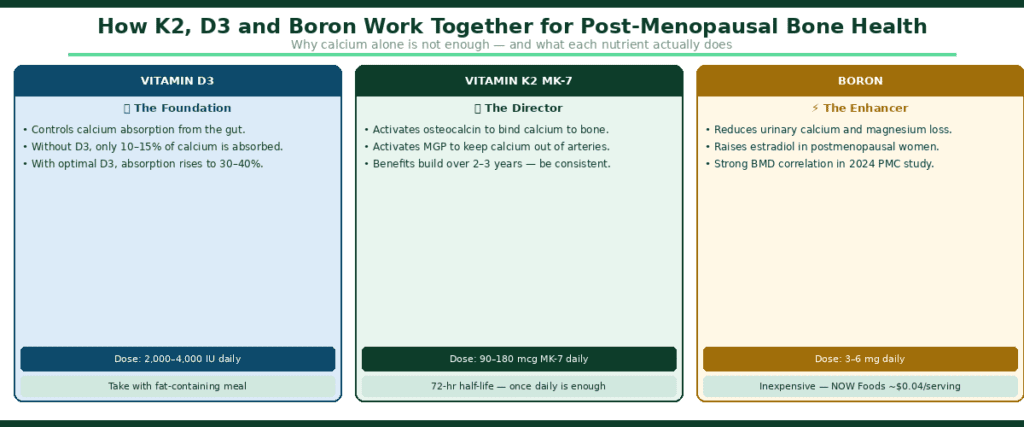
Why calcium alone is not enough after menopause — D3 controls absorption, K2 MK-7 directs calcium into bone via osteocalcin, and boron reduces calcium loss while supporting estrogen metabolism. Sources: PMC 2024, Osteoporosis International, Frontiers in Endocrinology 2025.What the clinical evidence shows for MK-7
A 3-year randomised, double-blind, placebo-controlled trial published in Osteoporosis International followed postmenopausal women taking 180 mcg of MK-7 daily. The study found that MK-7 supplementation significantly decreased the age-related decline in bone mineral density and bone strength compared to placebo — with benefits taking 2–3 years to fully emerge. The authors concluded that low-dose MK-7 supplements may help postmenopausal women prevent bone loss.
A 2024 systematic review and meta-analysis published in Bone and Joint Research (PMC) reviewed multiple RCTs and found that vitamin K supplementation increased lumbar spine bone mineral density (p=0.035) and significantly improved osteocalcin carboxylation markers. Subgroup analysis specifically found that vitamin K notably enhanced bone health in females, including increased lumbar spine BMD and decreased under-carboxylated osteocalcin.
A 2025 systematic review published in Frontiers in Endocrinology further confirmed vitamin K2’s role in improving bone turnover biochemical markers in postmenopausal osteoporosis patients across multiple RCTs.
| The key finding across K2 trials: the benefit on bone density takes 2–3 years of consistent supplementation to become statistically significant. This is a long-game supplement — not a quick fix. Consistency over years matters far more than any single dose. |
Vitamin D3 — The Calcium Absorption Gatekeeper
Vitamin D3 (cholecalciferol) is the form the body produces when skin is exposed to sunlight, and the form used in the vast majority of supplementation research. It is the most evidence-backed supplement in the entire bone health category.
D3’s primary role in bone health is controlling calcium absorption from the small intestine. Without adequate vitamin D, only 10–15% of dietary calcium is absorbed. With optimal vitamin D levels, absorption rises to 30–40%. This is why D3 is the foundation of any bone health supplement protocol — without it, calcium and K2 have less to work with.
For a full breakdown of optimal vitamin D blood levels and dosing for women over 60, see our dedicated guide on How Much Vitamin D Should a 60-Year-Old Woman Take Daily?“
Why D3 and K2 work better together
D3 increases calcium absorption from the gut — which is exactly what you want. But this also means more calcium is now circulating in the body and needs to be directed properly. This is where K2’s role in activating osteocalcin and MGP becomes critical. D3 and K2 are genuinely complementary rather than simply additive: D3 creates the calcium supply and K2 manages where it goes.
Research consistently shows that the combination of D3 and K2 produces better bone outcomes than either alone. A 2-year RCT found that women taking the combined D3 and K2 protocol showed significantly better bone density outcomes than those taking either vitamin in isolation.
| The D3 and K2 pairing is one of the most evidence-backed supplement combinations in bone health research. If you are already taking D3 and not taking K2, adding K2 is the single most impactful addition you can make to your current bone health routine. |
Boron — The Overlooked Trace Mineral
Boron is a trace mineral not yet given an official Recommended Daily Allowance in the US — which is part of why it remains unfamiliar to most people. But the research on boron and post-menopausal bone health is genuinely interesting and has strengthened over the past few years.
Boron also helps your body retain magnesium — another critical mineral for bone structure and muscle relaxation. See our comparison of Magnesium Glycinate vs Citrate for the best form to pair with this stack.
How boron affects bone after menopause
Boron influences bone health through two primary mechanisms. First, it modulates mineral metabolism — specifically reducing urinary excretion of calcium and magnesium, meaning more of these bone-building minerals are retained in the body rather than being lost. Second, boron has been shown to influence sex hormone metabolism. Research has found that boron supplementation raises plasma estradiol and testosterone levels in postmenopausal women — relevant because estrogen decline is the primary driver of post-menopausal bone loss.
A 2024 pilot study published in Food Science & Nutrition (PMC) in postmenopausal women with osteoporosis found a strong and statistically significant correlation between boron intake and bone mineral density (p<0.05). Women with higher boron intake had measurably better BMD — supporting the hypothesis that boron intake is a meaningful modifiable factor for bone health in this population.
A narrative review published in PubMed concluded that dietary supplementation of 3mg per day of boron demonstrated positive effects on bone health in humans, working through control of calcium, vitamin D and sex steroid hormone metabolism.
Boron’s evidence is strong enough to act on — but honest caveats apply
The boron research base is smaller than the K2 and D3 evidence base — there are fewer large RCTs and more observational studies. The honest framing: boron at 3–6mg daily is well tolerated, inexpensive, and supported by consistent positive signals in postmenopausal women. It is a sensible addition to a bone health supplement routine rather than a proven standalone intervention.
How K2, D3 and Boron Work as a Stack
Just as K2 protects heart health by preventing arterial calcification, Ubiquinol supports the heart’s energy production at the mitochondrial level — a natural pairing for cardiovascular health after 60.
| Nutrient | Primary Bone Action | Recommended Daily Dose |
| Vitamin D3 | Controls calcium absorption from the gut — the foundation of the stack | 2,000–4,000 IU (confirm blood levels with your doctor) |
| Vitamin K2 (MK-7) | Directs absorbed calcium into bone via osteocalcin carboxylation; protects arteries via MGP activation | 90–180 mcg MK-7 per day |
| Boron | Reduces calcium excretion; supports estrogen metabolism; enhances mineral retention | 3–6mg per day |
| Calcium (food first) | Provides the raw material — but only effective when D3 and K2 are adequate | From food where possible; 500–600mg supplement if dietary intake is low |
| All three nutrients are fat-soluble. Take them together with your largest fat-containing meal of the day — lunch or dinner — to maximise absorption. Vitamin D3 in particular shows dramatically better absorption when taken with dietary fat. |
Best K2, D3 and Boron Supplements for Women Over 60 — US Pricing (2026)
Five products covering different approaches — dedicated K2 MK-7, combined D3+K2, and a comprehensive bone stack formula. Pricing from Walmart, Amazon, and iHerb as of early 2026.
1. Life Extension Super K (Walmart / Amazon) — Best All-In-One Vitamin K
The most comprehensive vitamin K supplement available at mainstream US retailers. Each softgel delivers 2,000 mcg vitamin K1, 1,000 mcg MK-4, and 180 mcg MK-7 — all three forms in clinically relevant doses. The MK-7 dose (180 mcg) matches what was used in the 3-year postmenopausal bone trial. Gluten-free, non-GMO, one softgel daily. Available at Walmart for approximately $22–26 for 90 softgels (~$0.24–0.29 per serving) and on Amazon at similar pricing.
- K2 MK-7 per softgel: 180 mcg — matches 3-year bone density trial dose
- Also contains K1 and MK-4 for comprehensive coverage
- Price per serving: ~$0.24–0.29 (Walmart / Amazon)
- Certification: Non-GMO, gluten-free, Life Extension quality standard
- Best for: Post-menopausal women who want all K forms in one daily softgel
2. Thorne Vitamin K (Walmart / Amazon) — Best Certified K2 Option
Thorne’s vitamin K formula contains K1, MK-4 and MK-7 in a clinically studied combination. Thorne is one of the most respected supplement brands for quality consistency and testing rigour. Available at Walmart for approximately $28–34 for 60 capsules (~$0.47–0.57 per serving). NSF Certified for Sport — the highest third-party standard available.
- K2 MK-7 per capsule: 80 mcg | MK-4: 500 mcg | K1: 1,000 mcg
- Price per serving: ~$0.47–0.57 (Walmart)
- Certification: NSF Certified — highest available standard
- Best for: Women who prioritise purity certification above all else
3. Sports Research Vitamin K2 MK-7 with Organic Coconut Oil (Amazon) — Best Pure MK-7
A dedicated MK-7 supplement delivering 100 mcg of trans-MK-7 per softgel formulated in organic coconut oil to improve fat-soluble absorption. Non-GMO, soy-free, gluten-free. Available on Amazon for approximately $18–22 for 60 softgels (~$0.30–0.37 per serving). A clean, simple option for women who already take D3 separately and just need MK-7 added.
- K2 MK-7 per softgel: 100 mcg (trans-form — the active isomer)
- Price per serving: ~$0.30–0.37 (Amazon)
- Certification: Non-GMO, soy-free, third-party tested
- Best for: Women who take D3 separately and want a clean standalone MK-7 supplement
4. Life Extension Bone Restore Elite (Walmart / Amazon) — Best Complete Bone Stack
The most comprehensive single-product bone stack available at mainstream US retail. Contains calcium (three absorbable forms), vitamin D3 (1,000 IU), vitamin K2 (MK-7), magnesium, boron, and zinc in one formula. This is the rare supplement that includes boron specifically — making it ideal for post-menopausal women who want the full triple-threat stack without buying separate bottles. Available at Walmart and Amazon for approximately $30–36 for 120 capsules (~$0.50–0.60 per 4-capsule serving).
- Contains: calcium, D3 1,000 IU, K2 MK-7, magnesium, boron, zinc
- Price per serving: ~$0.50–0.60 (Walmart / Amazon)
- Certification: Non-GMO, gluten-free, Life Extension quality
- Best for: Post-menopausal women who want K2, D3, boron and calcium in one product — maximum convenience
5. NOW Foods Boron 3mg (Amazon / Walmart) — Best Standalone Boron
For women who already take K2 and D3 separately and just want to add boron, NOW Foods delivers 3mg of boron per capsule — exactly the dose shown to influence mineral metabolism in postmenopausal women. Highly affordable. Available at Amazon and Walmart for approximately $8–12 for 250 capsules — roughly $0.03–0.05 per serving.
- Boron per capsule: 3mg (as boron glycinate chelate)
- Price per serving: ~$0.03–0.05 (Amazon / Walmart) — extremely affordable
- Certification: NPA GMP Certified, non-GMO
- Best for: Women who already have K2 and D3 covered and want to add boron inexpensively
| # | Product | Key Nutrients | Price/Serve | Certification | Best For |
| 1 | Life Extension Super K | K1+MK-4+MK-7 (180mcg) | ~$0.27 | Non-GMO | Best all-in-one K |
| 2 | Thorne Vitamin K | K1+MK-4+MK-7 (80mcg) | ~$0.52 | NSF Certified | Best certified K |
| 3 | Sports Research K2 MK-7 | MK-7 100mcg + coconut oil | ~$0.33 | Non-GMO, tested | Best pure MK-7 |
| 4 | Life Extension Bone Restore Elite | Ca+D3+K2+Mg+Boron+Zn | ~$0.55 | Non-GMO | Best complete stack |
| 5 | NOW Foods Boron 3mg | Boron 3mg only | ~$0.04 | NPA GMP | Best boron add-on |
| ⚠️ Important — Vitamin K and blood-thinning medications If you take warfarin (Coumadin), Eliquis, Xarelto or any other anticoagulant medication, speak with your doctor before adding any vitamin K2 supplement. Vitamin K interacts with warfarin specifically — your INR levels may be affected. Newer anticoagulants (Eliquis, Xarelto) work through a different mechanism and are generally not affected by dietary vitamin K, but always confirm with your prescribing doctor before changing your supplement routine. |
Related Articles on SupplementsOver50.com
• How Much Vitamin D Should a 60-Year-Old Woman Take Daily?
• Magnesium Glycinate vs Citrate — Which Form Is Better for Seniors After 50?
• Ubiquinol vs CoQ10 — Is the More Expensive Form Worth It After 60?
Frequently Asked Questions
Should I take vitamin K2 with vitamin D3 for bone health?
Yes — this combination is strongly supported by clinical evidence. Vitamin D3 increases calcium absorption from the gut, which is essential. Vitamin K2 then directs that absorbed calcium into bone tissue via a protein called osteocalcin, while also protecting arteries via Matrix Gla Protein activation. Research consistently shows that D3 and K2 together produce better bone density outcomes than either nutrient alone. If you are taking D3 and not yet taking K2, adding MK-7 is the most impactful addition you can make to your current bone health routine.
What is the best dose of K2 MK-7 for post-menopausal bone health?
The 3-year randomised controlled trial showing significant bone density preservation in postmenopausal women used 180 mcg of MK-7 daily. A separate 3-year study used 375 mcg. Most supplement experts recommend 90–180 mcg of MK-7 per day as a practical target for post-menopausal women. Doses above 200 mcg have not shown additional bone benefit and the MK-7 form stays active in the bloodstream for approximately 72 hours, making once-daily dosing at 90–180 mcg effective.
What does boron do for bones after menopause?
Boron works through two mechanisms relevant to post-menopausal bone health. First, it reduces urinary excretion of calcium and magnesium, meaning the body retains more of these bone-building minerals. Second, boron has been shown to increase plasma estradiol and testosterone levels in postmenopausal women — and since estrogen decline is the primary driver of post-menopausal bone loss, supporting estrogen metabolism is directly relevant to bone density. A 2024 study in postmenopausal women with osteoporosis found a strong positive correlation between boron intake and bone mineral density.
Can I take K2, D3 and boron together?
Yes, all three are compatible and complementary. Take them all with your largest fat-containing meal of the day — all three are fat-soluble nutrients that absorb significantly better alongside dietary fat. The Life Extension Bone Restore Elite contains all three in one formula if you prefer a single product. If you prefer separate supplements, take D3 and K2 together with dinner and add boron at the same time for simplicity.
Is vitamin K2 safe for seniors to take daily?
Yes, for adults not on blood-thinning medications. Vitamin K2 at 90–180 mcg daily has an excellent safety profile in postmenopausal women across multiple 3-year clinical trials with no significant adverse effects reported. The one important exception is warfarin (Coumadin) — vitamin K directly interacts with warfarin’s mechanism. If you are on warfarin, speak with your doctor before adding K2. Newer anticoagulants like Eliquis and Xarelto work through a different mechanism and are generally not affected by dietary vitamin K levels.
The Bottom Line
Vitamin K2 D3 bone density menopause is a topic that deserves to be taken seriously — and the science now supports a clear, practical supplement approach for post-menopausal women who want to do more than just take calcium.
The stack is straightforward: vitamin D3 at 2,000–4,000 IU daily to ensure calcium is actually absorbed, vitamin K2 as MK-7 at 90–180 mcg daily to direct that calcium into bone and away from arteries, and boron at 3mg daily to support mineral retention and estrogen metabolism. The evidence for each is real, the cost is modest, and the safety profile across all three is excellent.
For maximum convenience, Life Extension Bone Restore Elite contains all three alongside absorbable calcium — available at Walmart and Amazon for approximately $0.55 per day. If you prefer separate supplements, Life Extension Super K (180 mcg MK-7, ~$0.27/day), your existing D3 supplement, and NOW Foods Boron 3mg (~$0.04/day) gives you the complete stack for under $0.50 per day combined.
Be patient — the K2 research consistently shows that benefits on bone mineral density take 2–3 years to fully manifest. Start now, stay consistent, and consider asking your doctor to include bone density monitoring in your next check-up.
References and Further Reading
1. Osteoporosis International / PubMed. Three-year low-dose menaquinone-7 supplementation helps decrease bone loss in healthy postmenopausal women. View on PubMed
2. Bone and Joint Research / PMC (2024). Effects of vitamin K supplementation on bone mineral density at different sites in the middle-aged and elderly population: a meta-analysis and systematic review. View on PMC
3. Frontiers in Endocrinology (2025). The effect of vitamin K2 supplementation on bone turnover biochemical markers in postmenopausal osteoporosis patients: a systematic review and meta-analysis. View article
4. Food Science & Nutrition / PMC (2024). A pilot study investigating the influence of dietary boron levels on osteoporosis in postmenopausal women. View on PMC
5. PubMed. Pivotal role of boron supplementation on bone health: A narrative review. View on PubMed
6. Nutrients (2024). The importance of vitamin K and the combination of vitamins K and D for calcium metabolism and bone health: A review. View article

Pingback: Best Collagen Supplement After 50 — Types, Evidence and 5 Products Compared