
| ⚕️ Medical Disclaimer This article is for informational purposes only and does not constitute medical advice. Sarcopenia is a medical condition — speak with your doctor or a registered dietitian before starting any protein supplementation program, especially if you have kidney disease, are on dialysis, or have been advised to limit protein intake. Individual protein needs vary based on health status, medications, and activity level. |
Whey vs plant protein for sarcopenia is one of the most important supplement decisions adults over 60 can make — and the science is more nuanced than most websites admit. If you are losing muscle no matter how much you exercise, you are not imagining it. Sarcopenia — the age-related progressive loss of muscle mass and strength — affects between 10 and 27 percent of adults aged 60 and over worldwide, according to a 2025 systematic review published in Nutrition Reviews. It is one of the leading drivers of falls, fractures, loss of independence, and nursing home admissions in older adults.
Protein supplementation is the most well-studied nutritional strategy for slowing sarcopenia, and the debate over whey vs plant protein for sarcopenia has intensified significantly since the 2025 meta-analysis we cover below. But the question most seniors eventually face is this: does it matter whether that protein comes from whey or a plant source like pea or brown rice.
The honest answer is more nuanced than most supplement websites will tell you — and the latest research from 2024 and 2025 shifts the picture in ways that matter for your decision. This article breaks it down clearly, with no hype, and with real US pricing so you know exactly what you are buying.
What Is Sarcopenia and Why Does Protein Help?
Sarcopenia is not just “getting weaker with age.” It is a measurable clinical syndrome. Adults typically lose 0.5 to 1 percent of their skeletal muscle mass per year beginning around age 50, according to research published in the journal Critical Reviews in Food Science and Nutrition. By the time you reach 70 or 80, that cumulative loss can be severe enough to impair balance, reduce grip strength, slow your walking speed, and dramatically increase fracture risk after a fall.
The biological reason protein helps is a process called muscle protein synthesis (MPS) — your body’s ability to build and repair muscle tissue. In older adults, MPS is blunted compared to younger people, a phenomenon called anabolic resistance. Your body becomes less efficient at converting the protein you eat into muscle. This is why older adults need more protein than the standard recommended daily allowance (0.8 g/kg/day) — and why the form that protein takes starts to matter more than it does in your 30s or 40s.
The current consensus from leading nutrition researchers recommends 1.2 to 1.5 g of protein per kilogram of body weight per day for adults over 60 who are trying to preserve or rebuild muscle — significantly above the standard RDA. For a 160 lb (73 kg) adult, that translates to roughly 88 to 110 grams of protein per day.
| Most older adults get only 60–70 grams of protein per day through food alone. A single protein supplement serving of 20–30g can bridge the gap — but which type you choose affects how your muscles actually respond to it. |
Whey Protein — Why It Has Been the Gold Standard
Whey protein is a byproduct of cheese manufacturing. During the cheese-making process, milk separates into solids (curds) and liquid (whey). That liquid is filtered, dried, and concentrated into powder. The result is one of the highest-quality protein sources ever studied in clinical trials.
Why whey wins the whey vs plant protein for sarcopenia debate for most seniors
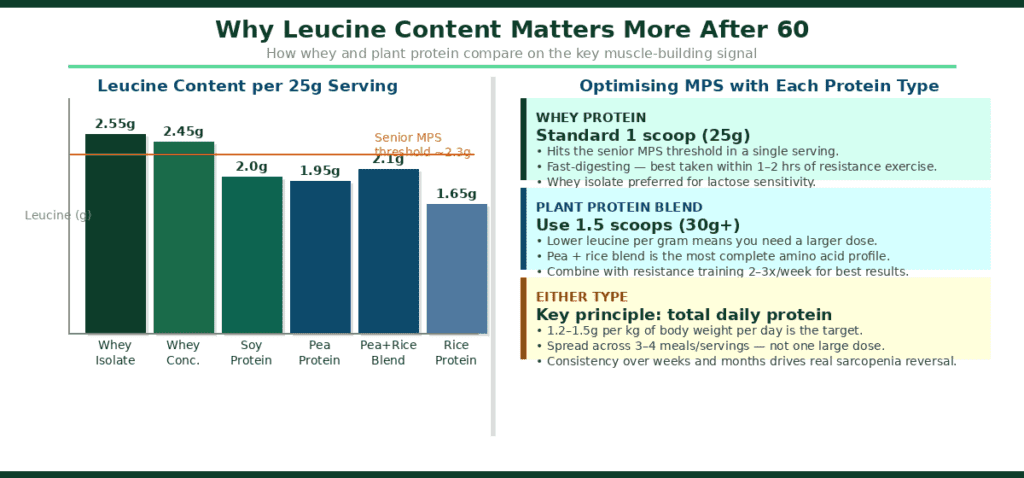
The key is leucine. Leucine is the amino acid most directly responsible for triggering muscle protein synthesis. Think of it as the ignition key — it signals the mTOR pathway in muscle cells to start building. Whey protein contains approximately 2.4 to 2.6 grams of leucine per 25-gram serving — one of the highest concentrations of any natural protein source.
This matters especially in older adults because research has found that the leucine threshold needed to maximally trigger MPS is higher in people over 60 than in younger adults. Specifically, a higher proportion of leucine — around 40 percent of essential amino acids — appears to be required for optimal muscle protein synthesis in seniors, compared to roughly 21 percent in younger people, according to a review in PMC on sarcopenia protein strategies.
Whey also has a high Digestible Indispensable Amino Acid Score (DIAAS) — a standardized measure of protein quality — of approximately 1.09. A score above 1.0 means it delivers all the essential amino acids your body needs and then some.
Whey concentrate vs. whey isolate — which matters for seniors
Whey concentrate (typically 70–80% protein by weight) contains small amounts of lactose and fat. For most people this is fine, but seniors with lactose sensitivity may experience bloating, gas, or digestive discomfort — which is a real issue since lactase production commonly declines with age.
Whey isolate (90%+ protein, almost no lactose) is the better choice for older adults, particularly anyone who has noticed digestive sensitivity to dairy. It costs slightly more, but the improved tolerance is worth it for daily use.
Plant Protein — Where It Stands in 2025
The plant protein side of the whey vs plant protein for sarcopenia debate has changed considerably over the past three years — and the 2025 research shifts the picture in ways that matter. The old assumption that “plant protein is inferior for muscle” is no longer the complete picture — but the nuance matters enormously for seniors specifically.
The leucine gap is real — and it matters more after 60
Plant proteins — including pea, rice, hemp, and soy — naturally contain lower concentrations of leucine than whey. A typical 25-gram serving of pea protein delivers roughly 1.8 to 2.1 grams of leucine, compared to 2.5+ grams in whey. That gap, while seemingly small, can meaningfully reduce the muscle protein synthesis signal in older adults who are already experiencing anabolic resistance.
Plant proteins also score lower on the DIAAS scale individually — typically 0.60 to 0.85 depending on the source. However, blending plant proteins intelligently (pea + rice is the most evidence-backed combination) produces a more complete amino acid profile that approaches — though does not fully match — the quality of whey.
What 2025 research actually shows
A landmark 2025 systematic review and meta-analysis published in Nutrition Reviews (PMC) analyzed 43 randomized controlled trials comparing plant versus animal protein for muscle health in older adults. The findings were more balanced than many expected:
- When total protein dose was equalized between groups, plant protein produced muscle outcomes that were not statistically different from animal protein in many trials
- However, older adults (≥60 years) showed a greater differential than younger adults — the leucine gap matters more when anabolic resistance is already present
- Soy protein had the most evidence; pea protein trials were more limited but promising
- Combined with resistance training, both protein types produced significant improvements in lean mass
A separate 2025 randomized clinical trial published in the Journal of the International Society of Sports Nutrition found that a blend of soy and pea protein supported similar strength and hypertrophy gains as whey in resistance training adults — though the participants in this study were younger on average.
| The bottom line on plant protein: it can work well for muscle maintenance after 60 IF the dose is high enough (aim for at least 25–30g per serving rather than 20g), the protein is a well-formulated blend rather than a single source, and it is combined with resistance exercise. For maximum muscle stimulus per gram of protein, whey still has a measurable edge — but it is smaller than it once appeared. |
Whey vs Plant Protein for Sarcopenia — Head-to-Head Comparison
| Factor | Whey Protein | Plant Protein (Pea/Rice Blend) |
| Protein quality (DIAAS score) | ~1.09 (excellent) | ~0.72–0.82 (good with blending) |
| Leucine per 25g serving | ~2.5g (high) | ~1.8–2.1g (moderate) |
| Digestion speed | Fast (ideal post-workout) | Moderate to slow |
| Lactose | Present in concentrate; minimal in isolate | None (dairy-free) |
| Complete amino acid profile | Yes | Yes (in well-formulated blends) |
| Muscle protein synthesis (MPS) | Higher acute response | Similar when dose is matched |
| Digestive tolerance in seniors | Can cause bloating (concentrate) | Generally well tolerated |
| Heavy metal risk | Very low | Low–moderate (check certifications) |
| Third-party certified options | Widely available | Available but fewer options |
| Average cost per serving (US) | $0.69–$1.10 | $1.10–$1.60 |
| Best for | Maximum muscle stimulus per gram | Dairy intolerance, plant-based diet |
Who Should Choose Whey
Whey protein remains the first-choice recommendation for most adults over 60 trying to combat sarcopenia. Here is who benefits most from choosing whey:
- You tolerate dairy well and do not experience bloating or digestive discomfort from whey concentrate
- You are dealing with significant muscle loss and need the most potent muscle protein synthesis signal per serving
- You are on a GLP-1 medication like Ozempic or Wegovy and eating less — you need maximum protein quality from a smaller volume (see our guide on protein powder for seniors on GLP-1 medications)
- You are trying to maximize the benefit of resistance exercise sessions
- Budget is a priority — whey is less expensive per serving than most plant alternatives
Who Should Choose Plant Protein
Plant protein is the right call in the whey vs plant protein for sarcopenia decision — and increasingly a competitive scientific choice — in these situations:
- You are lactose intolerant or have confirmed dairy sensitivity
- You follow a vegan or vegetarian diet
- You have experienced digestive bloating, gas, or nausea with whey concentrate products
- You have been diagnosed with early-stage kidney disease and your doctor has advised limiting animal protein (discuss your protein target and source with your nephrologist before supplementing)
- You prefer a more environmentally sustainable product and are willing to consume a slightly larger serving to compensate for the lower leucine density
Best Protein Powders for Sarcopenia After 60 — US Pricing
The following five products are selected specifically for older adults, covering both whey and plant options. Prices are from Costco, Walmart, and Amazon as of early 2026.
1. Kirkland Signature Whey Protein (Costco) — Best Value Whey
The most cost-effective whey protein available in the US market. Costco’s house-brand whey uses a whey isolate-first blend with whey concentrate, delivering 25 grams of protein and 5.6 grams of BCAAs per serving. Gluten-free, non-GMO, no added sugar, no artificial preservatives. Available at Costco in store and at costco.com.
- Protein per serving: 25g
- Approximate leucine: ~2.5g per serving
- Price: ~$47.99 for 70 servings (5.4 lbs) at Costco — approximately $0.69 per serving
- Certification: No independent third-party sport certification — a limitation worth noting
- Best for: Budget-conscious seniors who tolerate whey well
2. Optimum Nutrition Gold Standard 100% Whey — Best Widely Available Whey
One of the most extensively studied protein powders in the world. Uses a whey isolate-first blend with 24 grams of protein and 5.5 grams of naturally occurring BCAAs per serving. Gluten-free and rBST-free. Widely available at Costco, Walmart, and Amazon. Walmart typically carries the 2 lb bag for around $35–38. Costco carries the 5.47 lb bag for approximately $55. Informed Sport certified — a meaningful third-party standard.
- Protein per serving: 24g
- Price per serving: ~$0.87 (Costco 5.47 lb bag) / ~$1.10 (Walmart 2 lb bag)
- Certification: Informed Sport certified
- Best for: Reliable daily use, most broadly available option nationwide
3. Orgain USDA Organic Simple Plant Protein Powder (Costco) — Best Plant-Based Value
Costco’s primary plant protein offering and the best value plant-based option currently available at US retail. Uses an organic blend of pea, brown rice, roasted peanut flour, pumpkin seed, almond, and chia seed proteins — a well-formulated multi-source blend that improves the overall amino acid profile compared to a single plant source. Delivers 20 grams of protein per serving. Gluten-free, soy-free, dairy-free, kosher, and non-GMO.
Available at Costco for approximately $33.99 for 25 servings (32.6 oz), with frequent member pricing around $25.99 on promotion.
- Protein per serving: 20g
- Important note for sarcopenia: 20g may be at the lower threshold for seniors — consider using 1.5 scoops (30g) to maximize muscle stimulus
- Price per serving: ~$1.36 (regular) / ~$1.04 (sale price)
- Certification: USDA Organic, Non-GMO
- Best for: Dairy-free seniors who want a clean organic plant protein at Costco pricing
4. Garden of Life Sport Organic Plant-Based Protein — Best Certified Plant Option
For seniors who prioritize purity above all else, Garden of Life Sport holds both NSF Certified for Sport and USDA Organic certification — the most rigorous combination available for plant protein. Uses a blend of pea, navy bean, lentil bean, garbanzo bean, and cranberry seed protein. 30 grams of protein per serving — higher than most plant options and closer to the dose range needed to maximize MPS in older adults.
Available at Amazon for approximately $40–$45 for 12 servings and on iHerb for approximately $35–$40 for similar sizing. Also available at Whole Foods and Sprouts.
- Protein per serving: 30g
- Price per serving: ~$3.10–3.50
- Certification: NSF Certified for Sport + USDA Organic — highest certification standard
- Best for: Seniors who prioritize third-party testing and want a high-dose plant protein option
5. Vega Sport Premium Plant Protein — Best Mid-Range Plant Protein
A popular and well-reviewed plant protein with 30 grams of protein per serving from a pea, pumpkin seed, organic sunflower seed, and alfalfa blend. Informed Sport certified. Also contains tart cherry and turmeric for anti-inflammatory support — a bonus for seniors dealing with joint stiffness alongside muscle loss. Available at Walmart for approximately $40–44 for a 20-serving tub (around $2.00–2.20 per serving).
- Protein per serving: 30g
- Price per serving: ~$2.00–2.20 (Walmart)
- Certification: Informed Sport certified
- Best for: Plant-based seniors who want a higher protein dose (30g) plus anti-inflammatory ingredients in one product
| # | Product | Type | Protein | Price/Serving | Certification | Best For |
| Kirkland Whey (Costco) | Whey | 25g | ~$0.69 | None | Best value whey | |
| ON Gold Standard Whey | Whey | 24g | ~$0.87–1.10 | Informed Sport | Most available whey | |
| Orgain Simple Plant (Costco) | Plant blend | 20g | ~$1.04–1.36 | USDA Organic | Best value plant | |
| Garden of Life Sport | Plant blend | 30g | ~$3.10–3.50 | NSF + USDA Organic | Purest plant option | |
| Vega Sport Premium | Plant blend | 30g | ~$2.00–2.20 | Informed Sport | High-dose plant option |
The Dose Question — Getting This Right Matters
Research suggests that the amount of protein per serving matters as much as the type — particularly for seniors with anabolic resistance. Here is what the evidence supports for adults over 60:
| Protein Dose | What the Research Shows |
| Less than 20g per serving | Below the threshold to maximally stimulate MPS in most seniors at rest |
| 20g per serving | Near the lower effective threshold — adequate for many seniors when combined with exercise |
| 25–30g per serving | Optimal range for maximizing MPS in older adults, especially when combining with resistance exercise |
| 40g per serving | Some research suggests older adults (not young adults) may see additional MPS benefit at 40g — relevant for those who are very sedentary or highly sarcopenic |
| Timing | Within 1–2 hours of resistance exercise appears to offer modest additional benefit, but total daily protein intake matters more than timing |
For plant protein specifically: because of the lower leucine density, consider using 1.5 scoops (approximately 30g of protein) rather than the standard 1-scoop serving when using plant proteins like Orgain that deliver 20g per scoop. This brings leucine delivery closer to the whey standard.
The Role of Resistance Exercise — Non-Negotiable
Protein supplementation without resistance exercise produces modest gains in muscle mass in sedentary seniors, but the combination of the two is dramatically more effective. Multiple systematic reviews confirm that resistance training is the essential catalyst that makes protein supplementation truly effective for sarcopenia.
This does not mean you need to join a gym or lift heavy weights. Research has shown that even light-to-moderate resistance work using bodyweight exercises, resistance bands, or light dumbbells — performed two to three times per week — is enough to amplify the muscle-building response to protein. The exercise provides the signal; the protein provides the material.
| If you are choosing between whey and plant protein and are committed to resistance exercise three times per week, the difference between the two narrows considerably. If you are largely sedentary, whey’s higher leucine content gives it a more meaningful advantage. |
Related Articles on SupplementsOver50.com
• Best Protein Powder for Seniors on GLP-1 Medications (Ozempic and Wegovy)
• Creatine for Women Over 60 — Benefits Beyond the Gym
• NMN vs NR for Energy After 50 — Which One Is Worth Buying?
Frequently Asked Questions
Is whey protein safe for seniors with kidney disease?
This is one of the most important questions to get right. If you have chronic kidney disease (CKD), you may have been advised to limit protein intake — in which case you should not start any protein supplement without speaking directly to your nephrologist. The protein restrictions that apply to CKD patients are very different from the guidance for healthy seniors. For older adults with normal or mildly reduced kidney function, the research consistently shows that higher protein intake (1.2–1.5 g/kg/day) does not accelerate kidney damage. But CKD changes this picture — always check with your doctor first.
Can I get enough protein from food without supplementing?
Yes, in principle. A 3.5 oz serving of chicken breast or salmon provides about 25–30g of protein. However, many adults over 60 experience reduced appetite, dental changes that make chewing harder, or reduced absorption of dietary protein. For those who find it genuinely difficult to eat enough high-protein foods daily, a protein supplement is a practical and evidence-supported strategy.
Does the type of plant protein matter — pea vs soy vs rice?
It does. Soy protein has the longest research history and the highest DIAAS score among plant proteins (around 0.91–0.97), making it the closest single plant source to whey quality. However, some older adults avoid soy for various reasons including thyroid concerns or personal preference. Pea protein is the next best individual option, and a pea-plus-rice blend produces a more complete amino acid profile than either alone. If you are buying plant protein, look for a multi-source blend rather than a single-ingredient product.
How long before I notice results from protein supplementation?
With consistent protein intake at the right dose combined with resistance exercise, most older adults begin to notice measurable improvements in strength within 8 to 12 weeks. Actual muscle mass gains take longer to accumulate — typically 12 to 24 weeks in clinical trials. The more significant your protein deficit was beforehand, the sooner you may notice a difference. Patience and consistency matter more than any single product choice.
Should I take whey and plant protein together?
There is some emerging research on protein blends — combining whey and plant proteins — showing that the combination can stimulate a more sustained MPS response. A soy-dairy protein blend was shown to produce muscle protein synthesis responses similar to whey isolate alone in older men in one randomized trial. If you have access to both and tolerate whey well, mixing a scoop of each is a reasonable approach. However, for simplicity and cost, choosing one good option and being consistent with it will serve you better than overcomplicating the strategy.
The Bottom Line
For adults over 60 researching whey vs plant protein for sarcopenia, the most important variable is total daily protein intake — not whether it comes from whey or a plant source.. Hitting 1.2 to 1.5 grams of protein per kilogram of body weight per day, combined with any form of regular resistance exercise, is the evidence-backed foundation.
That said, whey protein — particularly whey isolate — remains the most scientifically established option for maximizing muscle protein synthesis in older adults, largely because of its superior leucine content and rapid digestibility. If you tolerate dairy, the Kirkland Signature Whey from Costco offers the best value in the US market. If you prefer the gold standard in testing, Optimum Nutrition Gold Standard with its Informed Sport certification is the most widely available option.
For plant protein, the Orgain USDA Organic Simple Plant Protein at Costco is the best value option — just use 1.5 scoops to hit 30g and compensate for the lower leucine density. Garden of Life Sport is the right choice if NSF-certified purity is your top priority.
The best protein is the one you will actually take every day. Choose the type that fits your dietary needs, your digestive tolerance, and your budget — then pair it with resistance exercise two to three times per week. That combination, sustained over months, is what the science actually shows reverses sarcopenia.
References and Further Reading
1. Reid-McCann RJ et al. (2025). Effect of Plant Versus Animal Protein on Muscle Mass, Strength, Physical Performance, and Sarcopenia: A Systematic Review and Meta-analysis of Randomized Controlled Trials. Nutrition Reviews, 83(7):e1581–e1603. View on PMC
2. Wu G. (2024). Dietary protein and amino acid intakes for mitigating sarcopenia in humans. Critical Reviews in Food Science and Nutrition. View on Taylor & Francis
3. Frontiers in Nutrition. (2025). Role of protein intake in maintaining muscle mass composition among elderly females suffering from sarcopenia. View article
4. Pharmacology Research & Perspectives. (2024). Nutritional strategies for improving sarcopenia outcomes in older adults: A narrative review. View on PMC
5. Nutrients. (2023). The Effects on Sarcopenia of Protein and Supplements in Human Clinical Studies: How Older Adults Should Consume Protein and Supplements. View on PMC
6. Clinical Nutrition. (2024). Effectiveness of whey protein supplementation on muscle strength and physical performance of older adults: A systematic review and meta-analysis of randomized clinical trials. View abstract
7. Journal of the International Society of Sports Nutrition. (2025). Similar effects between animal-based and plant-based protein blend as complementary dietary protein on muscle adaptations to resistance training. View article

Pingback: Creatine for Seniors Over 60 — Brain, Muscle and Energy Benefits (Not Just Bodybuilders)
Pingback: Omega 3 Brain Health Seniors — Can It Really Slow Decline After 60?
Pingback: Ubiquinol vs CoQ10 Seniors — Is the More Expensive Form Worth It After 60?
Pingback: Best Collagen Supplement After 50 — Types, Evidence and 5 Products Compared