
Review Disclaimer: This article is for informational purposes only and does not constitute medical advice. Information is sourced from peer-reviewed research including PMC, PubMed, and the Journal of the International Society of Sports Nutrition. Always consult your physician before starting any new supplement, especially if you have kidney disease or take prescription medications.
Creatine has a reputation problem. Most people picture a 25-year-old man at the gym loading up for a powerlifting session. But the research tells a different story — one that is increasingly relevant for women over 60.
After 60, women face a rapid acceleration of muscle loss (sarcopenia), declining bone density, reduced strength for everyday tasks, and growing cognitive vulnerability. Creatine is one of the most studied dietary supplements in existence — with hundreds of peer-reviewed trials — and the evidence for its benefits in older women specifically is now substantial. A 2025 narrative review published in the Journal of the International Society of Sports Nutrition concluded that creatine monohydrate supplementation in older adults supports muscle quantity, strength, bone architecture, functionality, and even cognitive function.
This article breaks down what the research actually shows for women over 60, which form to take, what dose works best, and five products with current US pricing from Costco, Walmart, and Amazon.
Quick Answer: Creatine for Women Over 60
Creatine monohydrate is the only form with strong clinical evidence. Take 3–5 g daily — no loading required. Best budget option: Optimum Nutrition Micronized Creatine at Costco (~$20 for 135 servings). Best clinical-grade option: Thorne Creatine (~$40 for 90 servings). Best third-party certified for purity: Klean Athlete Creatine (NSF Certified for Sport). Creatine works best combined with resistance training, but even low-intensity activity amplifies its effects for older women.
Creatine for Women Over 60: Why This Supplement Matters More Than You Think
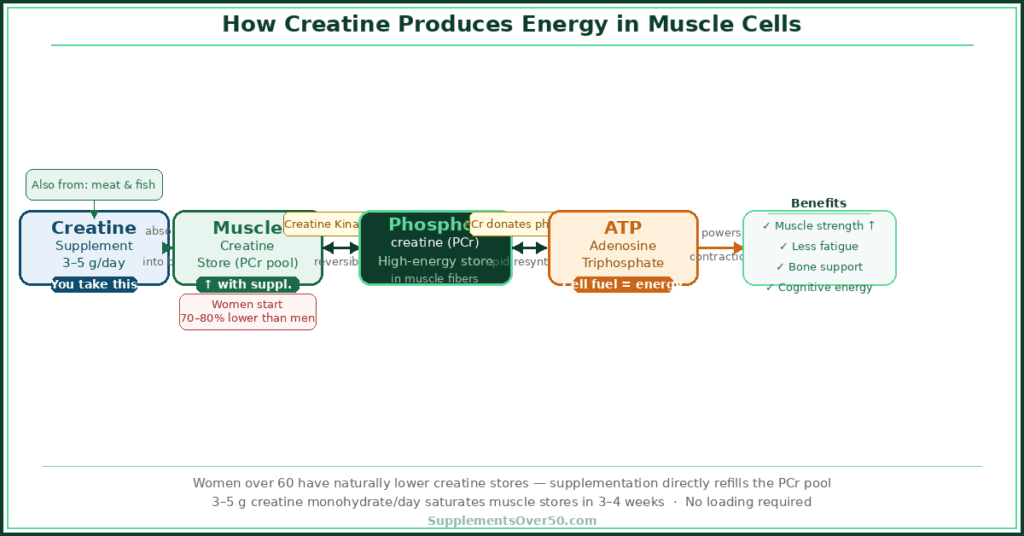
Women have naturally lower creatine stores than men — research published in PMC shows that females have 70–80% lower endogenous (internally produced) creatine levels compared to males. This gap widens further after menopause.
Here’s why that matters after 60:
| Age-Related Change | What Happens | How Creatine Helps |
| Sarcopenia (muscle loss) | Muscle mass declines 3–8% per decade after 30; accelerates sharply after 60 | Increases phosphocreatine stores → more ATP → greater training output and muscle retention |
| Estrogen decline (menopause) | Lower estrogen = reduced muscle protein synthesis and blunted anabolic response to exercise | Creatine may partially compensate by boosting the cellular energy available for muscle repair |
| Bone density loss | Women lose up to 20% of bone density in the 5–7 years after menopause | Creatine activates osteoblasts (bone-building cells) and may improve bone geometry at the femur |
| Cognitive decline | Brain creatine levels decline with age; linked to processing speed and memory | Supplementation raises brain phosphocreatine, supporting cognitive energy reserves |
| Reduced dietary creatine | Most dietary creatine comes from red meat and fish — intake often declines with age | Supplementation directly replenishes muscle and brain creatine stores |
What Does the Research Actually Show for Women Over 60?
Here is the honest evidence picture — what is established vs. what remains under investigation.
What Is Well-Established
A 2025 systematic review and meta-analysis published in the European Review of Aging and Physical Activity (PMC) analyzed 20 trials involving 1,093 participants (69% female) and found that creatine supplementation combined with exercise training significantly improved one-rep-max strength (1RM) in older adults — a direct measure of functional muscle strength.
A separate PMC review on Creatine Supplementation in Women’s Health found that postmenopausal women (65 ± 2 years) who used a short-term high-dose creatine loading protocol gained 0.52 kg of lean mass and improved leg press and bench press strength plus sit-to-stand performance compared to placebo.
A 2-year randomized controlled trial in postmenopausal women testing daily creatine combined with supervised exercise found improvements in bone geometric properties at the proximal femur — the hip area most vulnerable to fracture in older women — even though overall bone mineral density (BMD) did not change significantly.
A 2025 systematic review in Nutrition Reviews (Oxford Academic) specifically on creatine and cognition in older adults found emerging evidence that supplementation supports cognitive energy reserves — particularly processing speed and working memory — in adults aged 55 and older.
What Is Still Being Determined
Not every study shows benefit. A 2025 review from the ISSN noted that low-dose, long-term creatine supplementation (1–3 g/day for 52–104 weeks) in postmenopausal women had no significant effect on muscle mass, bone density, or strength compared to placebo. Studies that showed the strongest results used higher doses (0.3 g/kg/day during loading, then 5 g/day maintenance) combined with structured resistance training.
Bottom line: Creatine for women over 60 works best at adequate doses (3–5 g/day minimum) combined with resistance training. At very low doses or without exercise stimulus, benefits are modest. The evidence for muscle strength and functional performance is the strongest; bone and cognitive benefits are promising but require more research. Creatine is inexpensive, extremely safe, and has zero serious adverse events in decades of clinical research — making it a very reasonable supplement to trial.
Which Form of Creatine Is Best? (Hint: It’s the Cheapest One)
The supplement industry sells many forms of creatine — creatine HCl, buffered creatine (Kre-Alkalyn), creatine ethyl ester, creatine nitrate, and others. Marketing often implies these are superior to basic creatine monohydrate.
The research does not support that claim.
| Form | Evidence Base | Absorption | Best For | Cost |
| Creatine Monohydrate | ★★★★★ (hundreds of trials) | Excellent | Everything — the gold standard | Lowest |
| Micronized Monohydrate | ★★★★★ | Excellent (finer particles) | Easier mixing, less GI discomfort | Low |
| Creapure® Monohydrate | ★★★★★ | Excellent | Purity-verified, German-made | Low-Medium |
| Creatine HCl | ★★☆☆☆ | Good | Smaller dose volume only | High |
| Buffered (Kre-Alkalyn) | ★★☆☆☆ | No proven advantage | No clinical benefit over monohydrate | High |
| Creatine Ethyl Ester | ★☆☆☆☆ | Inferior to monohydrate | Not recommended | High |
Our recommendation: Buy plain creatine monohydrate — micronized if you have mixing issues. Creapure® is a patented, purity-verified version made in Germany and worth the small price premium if you want maximum quality assurance. All five products below use creatine monohydrate or micronized monohydrate.
Dosage and Timing for Women Over 60
| Protocol | How It Works | Best For |
| Loading + Maintenance | 20 g/day in 4 doses for 5–7 days, then 3–5 g/day ongoing | Fastest muscle saturation (1 week); may cause temporary bloating |
| Daily (No Load) | 3–5 g/day consistently, every day | Simpler, no bloating, reaches saturation in 3–4 weeks — preferred for most women over 60 |
Recommended protocol for women over 60: Skip the loading phase. Take 3–5 g of creatine monohydrate daily, with no break needed. Muscle stores reach full saturation in 3–4 weeks either way. The no-load approach avoids any temporary water retention or GI discomfort, which some older adults find uncomfortable during the loading phase.
Timing flexibility: Unlike many supplements, creatine does not need to be taken at a specific time. Post-workout with a carbohydrate source (fruit, rice, or a protein shake) may slightly enhance muscle uptake due to the insulin response — but consistency matters far more than timing. Take it whenever you will remember to take it.
Note on water retention: Creatine draws water into muscle cells — this is part of how it works. Women beginning creatine supplementation often notice a 1–2 lb increase on the scale in the first 1–2 weeks. This is intramuscular water, not fat. It is a sign that the supplement is working. This effect stabilizes quickly and is not the same as general bloating.
5 Best Creatine Supplements for Women Over 60 — US Pricing
All five products use creatine monohydrate — the only form with decades of clinical research. Prices reflect current 2026 US retail availability.
1. Optimum Nutrition Micronized Creatine Powder — Best Costco Value
Optimum Nutrition is one of the most trusted names in sports nutrition, with over 30 years of manufacturing history. Their micronized creatine monohydrate is unflavored, mixes cleanly, and contains zero additives. Costco carries an exclusive 1.49 lb (675 g) tub — 135 servings — at a price that makes it the lowest cost-per-serving of any quality creatine on the US market. Informed Choice certified and banned substance tested.
| Retailer | Size | Price (approx.) | Cost/Serving |
| Costco (exclusive) | 675 g / 135 servings | ~$16–20 | ~$0.12–0.15 |
| Amazon | 600 g / 120 servings | ~$22–28 | ~$0.18–0.23 |
| Walmart | 300 g / 60 servings | ~$14–18 | ~$0.23–0.30 |
- Creatine per serving: 5 g creatine monohydrate (micronized)
- Third-party tested: Yes — Informed Choice certified, banned substance tested
- Certifications: NSF registered facility; no artificial ingredients
- Best for: Costco members who want maximum value from a trusted brand
2. Thorne Creatine — Best Clinical-Grade Option
Thorne is the brand most recommended by healthcare practitioners and trusted by US national sports teams. Their creatine is manufactured in NSF-certified facilities, third-party certified, and uses nothing but pure creatine monohydrate in a vegetarian capsule-free powder format. No flavors, fillers, or additives. Each serving provides 5 g. FSA/HSA eligible via Truemed.
| Retailer | Size | Price (approx.) | Cost/Serving |
| Amazon | 450 g / 90 servings | ~$38–44 | ~$0.42–0.49 |
| Thorne.com | 450 g / 90 servings | ~$40 (FSA/HSA eligible) | ~$0.44 |
- Creatine per serving: 5 g creatine monohydrate
- Third-party tested: Yes — NSF Certified for Sport
- Certifications: NSF Certified for Sport, gluten-free, dairy-free, soy-free; FSA/HSA eligible
- Best for: Women working with a physician or wanting the highest-trust clinical brand
3. Klean Athlete Creatine — Best NSF Certified for Sport
Klean Athlete is specifically designed for the health-conscious athlete who wants NSF Certified for Sport verification — the gold standard for supplement purity testing. Every batch is tested to ensure it contains exactly what the label claims and nothing prohibited. Plain creatine monohydrate, 5 g per serving, no additives. Ideal for women who want absolute purity assurance.
| Retailer | Size | Price (approx.) | Cost/Serving |
| Amazon | 300 g / 60 servings | ~$28–34 | ~$0.47–0.57 |
| iHerb | 300 g / 60 servings | ~$26–30 | ~$0.43–0.50 |
- Creatine per serving: 5 g creatine monohydrate
- Third-party tested: Yes — NSF Certified for Sport (every batch)
- Certifications: NSF Certified for Sport, vegetarian, gluten-free, non-GMO
- Best for: Women who prioritize batch-by-batch purity certification above all else
4. Nutricost Creatine Monohydrate — Best Budget Amazon Option
Nutricost delivers clean, third-party tested creatine monohydrate at some of the most competitive prices on Amazon. No frills — just 5 g of creatine per serving with minimal excipients. GMP certified facility, independently lab tested for purity and potency. An excellent entry point for women trying creatine for the first time who don’t want to commit to a premium price.
| Retailer | Size | Price (approx.) | Cost/Serving |
| Amazon | 500 g / 100 servings | ~$16–20 | ~$0.16–0.20 |
| Nutricost.com | 500 g / 100 servings | ~$15–18 | ~$0.15–0.18 |
- Creatine per serving: 5 g creatine monohydrate
- Third-party tested: Yes — independent accredited lab
- Certifications: GMP certified, gluten-free, non-GMO, vegetarian-friendly
- Best for: Women on a budget who want verified purity without premium pricing
5. Bulk Supplements Creatine Monohydrate (Creapure®) — Best Purity-Verified Powder
Bulk Supplements offers Creapure® brand creatine monohydrate — a patented, pharmaceutical-grade creatine manufactured in Germany with documented purity standards. Creapure is widely regarded as the most rigorously quality-controlled creatine source available. Bulk Supplements sells it in resealable pouches at competitive per-gram pricing. If you want to be certain about what is in your creatine down to the molecular level, Creapure is the answer.
| Retailer | Size | Price (approx.) | Cost/Serving |
| Amazon | 500 g / 100 servings | ~$24–30 | ~$0.24–0.30 |
| BulkSupplements.com | 1 kg / 200 servings | ~$35–42 | ~$0.18–0.21 |
- Creatine per serving: 5 g Creapure® creatine monohydrate (German-made, patented)
- Third-party tested: Yes — Creapure manufacturing has ISO-certified quality control
- Certifications: Creapure® purity certified, vegan, non-GMO, gluten-free
- Best for: Women who want pharmaceutical-grade purity verification at moderate prices
Quick Buyer’s Reference
| Your Priority | Best Choice | Why |
| Best overall value | Optimum Nutrition (Costco) | ~$0.12/serving, Informed Choice certified, 135-serving tub |
| Clinical-grade / practitioner trust | Thorne Creatine | NSF Certified for Sport, FSA/HSA eligible, physician-recommended brand |
| Maximum purity certification | Klean Athlete | NSF Certified for Sport — batch-by-batch testing |
| Budget Amazon pick | Nutricost Creatine | ~$0.16–0.20/serving, GMP certified, third-party tested |
| Pharmaceutical purity standard | Bulk Supplements Creapure® | German-made, ISO-certified Creapure® monohydrate |
Getting the Most From Creatine: The Exercise Connection
The research is clear: creatine works significantly better when combined with resistance training. Muscle contractions drive creatine uptake into muscle cells — without exercise, the supplement still raises muscle creatine levels, but the functional strength and mass benefits are substantially reduced.
For women over 60 who are new to resistance training, you do not need to join a gym or lift heavy weights. Effective options include:
- Resistance bands: Highly effective for all major muscle groups, low joint stress, usable at home
- Bodyweight exercises: Squats, modified push-ups, step-ups, and wall sits all stimulate muscle creatine uptake
- Light dumbbells (5–15 lbs): Bicep curls, overhead press, lateral raises — 2–3 sets, 2–3 times per week
- Chair-based strength exercises: Fully appropriate for beginners or those with mobility limitations
Minimum effective dose of exercise: Two to three sessions of resistance exercise per week is sufficient to see creatine benefits. Sessions can be as short as 20–30 minutes. Consistency over weeks matters more than intensity. The studies showing the strongest results in postmenopausal women used programs of 24 weeks or longer — creatine rewards patience.
Who Should NOT Take Creatine
Creatine is one of the safest supplements in existence — no serious adverse events have been reported in decades of clinical research. However, specific groups should exercise caution or avoid it:
Kidney disease
This is the most important caution. Creatine metabolism produces creatinine, which is filtered by the kidneys. If your kidney function is impaired, creatinine can accumulate. Research in healthy older adults with normal kidney function shows no harm — but if you have chronic kidney disease (CKD), kidney stones, or elevated creatinine on recent bloodwork, consult your nephrologist before supplementing. Do not self-prescribe creatine with existing kidney issues.
If you have an upcoming annual blood panel, ask your doctor to include a baseline creatinine measurement before you start supplementing — this gives you a clear reference point and makes any future changes in creatinine levels easy to interpret.”
Pre-existing liver conditions
While creatine has not been shown to harm the liver in healthy adults, people with active liver disease or significantly elevated liver enzymes should consult their physician first. Creatine is metabolized in part by the liver.
Women taking certain diuretics or fluid-management medications
Because creatine draws water into muscle cells, it can affect fluid balance. If you take prescription diuretics for heart failure, hypertension, or edema, discuss creatine supplementation with your cardiologist or prescribing physician first.
Pregnancy and breastfeeding
Not relevant for most readers of this article, but included for completeness: no safety data exists for creatine supplementation during pregnancy or lactation. Avoid.
Bipolar disorder or mania history
Some case reports suggest creatine supplementation may trigger manic episodes in individuals with bipolar disorder. If you have a history of bipolar disorder or mania, consult your psychiatrist before starting.
Note on the ‘kidney myth’: You may have heard that creatine damages kidneys. This myth originates from a misunderstanding: creatine supplementation raises creatinine levels in the blood — a standard kidney function marker. In healthy adults, this elevation is benign and expected. Multiple long-term clinical trials, including a 2019 safety analysis in aging patients, have confirmed that creatine at standard doses does not harm kidney function in people without pre-existing kidney disease.
Safety and Common Side Effects
Creatine monohydrate has been studied in clinical trials for over three decades. Its safety profile is exceptional:
- No serious adverse events have been recorded in controlled trials at doses of 3–20 g/day
- The International Society of Sports Nutrition (ISSN) has repeatedly published position statements affirming creatine monohydrate as safe for long-term use
- A 2025 narrative review in the ISSN journal confirmed no evidence of harm to kidney, liver, or cardiovascular function in older adults at standard doses
The most commonly reported side effects are mild and dose-dependent:
- Temporary water weight gain of 1–2 lbs in the first 1–2 weeks (intramuscular, not fat)
- Mild GI discomfort during loading phase (avoidable by skipping loading and using 3–5 g/day instead)
- Occasional bloating at high doses — resolved by reducing to 3 g/day
Frequently Asked Questions
Q: Does creatine cause weight gain in women over 60?
The scale may go up 1–2 lbs in the first 1–2 weeks due to water being drawn into muscle cells. This is not fat gain — it is intramuscular hydration, which is actually part of how creatine improves muscle function. After this initial period, weight stabilizes. Long-term studies show creatine combined with resistance training increases lean muscle mass and can reduce body fat percentage over time.
Q: Do I need to cycle creatine — take breaks from it?
No. There is no evidence that creatine cycling is necessary or beneficial. You do not need to take breaks. Continuous daily supplementation at 3–5 g/day is the approach used in the most successful long-term clinical trials in older adults. Unlike some supplements, the body does not develop tolerance to creatine.
Q: Can I take creatine if I don’t exercise?
Yes, but the benefits will be significantly smaller. Creatine still increases muscle phosphocreatine stores at rest, which may provide mild functional benefits — particularly for cognitive energy reserves. However, the strong evidence for muscle strength and bone health in older women specifically comes from studies that combined creatine with resistance training. Even light activity (resistance bands, chair exercises) substantially amplifies the benefit.
Q: Can I mix creatine into coffee or hot drinks?
Creatine monohydrate is stable at temperatures up to around 60°C (140°F). Mixing into very hot coffee or tea (typically 85–95°C) may degrade a small portion of the creatine into creatinine. For maximum efficacy, mix creatine into cold or room-temperature water, a smoothie, or a protein shake. If convenience means you’ll take it in hot coffee, that is still far better than not taking it at all.
Q: How long until I notice results from creatine?
At 3–5 g/day without loading, muscle creatine stores reach saturation in approximately 3–4 weeks. Most women notice improved workout performance (slightly more reps, less fatigue toward the end of a set) within 3–4 weeks. Strength gains and changes in body composition become apparent over 8–12 weeks with consistent resistance training. Cognitive benefits, if they occur, are typically subtle and may take 4–8 weeks to notice.
Q: Should I take creatine with protein powder?
Combining creatine with protein is fine and potentially beneficial — protein provides the amino acids for muscle building while creatine provides the energy currency for the workout. You can mix both into the same shake. If you also take magnesium (see our magnesium article), there is no interaction concern. For women on GLP-1 medications like Ozempic or Wegovy who are trying to preserve muscle, the combination of adequate protein and creatine is especially important.