Review Disclaimer: This article is for informational purposes only and does not constitute medical advice. Information is sourced from peer-reviewed research, FDA communications, and clinical databases. NMN and NR are dietary supplements, not drugs, and have not been approved by the FDA to diagnose, treat, cure, or prevent any disease. Always consult your physician before starting any new supplement.
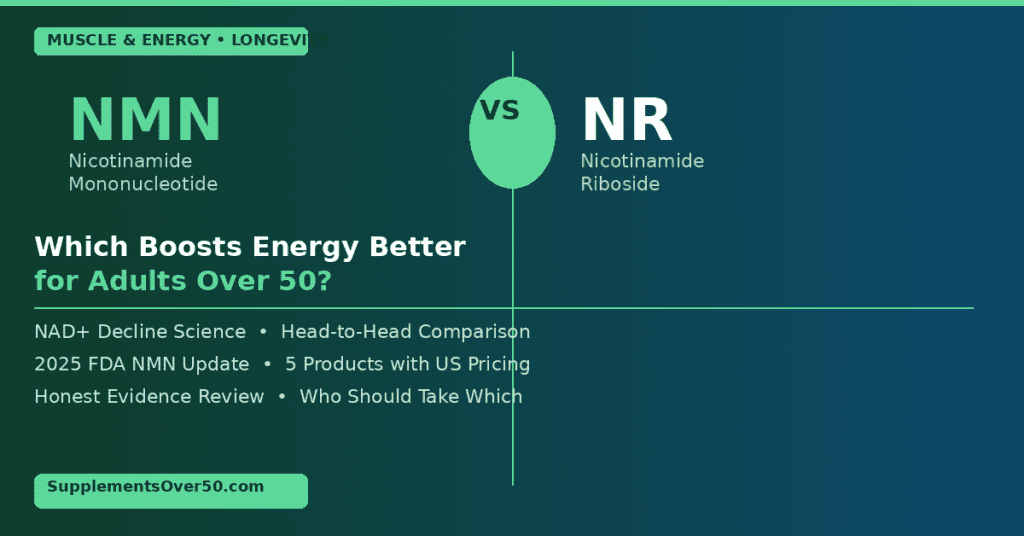
If you’ve spent any time in health and longevity circles recently, you’ve heard the abbreviations: NAD+, NMN, NR. They’ve been discussed by Harvard researchers, championed by longevity podcasters, and plastered across supplement shelves. But what are they actually, do they work, and which one is worth your money after 50? Here is how NMN vs NR after 50 breaks down across the categories that matter most.
This article cuts through the hype. You’ll get an honest look at what the science says, a direct head-to-head comparison of NMN and NR, and five specific product recommendations with current US pricing — so you can make an informed decision without having to sort through conflicting marketing claims.
2025 FDA Update: NMN Is Now Fully Legal as a Supplement
NMN had a complicated regulatory history: in 2022, the FDA raised questions about its status as a dietary supplement because it was simultaneously being investigated as a pharmaceutical drug. On September 29, 2025, the FDA formally reversed that position, confirming that NMN is lawful for use in dietary supplements. All major brands have since re-listed their products. This article reflects that current legal status.
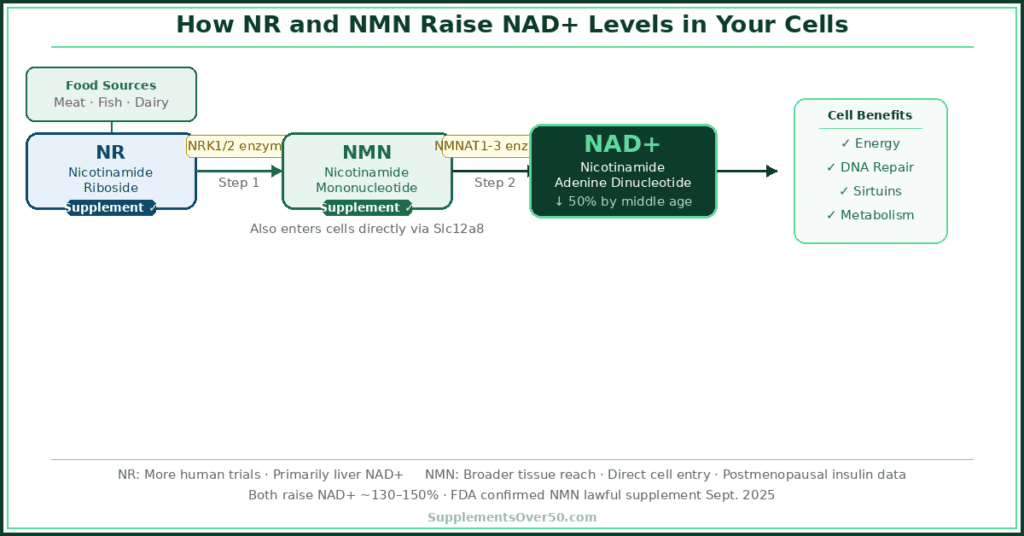
NAD+ (nicotinamide adenine dinucleotide) is a coenzyme found in every cell of your body. It plays a central role in metabolism, DNA repair, gene expression, and cellular communication. Without it, cells cannot produce energy. According to research published in PMC (National Institutes of Health), by middle age, NAD+ levels have fallen to roughly half of what they were in youth. By age 80, some research suggests up to an 80% reduction from peak levels.
This decline matters because NAD+ is fuel for several critical aging-related processes:
Sirtuins — enzymes that regulate DNA repair, inflammation, and metabolic health — require NAD+ to function
PARPs (poly ADP-ribose polymerases) — enzymes involved in DNA damage repair — also consume NAD+
Mitochondria, the energy-producing organelles in your cells, rely on NAD+ to convert food into ATP
Lower NAD+ has been linked to fatigue, muscle weakness, cognitive decline, and metabolic slowdown
You can’t take NAD+ directly as a supplement — it’s too large a molecule to survive digestion and enter cells. Instead, you take smaller precursor molecules that your body converts into NAD+. NMN and NR are the two most studied and commercially available precursors.
How NMN and NR Work — The Pathway
Understanding the conversion pathway helps explain why NMN and NR are not identical, and why researchers debate which is more effective.
How NR and NMN convert to NAD+ inside your cells. NMN can enter cells directly via the Slc12a8 transporter; NR requires an extra conversion step first.
NR (Nicotinamide Riboside)
NMN (Nicotinamide Mononucleotide)
Smaller molecule; enters cells via NR transporters
Larger molecule; has its own dedicated transporter (Slc12a8) in small intestine
Converts to NMN inside the cell, then to NAD+
Converts directly to NAD+ — one fewer step
Stronger clinical evidence base (more human trials)
Growing clinical evidence; fewer long-term human studies
Primary NAD+ boost concentrated in liver
Broader tissue distribution — muscles, brain, heart
Typical dose: 250–1,000 mg/day
Typical dose: 300–900 mg/day
Generally lower price per mg
Generally higher price per mg
Key insight: NMN and NR are interconnected — the body can convert NMN to NR and NR back to NMN depending on what tissues need. They are not completely separate pathways. This helps explain why the clinical differences between the two are modest in human studies so far.
What Does the Human Research Actually Show?
It’s important to separate what the science has established from what remains speculative. Animal studies on NAD+ precursors are impressive — lifespan extension in mice, reversal of muscle weakness, improved insulin sensitivity. Human evidence is more nuanced.
What Is Established in Humans
A 2025 systematic review published in MDPI’s Nutrients journal confirmed that oral NMN consistently raises blood NAD+ levels in humans — the effect is reliable and reproducible across multiple controlled trials. Similarly, NR (as Niagen) has been shown in over 40 clinical trials to increase NAD+ levels by up to 150%.
A 2024 randomized double-blind trial published in GeroScience found that NMN supplementation in older adults maintained walking speed and improved sleep quality compared to placebo — a meaningful functional outcome for seniors.
NMN has also shown promising results for insulin sensitivity — specifically in postmenopausal women, where it improved insulin signaling in muscle tissue, a finding not replicated with NR in comparable studies.
What Remains Uncertain
A broader meta-analysis of NMN RCTs (randomized controlled trials), cited in the 2025 MDPI review, found that while NAD+ levels reliably increase, most clinically relevant outcomes — glucose, cholesterol, physical performance, body composition — did not show statistically significant differences versus placebo. Studies also remain short-term (weeks to a few months), relatively small in sample size, and variable in dosing.
The honest assessment: NMN and NR reliably raise NAD+, but whether that translates to meaningful improvements in energy, cognition, or muscle function for most people after 50 is still being determined by ongoing research. Early functional signals are promising — but not proven.
Bottom line for readers: NMN and NR are among the most scientifically credible longevity supplements available in 2026. The mechanism is well-established. The functional evidence in humans is promising but still developing. If you are over 50, experiencing fatigue, and have already addressed foundational factors (sleep, exercise, nutrition), NMN or NR may be a reasonable next-tier supplement to trial. Expectations should be realistic — these are not overnight energy boosters.
NMN vs NR: Head-to-Head for Adults Over 50
Category
NR (Nicotinamide Riboside)
NMN (Nicotinamide Mononucleotide)
NAD+ Elevation
Reliably raises NAD+ 130–150% (40+ human trials)
Reliably raises NAD+ (growing body of human trials)
Energy/Fatigue
Modest reported benefits; evidence mixed in RCTs
Some RCT data on maintained physical function in older adults
Insulin sensitivity
Minimal evidence in humans; one study showed adverse effect
Demonstrated benefit in postmenopausal women (RCT)
Muscle health
Animal models strong; human evidence limited
NMN improved aerobic capacity in amateur runners (2021 RCT)
Brain/Cognitive
NR raised neuroprotective biomarkers in extracellular vesicles
Ongoing trials; animal evidence strong for Alzheimer’s
Safety
Excellent — no significant side effects in trials up to 2,000 mg/day
Excellent — safe up to 1,200 mg/day in human trials
Legal status
Always been a clear dietary supplement (Niagen is GRAS)
FDA confirmed lawful supplement status Sept. 29, 2025
Typical price
~$0.80–$1.50 per 300 mg serving
~$0.50–$1.50 per 500 mg serving (varies widely)
Our verdict
Best for: those who want the most human clinical evidence behind them; budget-conscious; liver health focus
Best for: those targeting energy, muscle, and metabolic outcomes; women over 50 and postmenopausal women
NMN vs NR After 50: Who Should Take Which?
Choose NR (Nicotinamide Riboside) if you:
Want the supplement with the longest and most established human research track record
Prefer a patented, well-studied ingredient (look for Niagen® on the label)
Are on a tighter budget — NR tends to cost less per effective dose
Have concerns about liver health — NR’s liver NAD+ effect is well-documented
Are just starting with NAD+ precursors and want to begin conservatively
Choose NMN if you:
Are a woman over 50 or postmenopausal — NMN has shown specific metabolic benefits in this group
Are targeting muscle performance, aerobic capacity, or metabolic health
Want a broader tissue distribution for NAD+ support (muscles, brain, heart vs. primarily liver)
Are comfortable with a newer but rapidly growing evidence base
Are interested in combining with resveratrol — the NMN + resveratrol combination is the most studied longevity stack
Consider combining them if:
You want to cover multiple NAD+ pathways simultaneously
Budget is not a constraint — some products (like OMRE NR+NMN) offer both in one formula
You are working with a functional medicine or longevity physician
Dosage and Timing
Supplement
Starter Dose
Optimal Range
Max Safe Dose
NR (Niagen)
150–300 mg/day
500–1,000 mg/day
2,000 mg/day (studied)
NMN
250–300 mg/day
500–900 mg/day
1,200 mg/day (studied)
Timing: Take NMN or NR in the morning — they can increase alertness and energy levels, which may interfere with sleep if taken in the evening. Take with or without food; absorption is not significantly affected by meals. Blood NAD+ levels begin rising within 1–2 weeks; subjective energy benefits typically appear within 2–4 weeks; deeper cellular effects may take 2–3 months.
Note on TMG: Some NMN formulas include TMG (trimethylglycine or betaine). At high NMN doses, the body may use methyl groups to process the excess nicotinamide produced — TMG donates methyl groups to offset this. If taking NMN at 500 mg/day or higher, a formula with TMG or adding a separate TMG supplement (500–1,000 mg/day) is worth considering.
5 Best NMN and NR Supplements for Adults Over 50 — US Pricing
Products below represent a mix of NMN and NR options across price points, all available at major US retailers. Prices reflect current 2026 market availability.
1. Tru Niagen (NR — Niagen 300 mg) — Best Clinical Evidence, Best NR
Tru Niagen is the gold standard of NR supplements. Their patented ingredient Niagen has received FDA New Dietary Ingredient (NDI) notification twice and has been designated GRAS (Generally Recognized As Safe). It has been studied in 40+ clinical trials and backed by over 500 published scientific papers. Supported by Nobel Prize-winning science. Vegetarian, gluten-free, no artificial flavors.
Retailer
Size
Price (approx.)
Cost/Serving
Tru Niagen website
30 ct (300 mg)
~$40/month
~$1.33
Amazon
30 ct (300 mg)
~$38–42
~$1.27–1.40
Tru Niagen (subscribe)
30 ct (300 mg)
~$32/month
~$1.07
Active ingredient: 300 mg Niagen (nicotinamide riboside chloride) per capsule
Third-party tested: Yes — ISO/IEC accredited labs, every batch
Certifications: GRAS, NDI status; vegetarian, gluten-free, nut-free, caffeine-free
FSA/HSA eligible: Yes
Pro version (1,000 mg/serving — 2 capsules): available for higher-dose protocol
2. Nutricost NMN 500 mg — Best Budget NMN
Nutricost is the go-to brand for clean, no-frills supplementation at accessible prices. Their NMN is third-party tested, vegetarian-friendly, gluten-free, and GMO-free. No unnecessary fillers — just NMN in rice extract capsules. Consistently top-rated on Amazon for value and verified purity. At roughly $0.50 per 500 mg serving, it’s the most affordable pure NMN on this list.
OMRE is a physician-founded brand that combines 500 mg NMN with 500 mg trans-resveratrol in a 1:1 ratio — the combination most associated with David Sinclair’s longevity research at Harvard. Triple third-party tested with certificates of analysis accessible via QR codes. Also includes BioPerine (black pepper extract) to enhance resveratrol absorption, which is notoriously poor on its own. Made in the USA.
Third-party tested: Yes — triple-tested, COAs available via QR code on bottle
Certifications: Made in USA, GMP certified, non-GMO
Best for: Those wanting the full NMN + resveratrol longevity stack in one capsule
4. partiQlar Pure NMN 500 mg — Best Sustained-Release NMN
partiQlar uses enteric-coated capsules designed for gradual, sustained release in the gut — rather than rapid dissolution. The rationale is that slower, more consistent NMN release may support steadier NAD+ elevation throughout the day. Pure NMN with no added ingredients. Provides a 2-month supply per bottle. 60-day money-back guarantee.
Retailer
Size
Price (approx.)
Cost/Serving
Amazon
60 ct (500 mg each)
~$39–45
~$0.65–0.75
partiQlar.com (subscribe)
60 ct (500 mg each)
~$39
~$0.65
Active ingredient: 500 mg NMN per sustained-release enteric capsule
Third-party tested: Yes
Certifications: Pure NMN, no fillers, non-GMO
Unique feature: Enteric-coated sustained-release capsules for consistent absorption
5. ProHealth NMN Pro 1000 (Uthever) — Best Clinically-Studied NMN Brand
ProHealth uses Uthever-branded NMN — the only commercially available NMN that has its own published, peer-reviewed clinical trial demonstrating efficacy in humans (published in Frontiers in Aging). Uthever is a patented, stabilized β-NMN produced by Effepharm in a pharmaceutical-grade facility. This is the NMN equivalent of Niagen for NR — a branded, clinically-studied ingredient. Each capsule delivers 500 mg; the 1000 Pro bottle offers 60 capsules at 2 capsules/serving.
Retailer
Size
Price (approx.)
Cost/Serving
Amazon
60 ct (500 mg each)
~$55–65
~$0.92–1.08
ProHealth.com
60 ct (500 mg each)
~$58 (subscribe: ~$46)
~$0.77–0.97
Active ingredient: 500 mg Uthever brand NMN — pharmaceutical-grade, patented
Third-party tested: Yes — triple-lab tested
Certifications: GMP facility, USA manufactured, non-GMO, gluten-free
Unique feature: Uses Uthever — the only NMN with its own published human clinical trial
Heat exposure (sauna): Preliminary evidence for NAD+-related pathways via heat shock proteins
Adequate sleep: Sleep is when most cellular repair (PARP-dependent, NAD+-dependent) occurs
NMN and NR work best as an enhancement on top of these foundations — not a replacement for them.
Safety and Who Should Be Cautious
Both NMN and NR have excellent safety profiles in human clinical trials:
No serious adverse events have been reported at standard doses (up to 1,200 mg/day NMN; 2,000 mg/day NR) in studies
Most common mild side effects: nausea, flushing (rare), digestive discomfort — usually dose-dependent and temporary
No known toxicity in human studies to date
Specific cautions:
Cancer history: NAD+ supports DNA repair mechanisms — this is generally beneficial, but some researchers have raised theoretical concerns about NAD+ precursors in active cancer. Discuss with your oncologist before supplementing.
Pregnancy/breastfeeding: No human safety data exists; avoid
Medications: No established major drug interactions, but as with any supplement, inform your prescribing physician
Kidney or liver disease: Use with medical supervision
Who Should NOT Take NMN or NR
NMN and NR have strong safety profiles, but several groups should avoid them or seek medical clearance first.
Active cancer or recent cancer treatment This is the most important caution. NAD+ plays a central role in DNA repair — which is generally beneficial for healthy aging, but cancer cells also rely on NAD+ to fuel rapid growth and resist cell death. Some researchers have raised theoretical concerns that boosting NAD+ could support tumor proliferation in people with active malignancies. The evidence is not conclusive, but the risk is not zero. If you have or recently had cancer, discuss NAD+ supplementation with your oncologist before starting.
Pregnancy or breastfeeding No human safety data exists for NMN or NR during pregnancy or lactation. Avoid entirely until more research is available.
Kidney disease The kidneys process the metabolic byproducts of NAD+ metabolism. If your kidney function is impaired, excess nicotinamide can accumulate. Use only under direct medical supervision with regular monitoring.
Liver disease High-dose niacinamide (a downstream metabolite of NMN/NR) has been associated with hepatotoxicity in animal studies. If you have active liver disease or elevated liver enzymes, consult your physician before supplementing.
People taking immunosuppressant medications NAD+ supports immune function, which is generally positive — but for organ transplant recipients or others taking immunosuppressants to intentionally dampen immune activity, this interaction warrants a conversation with your specialist.
Those with low blood pressure NR in particular has shown mild blood-pressure-lowering effects in some studies. If you already take antihypertensive medications or have naturally low blood pressure, monitor accordingly and inform your prescribing doctor.
Frequently Asked Questions
Here are the most common questions we see about NMN vs NR after 50
Q: Can I take NMN and NR together?
Yes — they work through overlapping but not identical pathways. Some research suggests combining NAD+ precursors may produce additive effects. Some products (like OMRE’s NR + NMN formula) offer both together. There is no known safety concern with combining them at standard doses.
Q: How long before I feel an effect from NMN or NR?
Blood NAD+ levels typically rise within 1–2 weeks of consistent daily supplementation. Subjective improvements in energy and mental clarity are commonly reported within 2–4 weeks. Deeper benefits — particularly for metabolic health and physical performance — may take 2–3 months to become apparent. Be realistic: these are not stimulants and the effects are subtle for many people.
Q: Is NMN or NR good for menopause symptoms?
There is growing interest in this area. NMN in particular showed improved insulin sensitivity in postmenopausal women in one RCT. Separately, some women report improvements in energy and sleep quality, though large menopause-specific trials haven’t been completed yet. NR has also been associated with improved muscle health and cardiovascular markers relevant to postmenopausal women. Either is worth considering as part of a broader approach to postmenopausal health.
Q: Do I need to take resveratrol with NMN?
No — NMN raises NAD+ on its own. Resveratrol is a sirtuin activator — it helps activate the enzymes that use NAD+ for DNA repair and longevity signaling. The combination is theoretically synergistic (more NAD+ fuel + enhanced sirtuin activity), which is why David Sinclair and others advocate for it. But resveratrol has its own bioavailability challenges, and many people take NMN alone with good results.
Q: Is sublingual NMN better than capsules?
Sublingual (under-the-tongue) NMN has been marketed on the premise that it bypasses digestive breakdown and absorbs directly into the bloodstream. The evidence for this advantage is limited — standard oral capsule absorption of NMN appears adequate based on the clinical trials conducted so far, most of which used regular oral capsules. Unless you have specific GI absorption issues, standard capsules are the most practical and well-studied option.
Q: Does NMN interact with statins or other common medications?
No significant interactions between NMN or NR and statins, blood pressure medications, or other commonly prescribed senior medications have been identified in clinical studies. That said, research is ongoing and NMN has only been widely studied in humans for a few years. Always inform your physician that you are supplementing, particularly if you have complex medical conditions.
1 thought on “NMN vs NR: Which NAD+ Supplement Is Better for Energy After 50?”




Pingback: Best Magnesium Supplement for Sleep After 50: Glycinate vs L-Threonate | SupplementsOver50