| ⚕️ Supplement Disclosure This article reviews lion’s mane mushroom (Hericium erinaceus) as a dietary supplement for informational purposes only. Lion’s mane is not approved to prevent, treat, or cure any neurological condition including Alzheimer’s disease, dementia, or mild cognitive impairment. Adults taking medications for neurological conditions or taking blood-thinning medications should consult their physician before starting lion’s mane supplements. Rare cases of allergic reaction have been reported, particularly in people with mushroom allergies. This article does not constitute medical advice. |
Lion’s mane Mushroom for Cognitive Health is one of the few cognitive supplements that has generated genuine scientific interest rather than just marketing enthusiasm. The reason is mechanistic: its bioactive compounds — hericenones from the fruiting body and erinacines from the mycelium — have been shown to stimulate nerve growth factor (NGF) synthesis in the brain, a process that supports the maintenance and repair of neurons. For adults over 60, where NGF signalling declines alongside neuronal density, this mechanism is directly relevant.
At the same time, the human clinical trial evidence is more modest and more mixed than the preclinical data suggests. This article covers what lion’s mane has genuinely been shown to do, what remains preliminary, the critical purchasing decision between fruiting body and mycelium products, and five supplements available at US retailers with 2026 pricing.
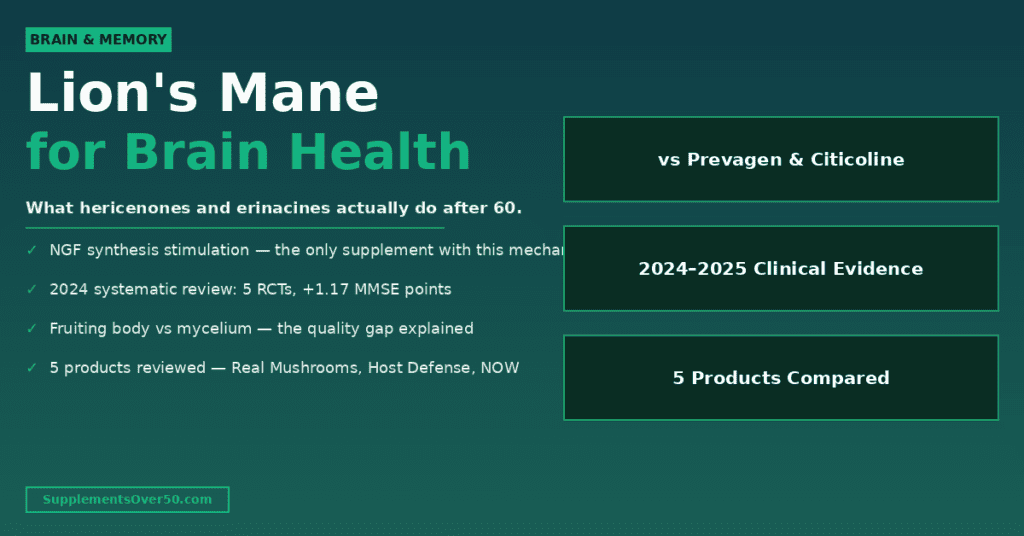
| The Clinical Story in Brief A 2024 systematic review (PMC, Menon et al.) covering 5 RCTs and 3 pilot clinical trials found a combined weighted mean MMSE improvement of 1.17 points in lion’s mane intervention groups. A 2025 Frontiers in Nutrition RCT confirmed acute cognitive effects (faster Stroop task processing at 60 minutes post-dose). A 16-week trial in adults with mild cognitive impairment (Mori et al., 2009 — the foundational study) found significant MMSE improvement that reversed after discontinuation. The honest summary: lion’s mane shows consistent but modest cognitive benefits in people with mild cognitive impairment, with more limited evidence in healthy older adults. |
What Are Hericenones and Erinacines — and Why Do They Matter for the Aging Brain?
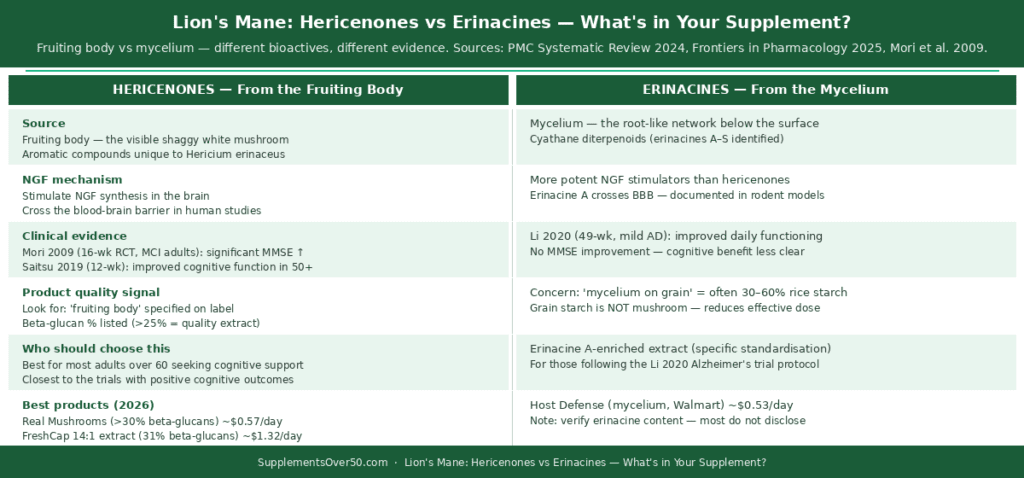
Lion’s mane (Hericium erinaceus) contains two classes of bioactive compounds unique to this mushroom:
- Hericenones — aromatic compounds derived from the fruiting body (the white shaggy exterior part of the mushroom). They stimulate NGF synthesis and have been shown to cross the blood-brain barrier. Found in fruiting body extracts.
- Erinacines — cyathane diterpenoids derived from the mycelium (the root-like network beneath the fruiting body). They are more potent NGF stimulators than hericenones. Erinacine A has the greatest documented biological activity and crosses the blood-brain barrier in animal models.
Nerve growth factor (NGF) is a protein essential for the survival, maintenance, and growth of neurons. NGF levels decline with age and are significantly lower in people with Alzheimer’s disease compared to cognitively healthy adults of the same age. While supplementing NGF itself is not practical (it cannot cross the blood-brain barrier), stimulating the brain’s own NGF production through hericenones and erinacines is a pharmacologically rational approach.
Beyond NGF, lion’s mane compounds have demonstrated anti-neuroinflammatory effects in animal models, BDNF (brain-derived neurotrophic factor) upregulation, and inhibition of amyloid-beta plaque accumulation in transgenic Alzheimer’s mice. The question is how much of this translates to measurable cognitive benefit in human trials.
The Human Clinical Trial Evidence — An Honest Assessment
What the Evidence Supports
- Adults with mild cognitive impairment: The best-designed trials show consistent but modest improvements on cognitive assessments (MMSE scores, cognitive test performance) in adults with MCI. The 2009 Mori et al. trial (16 weeks, 3g/day, n=30) remains the foundational human RCT and showed significant cognitive improvement — though notably, improvements reversed 4 weeks after stopping.
- Healthy older adults (55+): A 2024 trial in healthy adults over 55 found lion’s mane improved cognitive function on one of three tests used. Both the intervention and placebo groups improved over time, complicating interpretation.
- Acute effects: A 2025 Frontiers in Nutrition RCT found that a single dose of standardised lion’s mane extract produced faster Stroop task processing at 60 minutes, suggesting acute cognitive effects in healthy adults.
- Mild Alzheimer’s disease: A 49-week trial (Li et al., 2020) in adults with mild AD found significant improvement in Instrumental Activities of Daily Living scores with erinacine A-enriched mycelium supplementation, though no improvement on MMSE or cognitive screening tools.
What the Evidence Does NOT Support
- Lion’s mane is not an approved treatment for Alzheimer’s disease, dementia, or MCI — clinical evidence does not support its use as a treatment for diagnosed neurological conditions
- Evidence in healthy adults with no cognitive concerns is mixed — two small RCTs in healthy young adults found no significant cognitive improvement on their primary endpoints
- Trial sizes are small (30–80 participants) and durations short (4–49 weeks) — larger and longer trials are needed before firm conclusions can be drawn
- Products vary enormously in bioactive compound content — a supplement labelled ‘500mg lion’s mane’ may contain negligible levels of hericenones or erinacines depending on extraction method and part of mushroom used
| The Honest Bottom Line on Evidence Lion’s mane is a legitimate supplement with a plausible mechanism and consistent-if-modest clinical signals in cognitively impaired older adults. For healthy adults over 60 wanting general cognitive support, the evidence is encouraging but not definitive. It is not a nootropic that will produce dramatic cognitive changes in healthy brains — but it may support the NGF signalling pathways that protect neurons over time. Think of it as long-term brain maintenance rather than an acute cognitive enhancer. For the complete evidence-based cognitive supplement stack — Lion’s Mane alongside omega-3 DHA, creatine, and phosphatidylserine — see: 7 Best Brain Supplements for Seniors — Ranked by Clinical Evidence. |
Fruiting Body vs Mycelium: The Most Important Buying Decision
The biggest quality gap in the lion’s mane supplement market is between fruiting body and mycelium products — and most consumers don’t know it exists. The same quality principle applies across all cognitive supplements — form and standardisation matter as much as the ingredient itself. See how this plays out for the most important brain-supporting mineral: 5 Best Magnesium Supplements for Seniors — Why the Form Determines the Outcome.
| Feature | Fruiting Body Extract | Mycelium on Grain |
| Primary bioactives | Hericenones — proven NGF stimulators | Erinacines (if well-extracted) — more potent but variable |
| Starch/grain content | None — pure mushroom | Often 30–60% grain substrate — not mushroom |
| Beta-glucan content | Higher — >25% typical in quality extracts | Lower — diluted by grain content |
| Transparency | Easier to verify — look for beta-glucan % on label | Harder to verify — starch content often not disclosed |
| Clinical trial form | Mori 2009 and most positive trials used fruiting body | Li 2020 (Alzheimer’s trial) used erinacine A mycelium |
| US regulatory | Permitted in all supplement forms | Permitted; but EU/UK restrict mycelial preparations |
The key purchasing rule: look for supplements that specify ‘fruiting body’ and list a beta-glucan percentage (>25% is a quality indicator). Avoid products that list ‘mycelium on grain’ or simply say ‘lion’s mane extract’ without specifying the part of the mushroom used. Many cheap lion’s mane supplements are primarily rice substrate with minimal mushroom content.
5 Best Lion’s Mane Supplements for Seniors — US Pricing 2026
1. Real Mushrooms Lion’s Mane — Amazon / RealMushrooms.com — Best Fruiting Body Quality
Best for: seniors who want the highest-quality fruiting body extract with verified beta-glucan content.
| Formula | 500mg certified organic lion’s mane fruiting body extract per capsule — >30% beta-glucans verified by 3rd-party lab |
| Price (2026) | ~$30–38 for 120 capsules (~$0.50–0.63/day at 2 caps) |
| Third-Party Tested | USDA Organic; third-party beta-glucan verified; 100% fruiting body — no mycelium on grain, no starch fillers |
| Best For | Seniors who want the closest to clinical trial formulations used in human RCTs |
| Notes | Transparent labelling — lists actual beta-glucan content. The best option for evidence-conscious seniors. |
2. Host Defense Lion’s Mane — Walmart / Amazon — Best Mainstream Availability
Best for: seniors wanting lion’s mane at Walmart or Amazon with a trusted brand name.
| Formula | 500mg organic lion’s mane mycelium per 2 capsules (mycelium on fermented brown rice substrate) |
| Price (2026) | ~$28–35 for 60 servings at Walmart (~$0.47–0.58/day) |
| Third-Party Tested | USDA Organic; Non-GMO; Certified B Corp; founded by mycologist Paul Stamets |
| Best For | Seniors who prioritise retail availability and brand reputation over fruiting body vs mycelium distinction |
| Notes | Uses mycelium (not fruiting body) — contains erinacines, not hericenones. Widely available in Walmart stores. |
3. FreshCap Lion’s Mane — Amazon — Best Triple-Extracted Fruiting Body
Best for: seniors wanting the most potent fruiting body extract with triple extraction.
| Formula | 14,000mg full-spectrum equivalent per 2 capsules — 14:1 extract; fruiting body only; ~31% beta-glucans |
| Price (2026) | ~$35–44 for 60 servings (~$1.17–1.47/day) |
| Third-Party Tested | USDA Organic; third-party beta-glucan tested; triple extraction (hot water + alcohol + cold water) |
| Best For | Seniors who want maximum potency fruiting body extract with full spectrum of bioactives |
| Notes | Premium price justified by extraction depth and 31% beta-glucan verification — among the most potent available |
4. NOW Foods Lion’s Mane — Walmart / Amazon — Best Budget Option
Best for: seniors wanting to try lion’s mane at the lowest possible entry cost.
| Formula | 500mg organic lion’s mane per capsule (from certified organic fruiting body) |
| Price (2026) | ~$14–18 for 60 capsules at Walmart (~$0.47–0.60/day at 1–2 caps) |
| Third-Party Tested | NOW IGEN Non-GMO Tested; GMP certified; made with organic mushroom |
| Best For | Seniors new to lion’s mane who want a low-cost trial before committing to a premium brand |
| Notes | Fruiting body sourced; beta-glucan percentage not disclosed on label — adequate for entry-level use |
5. Zazzee USDA Organic Lion’s Mane 20:1 Extract — Amazon — Best Extract Ratio
Best for: seniors wanting a high-concentration extract with 30% beta-glucans at a mid-range price.
| Formula | 1,000mg per serving (as 20:1 extract) — 30% beta-glucans; fruiting body; USDA Organic |
| Price (2026) | ~$24–30 for 120 capsules (~$0.40–0.50/day) |
| Third-Party Tested | USDA Organic; Non-GMO; Made in USA; 30% beta-glucans stated on label |
| Best For | Best value for a verified beta-glucan fruiting body extract — strong option between NOW budget and Real Mushrooms premium |
| Notes | 20:1 concentration ratio means more bioactive compound density than standard 1:1 powder products |
Dosing, Timing and What to Expect
| Question | Evidence-Based Answer |
| Effective dose? | Clinical trials used 1–3g/day of fruiting body extract. Most products provide 500–1,000mg per serving — take 2 servings for closer alignment with trial doses. |
| When to take? | Can be taken with or without food. No clear advantage to specific timing. Consistency daily matters more than time of day. |
| How long to see effects? | The foundational Mori 2009 trial measured significant MMSE improvement at 8 weeks, with further improvement at 12 and 16 weeks. Allow 8–12 weeks minimum before evaluating. |
| What to expect realistically? | For healthy adults: subtle improvements in mental clarity and focus over 2–4 months. For adults with early cognitive concerns: modest improvements in cognitive test performance based on trial data. |
| Side effects? | Generally well-tolerated. Rare cases of abdominal discomfort, nausea, and skin rash reported in the 49-week Li 2020 trial (4 dropouts of 49). One case report of respiratory distress with large amounts — avoid if allergic to mushrooms. |
Who Should Consider Lion’s Mane After 60?
- Adults over 60 with a family history of Alzheimer’s or dementia who want proactive neuronal support
- Seniors experiencing early-stage memory concerns (misplacing items, word-finding difficulty, mental fog)
- Adults who want to complement other brain health supplements (pairs well with citicoline, omega-3 DHA, and phosphatidylserine — covering different neurological mechanisms)
- Lion’s Mane pairs particularly well with citicoline and phosphatidylserine — both support different aspects of neuronal membrane health that complement NGF-driven neuroplasticity. For a full comparison of these two brain supplements: Citicoline vs Phosphatidylserine — Which Brain Supplement Is Better After 60?
- People seeking an alternative to low-evidence supplements like Prevagen — lion’s mane has substantially stronger mechanistic and clinical evidence
Related: Natural Alternatives to Prevagen — Do Any Actually Work?
Related: Citicoline vs Phosphatidylserine — Which Brain Supplement Is Actually Better After 60?
Related Articles on SupplementsOver50.com
• Best Nootropic Stack for Seniors — Real Focus Without Caffeine Jitters
• Citicoline vs Phosphatidylserine — Which Brain Supplement Is Actually Better After 60?
• Natural Alternatives to Prevagen — Do Any Actually Work?
• Can Omega-3s Really Slow Brain Decline After 60? What the 2025 Research Shows
• Creatine for Seniors — Brain, Muscle and Energy Benefits
• NMN vs NR: Which NAD+ Supplement Is Better for Energy After 50?
References
Frequently Asked Questions
Is Lion’s Mane better than Ginkgo Biloba for memory in seniors?
Based on current clinical evidence, yes. The large NIH-funded GINKGO Evaluation of Memory (GEM) trial — 3,069 participants over 6 years — found ginkgo biloba had no significant effect on dementia incidence or cognitive decline compared to placebo. Lion’s Mane has shown consistent improvements in cognitive function scores in multiple RCTs specifically in adults with mild cognitive impairment, including the foundational Mori 2009 trial and the 2023 Journal of Neurological Sciences RCT. The reversal of benefits after Lion’s Mane discontinuation in the Mori study actually strengthens the evidence — it confirms the effects were causally related to the supplement rather than placebo response.
Can I take Lion’s Mane if I have a mushroom allergy?
No — avoid Lion’s Mane if you have a known allergy to culinary or medicinal mushrooms. Lion’s Mane (Hericium erinaceus) shares allergenic proteins with other fungi. Reported allergic reactions include skin rashes, itching, and in rare cases respiratory distress. If you have a mushroom allergy but want NGF-supporting supplementation, discuss alternatives with your physician — some of Lion’s Mane’s neurological benefits overlap with Bacopa monnieri and Phosphatidylserine, which are non-fungal.
Does Lion’s Mane have side effects for seniors?
Lion’s Mane is among the most well-tolerated cognitive supplements — clinical trials in older adults report minimal adverse events. The most common side effects are mild digestive discomfort or nausea, typically resolving within 1–2 weeks or when taken with food. One case series documented skin itching in a small number of users — discontinue if this occurs. No significant drug interactions have been identified in published research, though seniors on anticoagulants should disclose use to their physician as some mushroom extracts have mild platelet effects. Start at 500mg daily for the first two weeks before increasing to the full 1,000mg dose.
Does lion’s mane actually improve memory in older adults?
The evidence is consistent but modest. A 2024 systematic review of 5 RCTs found a combined weighted mean MMSE improvement of 1.17 points in lion’s mane groups — a real but not dramatic effect. The most robust results have been in adults with mild cognitive impairment rather than healthy older adults with no cognitive concerns. The 2009 foundational RCT (Mori et al.) found significant MMSE improvements at 8, 12, and 16 weeks that reversed 4 weeks after stopping — suggesting ongoing supplementation is required. For healthy adults over 60, the evidence suggests potential benefit for long-term neuronal maintenance rather than immediate memory enhancement.
What is the difference between lion’s mane fruiting body and mycelium?
The fruiting body is the visible shaggy white mushroom. It contains hericenones — the primary NGF-stimulating compounds. The mycelium is the root-like network beneath the surface. It contains erinacines — more potent NGF stimulators. Most budget lion’s mane supplements use mycelium grown on grain substrate (often rice), which dilutes the mushroom content with starch. Quality products clearly specify fruiting body and list beta-glucan content (>25% indicates quality). Real Mushrooms, FreshCap, and Zazzee are brands that prioritise fruiting body transparency.
How long does it take for lion’s mane to work?
The foundational clinical trial (Mori 2009, 16 weeks) measured significant cognitive improvements at 8 weeks, with further improvement through week 16. The 2025 Frontiers in Nutrition trial found acute effects at 60 minutes post-dose for Stroop task processing. The practical guidance: allow 8–12 weeks of consistent daily use before evaluating cognitive effects. Short-term acute effects on mental clarity are possible with quality extracts, but the primary benefit — supporting NGF synthesis and neuronal maintenance — is a long-term process.
Can lion’s mane help prevent Alzheimer’s disease?
Lion’s mane is not approved to prevent or treat Alzheimer’s disease. The preclinical evidence is interesting — erinacines reduced amyloid-beta plaque accumulation in transgenic Alzheimer’s mice — but this has not translated to a proven preventive effect in humans. A 49-week trial in mild AD patients (Li et al. 2020) found improvements in daily functioning but not on cognitive screening tools. For adults with a family history of Alzheimer’s who want proactive neuronal support, lion’s mane is one of the more mechanistically sound options — but expectations should be calibrated to the available evidence.
Is lion’s mane safe for seniors to take long-term?
Lion’s mane is generally recognized as safe as a food and has been eaten as a culinary mushroom in Asia for centuries. At supplement doses (500mg–3g/day), clinical trials of up to 49 weeks have reported good tolerability with occasional mild GI side effects (nausea, abdominal discomfort) as the most common adverse events. One case report documents respiratory distress with very large amounts — avoid if you have known mushroom allergies. Long-term safety beyond 12 months has not been formally established in published RCTs, which is worth noting for anyone planning indefinite supplementation.
The Bottom Line
Lion’s mane mushroom is one of the most mechanistically credible cognitive supplements available for adults over 60. The NGF-stimulation pathway is well-established in preclinical research, and human trials show consistent — if modest — benefits in adults with mild cognitive impairment, with more limited evidence in healthy older adults.
The most important purchasing decision is fruiting body vs mycelium quality. Avoid products that don’t specify which part of the mushroom is used or don’t list beta-glucan content. Real Mushrooms and FreshCap represent the strongest quality standards in the category. For budget-conscious seniors, Zazzee USDA Organic offers verified 30% beta-glucans at a mid-range price.
Expect 8–12 weeks before evaluating results. Lion’s mane works best as a long-term neuronal maintenance supplement — not a short-term cognitive booster. Pairs well with omega-3 DHA, citicoline, and phosphatidylserine for a comprehensive brain health protocol.