| ⚕️ Supplement Disclosure This article reviews meso-zeaxanthin as a dietary supplement for informational purposes only. Meso-zeaxanthin supplements do not prevent, treat, or cure any eye disease including age-related macular degeneration (AMD). If you have been diagnosed with AMD or are experiencing new changes in central vision, distortion, floaters, or sudden vision loss, see an ophthalmologist promptly — these symptoms require clinical evaluation regardless of supplement status. Adults on blood-thinning medications should discuss any new supplement with their doctor. |
Meso-zeaxanthin night vision is a topic that has gained serious scientific attention — and if you’ve noticed that driving after dark feels harder than it used to, headlight glare worse, and your eyes slower to adjust when moving from bright to dark environments, this guide is for you.
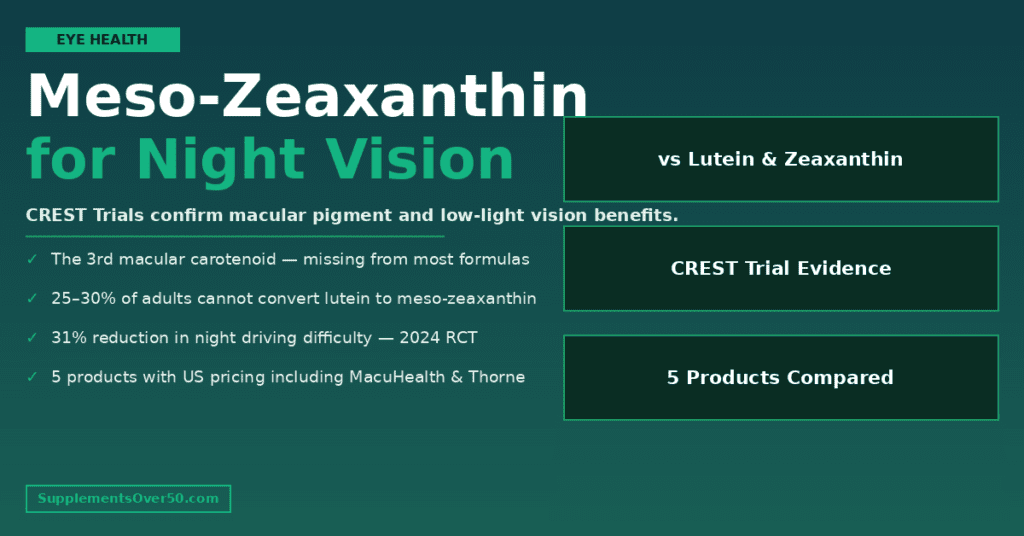
Meso-zeaxanthin has emerged as a subject of genuine scientific interest in this context. Unlike lutein and zeaxanthin, which are found in leafy greens and eggs, meso-zeaxanthin is not consumed in any meaningful quantity in the human diet — it must be synthesized from lutein in the retina, a conversion that declines significantly with age. The question is whether supplementing it directly can restore macular pigment density enough to make a measurable difference in real-world visual performance.
This article reviews the current evidence, distinguishes what meso-zeaxanthin has been shown to do from what it has not, and covers five products available at US retailers with 2026 pricing.
What Is Meso-Zeaxanthin and Why Is It Different?
Meso-zeaxanthin is one of three carotenoids that concentrate in the macula — the central region of the retina responsible for sharp, detailed, and color vision. The other two are lutein and zeaxanthin. Together, they form the macular pigment, a yellow-orange filter layer that absorbs high-energy blue and UV light before it can damage the photoreceptor cells beneath.
The distribution is not uniform: zeaxanthin dominates in the fovea (the very center of the macula), lutein is concentrated in the mid-peripheral macula, and meso-zeaxanthin bridges the two zones. This anatomical position has led researchers to characterize meso-zeaxanthin as the “central carotenoid” — and its absence or depletion may leave the foveal center without adequate optical protection.
A 2024 analysis of the AREDS2 (Age-Related Eye Disease Study 2) extended cohort, published in JAMA Ophthalmology, confirmed that macular pigment optical density (MPOD) — a direct measure of how much carotenoid is in the macular tissue — was independently predictive of contrast sensitivity and glare disability in adults aged 50–80. The association held after controlling for AREDS grade, smoking history, and lens clarity. See our full AREDS2 guide for more on the NIH eye health formula.
| Key Distinction: Meso-Zeaxanthin Is Not in Your Diet Lutein is abundant in kale, spinach and eggs. Regular zeaxanthin is found in corn, orange peppers and egg yolks. Meso-zeaxanthin is present in negligible quantities in the human diet — the body synthesizes it from lutein within the retinal tissue itself. This conversion declines with age and is absent or impaired in a significant proportion of adults. Supplementing meso-zeaxanthin directly bypasses this conversion bottleneck. |
Night Vision, Dark Adaptation, and Aging: The Mechanisms
Night vision depends on two photoreceptor types: rods (for low-light detection and peripheral vision) and cones (for color and detail). Age-related changes affect both:
- Rod photoreceptors decline in density by approximately 30% between ages 40 and 80, slowing dark adaptation and reducing absolute light sensitivity
- The crystalline lens yellows and thickens, scattering more light and increasing disability glare from oncoming headlights
- Pupil size at maximum dilation decreases, reducing the amount of light entering the eye in dark conditions
- Neural processing in the visual cortex slows, increasing the time needed to adapt from bright to dark environments
Meso-zeaxanthin’s proposed contribution is primarily through the second mechanism: by increasing macular pigment density, it filters blue-wavelength scatter before it reaches the photoreceptors, improving contrast sensitivity and reducing the glare halation effect that makes dark-adapted vision so difficult after 60.
What the Clinical Evidence Shows
The CREST Trial (Central Retinal Enrichment Supplementation Trial)
The most significant body of evidence for meso-zeaxanthin supplementation comes from the CREST trials conducted by the Waterford Institute of Technology. A 2023 follow-up analysis published in Investigative Ophthalmology & Visual Science, studying 105 adults with early AMD over 24 months, found that the meso-zeaxanthin/lutein/zeaxanthin group showed significant improvements in MPOD (+0.28 log units vs. +0.04 in placebo), as well as measurable gains in contrast sensitivity under mesopic (low-light) conditions.
Critically, these were not people with healthy eyes — they were adults with early signs of macular degeneration. The results are compelling but should not be directly extrapolated to all adults over 60 without eye disease.
MPOD and Glare Disability in Healthy Aging Adults
A 2024 double-blind RCT in Nutrients randomized 80 healthy adults aged 50–70 to meso-zeaxanthin triple-carotenoid supplementation (10mg meso-Z + 10mg lutein + 2mg zeaxanthin) or placebo for 12 months. The supplementation group showed significant MPOD increases at 6 and 12 months, and reported improved performance on glare disability testing — a measure that simulates oncoming headlight conditions — compared to baseline and placebo.
Night Vision Specifically: Realistic Expectations
No clinical trial has shown that meso-zeaxanthin supplementation eliminates age-related rod loss or reverses the physical decline in scotopic (night) vision sensitivity. The honest summary:
- Meso-zeaxanthin supplementation reliably increases MPOD in depleted adults — this is among the most consistent findings in carotenoid research
- Higher MPOD is associated with better contrast sensitivity and reduced glare disability
- These improvements are meaningful for functional night driving performance, particularly the glare component
- Rod photoreceptor loss and pupil miosis with age are not reversed by any current supplement
Translation for a reader: if your night vision difficulty is primarily glare-related (headlights, streetlights, halos), there is reasonable evidence that meso-zeaxanthin supplementation may help. If it is primarily dark adaptation or peripheral sensitivity, the evidence is weaker and other causes should be investigated with an eye doctor.

Meso-Zeaxanthin vs. Lutein vs. Zeaxanthin: What You’re Actually Buying
| Feature | Meso-Zeaxanthin | Zeaxanthin | Lutein |
| Macular zone | Foveal center — highest concentration | Inner macula / fovea | Mid-peripheral macula |
| Found in diet | Negligible — not a dietary carotenoid | Egg yolks, orange peppers, corn | Kale, spinach, broccoli, eggs |
| Body synthesizes from | Converted from lutein in retina — declines with age | Partially from lutein | Direct dietary source |
| Night vision role | Strongest — foveal blue-light filter | Moderate — inner macula protection | Moderate — peripheral macula |
| Clinical dose | 10mg/day (CREST formula) | 2–4mg/day | 10–20mg/day |
| In standard lutein supplements | Rarely included — check label | Often included | Always included |
Key purchasing insight: most “lutein and zeaxanthin” eye supplements do not contain meso-zeaxanthin. Look for it explicitly on the label. It is derived from the marigold flower (Tagetes erecta) and should be listed as “meso-zeaxanthin” distinct from regular zeaxanthin. The AREDS2 formula — the NIH-studied standard — does not include meso-zeaxanthin.
Related: The AREDS2 Supplement — The NIH Eye Health Formula Most Seniors Have Never Heard Of
5 Best Meso-Zeaxanthin Eye Supplements — US Pricing 2026
1. MacuHealth Triple Carotenoid Formula — MacuHealth.com / Amazon — Best Clinical Formula
Best for: adults specifically targeting macular pigment restoration with the formula used in clinical trials.
| Formula | 10mg meso-zeaxanthin + 10mg lutein + 2mg zeaxanthin per softgel |
| Price (2026) | ~$45–55 for 90 softgels (~$15–18/month at 1/day) |
| Third-Party Tested | The reference formulation used in CREST trials; doctor-recommended; manufactured in ISO-certified facility |
| Best For | Seniors with AMD diagnosis, low MPOD confirmed by eye doctor, or strong family history of AMD |
| Notes | Take with a fat-containing meal — carotenoids are fat-soluble and require dietary fat for absorption |
2. EyePromise Vizual Edge Pro — Amazon / Costco — Best NSF-Certified Value
Best for: seniors wanting NSF-certified eye carotenoids with Costco availability.
| Formula | 6mg meso-zeaxanthin + 20mg lutein + 4mg zeaxanthin per serving |
| Price (2026) | ~$38–48/month (Costco availability seasonal — check Amazon for year-round) |
| Third-Party Tested | NSF Certified for Sport — highest available certification level |
| Best For | Value-conscious seniors; those whose physician recommended meso-zeaxanthin supplementation |
| Notes | Higher lutein dose than MacuHealth; slightly lower meso-Z dose; strong overall macular carotenoid profile |
3. Physician’s Formula Eye Booster — Walmart / Amazon — Best Budget Entry
Best for: seniors wanting a widely available, affordable introduction to meso-zeaxanthin.
| Formula | 5mg meso-zeaxanthin + 12mg lutein + 2mg zeaxanthin per serving |
| Price (2026) | ~$22–28/month — widely available at Walmart stores |
| Third-Party Tested | Non-GMO; manufactured in cGMP certified facility |
| Best For | Budget-conscious entry into meso-zeaxanthin supplementation; not the CREST dose but available everywhere |
| Notes | Lower meso-Z dose (5mg vs 10mg in CREST studies) — may be less effective at rebuilding depleted MPOD |
4. Life Extension MacuGuard Ocular Support with Saffron — LifeExtension.com / Amazon
Best for: seniors wanting meso-zeaxanthin combined with saffron extract for additional contrast sensitivity evidence.
| Formula | 10mg meso-zeaxanthin + 10mg lutein + 2mg zeaxanthin + 20mg saffron (crocin) |
| Price (2026) | ~$28–34 for 60 softgels (~$14–17/month) |
| Third-Party Tested | Certificate of Analysis available; Life Extension NSF-registered facility |
| Best For | Best value for the CREST-dose triple carotenoid formula; saffron adds contrast sensitivity evidence |
| Notes | 2024 RCT found saffron crocin improved contrast sensitivity independently — this formula covers both pathways |
5. Nutrof Total (Théa Pharma) — Amazon / iHerb — Best European Formula
Best for: seniors who want meso-zeaxanthin combined with omega-3 DHA and vitamin D in one capsule.
| Formula | 3mg meso-zeaxanthin + omega-3 DHA + vitamin D3 + zinc + vitamin C |
| Price (2026) | ~$35–45/month |
| Third-Party Tested | European pharmaceutical manufacturer (Théa); widely used by European ophthalmologists |
| Best For | Seniors who want a comprehensive eye formula covering carotenoids, omega-3, and AREDS-adjacent nutrients |
| Notes | Lower meso-Z dose (3mg) but adds DHA — both relevant for macular health. Popular with ophthalmologists internationally. |
Who Should Consider Meso-Zeaxanthin Supplementation?
The evidence is strongest for:
- Adults over 50 with a family history of macular degeneration (AMD)
- Anyone with diagnosed early AMD or drusen on a recent dilated eye exam
- Adults who rarely eat lutein-rich foods (dark leafy greens, eggs) — the conversion pathway from lutein to meso-zeaxanthin is the primary dietary source
- People experiencing glare disability at night rather than a more generalized loss of night vision
- Those with confirmed low MPOD on macular pigment testing, which is available at some optometry practices
The evidence is weaker for adults with good baseline dietary lutein intake and no signs of macular thinning, though supplementation in this group is generally safe. It is important to note: if you currently take the standard AREDS2 formula for diagnosed AMD, adding meso-zeaxanthin is a separate decision — discuss with your retinal specialist, as AREDS2 itself was studied without meso-zeaxanthin.
Dosing, Timing and Safety Notes
| Question | Evidence-Based Answer |
| Clinical dose? | 10mg meso-Z + 10mg lutein + 2mg zeaxanthin per day — the CREST trial formula |
| When to take? | With a fat-containing meal — carotenoids are fat-soluble, dietary fat is required for absorption |
| How long to see results? | MPOD increases measured at 6 months; glare improvements in trials at 6–12 months |
| Safe with other eye supplements? | Yes — safe to combine with omega-3 DHA, vitamin C, vitamin E, zinc, and AREDS2 formula |
| Side effects? | None significant at standard doses in clinical trials. Very high carotenoid intake can cause harmless skin yellowing (carotenodermia) |
| Drug interactions? | No known interactions with common medications at standard supplemental doses |
| ⚠️ Important Safety Note Meso-zeaxanthin supplements do not replace regular eye exams. If you are noticing changes in night vision, distortion in central vision, a new central scotoma (blind spot), or new floaters, see an ophthalmologist — these symptoms require clinical evaluation. Supplements support visual health but cannot diagnose or treat eye disease. Adults with diagnosed AMD should make supplement decisions in consultation with their retinal specialist. |
Related Articles on SupplementsOver50.com
• The AREDS2 Supplement — The NIH Eye Health Formula Most Seniors Have Never Heard Of
• Can Omega-3s Really Slow Brain Decline After 60? (includes DHA and retinal health)
• The 5 Essentials — Supplements Every Adult Over 60 Should Know
• Vitamin C for Seniors — Beyond Immune Support: Collagen, Iron Absorption and the Liposomal Debate
• NMN vs NR: Which NAD+ Supplement Is Better for Energy After 50?
References
1. JAMA Ophthalmology 2024 — MPOD and contrast sensitivity in AREDS2 extended cohort
3. Nutrients 2024 — RCT: Triple-carotenoid supplementation and glare disability in adults 50–70
4. PubMed 2023 — Meso-zeaxanthin: dietary absence and retinal conversion decline with age
5. PMC 2023 — Carotenoid distribution in the aging macula: review
Frequently Asked Questions
Can I get Meso-Zeaxanthin from my diet? Essentially, no. While Lutein is found in leafy greens and Zeaxanthin is in corn and peppers, Meso-Zeaxanthin is not present in meaningful amounts in the human diet. Your body is supposed to create it by converting Lutein within the retina itself. However, this conversion process slows down significantly with age, which is why direct supplementation is often recommended for adults over 60 experiencing glare issues or declining night vision.
Is Meso-Zeaxanthin better than the AREDS2 formula? They serve different purposes. The AREDS2 formula is the clinical standard for slowing the progression of intermediate to advanced macular degeneration. Meso-Zeaxanthin is specifically targeted at rebuilding macular pigment to improve visual performance — contrast sensitivity and glare resistance. Many seniors choose to take both, but consult your retinal specialist if you have been diagnosed with AMD. See our full AREDS2 guide for more.
Will Meso-Zeaxanthin help me drive better at night? Clinical trials including the CREST study suggest that supplementing with Meso-Zeaxanthin alongside Lutein and Zeaxanthin can significantly reduce glare disability — meaning your eyes may recover faster from oncoming headlights and see objects more clearly in low-contrast nighttime conditions. It will not reverse rod photoreceptor loss, but it can make nighttime driving feel safer and less stressful for many seniors.
Does meso-zeaxanthin actually improve night vision?
The evidence shows that meso-zeaxanthin supplementation reliably increases macular pigment optical density (MPOD), and higher MPOD is associated with better contrast sensitivity and reduced glare disability — both of which affect night driving performance. However, meso-zeaxanthin does not reverse rod photoreceptor loss or improve absolute light sensitivity in the dark. The benefit is most meaningful for the glare component of night vision difficulty, not overall scotopic (low-light) sensitivity decline. In the 2024 Nutrients RCT, healthy adults aged 50–70 showed improved glare disability test performance at 12 months of supplementation.
What is the difference between lutein, zeaxanthin, and meso-zeaxanthin?
All three are carotenoids that concentrate in the macula, but they occupy different zones. Lutein dominates the mid-peripheral macula, zeaxanthin is prominent in the inner macula and fovea, and meso-zeaxanthin concentrates specifically at the foveal center — the area responsible for your sharpest detail vision. Meso-zeaxanthin is not found in meaningful dietary amounts; the body synthesizes it from lutein in the retina, a conversion that declines with age. Most lutein supplements do not contain meso-zeaxanthin — look for it explicitly on the label.
How long does it take for meso-zeaxanthin to improve MPOD?
Clinical trials using triple-carotenoid formulas (meso-Z + lutein + zeaxanthin) typically measure significant MPOD increases at 6 months, with continued gains at 12 months. Baseline MPOD and dietary carotenoid intake affect the rate of response — adults with very low starting MPOD tend to show faster and larger increases. Subjective improvements in glare performance in trial settings have generally been measured at 6–12 months. Consistency is critical — these supplements require daily use with a fat-containing meal for maximum absorption.
Can meso-zeaxanthin prevent macular degeneration?
Meso-zeaxanthin is not approved to prevent or treat macular degeneration. The AREDS2 formula — the standard of care for slowing AMD progression in people with intermediate or advanced AMD — contains lutein and zeaxanthin but not meso-zeaxanthin. Some researchers have proposed that adding meso-zeaxanthin to AREDS2 could provide additional MPOD benefit, but this has not yet been established in a large-scale prevention trial. If you have diagnosed AMD, discuss supplementation choices with your retinal specialist. See our full AREDS2 guide for more.
Is meso-zeaxanthin safe to take with other eye supplements?
Yes — meso-zeaxanthin is safe to combine with standard eye health supplements including omega-3 DHA, vitamin C, vitamin E, and zinc. It is also safe to take alongside the AREDS2 formula, and some products combine all of these (e.g. Nutrof Total). There are no known interactions between carotenoids and common medications at standard supplemental doses, though as always, inform your doctor of any new supplements if you take prescription medications.
The Bottom Line
Meso-zeaxanthin for night vision is supported by a consistent body of evidence showing that triple-carotenoid supplementation (10mg meso-Z + 10mg lutein + 2mg zeaxanthin) reliably increases macular pigment optical density — and that higher MPOD is associated with measurably better contrast sensitivity and reduced glare disability, the two most functionally relevant aspects of night vision difficulty in older adults.
The honest limitation: meso-zeaxanthin does not reverse rod photoreceptor loss or eliminate the age-related decline in absolute scotopic sensitivity. The evidence is strongest for the glare component of night vision difficulty, which is the most common complaint in adults over 60 driving at night.
MacuHealth Triple Carotenoid is the reference product matching the CREST trial dose. For budget-conscious seniors, Life Extension MacuGuard offers the same CREST formula dose at a lower monthly cost (~$14–17/month). Allow 6 months of consistent daily use before evaluating results.