Best Choline Supplement for Seniors: Alpha-GPC vs CDP-Choline vs Bitartrate
SupplementsOver50.com earns a commission on qualifying Amazon purchases at no extra cost to you.
If you’ve been ignoring choline, you’re not alone — but at 60+, that oversight may be quietly costing you. Choline is an essential nutrient most Americans don’t get enough of, and the gap widens significantly after 60. In this guide, we break down the best choline supplement for seniors, why form matters, and how to choose the right one for your brain and liver health.
Why Choline Is Critical After 60
Choline isn’t technically a vitamin, but the body can’t function without it. The NIH Office of Dietary Supplements classifies it as an essential nutrient, and the National Academy of Medicine set adequate intake (AI) at 550 mg/day for men and 425 mg/day for women — levels that most Americans never reach.
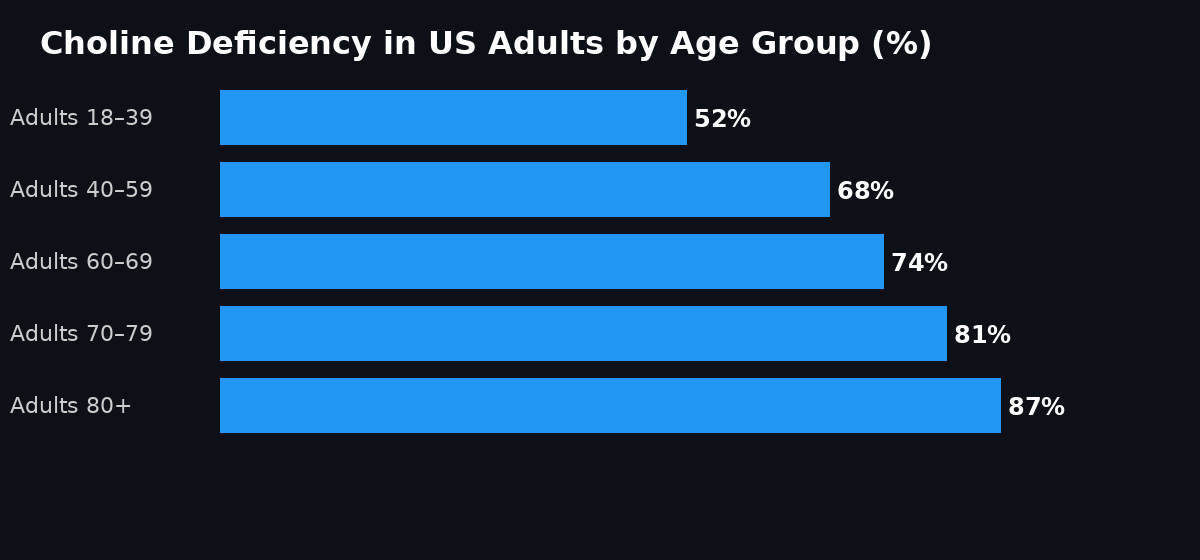
According to NHANES data, over 90% of Americans fall short of adequate choline intake. For adults over 60, the gap is even more pronounced. Here’s why this matters:
- Acetylcholine synthesis: Choline is the direct precursor to acetylcholine, the neurotransmitter critical for memory, learning, and muscle control. Levels naturally decline with age.
- Liver function: The liver uses choline for fat transport. Without enough, fat accumulates — a condition called non-alcoholic fatty liver disease (NAFLD), which is increasingly common in older adults.
- Homocysteine regulation: Choline works alongside B12 and folate to keep homocysteine in check. Elevated homocysteine is an independent risk factor for dementia and cardiovascular disease.
- Cell membrane integrity: Every cell membrane contains phosphatidylcholine. As cells turn over more slowly with age, adequate choline becomes even more important for membrane quality.
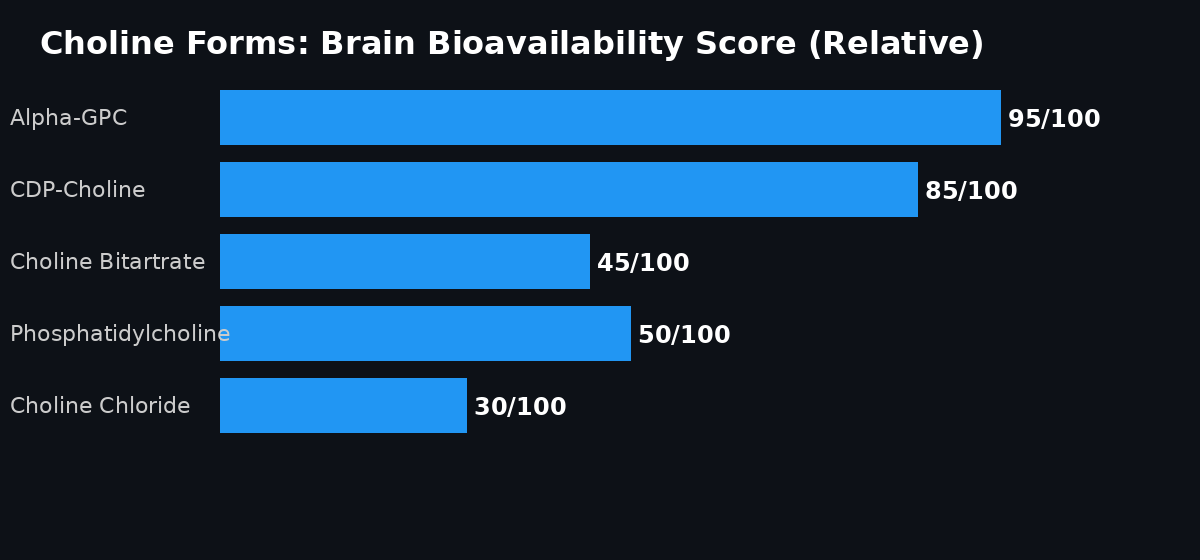
The 5 Forms of Choline — Which Actually Works?

Popular Supplement Guides:



1. Alpha-GPC (Best for Brain)
Alpha-glycerophosphocholine (Alpha-GPC) is the gold standard for cognitive benefits. It crosses the blood-brain barrier efficiently, directly boosting acetylcholine levels. European clinical studies have used Alpha-GPC for Alzheimer’s treatment — though US-based products are marketed as supplements only.
Clinical dose: 300–600 mg/day. NOW Foods Alpha-GPC is a reliable, well-dosed option. → Check price on Amazon
2. CDP-Choline (Citicoline) — Best All-Around
CDP-choline (also called citicoline) does double duty: it breaks down into both choline and cytidine (which converts to uridine, a key brain compound). Jarrow Formulas Citicoline is one of the most-studied forms for attention, focus, and memory in older adults.
Clinical dose: 250–500 mg/day. → Check price on Amazon
3. Choline Bitartrate — Budget Option, Lower Brain Impact
Choline bitartrate is the cheapest form. It’s reasonably absorbed, but much of it is metabolized by gut bacteria into TMAO (trimethylamine N-oxide) before reaching the brain. It’s fine for liver support and general choline sufficiency, but falls short for cognitive goals.
NOW Foods Choline 300mg is a good budget pick. → Check price on Amazon
4. Phosphatidylcholine
Found in lecithin supplements, phosphatidylcholine is the membrane form. It’s better for liver health than brain function. Useful if you’re targeting NAFLD prevention alongside a dietary approach.
5. Choline Chloride
Mostly used in animal feed. Poorly absorbed and rarely worth considering as a human supplement in 2025.
Choline Comparison Table
| Form | Brain Benefit | Liver Benefit | Typical Dose | Cost |
|---|---|---|---|---|
| Alpha-GPC | ★★★★★ | ★★★ | 300–600 mg | $$ |
| CDP-Choline | ★★★★☆ | ★★★ | 250–500 mg | $$ |
| Choline Bitartrate | ★★☆☆☆ | ★★★★ | 500–1000 mg | $ |
| Phosphatidylcholine | ★★☆☆☆ | ★★★★★ | 1–2 g | $$ |
How Much Choline Do Seniors Need?
The National Academy of Medicine’s adequate intake levels are:
- Men over 60: 550 mg/day
- Women over 60: 425 mg/day
- Upper limit: 3,500 mg/day (exceeding this causes fishy body odor and low blood pressure)
Food sources provide some choline — eggs (147 mg each), beef liver (356 mg per 3 oz), salmon (187 mg per 3 oz) — but many seniors don’t consume these regularly. Supplementation helps fill the gap, especially for those on plant-forward diets.
Does Choline Help With Memory and Dementia?
The link between choline and cognitive decline is real but nuanced. The Alzheimer’s Association notes that acetylcholine-based pathways are among the earliest disrupted in Alzheimer’s disease — and cholinesterase inhibitor drugs (like donepezil) work by preserving existing acetylcholine. Choline supplementation doesn’t mimic drugs, but maintaining adequate levels may support the substrate for these pathways.
A 2019 study in the American Journal of Clinical Nutrition found that higher dietary choline intake was associated with better cognitive performance in adults over 60. While causality isn’t proven, the biological plausibility is strong.
Choline and Liver Health in Older Adults
The American Liver Foundation reports that NAFLD affects roughly 30% of US adults, with prevalence increasing sharply after 60. Choline deficiency is a direct driver of hepatic fat accumulation — the liver needs choline to package fat into VLDL particles for export.
If liver health is your primary goal, phosphatidylcholine or choline bitartrate at higher doses (600–1000 mg) may be more useful than Alpha-GPC.
Can Choline Interact With Medications?
Choline is generally well-tolerated, but a few interactions are worth noting:
- Anticholinergic medications: Drugs like diphenhydramine (Benadryl), oxybutynin, or certain antidepressants work by blocking acetylcholine. Taking choline supplements may partially counteract these effects — discuss with your prescriber.
- Blood thinners: Phosphatidylcholine in high doses may mildly affect platelet function. Monitor if on warfarin.
- TMAO and cardiovascular risk: Some research (controversial) suggests choline bitartrate in very high doses could raise TMAO — a gut-derived compound linked to cardiovascular risk. This concern applies primarily to bitartrate and chloride forms, not Alpha-GPC or CDP-choline.
Related Supplements That Pair Well With Choline
Choline works best as part of a broader cognitive support strategy. Consider pairing it with:
- Best Brain Supplements for Seniors — our comprehensive cognitive health guide
- Best Supplements for Seniors — full stack overview for healthy aging
- Best Multivitamin for Seniors — many multis include some choline; check the label
Our Top Picks for Choline Supplements for Seniors
- Best for Brain Health: NOW Foods Alpha-GPC 300mg — → Check price on Amazon
- Best All-Around: Jarrow Formulas Citicoline 250mg — → Check price on Amazon
- Best Budget: NOW Foods Choline 300mg: → Check price on Amazon
Frequently Asked Questions
Is choline safe for seniors with kidney disease?
Choline at normal dietary doses is generally safe, but very high supplemental doses should be discussed with a nephrologist. The kidneys are involved in choline metabolism, and impaired kidney function could affect handling of higher doses.
How long does it take to notice effects from choline?
Alpha-GPC and CDP-choline can produce noticeable cognitive effects within 1–2 weeks of consistent use. For structural benefits (liver health, cell membrane support), expect 4–8 weeks. Choline bitartrate may take longer to show cognitive effects if they appear at all.
Can I get enough choline from eggs alone?
Two eggs per day provide roughly 294 mg of choline — about 53–69% of the adequate intake. If you eat eggs daily along with other choline-containing foods (salmon, beef, cruciferous vegetables), you may not need a supplement. However, many seniors limit egg intake due to cholesterol concerns or don’t eat meat, making supplementation useful.
Is Alpha-GPC better than citicoline?
For pure choline delivery to the brain, Alpha-GPC is slightly superior. For broader cognitive support including uridine pathway effects, CDP-choline (citicoline) has an edge. Most users report similar cognitive benefits. CDP-choline is often slightly cheaper per dose.
Does choline help with brain fog?
Many users report reduced brain fog with Alpha-GPC or CDP-choline supplementation, particularly if they were previously deficient. Acetylcholine supports attention and processing speed — the systems most affected by “fog.” Results are more pronounced in those with low baseline intake.
Choline Deficiency Signs Most Seniors Miss
Choline deficiency rarely announces itself dramatically. Instead, it shows up as a cluster of symptoms that are easy to attribute to normal aging or other conditions. Knowing what to look for matters because the NIH estimates that over 90% of Americans don’t meet adequate choline intake — and for seniors, the gap is even wider.
- Fatigue and cognitive fog: Acetylcholine drives attention and processing speed — the first systems to suffer when choline runs low
- Muscle aches after mild exercise: Choline is required for acetylcholine release at neuromuscular junctions; low levels impair muscle recovery signaling
- Difficulty with word recall: Distinct from the word-retrieval slowdown of normal aging, this presents as a sharper than expected gap in verbal memory
- Elevated liver enzymes (on blood tests): One of the earliest biochemical markers of choline insufficiency is mild fatty liver changes, which often show on routine labs before symptoms appear
- Mood instability: Acetylcholine and choline interact with dopamine and serotonin pathways; low choline has been associated with increased depressive symptoms in observational studies
None of these symptoms is specific to choline deficiency alone. But if multiple apply, assessing dietary choline intake is a reasonable first step before attributing everything to normal aging.
Choline and Dementia Prevention: What the Research Shows
The cholinergic system is one of the most studied pathways in dementia research. Alzheimer’s disease, in particular, is characterized by a progressive loss of cholinergic neurons in the basal forebrain — the region responsible for memory consolidation and learning. This is why the first approved Alzheimer’s drugs (cholinesterase inhibitors like donepezil) work by preserving existing acetylcholine rather than addressing the underlying disease process.
A 2011 prospective study in the American Journal of Clinical Nutrition (the Framingham Offspring Cohort, N=1,391 adults) found that higher dietary choline intake was associated with better verbal memory and visual memory performance independent of age, sex, and education. Participants in the highest choline quartile showed significantly reduced rates of white matter hyperintensities on brain imaging — a marker of cerebrovascular damage strongly associated with cognitive decline.
This doesn’t prove that choline supplements prevent Alzheimer’s. But it establishes that adequate choline is correlated with the structural brain health that reduces dementia risk — a compelling reason to correct deficiency proactively rather than waiting for symptoms.
Choline and Exercise Performance in Seniors
Choline levels in plasma drop measurably during sustained physical exercise — the body uses choline to synthesize acetylcholine for neuromuscular signaling at a faster rate than it can be replenished from dietary stores. For seniors following exercise programs (which they absolutely should be), this creates a window where choline status directly affects performance and recovery.
Athletes discovered this in the 1980s when choline depletion was linked to performance drops in marathon runners. For seniors doing strength training, walking programs, or any consistent cardiovascular activity, maintaining adequate choline supports better muscle activation, faster neural signaling, and reduced post-exercise fatigue. Taking Alpha-GPC or CDP-choline in the 30–60 minutes before exercise is a strategy used by some sports medicine practitioners for older active adults.
Food Sources vs. Supplements: A Practical Guide
Before defaulting to supplements, it’s worth understanding what food-based choline looks like in practice. The challenge for many seniors is that the richest sources are also foods they’ve been told to moderate:
| Food | Serving | Choline (mg) | Notes |
|---|---|---|---|
| Beef liver | 3 oz cooked | 356 mg | Highest food source; high in other nutrients too |
| Egg (whole) | 1 large | 147 mg | Most accessible source; cholesterol concerns often overstated |
| Atlantic salmon | 3 oz cooked | 187 mg | Also excellent omega-3 source |
| Chicken breast | 3 oz cooked | 72 mg | Moderate; widely consumed |
| Soybeans (edamame) | 1/2 cup | 107 mg | Best plant-based source |
| Broccoli | 1 cup cooked | 63 mg | Good non-animal source |
Two eggs plus 3 oz salmon in a day gets you to roughly 334 mg — close to the women’s adequate intake of 425 mg but still short. For seniors on plant-forward diets who don’t eat eggs or fish regularly, supplementation is essentially required to reach adequate intake. For a broader perspective on supplementing cognitive health, see our best brain supplements for seniors guide.
How to Stack Choline With Other Cognitive Supplements
Choline works well with several other supplements in a cognitive health stack:
- Lion’s Mane Mushroom: Stimulates nerve growth factor (NGF) production. Pairs with Alpha-GPC for a synergistic approach — Alpha-GPC provides the substrate for acetylcholine; Lion’s Mane promotes neuronal growth and connectivity.
- Bacopa Monnieri: Another adaptogen with RCT evidence for memory consolidation. Different mechanism from choline — complements rather than duplicates it.
- Omega-3 (DHA specifically): DHA is required for neuronal membrane integrity. Choline supports membrane production; DHA provides the structural material. Both are frequently deficient in seniors.
- B vitamins (B6, B9, B12): The methylation cycle that choline supports overlaps with B vitamin metabolism — ensuring B12 and folate are adequate amplifies choline’s homocysteine-lowering effect. See our best B12 supplement for seniors guide.
This article is for informational purposes only and does not constitute medical advice. Always consult your healthcare provider before starting any new supplement regimen, particularly if you take prescription medications.
Related Articles
- Best Vitamin B12 Supplement for Women Over 60
- Best Omega-3 for Women Over 60: EPA, DHA & Top Picks (2026)
- How Much Vitamin B12 Do Seniors Need Daily? — Dosing by Form, Deficiency Level and Medication
- Phosphatidylserine for Seniors — Memory, Brain Cell Membranes and the Evidence
- 5 Best CoQ10 Supplements for Seniors — Ubiquinol vs CoQ10 Ranked