This guide contains affiliate links. If you buy through them, we may earn a small commission at no extra cost to you.
We have not tested these devices ourselves. This guide compiles each brand’s published specs and plan terms, FDA and NIDCD guidance, and patterns in verified buyer reviews.
⚡ Quick Answer
AARP now lists two hearing aid discount programs: AARP Hearing Solutions provided by UnitedHealthcare Hearing (prescription hearing aids through a provider network, with a free hearing exam) and AARP Hearing Care by Soundly (prescription aids through local clinics plus OTC options online). Members also get a free yearly online screening through the National Hearing Test. The discount is worth it if you need prescription hearing aids and want in-person fitting. If your hearing loss is mild to moderate, OTC hearing aids such as ELEHEAR Beyond (best value) or Jabra Enhance Select (best support) can cost far less.
If you are an AARP member, the aarp hearing aid discount is one of the benefits most worth checking before you buy hearing aids. Prescription hearing aids often cost thousands of dollars a pair, Original Medicare does not pay for them, and it is hard to know whether a clinic’s price is fair. AARP’s programs give you a free hearing exam, published price tiers and a network of providers, which takes some of the guesswork out.
The benefit has also changed. AARP’s member benefits list now shows two separate hearing programs, not just the long-running UnitedHealthcare Hearing offer. Below we explain what each one includes, the prices we found on the providers’ own pages, who the discount suits, the catches in the fine print, and the cheaper OTC hearing aids worth comparing first. AARP is not an affiliate of ours, so its links in this article are plain links.
Table of Contents
AARP Hearing Aid Discount: Quick Comparison
Prices are per pair, from each provider’s own page at the time of writing. They can change at any time, so check current pricing before you book or buy.
Free hearing exam, prescription hearing aids from a nationwide provider network, 60-day trial
About $1,898 to $3,498 a pair, plus optional support packages
Prescription aids with local fitting
AARP Hearing Care by Soundly
Free online hearing test, local clinic care for prescription aids, OTC hearing aids delivered
Prescription from about $1,898 a pair; OTC from about $399 a pair
Comparing prescription and OTC in one place
OTC hearing aids on Amazon
Self-fitting or preset aids for mild to moderate loss, no exam needed
About $149 to $399 a pair for our picks
Mild to moderate loss on a budget
Jabra Enhance Select (direct)
Self-fitting OTC aids with remote audiology and a 100-day trial
About $1,195 to $1,995 a pair
OTC with professional support
Why Hearing Aid Costs Matter So Much After 50
Hearing loss becomes far more common with age, but many people who could benefit never get hearing aids, and cost is a big reason. According to NIDCD hearing statistics, fewer than 1 in 3 adults ages 70 and older who could benefit from hearing aids has ever used them.
Insurance rarely fills the gap. Medicare’s own hearing aid coverage page says Original Medicare does not cover hearing aids or exams for fitting them, so you pay all costs. Some Medicare Advantage plans offer extra hearing benefits, so check your plan before you use any discount. UnitedHealthcare Hearing cites a national average of about $5,500 a pair for hearing aids, a figure it attributes to Soundly. Against numbers like that, a discount program or a well-chosen OTC pair can make the difference between buying hearing aids and putting it off for another year.
What the AARP Hearing Aid Discount Includes Now
On AARP’s member benefits list, the Health and Wellness section includes three hearing benefits. Here is what each one offers, based on AARP’s benefit pages and the providers’ own sites.
AARP Hearing Solutions provided by UnitedHealthcare Hearing
This is the long-standing program. AARP’s benefit page describes savings on hearing aids and hearing care, a free hearing exam, access to a nationwide provider network and support options along the way. You redeem it through the program’s website or by phone, and you mention your AARP membership number.
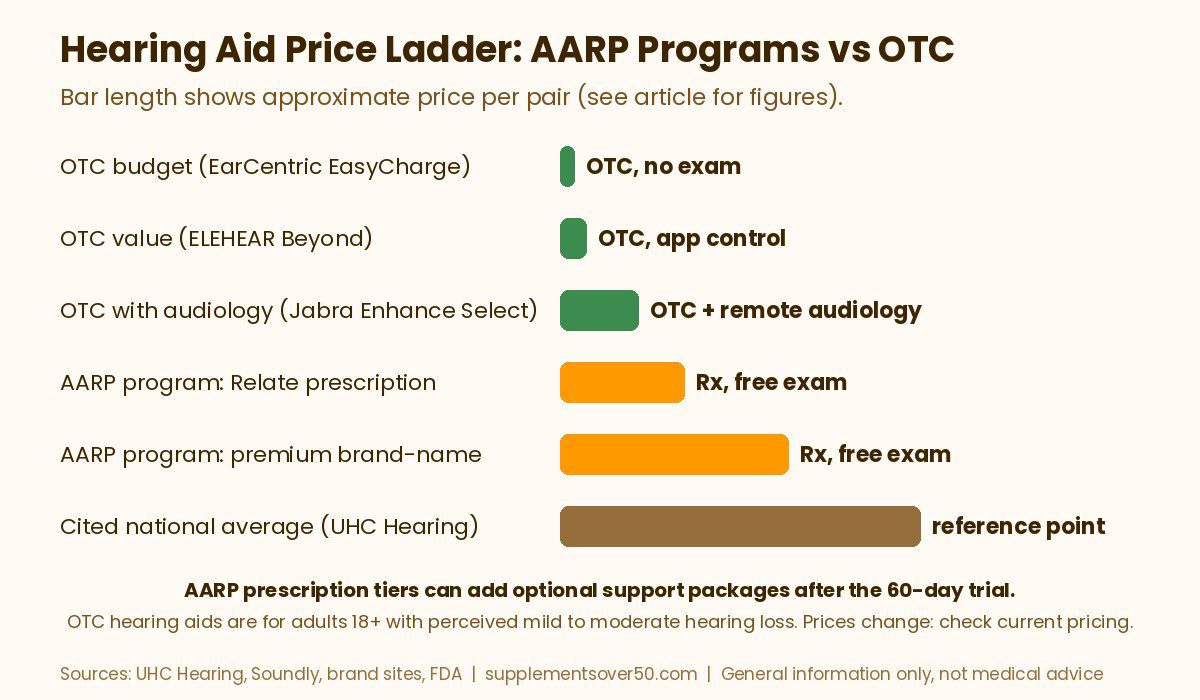
On the AARP Hearing Solutions site, UnitedHealthcare Hearing lists four prescription device tiers: Gold at about $1,898 a pair and Platinum at about $2,498 for its value range, and Standard at about $2,798 and Premium at about $3,498 for the latest technology. The value range uses Relate, a private-label prescription brand available through UnitedHealthcare Hearing. The brands listed on the site are Relate, Beltone, Oticon, Phonak, ReSound, Signia and Starkey. The site also says it has 6,500+ provider locations.
AARP Hearing Care by Soundly
The newer program is run by Soundly, a hearing aid comparison and retail site. AARP’s Soundly benefit page says savings apply to hearing aids, including OTC options, with a free hearing exam and local provider consult, and a 60-day trial on prescription hearing aids. It also states that the trial applies to prescription aids only and that OTC trial and return policies vary by manufacturer.
On Soundly’s AARP page, prescription hearing aids in a local clinic start at about $1,898 a pair, and OTC hearing aids delivered to your door start at about $399 a pair. Soundly shows private-label Relate aids at about $1,898 (against a listed $2,498) and premium brand-name aids at about $3,498 (against a listed $5,398), with a 3-year warranty on value options, a 4-year warranty on brand-name options and one loss or damage replacement. OTC brands featured include Sennheiser, Nuance Audio, Elehear and Jabra Enhance. Its FAQ is clear that the program is a discount program, not insurance.
The National Hearing Test (free screening)
Separately, AARP’s National Hearing Test page says members can take a free hearing test once a year by phone, computer or mobile device. AARP describes it as an independent, scientifically validated screening developed with NIH funding. It is a screening, not a full exam, but it is a free way to find out whether you should look into hearing aids at all.
AARP Hearing Aid Prices: How Much You Might Save
The honest answer is that savings depend on what you would have paid without the program. Using the providers’ own figures:
Premium brand-name aids: Soundly lists about $3,498 a pair against a listed $5,398, which is about $1,900 less on paper.
Private-label Relate aids: about $1,898 a pair against a listed $2,498, about $600 less. UnitedHealthcare Hearing says Relate costs more than 65% less than its cited national average of $5,500.
OTC hearing aids through Soundly: when we browsed Soundly’s OTC shop from the AARP page, prices showed about 5% below the list price (for example, about $379 against $399).
Two costs are easy to miss. First, both programs list optional support packages: about $500 a pair for 12 months with 3 extra follow-up visits, or about $1,250 a pair for 36 months with 12 extra visits. The device price includes a 60-day trial with fitting and adjustments, but care after that is extra unless you buy a package. Second, AARP membership itself costs money. AARP’s membership page lists $15 for the first year with automatic renewal and a standard rate of $20 a year, which is small next to the potential savings.
How the AARP Hearing Aid Discount Works
Join or log in to AARP. You need an active membership number to redeem either hearing program.
Take a free screening. Use the National Hearing Test or Soundly’s online hearing test to see where you stand.
Pick a program. UnitedHealthcare Hearing for prescription aids through its network, or Soundly for local clinic care or OTC aids delivered.
Book your free exam. UnitedHealthcare Hearing asks you to request an appointment through its site or by phone, and your first appointment is free.
Choose a device tier and support package with the hearing care professional, then use the 60-day trial to make sure the aids work for you.
The Catch: What to Know Before You Use It
Prescription only (UnitedHealthcare Hearing). AARP’s disclosure says the discount applies to prescription hearing aids prescribed by a licensed hearing professional. OTC aids are not part of that program.
Network providers only. You have to go through the program to reach a participating provider. Your current audiologist may not be in the network.
No stacking. The UnitedHealthcare Hearing discount cannot be combined with other discounts, promotions, coupons or hearing aid benefit plans unless stated.
Federal program exclusion. Products or services reimbursable by Medicare or Medicaid are not available at a discount through the program, so check how it interacts with any plan benefit you have.
OTC trials vary. Soundly’s 60-day trial covers prescription aids only. OTC return terms depend on the brand.
Support costs extra after the trial, unless you buy one of the support packages.
AARP is paid for the name. Both disclosures say the providers pay AARP a royalty for its intellectual property. That does not make the programs bad, but it does mean you should still compare prices.
Are There Hearing Aids Recommended by AARP?
People often search for AARP’s best hearing aids or hearing aids recommended by AARP. On the AARP benefit pages we read, AARP does not name a single best hearing aid. What it offers is access: the programs list the brands you can get through them, such as Oticon, Phonak, ReSound, Signia, Starkey, Beltone and Relate through UnitedHealthcare Hearing, and OTC brands like Sennheiser, Elehear, Nuance Audio and Jabra Enhance through Soundly. Being available through a benefit program is not the same as an endorsement, so pick the device based on your hearing test and needs, not the logo.
OTC Hearing Aids: The Cheaper Path the FDA Opened
You may not need the prescription route at all. The FDA’s guide to OTC hearing aids explains that the OTC category is for adults 18 and older with perceived mild to moderate hearing loss, with no exam or prescription required. You can buy them in a store or online. OTC devices let you adjust and customize the settings yourself.
That makes OTC hearing aids a strong alternative for many people over 50 whose main problems are following conversation in restaurants or turning the TV up too loud. Soundly itself says OTC devices are designed for mild to moderate loss, and that severe loss or complex audiograms may need a prescription device. If that describes you, the AARP discount is where the savings matter most.
Cheaper OTC Alternatives to the AARP Hearing Aid Discount
These are well-reviewed OTC options that cost less than the lowest prescription tier in either AARP program. Ratings and review counts come from the Amazon listings at the time of writing. OTC hearing aid ratings tend to run lower than for other electronics, because fit and expectations vary so much.
1. ELEHEAR Beyond (Best Value)
ELEHEAR Beyond is one of the OTC models Soundly features in the AARP program, and on Amazon it was about $399 a pair at the time of writing, sold by ELEHEAR. The listing describes up to 50 dB of gain and 24 dB of noise attenuation for mild to moderate hearing loss, with a receiver-in-canal fit and several dome sizes included.
The iOS and Android app lets you adjust volume and use features such as telephone speech enhancement and a serene sound relief setting. Battery life is up to 20 hours per charge and about 100 hours in total with the case, and the aids switch on and off when you lift them out or drop them back in. The listing also mentions the ElePro remote audiologist care service. It had 500+ bought in the past month and a 4.0 rating from 700+ reviews.
💵 Best Value
ELEHEAR Beyond
Up to 50 dB gain with noise attenuation; app with speech enhancement and sound relief; about 100 hours with the case; remote audiologist service.
If you want the lowest cost of entry, EarCentric EasyCharge was about $149 a pair at the time of writing, sold by the brand. It is a simple behind-the-ear OTC hearing aid with volume control rather than an app, which some people prefer.
The listing says one charge lasts about 3 days, and the portable case holds 3 more charges for up to 12 days in total. It comes with both a desktop charging dock and a portable case, multiple dome sizes, and regular and long tubes, and the brand offers US-based setup help. With 800+ bought in the past month and a 4.2 rating from 6,600+ reviews, it is a popular low-risk way to find out whether amplification helps you.
🛒 Best Budget Pick
EarCentric EasyCharge
Behind-the-ear OTC aids with simple volume control; about 3 days per charge, up to 12 with the case; desktop dock and travel case included.
If you already use an iPhone and your hearing loss is mild, AirPods Pro 3 are worth trying first. The listing describes an at-home hearing test and a Hearing Aid feature with automatic Conversation Boost, with up to 10 hours in Transparency using that feature. They were about $180 on Amazon at the time of writing, sold by Amazon, with 10K+ bought in the past month and a 4.4 rating from 17,000+ reviews.
The trade-offs are clear: you need an Apple device for setup, they look like earbuds, and they are not built for all-day wear like a dedicated hearing aid.
🎧 Best for iPhone Users
Apple AirPods Pro 3
At-home hearing test; Hearing Aid feature with Conversation Boost; up to 10 hours in Transparency with the feature; active noise cancellation.
Best OTC With Professional Support: Jabra Enhance Select
If you like the idea of professional help but not the prescription price, Jabra Enhance sits in between. Its Select line is sold direct at about $1,195 (M1), $1,695 (M2) and $1,995 (M3) a pair at the time of writing. Jabra says each model includes 3 years of professional adjustments sent to your hearing aids through its app, a 100-day risk-free trial with a full refund, and a 3-year warranty with 3 years of loss and damage protection. That trial is longer than the 60 days in either AARP program. Check current pricing on Jabra’s site.
Best for audiologist support
Jabra Enhance Select (buy direct)
Self-fitting OTC hearing aids with 3 years of remote professional adjustments, a 100-day risk-free trial and a 3-year warranty with loss and damage protection.
Is the AARP Hearing Aid Discount Worth It? Who It Suits
If you need prescription hearing aids (moderately severe loss, a complex audiogram or custom molds), use the AARP discount. A free exam plus published price tiers is a real advantage.
If you want in-person fitting and follow-up, pick UnitedHealthcare Hearing or Soundly’s local clinic route, and budget for a support package.
If your loss is mild to moderate and you are comfortable with an app, try ELEHEAR Beyond first.
If you want the cheapest possible start, try EarCentric EasyCharge.
If you want OTC pricing with professional support and a long trial, pick Jabra Enhance Select direct.
If you have Medicare Advantage, check your plan’s hearing benefit first, since the AARP discount cannot be combined with other hearing aid benefit plans.
Whatever route you choose, some symptoms need a medical check before you buy hearing aids. The FDA’s OTC hearing aid labeling tells you to see a doctor, preferably an ear, nose and throat (ENT) specialist, if you:
Have hearing loss or ringing in only one ear, or much worse hearing in one ear.
Had a sudden change in hearing in the past 6 months, or hearing that gets worse and then better.
Feel dizzy or have a spinning sensation (vertigo).
Have ear pain, or fluid, pus or blood coming from your ear.
Have a lot of earwax or think something could be in your ear.
If you struggle to follow speech even in a quiet room, OTC devices are likely not enough. That is exactly when the free exam through an AARP hearing program is most useful.
Frequently Asked Questions
Does AARP offer a hearing aid discount?
Yes. AARP lists two hearing aid programs: AARP Hearing Solutions provided by UnitedHealthcare Hearing, which offers savings on prescription hearing aids through a provider network, and AARP Hearing Care by Soundly, which covers prescription aids through local clinics and OTC hearing aids online. Both include a free hearing exam or test.
How much are hearing aids with the AARP discount?
At the time of writing, UnitedHealthcare Hearing listed prescription tiers from about $1,898 to $3,498 a pair, and Soundly listed prescription aids from about $1,898 and OTC aids from about $399 a pair. Optional support packages cost about $500 or $1,250 a pair. Check current pricing with each provider.
Does the AARP discount cover OTC hearing aids?
Through Soundly, yes: AARP says Soundly’s savings include OTC options. The UnitedHealthcare Hearing discount applies to prescription hearing aids prescribed by a licensed hearing professional, so OTC aids are not part of that program.
Is the AARP hearing test really free?
AARP members can take the National Hearing Test free once a year by phone, computer or mobile device. UnitedHealthcare Hearing also says your first appointment and hearing exam are free, and Soundly offers a free online hearing test and free exam at participating clinics.
Can I use the AARP discount with Medicare?
Original Medicare does not cover hearing aids. AARP’s disclosure says the UnitedHealthcare Hearing discount cannot be combined with other hearing aid benefit plans, and products reimbursable by Medicare or Medicaid are not discounted. If you have a Medicare Advantage plan with a hearing benefit, compare it first.
Does AARP recommend specific hearing aids?
The AARP benefit pages we read do not name a single best hearing aid. They list the brands available through each program, such as Oticon, Phonak, Starkey and Relate through UnitedHealthcare Hearing. Choose based on your hearing test, budget and the support you want.
Our Take
The AARP hearing aid discount is a good deal for one group in particular: people who need prescription hearing aids and want local fitting at a published price. The free exam, prices starting around $1,898 a pair and a 60-day trial beat walking into a clinic blind. Just read the terms: the UnitedHealthcare Hearing discount is prescription only and network only, support after the trial costs extra, and you cannot stack it with other benefits. If your hearing loss is mild to moderate, start cheaper with an OTC pair such as ELEHEAR Beyond, or pick Jabra Enhance Select if you want professional support and a 100-day trial. Take AARP’s free hearing test first either way.
This article is for general information only and is not medical advice. OTC hearing aids are intended for adults 18 and older with perceived mild to moderate hearing loss. Program terms and prices change often, so confirm details with AARP, UnitedHealthcare Hearing, Soundly or the brand before you buy, and talk to a doctor or licensed hearing professional about sudden, one-sided or severe hearing changes.
Looking for a smart watch for seniors with fall detection? We compare Apple, Samsung, Pixel and monitored medical alert watches: who they call, cost and battery.
Fall detection for seniors living alone: compare Apple Watch SE 3, Galaxy Watch9, help buttons and medical alert services, plus fees, range and battery tips.
Sleep tracker for seniors picks: Apple Watch SE 3, Fitbit, Oura and RingConn compared on comfort, battery, subscriptions and what trackers cannot tell you.
Best Buy hearing aids explained: which OTC models it carries, its 60-day hearing aid return policy, what in-store help to expect, and the picks worth buying.
Our ADT medical alert review covers On-The-Go and Medical Alert Plus, fall detection, real monthly costs, contract terms, customer reviews and better alternatives.