This guide contains affiliate links. If you buy through them, we may earn a small commission at no extra cost to you.
We have not tested these devices ourselves. This guide compiles each brand’s published specs and plan terms, FDA and NIDCD guidance, and patterns in verified buyer reviews.
⚡ Quick Answer
Hearing aids do not cure tinnitus, but if you also have mild to moderate hearing loss, amplifying the sounds around you can make the ringing less noticeable. Our top pick is Jabra Enhance Select M3 Aureon, because it comes with licensed audiology support and works with Jabra’s free tinnitus relief sound app. Also worth a look: ELEHEAR Beyond Pro (best built-in soundscapes), ELEHEAR Beyond (best value with a sound relief setting), Apple AirPods Pro 3 (best for iPhone users) and EarCentric EasyCharge (best budget, amplification only). Ringing in one ear, a pulsing sound or a sudden change? See a doctor first.
If you are shopping for otc hearing aids for tinnitus, you have probably already noticed the marketing: boxes promising to “stop the ringing” and listings that put the word tinnitus in every line. The honest picture is simpler and more useful. Hearing aids are a sound therapy, not a cure. For many people over 50, the ringing comes along with some hearing loss, and turning up the world around you can push the tinnitus into the background.
This guide to OTC hearing aids for tinnitus puts the evidence first. We explain how hearing aids help tinnitus according to the National Institute on Deafness and Other Communication Disorders (NIDCD) and the American Tinnitus Association, who should see an audiologist or ear, nose and throat (ENT) doctor before buying anything, and which features actually matter. Then we share five OTC picks, from a model with audiology support and a tinnitus sound app to a simple budget pair.
Table of Contents
OTC Hearing Aids for Tinnitus: Quick Comparison
Prices are approximate, from the Amazon listing or the brand’s own site at the time of writing. Check current pricing before you buy.
Licensed audiology included; free Jabra tinnitus relief app streams sounds to the aids; Bluetooth streaming
About $1,995 a pair on Amazon or direct
ELEHEAR Beyond Pro
Best built-in soundscapes
20 soundscapes in the app (rain, breeze, ambient tones); remote hearing care support
About $599 a pair on Amazon
ELEHEAR Beyond
Best value with sound relief
Serene sound relief setting in the app; up to 50 dB gain; remote audiologist service
About $399 a pair on Amazon
Apple AirPods Pro 3
Best for iPhone users
Hearing Aid feature; iPhone Background Sounds can play rain or ocean sounds through them
About $180 on Amazon
EarCentric EasyCharge
Best budget, amplification only
No sound generator; simple volume boost behind the ear
About $149 a pair on Amazon
Why Tinnitus and Hearing Loss Often Show Up Together After 50
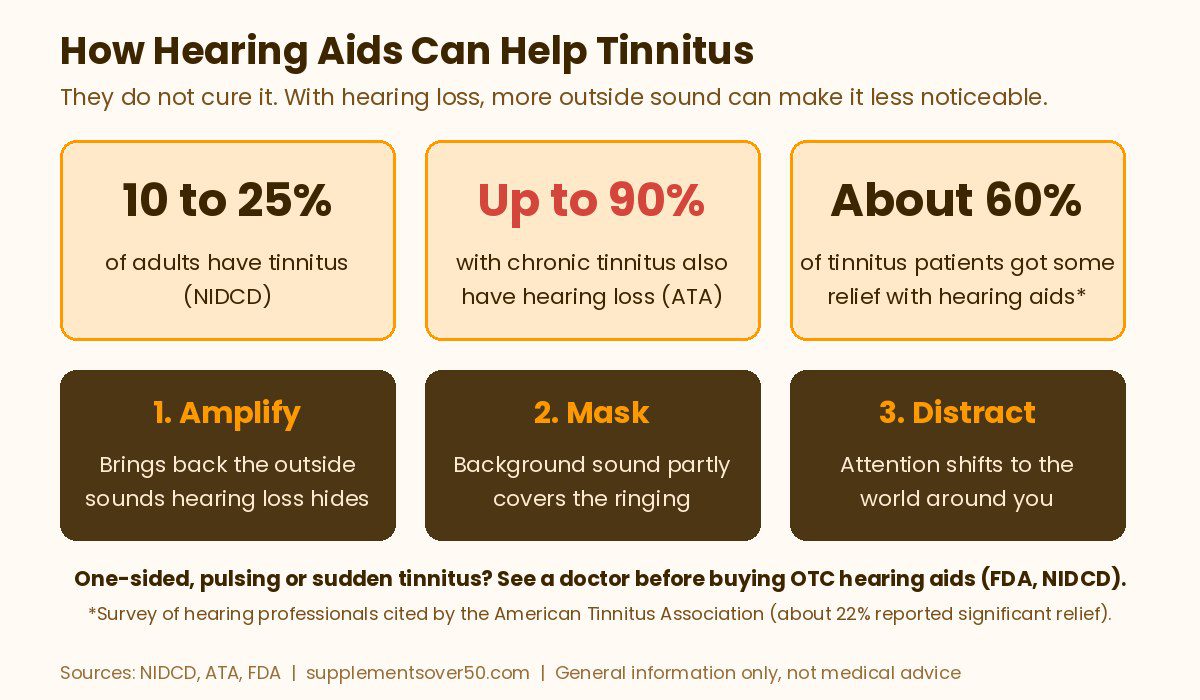
Tinnitus is the perception of sound that has no outside source, so nobody else can hear it. NIDCD says surveys estimate that 10 to 25% of adults have it. People describe ringing, buzzing, roaring, hissing or humming, and it can come and go or be constant.
Age matters because hearing loss matters. NIDCD says most people who have tinnitus have some degree of hearing loss, and that hearing loss caused by aging or noise exposure is strongly associated with it. The American Tinnitus Association goes further, noting that as many as 90% of people with chronic tinnitus also have hearing loss. One leading theory is that when the inner ear sends the brain less sound, the brain’s hearing centers change how they process sound, and tinnitus is the result.
That is also why people often blame the wrong thing. The ATA points out that many people assume loud tinnitus is what is blocking their hearing, when the hearing loss underneath is the bigger issue. A hearing check is the first step either way.
Other things can trigger or worsen tinnitus too. NIDCD lists earwax, ear infections, head or neck injuries, jaw joint problems, high blood pressure and blood vessel problems, and some medicines, including high doses of aspirin and other NSAIDs. If you are also keeping an eye on blood pressure, our guide to the best blood pressure monitors for home use over 50 may help.
Do Hearing Aids Help Tinnitus? What the Evidence Says
So do OTC hearing aids for tinnitus actually work? Here is what the two main sources say, in plain terms:
There is no cure. NIDCD says there is currently no cure for tinnitus, but there are ways to reduce symptoms, including sound therapy devices (hearing aids among them), behavioral therapies and medications for mood or sleep.
Hearing aids are a main option when hearing loss is present. NIDCD calls hearing aids one of the main treatment options for people with tinnitus who have hearing loss, because they amplify outside sounds and make tinnitus less noticeable.
They work by masking and distraction. The ATA explains that louder background sound can partly cover the tinnitus and pull your attention toward the world around you. It says masking is strongest when your hearing loss is in the same pitch range as your tinnitus.
Combination devices add sound generation. Both NIDCD and the ATA describe devices that amplify and also play soft sounds such as white noise. The ATA says the research is not definitive, but professional consensus is that hearing aids with built-in sound generators help a significant number of patients.
Results vary. The ATA cites a 2007 survey of hearing professionals who reported that roughly 60% of their tinnitus patients got at least some relief from hearing aids, and roughly 22% got significant relief. That is a professional survey, not a clinical trial, but it sets realistic expectations.
Two practical points from the ATA are worth knowing before you buy. Hearing aids seem to work best when worn consistently through waking hours, not just now and then. And they tend to work better when paired with tinnitus education or counseling, which is one reason we favor options with access to an audiologist.
What about pills? NIDCD says that while certain vitamins, herbal extracts and supplements are often advertised as tinnitus cures, none has been proven effective. Our look at tinnitus supplements and what actually helps goes through the research in more detail.
See an Audiologist or ENT First If You Have These Signs
Most tinnitus is not dangerous, but some patterns need a medical check before you try any hearing aid. The FDA’s OTC hearing aid warning label tells you to see a doctor, preferably an ENT, if you:
Hear ringing or buzzing in only one ear, or have worse hearing in one ear.
Had a sudden change in hearing in the past 6 months, or hearing that gets worse and then better again.
Feel dizzy or have a spinning or swaying feeling (vertigo).
Have ear pain, or saw blood, pus or fluid from your ear in the past 6 months.
Have a lot of earwax or think something could be in your ear.
Have an ear that was injured or has an unusual shape.
Add one more from NIDCD: tinnitus that pulses in rhythm with your heartbeat. NIDCD says an ENT may order imaging tests, especially if your tinnitus pulsates, because it can point to a structural problem or a blood vessel issue. NIDCD also suggests starting with your primary care doctor, who can check for earwax or fluid and review your medicines.
Finally, remember who OTC hearing aids for tinnitus are actually for. The FDA says they are for adults 18 and older with perceived mild to moderate hearing loss, and not for severe or profound loss. If you cannot hear speech even in a quiet room, start with a licensed hearing professional.
What to Look for in OTC Hearing Aids for Tinnitus
Good amplification first. Since most of the benefit comes from hearing the world better, a well-fitted aid that suits your hearing loss matters more than any tinnitus feature.
A sound generator or sound app. Built-in soundscapes or a companion app that streams relief sounds gives you a second tool for quiet rooms.
Fine control. Self-fitting aids with an in-app hearing test and adjustable bass and treble let you shape the sound, which can matter when your tinnitus sits at a certain pitch.
Access to a professional. Remote audiology or a hearing care specialist can adjust settings and offer tinnitus coping tips. The ATA says counseling improves results.
Comfort for all-day wear. Open, receiver-in-canal styles are light and easy to forget about, which helps you wear them all day.
A long return window. The FDA notes that warranties are not required, so check the return policy and give yourself several weeks of real-world use.
Top Picks: Best OTC Hearing Aids for Tinnitus
To choose these OTC hearing aids for tinnitus, we focused on in-stock models sold by Amazon or the brand itself, that either include tinnitus sound tools or are strong, simple amplifiers. Ratings and review counts come from the Amazon listings at the time of writing. OTC hearing aid ratings often run lower than for other products, because fit and expectations vary so much.
1. Jabra Enhance Select M3 Aureon (Best Overall for Tinnitus)
Jabra Enhance Select M3 Aureon is our top pick because it pairs strong hearing aids with the thing tinnitus sufferers benefit from most: a professional to talk to. The Amazon listing describes Jabra’s most advanced FDA-cleared self-fitting hearing aids, with unlimited adjustments and appointments with a licensed hearing professional 7 days a week, the option to send your audiogram for professional programming, and settings that adjust noise reduction and speech volume automatically as you move between quiet and busy places.
The tinnitus support is spelled out on Jabra Enhance’s help center. Its free tinnitus relief app offers calming sounds (you can layer up to 5), relaxation exercises and education, and it can stream sounds directly through your hearing aids. If your purchase includes audiology services, its licensed audiologists can adjust programming and offer personalized tinnitus counseling, though the brand says that counseling is not currently offered in California, Illinois and Iowa. The same page notes reports that the app may not work on some newer Android phones and says the company is working on a fix. Hardware-wise, the listing lists 24+ hours per charge, an IP68 rating, Bluetooth streaming and calls, a 3-year warranty and 3 years of loss and damage protection. It is sold by Amazon and rated 4.7 out of 5 from about 20 reviews.
🏆 Best Overall for Tinnitus
Jabra Enhance Select M3 Aureon
Licensed audiology included; works with Jabra’s tinnitus relief app; self-fitting test or audiogram programming; Bluetooth calls; 3-year warranty.
You can also buy the Select line from Jabra Enhance directly. At the time of writing, the brand lists the Select M1, M2 and M3 at about $1,195, $1,695 and $1,995 a pair, each with 3 years of audiology services, a 100-day risk-free trial and a 3-year warranty. Check current pricing on its site. For tinnitus, the long trial is a real advantage, because the ATA says it can take consistent daily wear to judge the benefit.
Best for audiologist support
Jabra Enhance Select (buy direct)
Hearing aids programmed from an in-app test or your audiogram, 3 years of remote audiology, a 100-day risk-free trial and a 3-year warranty. Its audiologists can also help with tinnitus in most states.
If you want relief sounds without juggling a second app, ELEHEAR Beyond Pro builds them into the hearing aid app. The listing describes 20 soundscapes, including rain, breeze, vinyl crackle and ambient tones, that you can pick and mix, and the listing’s feature summary includes tinnitus masking. Under that, it is a receiver-in-canal OTC aid for mild to moderate hearing loss with up to 50 dB of amplification, noise cancellation and feedback reduction.
The listing also mentions up to 20 hours per charge plus 4 more charges in the case, a 15-minute fast charge for about 6 hours of use, automatic on and off with the case, and remote support from ELEHEAR’s hearing care specialists through the app. It is sold by ELEHEAR, with 100+ bought in the past month and a 3.8 rating from 350+ reviewers. Some buyers specifically mention the tinnitus options in their reviews, while lower ratings are common for app-based aids where setup takes patience.
🌊 Best Built-In Soundscapes
ELEHEAR Beyond Pro
20 mix-and-match soundscapes in the app; up to 50 dB amplification; 20 hours per charge plus 4 case charges; remote hearing care support.
ELEHEAR Beyond is the lower-cost sibling and the better seller of the two. The listing describes up to 50 dB of gain with up to 24 dB of noise attenuation for mild to moderate hearing loss, and its iOS and Android app includes a serene sound relief setting alongside volume, telephone speech enhancement and a custom hearing compensation profile.
Battery life is excellent: up to 20 hours per charge and about 100 hours in total with the case. The aids switch on and off automatically when you lift them out of or place them in the case, multiple dome sizes are included, and the listing mentions an ElePro remote audiologist care service. It is sold by ELEHEAR, with 500+ bought in the past month and a 4.0 rating from 700+ reviewers. If you mainly want good amplification with a relief setting for quiet moments, this is the value choice.
💵 Best Value with Sound Relief
ELEHEAR Beyond
Serene sound relief setting in the app; up to 50 dB gain; about 100 hours with the case; ElePro remote audiologist service.
If you already have an iPhone, Apple AirPods Pro 3 are a low-commitment way to try amplification. Apple’s support page says AirPods Pro 2 and AirPods Pro 3 provide a clinical-grade Hearing Aid feature for people 18 and older with perceived mild to moderate hearing loss. The listing lists up to 10 hours in Transparency using the Hearing Aid feature, automatic Conversation Boost and an at-home hearing test.
For tinnitus, the useful extra is on your phone. Apple’s guide to Background Sounds explains how to play calming sounds such as ocean or rain through supported AirPods to mask unwanted environmental noise, with volume, equalizer and timer controls. Apple does not market this as a tinnitus treatment, but it works the same way as the tabletop sound generators NIDCD describes. The catches: you need an iPhone or iPad, and they look like earbuds. It is sold by Amazon, with 10,000+ bought in the past month and a 4.4 rating from 17,000+ reviewers.
📱 Best for iPhone Users
Apple AirPods Pro 3
Hearing Aid feature for perceived mild to moderate loss; at-home hearing test; Background Sounds on iPhone for rain or ocean sounds; up to 10 hours with Hearing Aid.
EarCentric EasyCharge has no tinnitus feature at all, and we are listing it on purpose. NIDCD says the main way hearing aids help tinnitus is by amplifying outside sound, so if your budget is tight and your hearing loss is mild, a simple, comfortable amplifier may be all you need during the day. Pair it with a bedside sound machine or a free phone app at night.
These behind-the-ear aids use a simple volume control, with several ear domes and both regular and long tubes that the brand says help comfort, even with glasses. You get a desktop dock and a portable charging case, and the listing says one charge lasts 3 days, with the case adding 3 more for up to 12 days in total. EarCentric lists US-based setup support. It is sold by the brand, with 800+ bought in the past month and a 4.2 rating from 6,500+ reviewers. It is not self-fitting, so it suits people who want a straightforward boost rather than custom tuning.
💰 Best Budget Pick
EarCentric EasyCharge
Simple behind-the-ear volume boost; no app needed; desktop dock plus portable case; up to 12 days of charge; glasses-friendly tubes.
Tinnitus at Night: What to Do When the Hearing Aids Come Out
Even the best OTC hearing aids for tinnitus are not worn to bed. Many people notice tinnitus most in a quiet bedroom, right when the hearing aids go back in the case. NIDCD suggests tabletop or smartphone sound generators for relaxation and sleep, playing sounds like waves, rain or a summer night, and says a fan or radio can work too. For mild tinnitus, that may be all you need to fall asleep.
Jabra Enhance notes that its tinnitus relief app also plays through headphones or your phone’s speaker, which helps after you take your aids off. The ATA’s advice is practical: if tinnitus mainly bothers you at bedtime, a bedside white noise machine may be enough, while all-day tinnitus calls for something portable. If poor sleep is part of the picture, our guide to the best sleep trackers for adults over 50 can help you see patterns.
How to Choose the Best Hearing Aids for Tinnitus
If you want the most support, pick Jabra Enhance Select M3 Aureon, or buy the Select line direct for the 100-day trial.
If you want relief sounds built into the hearing aid app, pick ELEHEAR Beyond Pro.
If you want a sound relief setting for less, pick ELEHEAR Beyond.
If you use an iPhone and want to start small, pick AirPods Pro 3 and use Background Sounds.
If budget comes first, pick EarCentric EasyCharge and add a bedside sound machine.
If you are sensitive to loud sounds, talk to an audiologist first. The ATA notes that people with hyperacusis or other sound sensitivity may find amplification uncomfortable.
If you have tinnitus but no hearing loss, OTC hearing aids are not designed for you. NIDCD lists wearable sound generators, sound apps and behavioral therapies as other options.
One brand to skip for now: Eargo. A notice on Eargo’s website says its parent company, LXE Hearing, began winding down its US operations and that support for the mobile app is changing. Existing aids are expected to keep working with on-device controls, but we would not buy one new today, including leftover stock sold elsewhere.
Shopping for a parent? Hearing aids can be a meaningful present, and our list of the best gifts for aging parents has more ideas for health and peace of mind.
Frequently Asked Questions
Do OTC hearing aids help tinnitus?
OTC hearing aids for tinnitus can help if you also have mild to moderate hearing loss. NIDCD says hearing aids are one of the main treatment options for people with tinnitus and hearing loss, because amplifying outside sound makes tinnitus less noticeable. They do not cure tinnitus, and results vary from person to person.
Can hearing aids make tinnitus worse?
Some people find amplification uncomfortable at first. The American Tinnitus Association notes that people with hyperacusis or other sound sensitivity may feel discomfort with sound amplifying devices. Lower the volume, wear them consistently while you adjust, and ask a hearing professional to fine-tune the settings if it does not settle.
Do hearing aids help tinnitus without hearing loss?
OTC hearing aids are meant for adults with perceived mild to moderate hearing loss, so they are not designed for tinnitus alone. The ATA says up to 90% of people with chronic tinnitus also have hearing loss, so get your hearing checked. Without hearing loss, NIDCD lists sound generators, apps and behavioral therapy as options.
Should I see a doctor before buying hearing aids for tinnitus?
Yes if your tinnitus is in only one ear, pulses with your heartbeat, started or changed suddenly, or comes with dizziness, ear pain or drainage. The FDA lists one-sided ringing and sudden hearing changes as reasons to see a doctor, preferably an ENT, before using OTC hearing aids.
How much do hearing aids for tinnitus cost?
At the time of writing, our picks range from about $149 a pair for EarCentric EasyCharge to about $1,995 for Jabra Enhance Select M3 Aureon with audiology included. AirPods Pro 3 cost about $180 on Amazon. Prices change often, so check current pricing before you buy.
What helps tinnitus at night?
NIDCD suggests tabletop or smartphone sound generators playing sounds like rain or waves, or even a fan or radio, to help you relax and fall asleep. Apps such as Jabra’s tinnitus relief app can also play through your phone’s speaker or headphones once your hearing aids are out.
Our Take
The best OTC hearing aids for tinnitus are good hearing aids first. If you have tinnitus along with mild to moderate hearing loss, wearing well-tuned aids every day is the step most likely to make the ringing fade into the background, and a sound app or built-in soundscapes adds a second tool for quiet moments. For the most support, we like Jabra Enhance Select M3 Aureon, with ELEHEAR Beyond Pro and Beyond as strong app-based options and EarCentric EasyCharge as a simple budget start. Rule out red flags with a doctor first, give any pair a few weeks, and do not expect a cure from any device or supplement.
This article is for general information only and is not medical advice. OTC hearing aids are intended for adults 18 and older with perceived mild to moderate hearing loss. Talk to a doctor or licensed hearing professional about tinnitus, especially if it is one-sided, pulsing or sudden.
Over the counter hearing aids explained: who they are for, OTC vs prescription, self-fitting vs preset, typical costs, where to buy and when to see a doctor.
The best medical alert systems for seniors compared: Bay Alarm Medical, Medical Guardian, LifeFone, MedicalAlert and 2 Amazon options, with fall detection and contract terms.
Home blood pressure monitor picks for adults over 50: upper arm OMRON, iHealth and Alcedo models compared on cuff size, display, memory and accuracy tips.
Fall detection for seniors living alone: compare Apple Watch SE 3, Galaxy Watch9, help buttons and medical alert services, plus fees, range and battery tips.
Sleep tracker for seniors picks: Apple Watch SE 3, Fitbit, Oura and RingConn compared on comfort, battery, subscriptions and what trackers cannot tell you.