This guide contains affiliate links. If you buy through them, we may earn a small commission at no extra cost to you.
We have not tested these devices ourselves. This guide compiles each brand’s published specs and plan terms, FDA and NIDCD guidance, and patterns in verified buyer reviews.
⚡ Quick Answer
Our top pick for most seniors with mild to moderate hearing loss is Jabra Enhance Select M2 Swift: FDA-cleared self-fitting, nearly invisible, Bluetooth calls and streaming, and sold by Amazon. Also worth a look: Apple AirPods Pro 3 (best for iPhone users), ELEHEAR Beyond (best app control for the money), EarCentric EasyCharge (best budget, no app needed) and Audien Atom Pro 2 (most discreet in-canal fit). Want an audiologist on call? Jabra Enhance also sells direct with remote audiology care included.
Finding the best otc hearing aids used to be simple, because there were none. Since the FDA created the over-the-counter category, you can now buy a real hearing aid online or at a store without a prescription or an audiologist visit. That is great news for anyone who keeps turning up the TV, but it also means hundreds of look-alike listings, confusing labels and prices that range from under $100 to about $2,000 a pair.
This guide is built for the best hearing aids for seniors who want to start with an OTC option. We explain who OTC hearing aids are for, what the FDA says to watch out for, which features matter most after 50, and which Bluetooth models actually stream calls. Then we share five picks across budgets and hearing needs, plus a brand-direct option with audiology support and one brand to avoid right now.
Table of Contents
Best OTC Hearing Aids for Seniors: Quick Comparison
Prices are approximate, taken from the Amazon listing or the brand’s own site at the time of writing. Check current pricing before you buy.
FDA-cleared self-fitting test in app; Bluetooth calls and streaming (iOS/Android); 24+ hours per charge; IP68; 1-year warranty
About $999 a pair on Amazon
Apple AirPods Pro 3
Best for iPhone users
Hearing Aid feature for perceived mild to moderate loss; needs iPhone or iPad; up to 10 hours using Hearing Aid
About $180 on Amazon
ELEHEAR Beyond
Best app control for the money
Up to 50 dB gain; iOS and Android app; up to 20 hours per charge, 100 with case; remote audiologist service
About $399 a pair on Amazon
EarCentric EasyCharge
Best budget, no app
Behind-the-ear; simple volume control; desktop dock plus portable case; up to 12 days with case
About $149 a pair on Amazon
Audien Atom Pro 2
Most discreet
In-canal fit; 4 listening modes; UV-C sanitizing case; 24 hours per charge plus 48 from case
About $231 a pair on Amazon
Jabra Enhance Select (direct)
Best with audiologist support
M1, M2 or M3; 3 years of remote audiology; 100-day trial; 3-year warranty
About $1,195 to $1,995 a pair on jabraenhance.com
Why Hearing Loss Matters More After 50
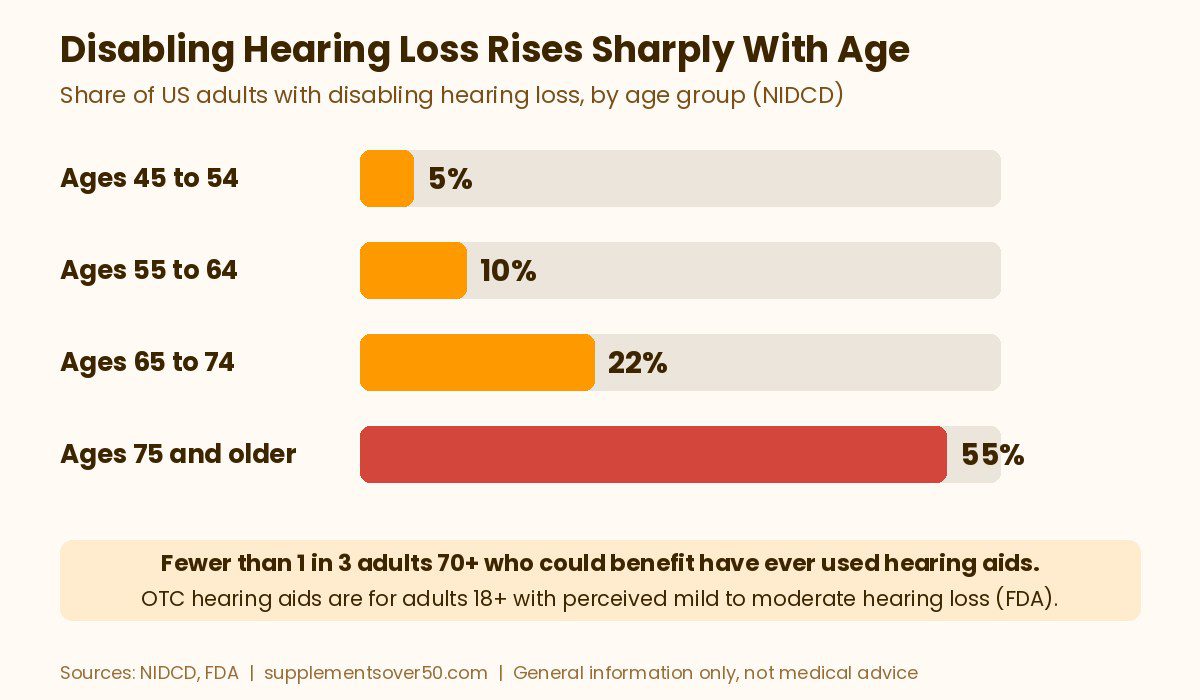
Hearing usually fades slowly, so many people do not notice until family members start repeating themselves. According to the National Institute on Deafness and Other Communication Disorders (NIDCD), about 5% of adults aged 45 to 54 have disabling hearing loss. That rises to 10% at ages 55 to 64, 22% at ages 65 to 74 and 55% for adults 75 and older.
Very few people act on it. NIDCD reports that fewer than 1 in 3 adults aged 70 and older who could benefit from hearing aids have ever used them. Cost and hassle have been big reasons, which is exactly the gap OTC hearing aids were created to close.
It is worth closing. The FDA notes that using hearing aids may reduce the frequency or severity of cognitive decline, depression and other health problems in adults, and can improve social participation and quality of life. NIDCD also reports that among adults over 52 with moderate to severe hearing loss, about 28% have difficulty with daily activities, compared with 7.3% of people the same age without hearing loss.
What OTC Hearing Aids Are (and Who They Are For)
The FDA created the OTC hearing aid category a few years ago. Here is what the agency says these devices are, and are not:
For adults 18 and older with perceived mild to moderate hearing loss. They are not meant for severe or profound hearing loss, because their maximum output is limited.
No exam or prescription needed. You can buy them in a store or online without seeing an ear, nose and throat (ENT) doctor or an audiologist.
You control the settings. Some are basic models with volume control and preset programs. Others are self-fitting, using a hearing test and a smartphone app to customize the sound.
Look for the words OTC and hearing aid on the box. The FDA requires them, along with a return policy and warnings about when to see a doctor.
The FDA’s signs that you may have mild to moderate hearing loss include trouble hearing speech in noisy places, struggling to follow group conversations, difficulty on the phone, feeling tired from listening, and turning up the TV until others complain. If you cannot hear speech even in a quiet room, or you do not hear loud sounds like power tools well, an OTC device may not be enough.
One label tip many buyers miss: the FDA says phrases such as “FDA Registered” or “FDA Certified” on hearing aid packaging may be misleading. Registration is not the same as clearance. Self-fitting models like the Jabra Enhance Select are described as FDA-cleared, which is a stronger signal than a registration claim.
What to Look for in the Best Hearing Aids for Seniors
Ease of handling. Small buttons and tiny domes can be hard with arthritis or poor eyesight. Simple dials, a touch-free case or an app with large controls can make a big difference.
Rechargeable batteries. Every pick below is rechargeable, so there are no tiny batteries to change. Check hours per charge and whether the case carries extra charges.
Fit style. Behind-the-ear models are easier to handle and work well with glasses. In-canal models are more discreet but can be fiddly and may not suit small or waxy ear canals.
Self-fitting vs preset. Self-fitting aids tune themselves to your hearing test. Preset models rely on volume and a few modes, which is simpler but less tailored.
Bluetooth. Decide whether you want true streaming of calls and TV audio, or just an app to adjust settings. They are not the same thing (more below).
Return window and support. The FDA notes that warranties are not required, so read the return policy. You need time to adjust in real places like restaurants and church.
Company stability. A hearing aid depends on apps, firmware and support. A brand that disappears can leave you with a device you cannot update.
Top Picks for the Best OTC Hearing Aids
We focused on hearing aids that are in stock, sold by Amazon or the brand itself, and reasonably well reviewed, across a range of budgets. Ratings and review counts come from the Amazon listings at the time of writing. Note that OTC hearing aid ratings tend to run lower than for other products, because fit and expectations vary so much from person to person.
1. Jabra Enhance Select M2 Swift (Best Overall)
Jabra Enhance Select M2 Swift is our top pick because it combines the things seniors ask for most: clear speech, a nearly invisible design and genuine Bluetooth. The listing describes FDA-cleared self-fitting hearing aids that you set up with a hearing test inside the Jabra app, then fine-tune with volume, bass, treble and environment presets. It weighs about 2.12 grams per aid and automatically adjusts the volume of speech as you move from a quiet kitchen to a busy restaurant.
You can take hands-free calls and stream music and video from compatible Apple and Android devices, and it supports Bluetooth LE Audio and Auracast. Jabra lists over 24 hours of listening per charge with a portable charger, an IP68 rating, a 1-year warranty with 1-year loss and damage protection, and FSA/HSA eligibility. It is sold by Amazon and rated 4.7 out of 5, though from only about 20 reviews so far.
🏆 Best Overall
Jabra Enhance Select M2 Swift
FDA-cleared self-fitting; Bluetooth calls and streaming for iOS/Android; 24+ hours per charge; IP68; nearly invisible.
Prefer to have a professional in your corner? Jabra Enhance also sells its Select M1, M2 and M3 directly with licensed audiology built in. At the time of writing, the brand lists prices from about $1,195 to $1,995 a pair (financing available), with 3 years of unlimited remote appointments and adjustments, a 100-day risk-free trial, a 3-year warranty and the option to upload an audiogram for professional programming. Check current pricing on its site.
Best for audiologist support
Jabra Enhance Select (buy direct)
Hearing aids programmed to your hearing test or audiogram, with 3 years of remote audiology, video check-ins 7 days a week, a 100-day trial and a 3-year warranty.
If you already use an iPhone, Apple AirPods Pro 3 may be the simplest way to try hearing help without looking like you wear hearing aids at all. Apple’s support page says AirPods Pro 2 and AirPods Pro 3 offer a clinical-grade Hearing Aid feature for people 18 or older with perceived mild to moderate hearing loss. You take Apple’s hearing test on your iPhone or iPad, or use an audiogram from your hearing professional, and the AirPods customize amplification to your results.
The listing lists up to 10 hours of use in Transparency with the Hearing Aid feature, Conversation Boost for one-on-one talks, active hearing protection and five ear tip sizes. The catch: you need an iPhone or iPad to set it up, and they look like earbuds, which some people love and others do not. It is one of Amazon’s top sellers, with 10,000+ bought in the past month and a 4.4 rating from 17,000+ reviewers.
📱 Best for iPhone Users
Apple AirPods Pro 3
Hearing Aid feature for perceived mild to moderate loss; hearing test on iPhone; up to 10 hours with Hearing Aid; noise cancellation.
3. ELEHEAR Beyond (Best App Control for the Money)
ELEHEAR Beyond is a receiver-in-the-canal hearing aid for mild to moderate hearing loss with up to 50 dB of gain and up to 24 dB of noise attenuation, according to the listing. The ELEHEAR app works on iOS and Android and lets you adjust volume and frequency, use a telephone speech setting and a sound relief feature, and set your own hearing compensation profile.
Battery life is a standout: up to 20 hours per charge, with the case adding four more charges for about 100 hours in total. The aids turn on and off automatically when you take them out of or put them back in the case, and the listing mentions an ElePro remote audiologist care service. It is sold by ELEHEAR, with 500+ bought in the past month and a 4.0 rating from 700+ reviewers.
📲 Best App Control
ELEHEAR Beyond
Up to 50 dB gain; iOS and Android app; 20 hours per charge, about 100 with case; remote audiologist service.
EarCentric EasyCharge is our pick among cheap hearing aids for seniors because it keeps things simple and has the best reviews in its price range. These are behind-the-ear aids with a simple volume control, several ear domes and both regular and long tubes, which the brand says helps with comfort even if you wear glasses. There is no app to learn.
Charging is the clever part. You get a desktop dock for the nightstand and a portable charging case, and the listing says one charge lasts 3 days, with the case holding 3 more charges for up to 12 days in total. EarCentric lists US-based setup support. It is sold by the brand, with 800+ bought in the past month and a 4.2 rating from 6,500+ reviewers. Like most budget models, it is not self-fitting, so it suits people who want a straightforward volume boost.
💰 Best Budget Pick
EarCentric EasyCharge
Behind-the-ear; simple volume control; desktop dock plus portable case; up to 12 days of charge; glasses-friendly tubes.
If being seen in hearing aids is what stops you, Audien Atom Pro 2 sits inside the ear canal, and Audien says it is 15% smaller than the previous generation. One button handles volume and four listening modes: conversation, restaurant, TV and outdoor. The charging case runs a 5-minute UV-C light cycle each time you dock the aids.
The listing lists up to 24 hours per charge, plus 48 more hours from the case, three dome sizes and a free expert-guided setup session. Reviews are mixed: it holds a 3.7 rating from 3,800+ reviewers, which is typical for tiny in-canal aids where fit varies a lot. Note that Audien describes it as FDA-registered, which the FDA says is not the same as clearance. Choose it for discretion and simplicity, and use the return window if the fit is not right.
🕶 Most Discreet
Audien Atom Pro 2
In-canal fit; 4 listening modes; UV-C sanitizing case; 24 hours per charge plus 48 from case; free setup session.
Bluetooth on a hearing aid box can mean two very different things, so check before you pay extra:
True streaming (calls, music, TV): Jabra Enhance Select M2 Swift streams calls and media from compatible Apple and Android devices and supports Bluetooth LE Audio and Auracast. AirPods Pro 3 stream everything from Apple devices and switch between them automatically.
App control only: ELEHEAR Beyond lists Bluetooth 5.3 for its app, which adjusts settings. Its listing does not promise call or music streaming, so do not count on it for phone calls.
No Bluetooth: EarCentric EasyCharge and Audien Atom Pro 2 use buttons or dials. For many seniors that is a feature, not a flaw.
If your main goal is hearing phone calls clearly, choose true streaming. If you mostly want to hear the people in the room, a simpler aid may serve you just as well.
One Brand to Avoid Right Now: Eargo
Eargo was long a popular choice for nearly invisible hearing aids, but we are not recommending it. A notice on Eargo’s own website says its parent company, LXE Hearing, has begun winding down its US operations. The notice says new warranty or repair requests stopped being accepted after September 15, the Eargo app was removed from app stores on October 22, and customer support ended that day. The same notice says the company can no longer support Eargo, Lexie and Go customers. Existing aids are expected to keep working with on-device controls, but buying one now means no support. Be careful with leftover stock sold elsewhere.
How to Choose the Best OTC Hearing Aids for You
If you want the best all-rounder, pick Jabra Enhance Select M2 Swift.
If budget comes first, pick EarCentric EasyCharge, our best cheap hearing aid for seniors who want a simple volume boost.
If you want Bluetooth calls and streaming, pick Jabra Enhance Select M2 Swift, or AirPods Pro 3 if you use an iPhone.
If you want them nearly invisible, pick Audien Atom Pro 2, and use the return window to check the fit.
If you want the longest time between charges, pick EarCentric EasyCharge (up to 12 days with the case) or ELEHEAR Beyond (about 100 hours with the case).
If you have tinnitus as well as hearing loss, consider Jabra Enhance Select bought direct, so an audiologist can tune the aids. NIDCD says hearing aids are a main treatment option for people with tinnitus and hearing loss and can make tinnitus less noticeable. They are not a cure.
If you have trouble with apps, pick EarCentric EasyCharge or Audien Atom Pro 2.
OTC hearing aids are a good starting point, but they are not right for everyone. The FDA lists these red flags. See a doctor, preferably an ENT, before buying if you have:
Hearing that changed suddenly in the past 6 months, or that gets worse and then better again.
Worse hearing in one ear, or ringing or buzzing in only one ear.
Blood, pus or fluid from your ear in the past 6 months, or ear pain or discomfort.
A lot of earwax, or the feeling something is in your ear.
Dizziness or a spinning or swaying feeling (vertigo).
An ear that has an unusual shape or was injured.
Also see a licensed hearing professional if you cannot hear speech in a quiet room, if loud sounds seem faint, or if OTC aids do not help enough after a fair trial. The FDA says it takes time and practice to get used to hearing aids, so wear them regularly for a few weeks before you decide. Sudden hearing loss in particular needs prompt medical attention.
Frequently Asked Questions
What are the best OTC hearing aids for seniors?
For most seniors with mild to moderate hearing loss, Jabra Enhance Select M2 Swift is our top pick for its self-fitting app, Bluetooth streaming and small size. AirPods Pro 3 suit iPhone users, EarCentric EasyCharge is the best budget option and Audien Atom Pro 2 is the most discreet.
Are OTC hearing aids as good as prescription hearing aids?
For perceived mild to moderate hearing loss, many people do well with OTC hearing aids. Prescription aids are programmed by a professional and can handle all levels of loss. The FDA says OTC aids are not meant for severe or profound hearing loss because their output is limited.
Do I need a hearing test before buying OTC hearing aids?
No prescription or exam is required for adults 18 and older. Many self-fitting models include an in-app hearing test. A professional test is still a good idea if you are unsure how severe your loss is or have any red flags such as sudden or one-sided hearing loss.
Can AirPods really work as hearing aids?
Apple says AirPods Pro 2 and AirPods Pro 3 offer a Hearing Aid feature for people 18 and older with perceived mild to moderate hearing loss. You set it up with a hearing test on an iPhone or iPad, or with an audiogram from your hearing professional.
What are the best cheap hearing aids for seniors?
EarCentric EasyCharge is our budget pick. It is a simple rechargeable behind-the-ear aid with a volume control, a dock and a portable charging case. Cheap aids are usually not self-fitting, so they suit people who want a basic volume boost rather than custom tuning.
Do hearing aids help with tinnitus?
NIDCD says hearing aids are one of the main treatment options for people with tinnitus who also have hearing loss, because amplifying outside sounds can make tinnitus less noticeable. There is no cure for tinnitus. Ringing in only one ear should be checked by a doctor.
Our Take
The best OTC hearing aids for most seniors are the ones you will actually wear every day. For a strong all-round choice with Bluetooth and an app that tunes itself to your hearing, Jabra Enhance Select M2 Swift is our pick. iPhone users can try AirPods Pro 3 first, and EarCentric EasyCharge is a sensible low-cost start if you just want things louder and clearer. Whatever you choose, read the return policy, give yourself a few weeks to adjust, and see a professional if your hearing changes suddenly or the aids do not help enough.
This article is for general information only and is not medical advice. OTC hearing aids are intended for adults 18 and older with perceived mild to moderate hearing loss. Talk to a doctor or licensed hearing professional if you have questions about your hearing.
Sleep tracker for seniors picks: Apple Watch SE 3, Fitbit, Oura and RingConn compared on comfort, battery, subscriptions and what trackers cannot tell you.
Jabra Enhance hearing aids reviewed: Select M1, M2 and M3 vs Pro 30 and Plus, OTC vs prescription, remote audiology, trial, warranty, pricing and where to buy.
Fall detection for seniors living alone: compare Apple Watch SE 3, Galaxy Watch9, help buttons and medical alert services, plus fees, range and battery tips.
Our Philips Lifeline review explains the name change to Lifeline, current devices, fees, contract terms and customer reviews, plus three better alternatives.