This guide contains affiliate links. If you buy through them, we may earn a small commission at no extra cost to you.
We have not tested these devices ourselves. This guide compiles each brand’s published specs and plan terms, CDC falls data, and patterns in verified buyer reviews.
⚡ Quick Answer
Medical Guardian is a solid pick for families who want a small, modern GPS device with long battery life. The Guardian Flex is the standout (best all-rounder for home and away), the MG Home Landline or Cellular suits a parent who mostly stays home, and the MG Move watch fits someone who will not wear a pendant. Fall detection is an optional add-on on every current device. The trade-offs: the current terms include a three-month minimum, devices are purchased up front on the online checkout, and cancelling takes a phone call or letter plus a device return for leased equipment.
Medical Guardian reviews tend to split into two camps. Many families praise the small devices, the friendly staff and the peace of mind; a smaller but vocal group describes frustration with billing and cancelling. Both are worth hearing before you sign a parent up for Medical Guardian, one of the best known medical alert companies in the US.
This guide to Medical Guardian reviews covers every device Medical Guardian currently lists, how its fall detection works, what the monitoring center promises, what it really costs once add-ons and fees are included, and the contract and cancellation terms in its current Terms and Conditions. We also summarize the patterns we found on Trustpilot and the BBB and compare it with two close rivals, Bay Alarm Medical and LifeFone. Facts come from the brand’s own product, checkout and legal pages and the review pages we opened at the time of writing.
Table of Contents
Medical Guardian at a Glance
Who runs it: Medical Guardian, LLC, headquartered in Philadelphia. Its site says it has offered medical alert service since 2006, and its BBB profile lists the business as started in late 2005. The about page credits founder Geoff with starting the company to protect his grandmother.
Devices on the main menu: MG Home Landline, MG Home Cellular, Guardian Flex and the MG Move smartwatch. The MG Mini and MG Mini Lite still have product pages but are sold by phone quote.
Monitoring: two US-based monitoring centers with more than 550 trained operators, per the brand, and a TMA Five Diamond designation.
Fall detection: optional on every current device, about $10 more per month at the time of writing.
Contract: no long-term contract, but the current terms set a minimum three-month service commitment.
Ratings we saw: A+ BBB rating (accredited since 2009), 4.32 out of 5 from 659 BBB customer reviews, and 4.1 out of 5 from about 1,500 reviews on Trustpilot.
Why a Medical Alert Matters More After 50
Falls are the main reason families start comparing medical alert companies. According to the CDC’s Facts About Older Adult Falls, more than one in four adults age 65 and older falls each year, yet less than half tell their doctor. Falling once doubles the chance of falling again, and CDC reports about 4.5 million emergency department visits a year from falls in older adults, including 1.4 million hospitalizations.
A medical alert does not prevent falls. What it does is shorten the time between a fall and help arriving, which matters most for anyone who lives alone or spends long stretches of the day by themselves. With a monitored service like Medical Guardian, one press connects to a trained operator who can send EMS, police or fire, or call a neighbor or family member on the wearer’s Care Circle list. Fall detection can place that call automatically if the wearer cannot press the button.
Medical Guardian Devices Compared
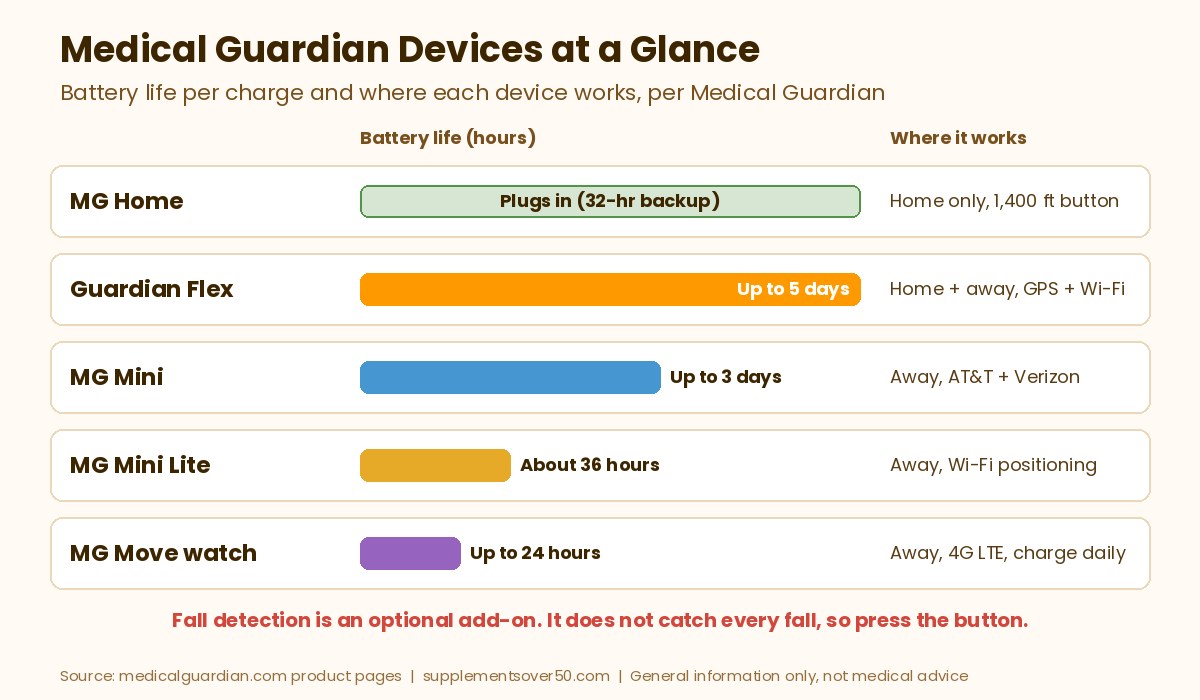
Here is how the line-up compares. The monthly figures are the “as low as” rates on each product page at the time of writing, without fall detection. Prices and promotions change often, so check current pricing before you order.
Device
Best for
Where it works
Battery
Starting cost
MG Home Landline
Lowest bill, home with a working landline
Home, button range up to 1,400 ft
Plugs in, 32-hour backup
About $27.95/mo
MG Home Cellular
Home without a landline
Home, 4G LTE, button range up to 1,400 ft
Plugs in, 32-hour backup
About $34.95/mo
Guardian Flex
Best all-rounder, home and away
Anywhere with coverage (GPS, Wi-Fi backup)
Up to 5 days
About $39.95/mo on an annual plan
MG Move
People who prefer a watch
Anywhere with 4G LTE coverage
Up to 24 hours
About $44.95/mo
MG Mini
Tiny necklace or belt clip
Anywhere with coverage (AT&T and Verizon)
Up to 3 days
About $39.95/mo, by phone quote
MG Mini Lite
Simple wrist-worn button
Anywhere with coverage, Wi-Fi positioning
About 36 hours
About $42.95/mo, by phone quote
Every wearable is described as water resistant and shower safe, and cellular service is included in the monthly fee, so there is no separate phone bill. On the online checkout we opened, the base unit or device was listed as purchased equipment, which is a real up-front cost covered in the pricing section below.
Medical Guardian Devices Explained
MG Home Landline and MG Home Cellular: In-Home Systems
Both home systems use the same compact base unit with a two-way speaker, a Smarti Voice Assist button that runs a self-test and reads out device status, and a 32-hour backup battery. The included help button snaps into a necklace or wristband and works up to 1,400 feet from the base, per the product pages (the product quiz describes the landline range as 1,300 feet, so treat the exact figure loosely). You talk to the operator through the base, not the button, so the system works best for someone who stays within earshot of it.
The landline version plugs into a phone jack, while the cellular version runs on 4G LTE and only needs a wall outlet. Both let you add more buttons for a spouse, wall buttons for the bathroom or stairs, and a fall detection pendant. At the time of writing, the product pages listed the MG Home Landline from about $27.95 a month and MG Home Cellular from about $34.95 a month. The product page says the alarm can be cancelled within 10 seconds of an accidental press by holding the button.
Guardian Flex: Best for Home and Away
The Guardian Flex is Medical Guardian’s newest mobile device and the one most families should look at first. It weighs about 1.4 ounces, can be worn three ways (wrist band, belt clip or lanyard) and has its own cellular connection, GPS, Wi-Fi location backup and a two-way speaker. The brand lists up to 5 days of battery life and about 2 hours to a full charge, which is longer than most rival mobile buttons.
The Flex includes step tracking in the app, and the brand says it accepts most 22mm watch bands. At the time of writing, the annual plan was listed at about $39.95 a month, and the device itself was listed at $149.95 with a large promotional discount applied. One practical note from a recent Trustpilot review: the small release buttons used to swap between the band and lanyard can be fiddly for someone with poor eyesight or stiff fingers, so plan to set it up for your parent.
MG Move: Medical Alert Smartwatch
The MG Move is a standalone medical alert watch with 4G LTE, an SOS button, a cancel button for accidental presses, step counting and local weather. No smartphone is needed for the basic plan. An optional Social Circle Apps package adds voice-to-text messages and reminders (for medication or events) on the watch, and caregivers can see hourly location history in the member portal.
The catch is battery life. Medical Guardian lists up to 24 hours and says the watch must be charged daily, which takes 1 to 2 hours. It is IP67 rated for the shower but should not be submerged, and the band is not replaceable. The product page lists it from about $44.95 a month and says “while supplies last”, so ask whether it will still be supported long term before you choose it.
MG Mini and MG Mini Lite: Phone-Quote Options
The MG Mini is a very small necklace or belt-clip button (about 0.08 pounds) with a two-way speaker, hourly GPS updates and OmniSIM access to both AT&T and Verizon networks, per its page. Battery life is listed at up to 3 days. The MG Mini Lite is a simple wrist-worn button with Wi-Fi positioning and about 36 hours of battery. Both pages list prices (about $39.95 and $42.95 a month) but ask you to call for a quote, and neither device appears on the main menu. The Flex page compares itself directly with the Mini, which suggests the Flex is now the default mobile pick.
BEST FOR SMALL GPS DEVICES
Medical Guardian
In-home and mobile systems including the Guardian Flex with up to 5 days of battery, optional fall detection on every current device and two US-based monitoring centers, per the brand.
Fall detection is an add-on rather than a standard feature. On the home systems it comes as a separate fall detection pendant that must be worn around the neck; on the Flex, MG Move and Mini it is switched on in the device. Every checkout page we opened listed it at $10.00 a month, and the MG Mini page claims 9 of 10 customers add it.
Medical Guardian describes its sensors as accelerometers that look for an abrupt change in movement, and says the Flex uses machine-learning models trained on real fall data. The MG Move page says its fall detection can tell soft falls from hard impacts. When a fall is detected, the device calls the monitoring center and an operator asks whether you need help; if you cannot answer, they send emergency services.
The brand is clear about limits. Its terms state that fall detection does not detect 100% of falls and is not a replacement for pressing the help button. Its fall detection page also warns that dropping the device can trigger a false alarm, which you cancel by telling the operator you are fine. That matches what we saw in reviews: a handful of recent one-star Trustpilot reviews describe falls the device did not catch, and a few mention alerts while sitting still or lying in bed. The terms add that fall detection is particularly suggested for people with conditions such as epilepsy, Parkinson’s disease, diabetes or multiple sclerosis.
Monitoring Center and Response
Medical Guardian says it connects members to more than 550 trained emergency operators across two US-based monitoring centers, staffed 24/7. Its MG Move page explains that its Five Diamond designation comes from The Monitoring Association and is held by fewer than 200 centers nationwide, and its FAQ also points to UL certification. Members who speak a language other than English or Spanish can be helped through a third-party translation service.
Product pages advertise “response times as fast as 8 seconds”. Treat that as the brand’s best-case claim, not an average. Under its terms, operators may first try to reach you, then call the people on your list in the order you choose, and call 911 if the situation appears to need it. The terms also say accidental presses are not penalized unless they become a persistent pattern. The company recommends a test call at least once a month, and some devices now support self-testing without an operator.
Medical Guardian Cost Per Month and Fees
So, how much is Medical Guardian per month? At the time of writing, the advertised starting rates were about $27.95 (MG Home Landline), $34.95 (MG Home Cellular), $39.95 (Guardian Flex on an annual plan) and $44.95 (MG Move), with fall detection adding about $10. Those “as low as” rates appear to reflect annual billing. When we opened each checkout page with monthly billing selected, the subscription showed higher: about $31.95 for MG Home Landline, $38.95 for MG Home Cellular, $44.95 for the Flex and $49.95 for the MG Move. The checkout says annual billing saves 16% and adds a free lockbox and free ground shipping.
Equipment is the cost many shoppers miss. Medical Guardian’s older FAQ says it charges no equipment fees, but the online checkout we opened listed the base unit or device as purchased equipment: $149.95 for MG Home Landline, MG Home Cellular and the Flex, and $199.95 for the MG Move, before any promotion. The Flex page showed a 75% promotional discount on the device when we checked, so the real figure depends on the deal running that week. Ask a sales agent whether a leased option is available for the system you want.
Account services fee: about $0.99 a month on the checkouts we opened.
Shipping: about $12.50 for standard shipping on monthly orders; ground shipping is free on annual plans.
Lockbox: about $2.99 a month, or free with annual billing.
Protection Plan: about $6.99 a month for equipment replacement and support. Without it, the terms allow a charge of up to $350 for a leased device that is lost or not returned.
OnGuard Alerts: about $2.99 a month to keep contacts updated in real time during an emergency.
Extra buttons: an extra pendant or wireless wall button about $2.99 a month each, a voice-activated wall button about $4.99 a month.
Social Circle Apps (MG Move): about $5 a month for messages and reminders on the watch.
Payment: major cards including American Express; HSA and FSA cards may work for eligible items, per the terms.
Add it up and a Flex with fall detection on monthly billing came to about $56 a month (including the account services fee) plus the device, which matches the cost complaints we read. Annual billing brings the monthly figure down noticeably, but it also means paying a year up front, so weigh that against the cancellation terms below.
Contract, Cancellation and Equipment Returns
Medical Guardian markets itself as having no long-term contracts, and that is true in the sense that there is no multi-year deal. But its current Terms and Conditions include several details that matter more than the marketing lines:
Three-month minimum: every membership has a minimum 90-day service commitment, and cancelling early does not remove the obligation to pay for those three months.
Automatic renewal: plans renew at the end of each monthly, quarterly or annual billing period until you cancel.
How to cancel: by phone to member support or by mailed written notice. The terms do not list an online cancellation option.
Leased devices: cancellation only takes effect once the device is returned and processed, which can take up to 30 days, and billing may continue until then. Returns ship at your expense. If a leased device is not returned within 30 days of your cancellation notice, the terms allow a one-time $350 charge, and a restocking fee of up to $50 may come out of any refund.
Purchased devices: no $350 non-return fee, but monitoring fees continue until the written cancellation is confirmed.
15-day return window: new device purchases can be returned within 15 days of receipt for a full refund of the purchase price, less shipping, in original condition. The window may not apply to promotional or refurbished devices where stated.
Refunds: prepaid plans get a prorated refund for unused time beyond the three-month minimum, less any restocking fee. Monthly plans do not get partial-month refunds.
Warranty: 90 days on new devices against defects.
The site’s older FAQ still says there are no equipment, activation or cancellation fees, with a footnote that cancellation fees may apply. When the two disagree, the dated Terms and Conditions are what you agree to at checkout, so read them, keep written confirmation of any cancellation and always ship returns with tracking.
Medical Guardian Reviews: What Customers Say
Here is what Medical Guardian reviews looked like on the public review pages we opened. Ratings change, so treat these as a snapshot.
BBB:Medical Guardian’s BBB profile showed an A+ rating, BBB accreditation since 2009, and 4.32 out of 5 from 659 customer reviews. It also listed 243 complaints in the last 3 years and 53 in the last 12 months, which is a lot in absolute terms but reflects a large customer base. The complaints we read were marked answered or resolved.
Trustpilot:Medical Guardian’s Trustpilot page showed 4.1 out of 5 from about 1,500 reviews. About 59% were five stars and about 18% were one star. The profile is claimed by the company and on a paid Trustpilot plan, which is common for larger brands.
Medical Guardian’s own site shows badges from other review sites and claims to be the top rated medical alert company; we did not verify those figures independently.
What people praise most: in the recent four- and five-star reviews we read, the most common themes were kind, patient customer service, quick operator responses when the button was pressed, and peace of mind for adult children who live far from a parent. Several reviewers describe paramedics arriving and using the lockbox to get in.
Common complaints: in the 80 most recent one- and two-star Trustpilot reviews, billing and cancellation came up far more than anything else, mentioned in roughly 40% or more of them. Reviewers describe charges that continued while a returned device was being processed, difficulty cancelling by phone, and disappointment at receiving only a prorated refund. The BBB complaints we read followed the same pattern. A smaller group described missed falls, GPS location problems or devices that stopped working. Nearly all of this lines up with the written terms above, which is why reading them before you buy is the single most useful thing you can do.
Medical Guardian Reviews: Pros and Cons
Pulling together the brand’s published specs, its terms and the patterns in Medical Guardian reviews, here is how it stacks up.
Pros
Guardian Flex offers up to 5 days of battery and three ways to wear it
Long in-home button range (up to 1,400 feet, per the brand) and a 32-hour backup battery
Fall detection available on every current device at about $10 a month
Two US-based monitoring centers with TMA Five Diamond status, per the brand
Member portal and app with a Care Circle, location history and step data
A+ BBB rating and strong average scores on the BBB and Trustpilot
Cons
Devices were listed as up-front purchases on the online checkout
Three-month minimum commitment and phone or mail-only cancellation
Leased equipment must be returned before billing stops, with a possible $350 non-return charge
Add-ons like the lockbox, protection plan and alerts raise the monthly bill
MG Move needs charging every day
Medical Guardian vs Alternatives
If Medical Guardian is not quite right, two close rivals are worth comparing. Figures come from each brand’s website at the time of writing; check current pricing.
Bay Alarm Medical
Bay Alarm Medical competes head to head on price. Its pricing page listed SOS Home from about $27.95 a month, the SOS All-In-One 2 and SOS Micro from about $34.95, and the SOS Smartwatch from about $39.95, with automatic fall detection available as an upgrade. It advertises a 15-day risk-free trial. Pick it if you want similar monthly rates and a wider choice of mobile devices.
BEST FOR LOW STARTING PRICE
Bay Alarm Medical
In-home and GPS devices including a smartwatch, optional fall detection and a 15-day risk-free trial, per the brand.
LifeFone stands out on policies. Its homepage lists a 30-day money-back guarantee, no activation or equipment fees, free coverage for a spouse with basic service, cancellation at any time paying only for the time used, and automatic fall detection for just $5 more a month. Choose it if fall detection is a must or the cancellation terms above worry you.
BEST FOR FRIENDLY POLICIES
LifeFone
Home and mobile medical alerts with a 30-day money-back guarantee, no activation or equipment fees and low-cost optional fall detection, per the brand.
People who will not wear or charge a device. A button left on the nightstand does nothing. If charging is a problem, a home system with wall buttons is the safer choice.
Shoppers who want to try it for a few weeks and leave. The three-month minimum and return process make Medical Guardian a poor fit for a short trial.
People with advanced memory loss. Someone who forgets what the button is for may need in-person care or other monitoring.
Homes with poor cell coverage. Check coverage first, or choose the landline system.
Anyone expecting fall prevention. A medical alert summons help; strength and balance work, a medication review and removing tripping hazards still matter most.
If your parent has already fallen, talk to their doctor about fall risk. CDC advises that an older adult who falls and hits their head should see a doctor right away.
Frequently Asked Questions
Are Medical Guardian reviews mostly positive?
Mostly, yes. When we checked, Medical Guardian had an A+ BBB rating, 4.32 out of 5 from 659 BBB customer reviews and 4.1 out of 5 from about 1,500 Trustpilot reviews, with about 59% five-star ratings. The negative reviews focus mainly on billing, cancellation and device returns, with a smaller number about missed falls or device problems.
How much is Medical Guardian per month?
At the time of writing, advertised starting rates were about $27.95 a month for MG Home Landline, $34.95 for MG Home Cellular, $39.95 for the Guardian Flex on an annual plan and $44.95 for the MG Move. Monthly billing showed higher rates at checkout, fall detection adds about $10, and the online checkout listed the device as a purchase. Check current pricing, as promotions change often.
Does Medical Guardian have fall detection?
Yes, as an optional add-on on every current device, listed at $10 a month on the checkout pages we opened. Home systems use a separate fall detection pendant worn around the neck. Medical Guardian says fall detection does not catch 100% of falls, so the wearer should still press the button whenever they can.
What is the difference between the MG Mini and the Guardian Flex?
The Guardian Flex is the newer device. Per Medical Guardian, it can be worn three ways (wrist, belt or lanyard), lasts up to 5 days per charge and charges in about 2 hours. The MG Mini is worn as a necklace or on a belt clip, lasts up to 3 days and takes about 4 hours to charge. The Mini and Mini Lite are now sold by phone quote.
Is there a contract or cancellation fee with Medical Guardian?
There is no long-term contract, but the current terms set a minimum three-month commitment. You cancel by phone or written letter. For leased devices, billing can continue until the device is returned and processed, a restocking fee of up to $50 may apply, and an unreturned device can be charged up to $350.
Does Medicare cover Medical Guardian?
Medical Guardian’s FAQ says standard Medicare does not cover medical alert devices, but some Medicare Advantage plans may cover or reimburse the cost, and Medicaid may cover it depending on your plan and state. Check with your plan directly before you buy.
Our Take
Medical Guardian makes some of the most appealing devices in the category, led by the Guardian Flex and its 5-day battery, and its ratings on the BBB and Trustpilot are good overall. For an active parent we would start with the Flex, and for someone who mostly stays in, the MG Home Landline or Cellular. Most Medical Guardian reviews from happy customers mention the people and the devices, while the unhappy ones mention billing, so go in with eyes open on cost and terms: price out the device, fall detection and add-ons on the checkout page, read the three-month minimum and return rules, and keep written confirmation and a tracking number if you ever cancel. If those terms are a deal-breaker, LifeFone and Bay Alarm Medical are strong alternatives.
This article is for general information only and is not medical advice. Medical alert systems do not prevent falls, and fall detection does not detect every fall. Prices and plan terms were taken from each brand’s website at the time of writing and may change. Talk to a doctor about fall risk and call 911 in an emergency.
Our Philips Lifeline review explains the name change to Lifeline, current devices, fees, contract terms and customer reviews, plus three better alternatives.
The best medical alert systems for seniors compared: Bay Alarm Medical, Medical Guardian, LifeFone, MedicalAlert and 2 Amazon options, with fall detection and contract terms.
Looking for a smart watch for seniors with fall detection? We compare Apple, Samsung, Pixel and monitored medical alert watches: who they call, cost and battery.
Over the counter hearing aids explained: who they are for, OTC vs prescription, self-fitting vs preset, typical costs, where to buy and when to see a doctor.
Our ADT medical alert review covers On-The-Go and Medical Alert Plus, fall detection, real monthly costs, contract terms, customer reviews and better alternatives.