This guide contains affiliate links. If you buy through them, we may earn a small commission at no extra cost to you.
We have not tested these devices ourselves. This guide compiles each brand’s published specs and plan terms, CDC falls data, and patterns in verified buyer reviews.
⚡ Quick Answer
ADT medical alert service is a reasonable choice if you value a big, established monitoring company and a simple line-up. The On-The-Go is the pick for anyone who leaves the house (GPS and optional built-in fall detection), and Medical Alert Plus suits someone who stays home and in the yard. The trade-offs: there is no smartwatch, the best rates require paying three or twelve months up front, the equipment stays ADT property, and public reviews of ADT as a whole are rough on billing and cancellation. If those matter, LifeFone (friendliest policies) and Bay Alarm Medical (lower starting rates) are the alternatives we would compare first.
ADT medical alert systems come with a name most families already know. ADT has sold home security for well over a century, and its health division (branded ADT Health on its site) offers monitored emergency buttons for older adults who want to keep living on their own. The question is whether the brand name is worth paying for, or whether a specialist medical alert company gives you more for less.
This ADT medical alert review covers the devices ADT currently sells, how the monitoring and fall detection work, what you really pay once activation, add-ons and billing terms are counted, and what ADT’s own terms say about contracts and equipment. We also summarize what ADT medical alert reviews look like on the BBB and Trustpilot, and compare it with three strong alternatives. Everything here comes from ADT’s product, FAQ and terms pages and the review pages we opened at the time of writing.
Table of Contents
ADT Medical Alert at a Glance
Who runs it: ADT, the home security company. Its BBB profile lists the business as started in 1890, and ADT’s health pages say it serves nearly 6 million customers across its services.
Devices sold online: two packages, the On-The-Go mobile system and the Medical Alert Plus in-home system. A landline-based Medical Alert Basic still appears in ADT’s terms and in an offer for existing ADT Security customers, but it has no package page in the online shop.
No smartwatch: ADT does not sell a medical alert watch. Help buttons come as a neck pendant or wristband.
Fall detection: optional on On-The-Go and Medical Alert Plus, about $11 a month per ADT’s terms. Not available on Basic.
Contract: month-to-month with no termination fees, per ADT’s terms, but the discounted rates require prepaying a quarter or a full year.
Ratings we saw: an A rating on the BBB for ADT Security Services and 1.2 out of 5 on Trustpilot for ADT USA. Both profiles cover all of ADT, not just the medical alert line.
Why a Medical Alert Matters More After 50
Falls drive most medical alert purchases, and the numbers explain why. According to the CDC’s Facts About Older Adult Falls, more than one in four adults 65 and older falls each year, yet less than half tell their doctor. Falling once doubles the chance of falling again, and CDC reports about 4.5 million emergency department visits a year from falls in older adults, with 1.4 million hospitalizations. Falls are also the most common cause of traumatic brain injuries in older adults.
A medical alert does not stop a fall from happening. What it changes is how long someone waits for help afterward, which matters most for people who live alone or spend long parts of the day by themselves. With an ADT medical alert, one press of the button connects to a monitoring professional over two-way voice, and fall detection can send the alert automatically if the wearer cannot press anything.
ADT Medical Alert Devices Compared
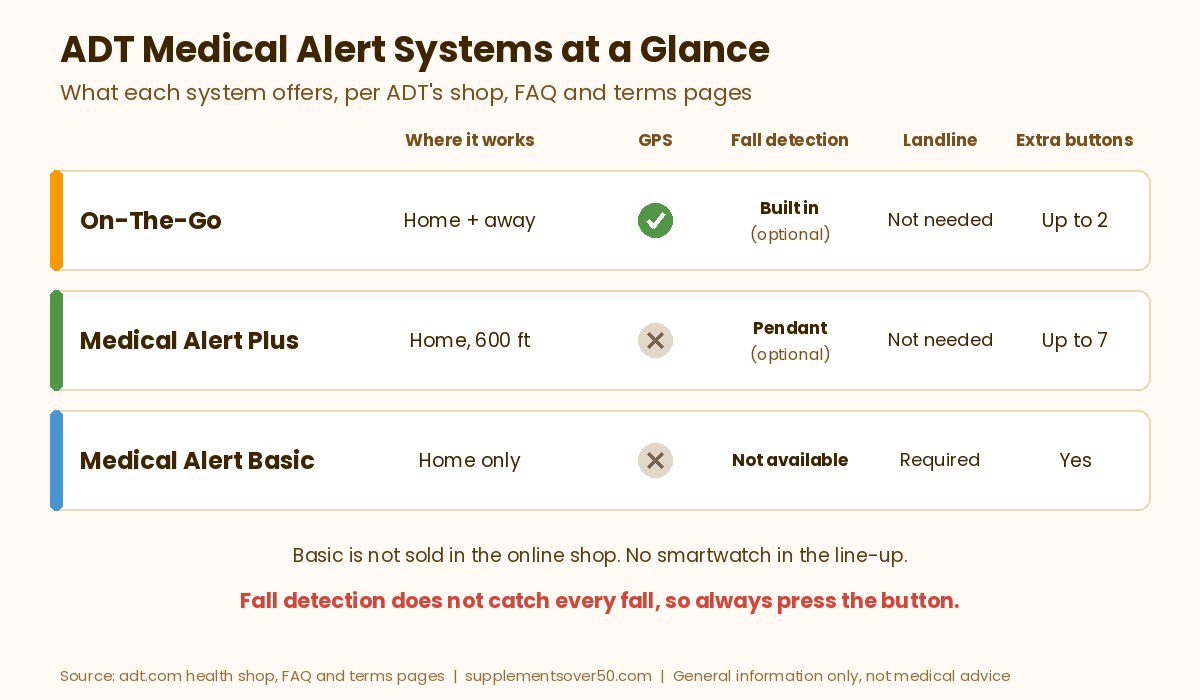
ADT keeps its line-up small. Here is how the three systems compare, using the rates on ADT’s shop and terms pages at the time of writing. Prices and promotions change, so check current pricing before you order.
System
Best for
Where it works
Needs
Monthly rate (monthly billing / prepaid)
On-The-Go
Active adults who leave home
Home and away, cellular and GPS
Cell coverage; daily charging
About $41.99 / $39.99
Medical Alert Plus
Home and yard
Home, up to 600 ft from the base
Wall outlet; no landline needed
About $39.99 / $37.99
Medical Alert Basic
Homes with a landline, no fall detection
Home only
Landline
About $31.99 / $29.99
The prepaid rate is what you get with quarterly or annual billing. Fall detection adds about $11 a month to On-The-Go or Plus. ADT’s pages we opened did not list a battery life for the On-The-Go, so ask the sales agent how often it needs charging before you choose it.
ADT Medical Alert Devices Explained
On-The-Go: Best for Getting Out of the House
The On-The-Go is an all-in-one mobile device. It connects straight to ADT’s monitoring center over cellular and GPS, has a built-in speaker for two-way voice, and comes with a charging cradle and neck lanyard. Because the device itself is the help button, there is no base station to stay near. ADT says you can take it anywhere, and if it is ever misplaced, an ADT representative can help locate it using its built-in GPS.
ADT recently added integrated fall detection inside the device (labeled a new offering on the shop page), so no separate pendant is needed. A separate fall detection pendant is also available. You can pair up to two extra pendants or wristbands, which ADT suggests for wearing overnight or while the main device charges. One quirk: if two active people in the same home both need mobile coverage, ADT recommends buying two On-The-Go devices on two separate orders.
ADT’s terms point out that the On-The-Go relies on cellular coverage and GPS data, and that GPS is not operated by ADT. Location accuracy matters: one Trustpilot reviewer described a fall away from home where the system placed him in his home town instead, so test the device in the places your parent actually goes.
Medical Alert Plus: Best for Home and Yard
Medical Alert Plus is a base station plus a waterproof wristband or neck pendant. ADT lists a range of up to 600 feet from the base, which it describes as twice the coverage area of its Basic system, so it suits someone who gardens or visits a neighbor’s porch. It runs on a cellular connection (ADT’s FAQ says most customers are covered by AT&T LTE), so no landline is needed, and it adds home temperature monitoring.
You talk to the operator through the base, not the button. Fall detection comes as a separate pendant worn around the neck. You can pair up to seven extra accessories, such as more buttons for a spouse or waterproof wall-mount buttons for the bathroom and bedside, which makes Plus the more flexible choice for a couple.
One inconsistency to know about: the tiles on ADT’s main health page list GPS location and mobile coverage for both packages, but the Medical Alert Plus product page and terms describe an in-home system with a range from the base. Treat Plus as a home system and choose On-The-Go if your parent needs help away from home.
Medical Alert Basic: The Landline Option
Medical Alert Basic still appears in ADT’s terms: a landline-based base and button with no fall detection, from about $31.99 a month. It does not have a package page in the online shop, and ADT’s FAQ says the landline unit is for people outside its cellular coverage. It also appears in a discounted offer for existing ADT Security customers. If you need it, call ADT and ask.
BEST FOR A TRUSTED BIG-NAME MONITOR
ADT Medical Alert
In-home and mobile systems with optional fall detection, 24/7 professional monitoring, waterproof help buttons and an included Premium Protection Plan, per ADT.
When the button is pressed, or a fall is detected, the alert goes to an ADT monitoring professional. ADT says its agents are senior-sensitivity trained, and its FAQ claims an average response time of 30 seconds or less from the base stations. Treat that as the brand’s own average, not a guarantee.
The agent speaks through the base or the On-The-Go device. If there is no answer, ADT’s FAQ says the agent calls the primary phone number on file, then follows the member’s instructions, which can mean calling emergency contacts first or sending first responders. There is no limit on emergency contacts, though at least one is required. If the alarm goes off by accident, ADT says you have about 15 seconds to cancel it, and that ADT itself does not charge for false alarms (local authorities may have their own rules).
Two lines from ADT’s terms are worth reading closely. ADT states that its medical alert system is not a medical device, and that ADT is not a 911 emergency medical response service and does not give medical advice. In practice, an operator still dispatches responders, but it is a monitoring service that contacts help on your behalf.
ADT Medical Alert Fall Detection
Fall detection is optional on both On-The-Go and Medical Alert Plus, and ADT’s terms list it at $11 a month (the shop pages show $33 a quarter). On Plus, it comes as a lightweight waterproof pendant worn around the neck. On On-The-Go, it is built into the device.
ADT does not put fall detection in wristbands, and its FAQ explains why: the wrist moves constantly through the day, which raises the risk of false alerts, so ADT keeps fall sensors at the center of the body. That is a sensible choice, but it means your parent has to wear the pendant or device on a lanyard rather than a watch-style band to get automatic alerts.
ADT is clear that fall detection does not detect 100% of falls, and its FAQ says users should always press the help button when they can. That matches every brand we have researched, so treat fall detection as a backup, not a replacement for the button. For a broader look at watch-style and pendant options from other brands, see our guide to the best fall detection devices for seniors living alone.
ADT Medical Alert Cost: What You Really Pay
So what does an ADT medical alert cost? At the time of writing, ADT’s shop pages listed On-The-Go at about $41.99 a month on monthly billing and about $39.99 a month on quarterly or annual billing, and Medical Alert Plus at about $39.99 monthly or $37.99 prepaid. Fall detection adds about $11 a month. Those are the headline rates. The real bill depends on a few other charges:
Activation fee: the shop pages listed $99.00, while ADT’s terms say $99.99. A new-customer promotion (code FREEACT) waives it, along with shipping, but only if you pick quarterly or annual billing.
Prepayment: under that promotion, the first three months are due at purchase on quarterly billing, and the first twelve months on annual billing.
Shipping: free on quarterly and annual plans (ADT values it at $29.99). The product pages say the first charge on other orders includes shipping when applicable.
Extra buttons: an extra pendant or wristband costs $14.99 once plus about $3 a month in monitoring.
Wall-mount buttons: about $2.99 a month each.
Lockbox: $29.99 once, or free with annual billing.
Professional installation: available on request for an extra fee, per the terms. Most people set it up themselves.
Here is what that looks like for the most common choice, On-The-Go with fall detection. On quarterly billing with the promotion, you pay about $152.97 at checkout once the promotion removes the activation fee (three months of monitoring plus three months of fall detection), and roughly $612 for the first year with no activation fee. On monthly billing, the same setup runs about $52.99 a month plus the activation fee, or around $735 for the first year before shipping and taxes. So the promotion saves real money, but only if you are comfortable paying a quarter or a year at a time.
A few things work in ADT’s favor. There is no device purchase fee on the package pages we opened, which sets it apart from rivals that charge $149 or more for a mobile device. And ADT says its Premium Protection Plan is included at no extra cost for active customers. It covers unlimited replacement batteries and repairs or replacements for normal wear and tear, defects and power surges. Accidental drops, spills, or damage from dust, heat or humidity are covered for a $75 deductible per base unit and $15 per accessory, limited to one base and two accessories a year. A lost device is not covered and is charged at full replacement cost.
ADT Medical Alert Contract and Cancellation Terms
ADT’s marketing says there are no long-term contracts and no hidden fees, and its FAQ says you may cancel at any time. ADT’s medical alert terms and conditions back that up on paper: each package “requires a month-to-month agreement” and the terms state “No termination Fees”. Here is what you are actually agreeing to:
Month-to-month service: no multi-year contract, which is very different from many ADT home security agreements.
Prepaid billing for the best rate: the promotional rates require paying three or twelve months up front. The terms pages we opened did not say whether unused prepaid time is refunded if you cancel early, so ask before choosing annual billing.
Equipment stays ADT’s property: the terms state that systems remain the property of ADT, which means you will need to send it back when you cancel. We did not find a published return deadline or non-return fee on the pages we opened, so get the return process in writing.
Prices can change: the terms note that prices are subject to change, and the current new-customer promotion carries an end date.
Coverage limits: digital cellular service is not available everywhere or at all times, per the terms. ADT’s FAQ suggests calling to check coverage at the address first.
The month-to-month structure is genuinely better than the three-month minimum some competitors write into their terms. The gaps are in the details: refund rules for prepaid plans and the equipment return process. Those are also the themes that show up in the complaints below, so settle them on the phone before you pay.
ADT Medical Alert Reviews: What Customers Say
ADT medical alert reviews are harder to pin down than most because the big review profiles mix every ADT service together. Here is what we found on the pages we opened. Ratings change, so treat these as a snapshot.
BBB:ADT Security Services’ BBB profile showed an A rating, BBB accreditation for more than a decade, 2,769 customer reviews, and 10,724 complaints in the last 3 years (3,502 in the last 12 months). That profile covers ADT’s headquarters and corporate-owned locations across all services, and ADT is a very large company, so the totals mostly reflect home security customers.
Trustpilot:ADT USA’s Trustpilot page showed 1.2 out of 5 from about 5,240 reviews, with 90% one-star ratings. Trustpilot notes the company has not invited customers to review recently, which tends to pull scores down, and ADT replies to nearly all negative reviews. Again, almost all of these reviews are about security systems.
ADT’s own site shows quotes about its medical alert line from review partners. We did not count those as independent reviews.
Common complaints: when we filtered Trustpilot for medical alert reviews, only a handful were about the medical alert service. The patterns there were billing problems after cancelling, including one reviewer who said a cancelled fall alert account later went to collections and another who was billed again after returning the system, plus the GPS location issue mentioned above. Across ADT as a whole, the biggest themes were long phone waits and difficulty cancelling.
What works in ADT’s favor: its terms are clearer on cancellation than many rivals (month-to-month, no termination fees), the Premium Protection Plan is included, and the reviews quoted on ADT’s site from its partners praise the GPS on On-The-Go and the reliability of the monitoring. Because public reviews of the medical alert line specifically are thin, we would weigh the terms above more heavily than the overall star ratings.
ADT Medical Alert Pros and Cons
Pros
Month-to-month service with no termination fees, per ADT’s terms
No device purchase fee on the package pages we opened
Premium Protection Plan included, with unlimited battery replacements
On-The-Go has GPS and optional fall detection built into the device
Medical Alert Plus covers up to 600 feet and pairs up to seven extra accessories
Help buttons are waterproof (rated for up to 3 feet for 30 minutes)
Cons
No smartwatch, and only two systems in the online shop
Activation fee of about $99 unless you prepay three or twelve months
Fall detection costs about $11 a month, more than some rivals
Equipment must be returned, and the return and prepaid refund rules are not spelled out on the pages we opened
Very poor Trustpilot rating for ADT overall, mostly driven by billing and cancellation complaints
ADT Medical Alert Alternatives
If ADT is not the right fit, these three companies are worth comparing. Figures come from each brand’s website at the time of writing; check current pricing.
Bay Alarm Medical
Bay Alarm Medical has lower starting rates. Its pricing page listed SOS Home from about $27.95 a month, the SOS All-In-One 2 and SOS Micro from about $34.95, and the SOS Smartwatch from about $39.95, with a 15-day risk-free trial. The catch is equipment: the pricing page showed a $149 device purchase for the All-In-One 2 and Micro and $199 for the Smartwatch (before discounts). Choose it if you want a smartwatch or the lowest monthly rate for a home system.
BEST FOR LOWER MONTHLY RATES
Bay Alarm Medical
In-home and GPS devices including a medical alert smartwatch, optional fall detection and a 15-day risk-free trial, per the brand.
LifeFone leads on policies. Its homepage lists a 30-day money-back guarantee, no activation or equipment fees, a lifetime price guarantee, free coverage for a spouse, cancellation at any time paying only for the time used, and automatic fall detection for just $5 more a month. Choose it if fall detection is a must or you want the lowest-risk way to try a medical alert.
BEST FOR FRIENDLY POLICIES
LifeFone
Home and mobile medical alerts with a 30-day money-back guarantee, no activation or equipment fees and low-cost optional fall detection, per the brand.
MedicalAlert offers a home system, mobile systems and a smartwatch, with the Medical Alert Connect app included on all of them. Its homepage says systems start at about $29.95 a month, the home system covers up to 800 feet, and its response center can use a translation line covering 140 languages. Promotional pricing applies to the first billing cycle only, so check the regular rate. Choose it if you want a smartwatch and a family app from one company.
BEST FOR APP AND SMARTWATCH
MedicalAlert
Home, mobile and smartwatch systems with optional fall detection and a caregiver app included with every system, per the brand.
People who want a smartwatch. ADT only offers pendants, wristbands and the On-The-Go device.
Anyone who will not wear or charge a device. A button on the nightstand cannot help, and the On-The-Go needs regular charging. A home system with wall buttons is safer for them.
Homes with weak cell coverage. Check coverage first; the landline Basic system is the fallback.
People with advanced memory loss. Someone who forgets what the button is for may need in-person care or other monitoring.
Anyone expecting fall prevention. A medical alert summons help. Strength and balance work, a medication review and removing tripping hazards still matter most.
If your parent has already fallen, talk to their doctor about fall risk. CDC notes that falls can cause serious head injuries, especially in people taking blood thinners, so an older adult who falls and hits their head should see a doctor right away.
Frequently Asked Questions
Are ADT medical alert reviews good?
They are mixed and hard to separate from ADT’s security business. ADT Security Services had an A rating on the BBB, while ADT USA had 1.2 out of 5 on Trustpilot from about 5,240 reviews, almost all about home security. The few medical alert reviews we found focused on billing after cancellation and GPS location problems.
How much does an ADT medical alert cost per month?
At the time of writing, On-The-Go was about $41.99 a month on monthly billing or $39.99 on quarterly or annual billing, and Medical Alert Plus was about $39.99 or $37.99. Fall detection adds about $11 a month, and there is an activation fee of about $99 unless a promotion waives it. Check current pricing on ADT’s site.
Does ADT medical alert have fall detection?
Yes, as an optional add-on for On-The-Go and Medical Alert Plus, about $11 a month per ADT’s terms. On-The-Go has it built into the device, while Plus uses a separate pendant worn around the neck. ADT says fall detection does not detect 100% of falls, so the wearer should still press the button when possible.
Does ADT have a medical alert watch?
No. ADT does not currently sell a medical alert smartwatch. Its help buttons come as a neck pendant or wristband, and fall detection is not offered in wristbands. If a watch matters, Bay Alarm Medical and MedicalAlert both sell one.
Is there a contract with ADT medical alert?
ADT’s terms describe a month-to-month agreement with no termination fees, and its FAQ says you can cancel at any time. However, the best rates require prepaying three or twelve months, and the equipment remains ADT’s property, so ask how prepaid refunds and device returns work before you buy.
Does Medicare pay for an ADT medical alert?
ADT’s FAQ says it has government and insurance funding options, but its representatives cannot tell you whether you qualify. You apply through your insurance, and if approved, your case worker contacts ADT. You can start on self-pay and switch once approval comes through.
Our Take
An ADT medical alert is a solid, no-frills choice. The On-The-Go is the one most families should consider, thanks to GPS and fall detection built into a single device, and Medical Alert Plus is a good home system with a long 600-foot range. We like that ADT’s terms are month-to-month with no termination fees and that there is no device purchase fee or separate protection plan to pay for. The weak spots are a short line-up with no smartwatch, an activation fee unless you prepay, and public reviews that point to billing friction when people cancel. If you choose ADT, prepay quarterly rather than annually until you are sure it fits, keep written confirmation of any cancellation, and ship the equipment back with tracking. If those trade-offs bother you, LifeFone and Bay Alarm Medical are the first alternatives we would price out.
This article is for general information only and is not medical advice. Medical alert systems do not prevent falls, and fall detection does not detect every fall. Prices and plan terms were taken from each brand’s website at the time of writing and may change. Talk to a doctor about fall risk and call 911 in an emergency.
Fall detection for seniors living alone: compare Apple Watch SE 3, Galaxy Watch9, help buttons and medical alert services, plus fees, range and battery tips.
Home blood pressure monitor picks for adults over 50: upper arm OMRON, iHealth and Alcedo models compared on cuff size, display, memory and accuracy tips.
Sleep tracker for seniors picks: Apple Watch SE 3, Fitbit, Oura and RingConn compared on comfort, battery, subscriptions and what trackers cannot tell you.
Jabra Enhance hearing aids reviewed: Select M1, M2 and M3 vs Pro 30 and Plus, OTC vs prescription, remote audiology, trial, warranty, pricing and where to buy.
Best Buy hearing aids explained: which OTC models it carries, its 60-day hearing aid return policy, what in-store help to expect, and the picks worth buying.