Best Blood Pressure Monitors for Home Use Over 50
This guide contains affiliate links. If you buy through them, we may earn a small commission at no extra cost to you.
A good home blood pressure monitor turns one rushed reading at the doctor’s office into a real picture of your blood pressure, week after week. After 50 that matters more than ever, because blood pressure tends to creep up with age and usually gives no warning signs. The good news: the right monitor is not expensive, not complicated, and takes about a minute a day to use.
This guide covers devices only. We compared five upper arm monitors on the things that make home readings useful: a cuff that fits, a screen you can read, memory you can bring to appointments and an honest look at what each listing says about accuracy. Product details come from the Amazon listings, and the advice on choosing and using a monitor comes from the American Heart Association and the National Institute on Aging.
Table of Contents
Home Blood Pressure Monitor: Quick Comparison
| Monitor | Best for | Cuff fits arms | Memory and app |
|---|---|---|---|
| OMRON Bronze | Best overall, simple daily use | 9 to 17 inches | 14 readings on the monitor; unlimited in OMRON connect app |
| OMRON Platinum | AFib screening and two users | 9 to 17 inches | 100 readings each for 2 users; app; AC adapter included |
| OMRON Silver | Step-up with more memory | 9 to 17 inches | 30 readings; app; easy-wrap ComFit cuff |
| iHealth Track | Color-coded, easy-read screen | 8.7 to 16.5 inches | 99 readings on the monitor; unlimited in iHealth app |
| Alcedo Upper Arm Monitor | Voice readout for low vision | 8.7 to 16.5 inches | 120 readings each for 2 users; averages 3 readings |
Why Home Blood Pressure Checks Matter More After 50
The National Institute on Aging explains that blood vessels change with age: arteries get stiffer, and that pushes blood pressure up, even in people with heart-healthy habits who feel fine. High blood pressure affects nearly half of all adults, and many do not know they have it, because it often causes no signs you can see or feel. The chance of having it rises as you get older, and NIA notes that women are more likely to have high blood pressure after menopause.
The most common type in older adults is isolated systolic hypertension, where the top number is 130 or higher but the bottom number stays under 80. NIA links it to lightheadedness when standing up too fast and to falls, as well as heart disease, stroke and kidney problems when it is not controlled.
Popular Supplement Guides:


What home monitoring adds
The American Heart Association recommends home monitoring for everyone with high blood pressure, so their healthcare professional can see whether treatment is working. It is especially useful when you are starting or changing treatment, and it can also help confirm a diagnosis. NIA adds that if your reading is high at two or more check-ups, your doctor may ask you to measure at home. One thing the AHA is clear about: home readings do not replace doctor visits, and you should never stop blood pressure medicine based on your home numbers without talking to your healthcare professional.
What to Look for in a Home Blood Pressure Monitor
- Upper arm, not wrist. The AHA recommends an automatic, cuff-style upper arm (biceps) monitor. It says wrist and finger monitors are not recommended because they give less reliable readings. Every pick in this guide is an upper arm model.
- Validated for accuracy. Choose a validated monitor. The AHA suggests asking your healthcare professional or pharmacist, or checking validatebp.org, the US validated device listing. It also says to make sure a monitor is validated for seniors when buying for an older adult. We tell you below what each listing says.
- The right cuff size. The AHA says a cuff in the wrong size will give an inaccurate reading. Measure around your upper arm with a tape measure and make sure it falls inside the cuff range listed for the monitor.
- A screen you can read. Big digits, a backlight, color coding or a voice readout help if your eyesight is not what it was.
- Memory and sharing. The AHA suggests taking your monitor to appointments if it stores readings. An app that keeps a full history and makes a report for your doctor is a bonus.
- Two users. If you and a partner both check, a two-user model keeps your readings apart.
Top Picks for the Best Home Blood Pressure Monitor
1. OMRON Bronze Upper Arm Monitor (Best Overall)
For most people over 50, this is the monitor we would buy first. It is a straightforward upper arm model, and the Amazon listing highlights it as clinically validated. The wide-range D-ring cuff fits arms from 9 to 17 inches, which covers a lot of adults, and it checks for heartbeat irregularities during each reading so you can raise anything unusual with your doctor. A Hypertension Indicator flags when your reading is elevated.
The monitor itself stores 14 readings, which is enough for a week of twice-daily checks. For a full history, it connects by Bluetooth to the free OMRON connect app, which stores unlimited readings, tracks trends, shares reports with your doctor and works with Apple Health and Google Fit. It comes with a storage case and four AA batteries. It has more than 8,100 ratings with a 4.5 rating, the highest of the OMRON models we checked, and it is shipped and sold by Amazon.
2. OMRON Platinum Upper Arm Monitor (Best for AFib Screening and Two Users)
The Platinum is the most feature-rich OMRON in this guide. Its standout is OMRON’s AFib detection, which the listing says screens for unusual heart rhythms every time you check your blood pressure, helping you and your doctor decide if further evaluation is needed. It is a screening feature, not a diagnosis, so share any alert with your doctor rather than acting on it yourself.
It stores up to 100 readings each for two users, which suits couples, and a High Morning Average Indicator flags morning blood pressure that runs high. It connects to the OMRON connect app, uses the same 9 to 17 inch D-ring cuff, and is the only pick here that includes an AC adapter in the box, so you are not always replacing batteries. One honest note: its rating is lower than the Bronze, at 4.2 from more than 4,300 ratings, so pick it for the AFib screening and two-user memory rather than as a default. It is shipped and sold by Amazon.
3. OMRON Silver Upper Arm Monitor (Best Step-Up for More Memory)
The Silver sits between the Bronze and the Platinum. It keeps the core features you want: irregular heartbeat detection, Hypertension Indicator alerts and the OMRON connect app for unlimited readings and doctor reports. The listing highlights it as clinically validated.
The two differences from the Bronze are memory, with up to 30 readings stored on the monitor, and the easy-wrap ComFit cuff, which also fits arms from 9 to 17 inches. If you prefer not to rely on your phone and want a couple of weeks of readings on the device itself, this is the upgrade. It has more than 5,300 ratings with a 4.3 rating, and it is shipped and sold by Amazon.
4. iHealth Track Smart Upper Arm Monitor (Best Easy-Read Display)
The iHealth Track is the most reviewed monitor in this guide by a wide margin, with more than 69,000 ratings and a 4.4 rating. Its large, backlit display uses oversized numbers and green, yellow and red color coding, so you can tell at a glance whether a reading is in range. Two buttons run the whole thing, and the listing says no calibration is needed.
It stores 99 readings on the monitor and unlimited readings in the free iHealth app for iPhone and Android. It warns you with a symbol if it picks up a heart rhythm disturbance during a reading. The listing says the monitor meets ESH 2010 performance standards, and the wide-range cuff fits upper arms from 8.7 to 16.5 inches. It runs on four AAA batteries and comes with a 12-month warranty. It is sold by iHealthLabs and ships from Amazon.
5. Alcedo Upper Arm Monitor (Best Voice Readout for Low Vision)
If small numbers are hard to read, a monitor that speaks your result is a real help. This Alcedo model announces your blood pressure out loud with an adjustable volume, and it has a clear LCD screen. One button starts a reading, and the listing says it automatically averages three values for a more precise result. It also shows symbols if the cuff is not positioned well or if you move during the reading, which lines up with the AHA’s advice to sit still.
It stores 120 readings each for two users, and the cuff fits arms from 8.7 to 16.5 inches. It has more than 27,000 ratings with a 4.5 rating, and it is sold by Alcedo Health and ships from Amazon. Unlike the OMRON listings, this listing does not say whether the monitor has been clinically validated, so check validatebp.org or ask your pharmacist before you rely on it, and compare it with your doctor’s reading at your next visit.
Why the Withings BPM Connect Is Not on This List
The Withings BPM Connect was on our starting shortlist. It is an upper arm model with Wi-Fi and Bluetooth syncing and a rechargeable battery, but when we checked, its Amazon rating was 4.0, lower than every pick above, so we left it out.
How to Choose the Best Home Blood Pressure Monitor
- If you want one simple, well-rated monitor, pick the OMRON Bronze.
- If you want AFib screening or share the monitor with a partner, pick the OMRON Platinum.
- If you want more readings on the device without using an app, pick the OMRON Silver or the iHealth Track.
- If you struggle to read small screens, pick the iHealth Track for its color-coded display or the Alcedo for its voice readout.
- If your arm measures outside 9 to 17 inches, do not guess. Ask your pharmacist about a monitor with the right cuff size, because the AHA says the wrong size gives inaccurate readings.
A monitor tells you where you stand. If you are also looking at diet and supplements, our guides to the best heart health supplements for seniors, magnesium for heart health and blood pressure after 50 and the heart health supplement stack for seniors cover the evidence. Bring your home readings to your doctor before adding anything new.
How to Get an Accurate Reading at Home
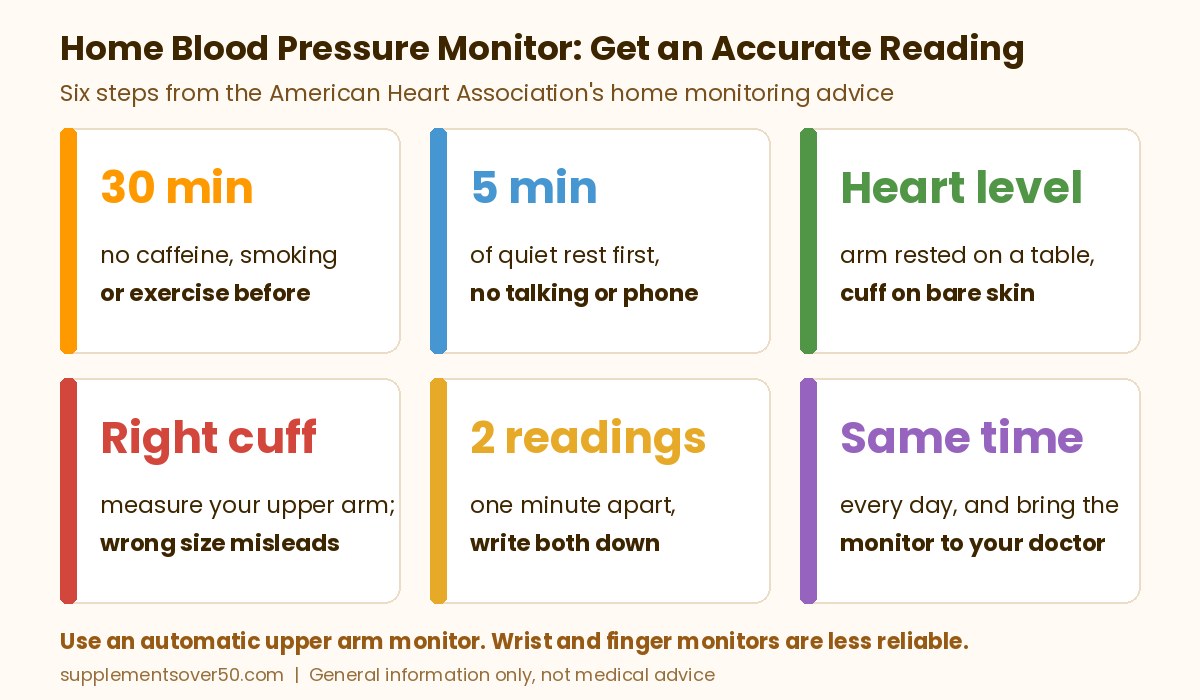
A good monitor still gives a bad number if you use it the wrong way. These steps come straight from the AHA’s home monitoring guidance:
- Plan ahead. No smoking, caffeine or exercise for 30 minutes before. Empty your bladder.
- Bare arm. Do not measure over clothing. Either arm is fine; there is usually not a big difference.
- Rest and be still. Sit quietly for at least five minutes first. Do not talk or use the phone.
- Sit correctly. Rest your arm on a flat surface at heart level, using a pillow if needed. The bottom of the cuff goes just above the bend of the elbow.
- Same time every day. Measure at the same time each day, and ask your healthcare professional how often.
- Two readings, one minute apart. Record both each time, or let the monitor’s memory and app store them.
Before You Buy: Check It With Your Doctor
The AHA’s advice is to take your new monitor to your next appointment. Your healthcare professional can check that you are using it correctly, that the cuff fits, and that it gives the same results as the office equipment. Plan to bring it in about once a year, or as the manufacturer directs, to make sure it stays accurate.
When to call your doctor
According to the AHA, a single high reading is not an immediate cause for alarm. Take a second reading, write both down and check with your healthcare professional. If your readings are suddenly higher than 180/120, wait at least one minute and test again; if they are still that high, contact your healthcare professional immediately. If your reading is higher than 180/120 and you have chest pain, shortness of breath, back pain, numbness, weakness, a change in vision or difficulty speaking, call 911. Do not wait to see if it comes down on its own.
- Best Medication Reminder Devices for Seniors
- Best Sleep Trackers for Adults Over 50
- Best Gifts for Aging Parents: Thoughtful Picks for Health and Peace of Mind
Frequently Asked Questions
What is the best home blood pressure monitor for seniors?
For most people over 50, we like the OMRON Bronze: an upper arm monitor with a 9 to 17 inch cuff, irregular heartbeat detection and a free app, and the Amazon listing highlights it as clinically validated. If small numbers are hard to read, the iHealth Track’s color-coded screen or the Alcedo’s voice readout may be easier.
Are wrist blood pressure monitors accurate?
The American Heart Association recommends an automatic upper arm cuff monitor and says wrist and finger monitors are not recommended because they give less reliable readings. That is why every pick in this guide is an upper arm model.
What cuff size do I need?
Measure around the middle of your upper arm and choose a monitor whose cuff range includes that number. The AHA says a cuff in the wrong size gives an inaccurate reading. The OMRON picks fit 9 to 17 inches and the iHealth and Alcedo fit 8.7 to 16.5 inches.
When is the best time to check blood pressure at home?
The AHA says to measure at the same time every day. Avoid caffeine, smoking and exercise for 30 minutes before, rest quietly for five minutes, and take two readings one minute apart. Ask your healthcare professional how often you should check.
How do I know if my home monitor is accurate?
Choose a validated monitor, then take it to your next appointment so your healthcare professional can compare it with the office equipment and check your technique. The AHA suggests bringing it in about once a year, or as the manufacturer directs.
What blood pressure reading is an emergency?
The AHA says that if your reading is suddenly above 180/120, wait one minute and test again, and contact your healthcare professional immediately if it stays that high. If it is above 180/120 and you have chest pain, shortness of breath, back pain, numbness, weakness, vision changes or trouble speaking, call 911.
Our Take
The best home blood pressure monitor is an upper arm model with a cuff that fits you and a screen you will actually read. For most adults over 50, the OMRON Bronze Upper Arm Blood Pressure Monitor is our top pick: it is simple, well rated, highlighted as clinically validated on its listing and easy to share with your doctor through the app. Step up to the Platinum for AFib screening and two users, or choose the iHealth Track or Alcedo if reading the screen is the hard part. Whichever you pick, measure the same way every day and bring it to your next appointment.
This article is for general information only and is not medical advice. A home blood pressure monitor does not replace regular check-ups. Do not start, stop or change blood pressure medication based on home readings without talking to your healthcare professional.