If you take a blood thinner, the supplements health agencies flag most often are: (1) vitamin K, which can change how warfarin works, (2) St. John’s wort, which can weaken warfarin and may interact with apixaban (Eliquis) and rivaroxaban (Xarelto), (3) ginkgo and garlic, linked to extra bleeding, (4) high-dose vitamin E and high-dose fish oil, (5) nattokinase and dong quai, and (6) CoQ10, turmeric, ginger, cranberry and ginseng, where evidence is mixed but caution is advised. What to do: never stop or change your blood thinner on your own, keep vitamin K intake steady if you take warfarin, and show your pharmacist every bottle before you start anything new.
If you take a medicine to prevent blood clots, knowing the supplements to avoid with blood thinners can protect you from two very different problems: bleeding that is harder to stop, and clots that your medicine was supposed to prevent. Blood thinners are among the most common prescriptions for adults over 60, often for atrial fibrillation, a past clot in the leg or lung, a heart valve, or after a stent. Many of the same people also take fish oil, vitamin E, turmeric or a “heart health” blend.
This guide explains which supplements health agencies and researchers flag, why each one matters, and what to ask your pharmacist. It is meant to help you have a better conversation with your care team. It is not a reason to stop or change any medicine on your own.
Table of Contents
Why Blood Thinners and Supplements Are a Risky Mix After 60
“Blood thinner” is a common name for two groups of medicines. Anticoagulants slow the clotting process itself. They include warfarin (Coumadin, Jantoven) and the newer direct oral anticoagulants, often called DOACs, such as apixaban (Eliquis) and rivaroxaban (Xarelto). Antiplatelet medicines, such as aspirin and clopidogrel, stop platelets from clumping together. Some people take one of each.
Age matters here. The MedlinePlus warfarin page notes that people over 65 have a higher chance of bleeding while taking warfarin, and that bleeding is also more likely at higher doses or with long-term use. Older adults are also more likely to take several medicines and several supplements at once, which raises the odds of an interaction.
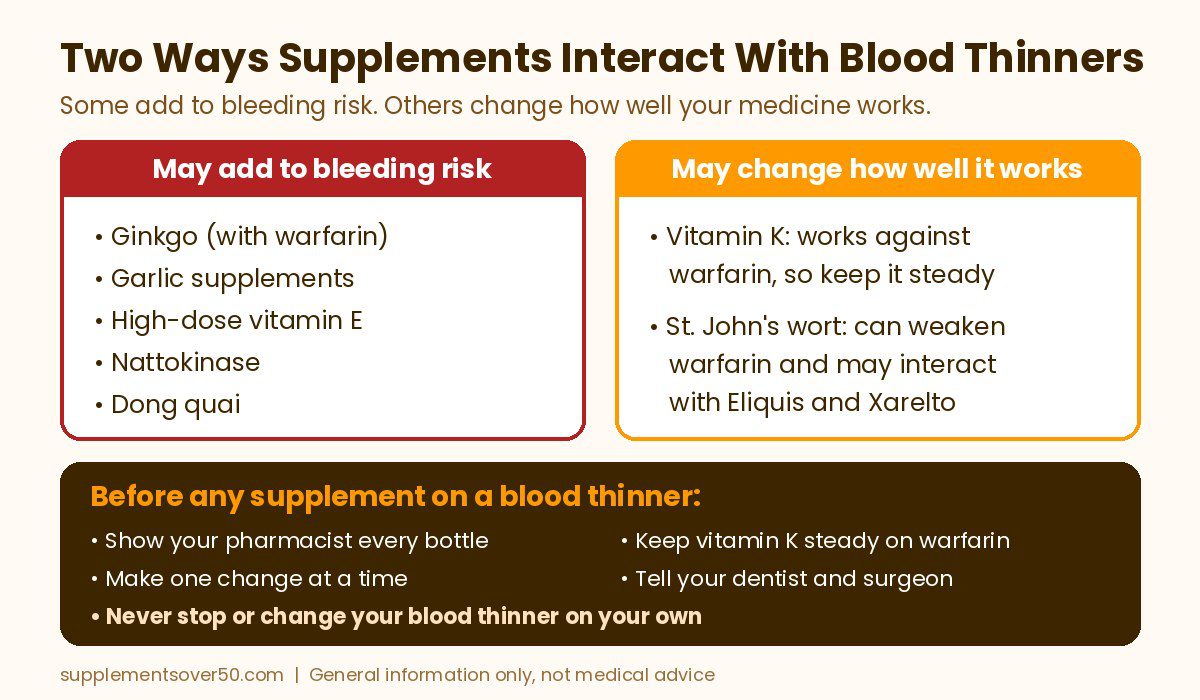
Adding to the bleeding effect. Some products, such as ginkgo, garlic and high-dose vitamin E, may affect clotting or platelets on their own. Stacked on top of a blood thinner, that can raise bleeding risk.
Changing how much medicine is working. Vitamin K works against warfarin, and St. John’s wort can lower the levels of several medicines in your body. That can leave you less protected against clots, which is the opposite of what most people expect.
Warfarin and the DOACs also differ. Warfarin is checked with a regular blood test called the INR, and it is sensitive to vitamin K in food and supplements. The MedlinePlus apixaban page, by contrast, says to continue your normal diet unless your doctor tells you otherwise. Both still interact with certain herbs and medicines, so neither group is “supplement proof”.
What the Research Says About Supplements to Avoid With Blood Thinners
The evidence is uneven, and honest guides should say so. A review of dietary supplements and bleeding, published in 2022 in the Baylor University Medical Center Proceedings, looked at popular herbal and dietary supplements. The authors found that garlic was strongly associated with surgical bleeding even without blood thinners. In people taking anticoagulants, ginkgo, turmeric, chamomile, glucosamine-chondroitin, melatonin and several other products were associated with bleeding risk, mostly based on case reports rather than large trials.
The same review placed fish oil in the group with no clinical link to bleeding in randomized trials, and called the evidence for St. John’s wort, ginger, ginkgo and cranberry conflicting. The authors concluded that doctors need to know about supplement use and that it is best to stop nonessential supplements two weeks before surgery, with your surgeon’s guidance.
Government sources lean cautious. The NCCIH summary of herb-drug interactions says taking ginkgo with warfarin is associated with a higher risk of major bleeding than warfarin alone, and lists documented interactions between St. John’s wort and warfarin. The MedlinePlus warfarin page names coenzyme Q10, echinacea, garlic, ginkgo, ginseng, goldenseal and St. John’s wort as nonprescription or herbal products that may interact with warfarin.
Put simply: some interactions are well documented, others rest on case reports, and a few look smaller than once feared. Because a serious bleed or a clot can be life-changing, the safe default is to treat every supplement as something your pharmacist should review.
Supplements to Avoid With Blood Thinners: Summary Table
This table pulls together what the sources in this guide say. It is not a complete list, and your own risk depends on which medicine you take, your dose, your kidney and liver function, and everything else on your list.
Supplement
Possible interaction
What to do
Vitamin K (including K2 and many multivitamins)
Works against warfarin; sudden changes can cause bleeding or clots
On warfarin, keep intake steady; ask before starting or stopping any product with vitamin K
St. John’s wort
Can weaken warfarin; MedlinePlus lists it as an interaction for apixaban and rivaroxaban
Avoid unless your prescriber approves
Ginkgo
Linked to a higher risk of major bleeding with warfarin
Avoid unless your prescriber approves
Garlic supplements
May increase bleeding risk, especially with anticoagulants or aspirin
Ask first; tell your surgeon before any procedure
Vitamin E (high dose)
Can increase bleeding risk with anticoagulant or antiplatelet medicines
Avoid high-dose products unless approved
Fish oil / omega-3 (high dose)
NIH says high doses may cause bleeding problems with warfarin; trials have been more reassuring
Ask about your dose; do not add high-dose products on your own
Nattokinase
May increase bleeding with blood thinners
Do not take with an anticoagulant; never use it as a replacement
Dong quai
May add to the effect of warfarin
Avoid unless your prescriber approves
CoQ10
Listed by MedlinePlus as possibly interacting with warfarin
Ask before starting or stopping; your INR may need checking
Turmeric / curcumin, ginger
Case reports of bleeding or raised INR with blood thinners; evidence mixed
Ask first, especially for concentrated extracts
Cranberry
Conflicting evidence on an interaction with warfarin
Ask before using supplements or large amounts of juice
The Main Supplements to Avoid With Blood Thinners, Explained
1. Vitamin K (Warfarin Users)
Vitamin K helps your blood clot, and warfarin works by blocking that process. The NIH Office of Dietary Supplements vitamin K fact sheet says vitamin K can have a serious interaction with warfarin, and that if you take warfarin, the amount of vitamin K you get from food and supplements should be about the same every day. A sudden change can cause dangerous bleeding if you get less, or blood clots if you get more.
The key word is consistency, not avoidance. The MedlinePlus warfarin page also advises eating consistent amounts of vitamin K foods from week to week and not eating large amounts of leafy green vegetables. Check your multivitamin and any bone or heart formula, since vitamin K1 or K2 often appears there. If you are curious about K2 for bones, our Best Vitamin K2 Supplement for Seniors guide covers the forms, but on warfarin the decision belongs to your prescriber.
2. St. John’s Wort
St. John’s wort is the clearest example of a supplement that can make a blood thinner less effective. The NCCIH St. John’s wort page says it can interact in dangerous, sometimes life-threatening ways with many medicines and can weaken their effects, and it lists warfarin among them. The NCCIH interaction summary explains why: it is a potent inducer of liver enzymes and a gut transporter that help clear drugs from the body.
This also applies to the newer blood thinners. The MedlinePlus apixaban page lists St. John’s wort, aspirin and NSAIDs as products that may interact with apixaban, and the MedlinePlus rivaroxaban page names St. John’s wort as well. Weaker anticoagulation can mean a higher risk of stroke or clots, so do not use it without your prescriber’s approval.
3. Ginkgo
Ginkgo is often sold for memory. According to the NCCIH interaction summary, taking ginkgo with warfarin is associated with an increased risk of major bleeding compared with warfarin alone. NCCIH also notes there is no conclusive evidence that ginkgo helps any health condition, so for most people on a blood thinner the trade-off is easy to judge.
4. Garlic Supplements
Cooking with garlic is not the concern here. The NCCIH garlic page says garlic supplements may increase the risk of bleeding and that it is especially important to tell your providers if you take anticoagulants or aspirin or are going to have surgery. The bleeding review above also found garlic strongly associated with surgical bleeding.
5. High-Dose Vitamin E
The NIH vitamin E fact sheet says high doses of vitamin E supplements might increase the risk of bleeding and of bleeding in the brain, and that vitamin E can increase bleeding risk in people taking anticoagulant or antiplatelet medicines such as warfarin. The adult upper limit for supplements is 1,000 mg a day, but on a blood thinner, ask before taking any separate vitamin E product.
6. Fish Oil and Omega-3s
This is the one most readers ask about. The NIH omega-3 fact sheet says high doses of omega-3s may cause bleeding problems when taken with warfarin or other anticoagulants. On the other hand, the 2022 bleeding review cited trials, including one with more than 25,000 participants, that found no excess bleeding risk with fish oil, and a cohort study that found no interaction with warfarin.
So fish oil may be less risky than its reputation suggests, but dose and your full medicine list still matter. If you already take fish oil, do not stop or double it without asking. Our Best Fish Oil for Seniors guide explains EPA, DHA and forms for people who get the go-ahead.
7. Nattokinase
Nattokinase is an enzyme from fermented soybeans that is marketed for circulation. The Memorial Sloan Kettering nattokinase profile says it may increase the risk of bleeding when used with blood-thinning drugs and advises against taking it with an anticoagulant. It also describes a case in which a patient replaced warfarin with nattokinase for a long period and developed a clot that required repeat valve surgery. Nattokinase is not a substitute for a prescribed blood thinner.
8. Dong Quai
Dong quai is a traditional herb often sold for menopause symptoms. The Memorial Sloan Kettering dong quai profile says it may increase the risk of bleeding and may have an additive effect with anticoagulants, and it advises talking with your provider if you take warfarin.
9. CoQ10, Turmeric, Ginger and Cranberry
These four sit in a gray zone. MedlinePlus lists coenzyme Q10 among products that may interact with warfarin, so starting or stopping it may call for an extra INR check. Our Best CoQ10 Supplements for Seniors guide explains why many people over 60 take it, often alongside a statin.
For turmeric, the bleeding review describes case reports of a raised INR or bleeding in people on warfarin, while trials found no effect on platelet function. Ginger appears in a case report of fatal bleeding alongside cinnamon in a patient taking dabigatran, though the overall evidence is conflicting. NCCIH says the evidence on cranberry and warfarin is also conflicting. If you rely on turmeric for joints, as many readers of our Best Turmeric Supplement for Seniors guide do, ask your pharmacist whether it fits your plan.
What to Do Instead: A Safer Plan With Your Pharmacist
Avoiding risky products is only part of the answer. These habits come straight from the MedlinePlus drug pages and NIH guidance:
Keep a written list. MedlinePlus advises keeping a list of every prescription, over-the-counter medicine, vitamin, mineral and supplement you take, and carrying it with you in case of emergencies.
Use one pharmacy if you can, and ask the pharmacist to check each new product against your blood thinner before you buy it.
Keep vitamin K steady on warfarin. Aim for a similar amount from week to week rather than cutting out greens.
Make one change at a time, and only after your prescriber agrees, so any shift in your INR or symptoms can be traced.
Choose single-ingredient products. Heart, joint, memory and menopause blends often combine several of the herbs above.
Tell every doctor and dentist about your blood thinner and supplements before surgery or dental work.
Questions to Ask Your Pharmacist
Does this supplement interact with my blood thinner or my other medicines?
Could it raise my bleeding risk or make my medicine less effective?
If I take warfarin, will I need an extra INR test after starting or stopping it?
Is the dose on this label different from what was studied?
Is there a safer option for what I am trying to treat?
When to See a Doctor
Never stop, skip or change the dose of a blood thinner on your own. The MedlinePlus apixaban page warns that stopping it can raise your risk of stroke or a blood clot. Call your prescriber or pharmacist before you start or stop any supplement, including one you have taken for years.
MedlinePlus lists warning signs to report to your doctor right away while taking warfarin, including bleeding that will not stop, nosebleeds, bleeding gums, easy bruising, pink, red or dark brown urine, red or black tarry stools, coughing or vomiting blood or material that looks like coffee grounds, headache, dizziness or weakness. If you have sudden weakness on one side, trouble speaking, chest pain, trouble breathing, or a fall with a head injury, call emergency services.
Frequently Asked Questions
What supplements should you avoid with blood thinners?
Health agencies most often flag vitamin K (for warfarin users), St. John’s wort, ginkgo, garlic supplements, high-dose vitamin E, high-dose fish oil, nattokinase and dong quai. CoQ10, turmeric, ginger and cranberry have mixed evidence but are worth checking. Ask your pharmacist about every product you take.
Can I take fish oil with Eliquis or warfarin?
Sometimes, with your prescriber’s approval. NIH says high doses of omega-3s may cause bleeding problems with warfarin or other anticoagulants, while several large trials found no extra bleeding with fish oil. Your dose and other medicines matter, so ask before starting, stopping or increasing it.
Does vitamin K affect Eliquis or Xarelto?
Vitamin K is mainly a concern for warfarin, where your intake should stay about the same every day. The MedlinePlus apixaban page says to continue your normal diet unless your doctor tells you otherwise. Still check any supplement with your pharmacist, since other products can interact with these medicines.
Is turmeric safe with blood thinners?
The evidence is mixed. A review found case reports of a raised INR or bleeding with turmeric in people on warfarin, while trials found no effect on platelets. Concentrated extracts are different from turmeric in cooking, so ask your pharmacist before taking a turmeric or curcumin supplement.
Can I take a multivitamin while on blood thinners?
Often yes, but check the label. Many multivitamins contain vitamin K and vitamin E. If you take warfarin, a steady daily multivitamin may be fine, but starting or stopping one can change your INR, so tell your prescriber first.
Should I stop my supplements before surgery if I take a blood thinner?
Ask your surgeon. A review of supplements and bleeding suggested stopping nonessential supplements about two weeks before surgery. Your blood thinner itself should only be paused or changed on your doctor’s specific instructions.
Our Take
Most of the supplements to avoid with blood thinners fall into two groups: products that may add to bleeding, such as ginkgo, garlic, high-dose vitamin E and nattokinase, and products that change how well your medicine works, such as vitamin K with warfarin and St. John’s wort, which can weaken warfarin and may interact with Eliquis and Xarelto. The evidence is stronger for some than others, but the safe approach is the same for all of them. Keep your list up to date, keep vitamin K steady if you take warfarin, check every new bottle with your pharmacist, and never stop a blood thinner because of a supplement.
This article is for informational purposes only and is not medical advice. Interactions depend on your specific blood thinner, dose, other medicines and health conditions. Talk to your doctor or pharmacist before starting or stopping any supplement, and never change your blood thinner without medical guidance.
The best cholesterol supplements for seniors: plant sterols, psyllium, berberine and fish oil, what each can do for LDL or triglycerides, and key drug interactions.
Which supplements to lower blood pressure have real evidence after 50? Garlic, magnesium and beetroot nitrate compared, plus DASH, drug interactions and safety.
Red yeast rice benefits and side effects explained for adults over 50: how monacolin K mirrors lovastatin, what the LDL research shows, citrinin risk and who should avoid it.
Looking for the best beetroot supplement? We compare 5 picks for seniors and explain nitrate dose, blood pressure evidence, mouthwash and safety cautions.
Do lymphatic drainage supplements work? An honest look at cleavers, dandelion and horse chestnut for swelling after 50, when to see a doctor, and what helps.
Home blood pressure monitor picks for adults over 50: upper arm OMRON, iHealth and Alcedo models compared on cuff size, display, memory and accuracy tips.