This guide contains affiliate links. If you buy through them, we may earn a small commission at no extra cost to you.
⚡ Quick Answer
There is little to no human research showing that herbal “lymphatic drainage” blends with cleavers, red root, burdock or dandelion move lymph or reduce swelling. Leg swelling after 50 often has a cause worth checking, such as vein problems, heart or kidney disease, medicines or lymphedema. What has better support is movement, leg elevation, compression and, for lymphedema, therapy from a trained specialist. If you want to try a product, consider: (1) Nature’s Way Horse Chestnut Extract, best supplement option for achy, swollen legs from vein problems (the evidence is modest but real), (2) CHARMKING 15-20 mmHg Compression Socks, best everyday non-supplement step for mild swelling, and (3) MaryRuth’s Organic Lymphatic Support Drops, the most popular lymphatic blend, with weak evidence behind it.
Lymphatic drainage supplements are everywhere right now. Social media is full of drops and capsules that promise to “de-puff,” reduce bloating and help your lymph flow, and many of these products are aimed at women and men over 50 who notice swollen ankles, puffy legs or a heavy, tired feeling by the end of the day.
It is a fair question to ask whether any of them work. The short answer is that the herbs in most lymphatic blends have almost no human research behind them for swelling. Swelling after 50 is also something to understand, not just treat, because it can be a sign of a heart, kidney, vein or lymph problem. This guide explains what your lymphatic system does, what the evidence says about popular ingredients, when swelling needs a doctor, and the approaches that have better support.
Table of Contents
Why Swelling and Lymphatic Drainage Matter After 50
Your lymphatic system is a network of thin vessels, lymph nodes and organs that runs alongside your blood vessels. According to the NHS overview of lymphoedema, its main jobs are helping fight infection and draining excess fluid from your tissues. The fluid it carries, called lymph, contains white blood cells that defend against germs. Unlike your blood, which the heart pumps, lymph has no central pump. It moves mainly because your muscles squeeze the vessels as you move and breathe.
That is one reason swelling becomes more common with age. The MedlinePlus guide to foot, leg and ankle swelling notes that painless swelling of the feet and ankles is a common problem, especially among older people. Less activity, more time sitting, extra weight, weaker vein valves and certain medicines all make it easier for fluid to pool in the lower legs, where gravity pulls it.
Swelling after 50 can have many causes, and most of them have nothing to do with a “sluggish” lymphatic system that needs a detox. Common ones include:
Venous insufficiency. The MedlinePlus page on venous insufficiency explains that this happens when vein walls weaken and valves are damaged, so blood pools in the legs. Age is a risk factor, along with family history, being female, past blood clots and long periods of sitting or standing. It can cause aching, heaviness, itching, swelling and skin changes.
Heart, kidney or liver disease. MedlinePlus notes that swollen legs may be a sign of heart failure, kidney failure or liver failure, when there is too much fluid in the body and it collects in the legs.
Medicines. Calcium channel blockers for blood pressure, NSAID pain relievers, steroids, hormones such as estrogen and testosterone, and some antidepressants can all cause leg swelling.
Lymphedema. This is true lymphatic swelling. MedlinePlus lists causes such as infection, cancer, and scar tissue from radiation or surgical removal of lymph nodes. After 50, it most often follows treatment for cancers such as breast cancer, or surgery or radiation involving lymph nodes in the groin or pelvis.
Blood clots, infection or injury. These usually cause swelling in one leg and need prompt medical attention.
Do Lymphatic Drainage Supplements Actually Work?
Most products sold as lymphatic drainage supplements are herbal blends. Common ingredients include cleavers (Galium aparine), red root, burdock root, dandelion, echinacea, calendula and various other traditional herbs. They are usually sold as liquid drops or capsules, often with proprietary blends that do not show how much of each herb you get.
Here is the honest problem: these herbs have a long history of traditional use, but there is little to no clinical research in people showing that they improve lymph flow or reduce swelling. We found no published clinical trials testing cleavers or red root for lymphatic drainage in people. The research that does exist on these plants is mostly lab work or studies of other uses.
The government’s own summaries reflect this. The NCCIH dandelion page says very little research exists on dandelion and there is no compelling scientific evidence supporting its use for any health condition. It also notes dandelion might, in theory, interact with water pills, diabetes medicines and blood thinners. For echinacea, a common ingredient in lymphatic blends, NCCIH says many studies have looked at colds, but it is unclear whether echinacea helps other health conditions, and some people have allergic reactions to it, which may be severe.
Many lymphatic products are also marketed for “bloating” or “de-puffing.” Some herbs, like dandelion, are traditionally considered mild diuretics, meaning they may make you pass more urine. That is not the same as improving lymph drainage, and for an older adult on blood pressure or heart medicines, an unpredictable water-pill effect is not a good thing.
Horse Chestnut Seed Extract: A Better-Studied Option for Vein-Related Swelling
If your swelling comes from vein problems rather than the lymph system, horse chestnut seed extract has noticeably better evidence. The National Center for Complementary and Integrative Health (NCCIH) explains it is promoted for chronic venous insufficiency, which can lead to leg pain, swelling and itching. A Cochrane review of 17 randomized trials found that the extract improved leg pain, leg volume and other signs and symptoms compared with placebo, and one trial suggested it may work about as well as compression stockings. Side effects were usually mild and infrequent.
There are important caveats. The reviewers called for larger, more rigorous trials. NCCIH says standardized extracts are likely safe for short-term use and have been used safely in studies for up to 12 weeks, but the raw seeds, bark, flowers and leaves are unsafe to take by mouth because they contain a toxic component. Side effects can include dizziness, digestive upset, headache and itching. And horse chestnut has not been shown to treat lymphedema or swelling caused by heart or kidney disease.
What Has Better Evidence Than a Bottle
For most people over 50 with mild, both-sided ankle swelling, simple daily habits are the first-line approach. The MedlinePlus swelling guide and the NHS lymphoedema pages agree on most of these:
Move your legs often. Walking, ankle circles and calf raises use your muscles to pump fluid back toward your heart. On long trips, take breaks to stand up and move around.
Elevate your legs. Lying down with your legs propped on pillows above heart level helps fluid drain.
Wear compression. Support stockings or socks gently squeeze the legs to help move blood and fluid upward. MedlinePlus lists compression stockings as a self-care step for venous insufficiency.
Cut back on salt. A lower-salt diet may reduce fluid buildup.
Avoid tight bands around the thighs and lose weight if you need to.
Review your medicines with your doctor. Never stop a medicine you suspect is causing swelling without talking to your provider first.
For diagnosed lymphedema, the picture is different. The NHS lymphoedema treatment guidance says the recommended treatment is decongestive lymphatic therapy. It combines compression bandages or garments, skin care, tailored exercise and a specialized massage called manual lymphatic drainage, usually done by a trained therapist. You are then taught simpler self-massage to keep swelling down. This is not something a supplement can replace, and it starts with a referral from your doctor or cancer team.
Lymphatic Drainage Supplements: Claims vs Evidence
Approach
What it claims
What the evidence shows
Evidence strength
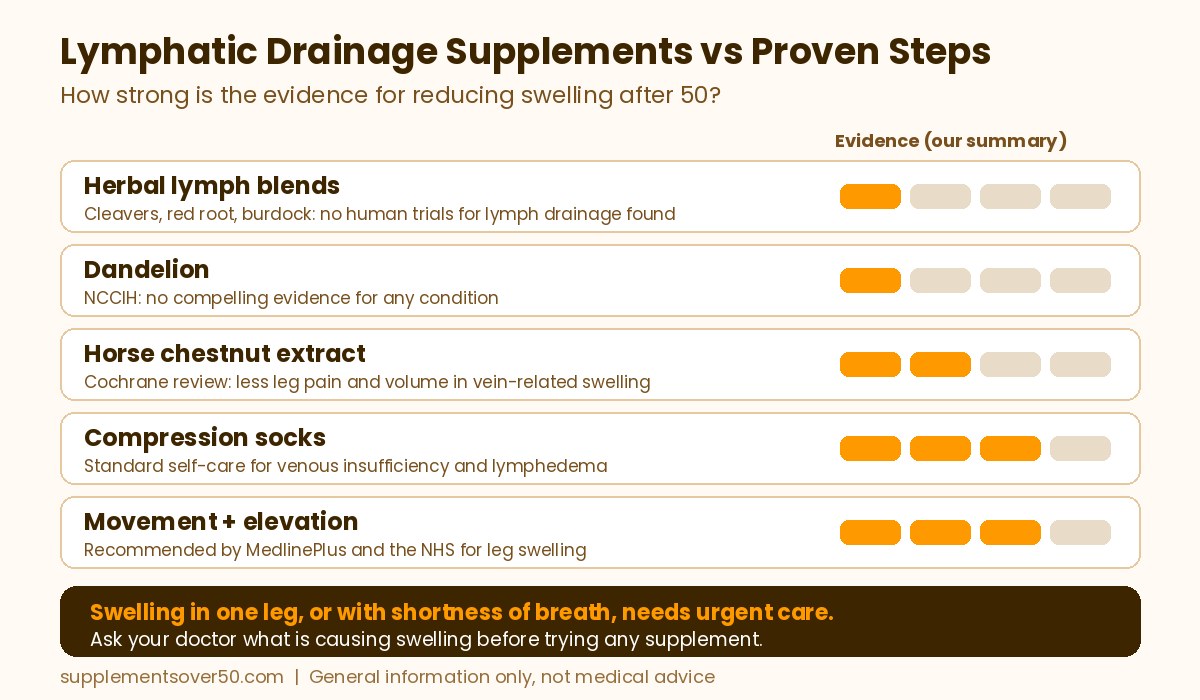
Herbal lymphatic blends (cleavers, red root, burdock)
Improve lymph flow, reduce puffiness
Traditional use; no clinical trials in people for lymph drainage that we could find
Very weak
Dandelion
Detox, de-bloat
No compelling evidence for any condition (NCCIH); may interact with water pills
Very weak
Horse chestnut seed extract
Supports healthy leg veins
Improved leg pain and volume in vein-related swelling in a Cochrane review
Moderate, short-term
Compression stockings or socks
Reduce leg swelling
Standard self-care for venous insufficiency and part of lymphedema treatment
Good
Movement and elevation
Help fluid drain
Recommended by MedlinePlus and the NHS for swelling and lymphedema
Good
Manual lymphatic drainage by a trained therapist
Move fluid out of swollen limbs
Part of the recommended lymphedema treatment (NHS)
Good, as part of a program
What to Look for in Lymphatic Drainage Supplements
If you still want to try a supplement, use these checks before you buy:
A clear reason for the swelling. Get it checked first. A supplement chosen for the wrong cause is wasted at best.
Ingredients with human data. Horse chestnut seed extract standardized to aescin has the most research for vein-related leg swelling. Most lymphatic herbs have little or none.
Disclosed amounts. Proprietary blends hide how much of each herb is in a dose, which makes it hard to judge safety.
Standardized horse chestnut only. Never use raw horse chestnut seeds, bark or leaves.
Diuretic herbs and your medicines. Dandelion and similar herbs may stack with water pills or affect other drugs. Ask your pharmacist.
Allergy risk. Echinacea and dandelion belong to the same plant family as ragweed and daisies, so take care if you have those allergies.
Realistic promises. Be wary of labels promising detox, rapid de-puffing or weight loss.
Lymphatic Drainage Supplements: Quick Comparison
Product
Best for
Key details
Daily dose
Nature’s Way Horse Chestnut Extract
Achy, swollen legs from vein problems
250 mg seed extract standardized to 20% aescin (50 mg) per capsule, vegan, Non-GMO Project Verified
1 capsule twice daily
CHARMKING Compression Socks 15-20 mmHg
Everyday mild swelling, travel, long hours standing
Top Picks If You Want to Try Lymphatic Drainage Supplements
We chose these based on evidence first and popularity second. Only one is a supplement with meaningful human research, one is not a supplement at all, and one is the best-selling lymphatic blend, included so you know exactly what you are getting. None of them treats lymphedema, heart failure or kidney disease.
1. Nature’s Way Horse Chestnut Extract (Best Evidence-Friendlier Supplement)
Nature’s Way provides 250 mg of horse chestnut seed extract (Aesculus hippocastanum) per capsule, standardized to 20% aescin, which works out to 50 mg of aescin per serving. The brand positions it for healthy leg veins and circulation. It is vegan, gluten-free and Non-GMO Project Verified, with no artificial colors or flavors.
The label directions are one capsule twice daily with food or water. This is the pick to consider if a doctor has told you your swelling is related to your veins, since that is where the research is. Studies have generally lasted up to 12 weeks, so check in with your doctor if you plan to use it longer, and stop if you notice dizziness, stomach upset, headache or itching.
🏆 Best Evidence-Friendlier Supplement
Nature’s Way Horse Chestnut Extract, 90 Capsules
250 mg seed extract with 50 mg aescin per capsule. Vegan, Non-GMO Project Verified.
Compression is one of the best-supported everyday steps for leg swelling, so it earns a place here even though it is not a pill. These knee-high CHARMKING socks offer 15-20 mmHg graduated compression, a level the brand pitches for everyday wear, travel and long hours on your feet. The pack includes 8 pairs, and the brand says the fabric is a breathable, high-stretch nylon blend.
Use the brand’s size chart and measure your calves for a proper fit; socks that are too tight can dig in. Higher-strength, medical-grade garments for lymphedema or venous ulcers should be fitted by a professional. The NHS notes compression may not be suitable for people with arterial problems in their legs, so ask your doctor first if you have peripheral artery disease, diabetes with poor foot sensation, or skin wounds on your legs.
🧦 Best Non-Supplement Option
CHARMKING Compression Socks for Women and Men, 15-20 mmHg (8 Pairs)
Knee-high graduated compression for everyday wear, travel and long hours standing.
3. MaryRuth’s Organic Lymphatic Support Drops (Most Popular Lymphatic Blend, Weak Evidence)
MaryRuth’s is one of the best-selling lymphatic products on Amazon. It is a liquid herbal blend that the brand says uses traditionally used herbs, including organic echinacea root, elderberry, plantain leaf, blue vervain, yarrow, myrrh and thyme. It is USDA Organic, vegan, alcohol-free and sugar-free, and the directions are 1 mL (30 drops) one to three times a day, by mouth or in water or juice.
Be clear about what you are buying. The formula is a proprietary blend, so the amount of each herb is not listed, and there are no clinical trials showing this or similar blends improve lymph drainage or reduce swelling. NCCIH notes echinacea can cause allergic reactions, which may be severe. If you enjoy herbal drops and your doctor is comfortable with it, it is unlikely to replace anything that works, but do not expect it to fix swelling.
🌿 Most Popular Blend (Weak Evidence)
MaryRuth’s Organic Lymphatic Support Liquid Drops
Organic herbal blend in alcohol-free drops. Popular, but not backed by clinical trials for swelling.
How to Choose Lymphatic Drainage Supplements or Alternatives
If both ankles swell mildly by evening and go down overnight, start with movement, elevation, less salt and compression socks. Mention it at your next checkup.
If a doctor says you have vein-related swelling or varicose veins, compression is the base, and horse chestnut seed extract is the supplement with the most evidence to ask about.
If you have had cancer surgery or radiation and an arm or leg is swelling, skip supplements and ask your cancer team for a lymphedema specialist referral.
If you have heart or kidney disease, do not add herbal blends or diuretic herbs without your doctor’s okay. Swelling may mean your treatment needs adjusting.
If you just like the idea of a lymphatic blend, choose one that lists its ingredients, check it against your medicines, and keep expectations low.
Call 911 or your local emergency number if swelling comes with shortness of breath or chest pain, especially pressure or tightness.
Contact your provider right away if you have new or worsened swelling in only one leg, which can be a sign of a blood clot.
Contact your provider right away if a swollen leg is red or warm to the touch, or you have a fever, which can mean infection such as cellulitis.
Contact your provider right away if you have heart disease or kidney disease and the swelling gets worse, or you have liver disease and new swelling in your legs or belly.
Book an appointment if swelling is sudden, keeps getting worse, does not improve with self-care, or appears in an arm or leg after cancer treatment.
Your doctor may check your heart, lungs, lymph nodes and legs, and may order blood tests, a urine test or an ultrasound of the leg veins. Treatment depends on the cause, which is exactly why a supplement should never be the first step.
Frequently Asked Questions
Do lymphatic drainage supplements really work?
There is little human evidence that herbal lymphatic blends with cleavers, red root, burdock or dandelion improve lymph flow or reduce swelling. Horse chestnut seed extract has better evidence, but only for leg swelling and pain from vein problems.
What is the best supplement for swollen ankles after 50?
There is no single best supplement, because the cause matters. For vein-related swelling, standardized horse chestnut seed extract has the most research. For swelling from heart, kidney or liver disease or from medicines, treatment needs to come from your doctor.
Can lymphatic drainage supplements help lymphedema after breast cancer?
No supplement has been shown to treat lymphedema. The recommended treatment is decongestive lymphatic therapy, which combines compression, skin care, exercise and manual lymphatic drainage by a trained therapist. Ask your cancer team for a referral.
Are lymphatic drainage supplements safe for seniors?
Many have not been well studied for safety. Herbs like dandelion may interact with water pills, diabetes medicines and blood thinners, and echinacea can cause allergic reactions. Check with your pharmacist, especially if you take several medicines.
Is horse chestnut safe to take?
Standardized horse chestnut seed extract is likely safe for short-term use and has been used in studies for up to 12 weeks. Raw horse chestnut seeds, bark, flowers and leaves are unsafe to eat. Side effects can include dizziness, stomach upset, headache and itching.
When is leg swelling an emergency?
Call 911 if swelling comes with shortness of breath or chest pain. Contact your doctor right away for new swelling in only one leg, a leg that is red, warm or painful, a fever, or worsening swelling if you have heart, kidney or liver disease.
Our Take
Most lymphatic drainage supplements promise far more than the research supports. The herbal blends filling social feeds have traditional use behind them but almost no human trials for lymph flow or swelling. Horse chestnut seed extract is the one supplement with real, if modest, evidence, and only for vein-related leg swelling. For most adults over 50, the better plan is to find out why you are swelling, then lean on what works: regular movement, elevation, less salt, well-fitted compression and, for lymphedema, care from a trained therapist. Sudden, one-sided or breathless swelling is never a supplement problem. Get it checked.
This article is for informational purposes only and is not medical advice. Talk to your doctor or pharmacist before starting any supplement, especially if you have heart, kidney or liver disease, have had cancer treatment, or take prescription medicines.
Thoughtful Thanksgiving gifts for seniors: hostess gifts to bring to dinner, cozy picks for cold November nights, keepsakes that keep family close and easy ideas for grandparents who cannot travel.
Discover the best joint supplement stack for seniors to reduce stiffness, improve mobility, and support healthy cartilage. Boost your active lifestyle today!