Best Cortisol Supplement for Women Over 50: An Honest Evidence Check
This guide contains affiliate links. If you buy through them, we may earn a small commission at no extra cost to you.
Search for the best cortisol supplement for women over 50 and you will find hundreds of bottles promising to lower cortisol, flatten a “cortisol belly” and give you your sleep back. The category has exploded on Amazon and social media, and women in perimenopause and menopause are its main target. That makes sense: this is the stage of life when sleep gets choppy, stress feels harder to shake off and weight starts settling around the middle.
The marketing has run well ahead of the science, though. This guide explains what cortisol actually does, why stress and sleep shift around menopause, what the research says about the ingredients these products contain, and the red flags to watch for. Then we cover the five options we would consider, described strictly by what their Amazon listings say.
Table of Contents
Why Stress and Cortisol Feel Different After 50
Cortisol is a hormone made by your adrenal glands. It is not a villain. It helps you wake up, keeps blood sugar and blood pressure steady, and rises when you face a challenge so you can respond. In a healthy rhythm it is highest in the morning and drops toward night, which helps you wind down for sleep.
Several things around menopause can make that system feel off balance:
Popular Supplement Guides:
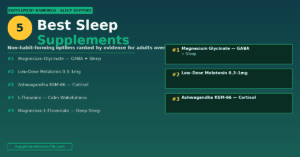

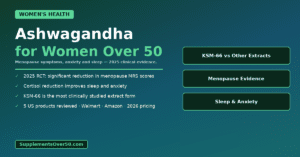


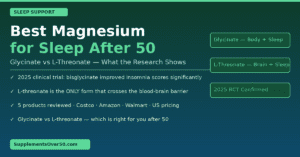
- Broken sleep. Hot flashes and night sweats wake many women repeatedly. Poor sleep makes the next day feel more stressful, and stress in turn makes sleep harder. It is a loop that is easy to fall into.
- Falling estrogen. Hormone changes during the transition can affect mood, anxiety and how resilient you feel, independent of what is going on in your life.
- Midlife load. Many women over 50 are juggling work, aging parents, adult children and their own health at the same time.
- Weight shifting to the middle. Lower estrogen and aging change where the body stores fat. That shift happens whether or not your cortisol is high, which is why blaming a “cortisol belly” can be misleading.
Truly abnormal cortisol is a medical issue. Cushing’s syndrome (too much cortisol) and adrenal insufficiency (too little) are diagnosed with blood, saliva or urine tests and treated by a doctor, not with an over-the-counter blend. “Adrenal fatigue”, a term you will see on many labels, is not a recognized medical diagnosis.
Does a Cortisol Supplement Actually Work?
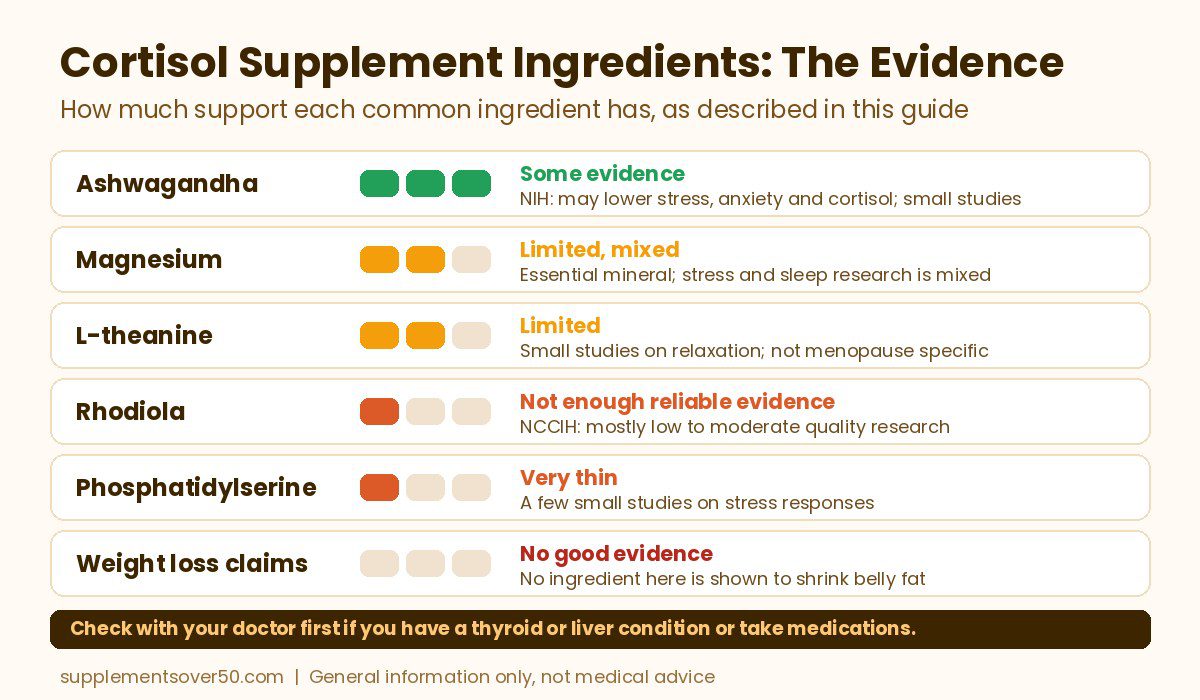
Here is the honest answer: a few of the ingredients in these products have some research behind them for stress, anxiety or sleep. None of them has good evidence for weight loss, and no product should be expected to reliably lower your cortisol. The research is mostly small, short-term studies using specific extracts and doses, which may not match what is in a given bottle.
Ashwagandha. This is the strongest of the group. According to the NIH Office of Dietary Supplements ashwagandha fact sheet, research suggests ashwagandha extracts may lower stress, anxiety and cortisol levels, and a small number of studies suggest it may improve aspects of sleep, especially in people with insomnia. The same fact sheet points out that studies have used different preparations and doses, which makes firm recommendations difficult. It appears well tolerated for up to about 3 months, but long-term safety is not known.
Rhodiola. Rhodiola is promoted for stress, energy and mood, but the National Center for Complementary and Integrative Health (NCCIH) page on rhodiola says there is not enough reliable evidence to determine whether it is useful for any health purpose, and most human research is low to moderate quality. NCCIH describes it as possibly safe for up to 12 weeks.
Magnesium. Magnesium is an essential mineral, and many adults do not get enough from food. Research on magnesium specifically for stress and sleep is limited and mixed. If you take it, the NIH magnesium fact sheet sets the upper limit for supplemental magnesium at 350 mg a day for adults.
L-theanine. This amino acid from tea is popular for calm focus. Small studies suggest it may help some people feel more relaxed, but the evidence is limited and not specific to menopause.
Phosphatidylserine. It appears in many cortisol blends. A few small studies have looked at it for stress responses, but the research is too thin to rely on.
Red Flags in Cortisol Supplement Marketing
- Weight-loss promises. Claims that a pill will shrink belly fat by lowering cortisol are not supported by good evidence.
- “Clinically proven to lower cortisol.” Studies on single ingredients do not prove that a 16-ingredient blend works.
- Proprietary blends. If a label hides the amount of each ingredient, you cannot compare doses with the research.
- “Adrenal fatigue” or “adrenal reset” language. These are marketing terms, not diagnoses.
- Before-and-after photos and quick fixes. Sleep, movement and stress management do more heavy lifting than any capsule.
What to Look for in a Cortisol Supplement After 50
- Ingredients with at least some research. Ashwagandha has the most. Magnesium and L-theanine are lower-risk options with limited evidence.
- Clear doses. Prefer labels that list each ingredient amount. A named extract such as KSM-66 tells you which ashwagandha preparation you are getting.
- Fewer ingredients if you take medications. Every extra herb is another possible interaction. A single ingredient is easier to judge and easier to stop if it does not suit you.
- No duplicate stacking. Many sleep, menopause and “hormone balance” products already contain ashwagandha or magnesium. Add up everything you take.
- Third-party testing claims. Supplements are not FDA approved. Independent testing is a useful quality signal, though it does not prove a product works.
- A short trial with a clear goal. Decide what you want to improve, such as falling asleep faster, and reassess after a few weeks.
Best Cortisol Supplement for Women Over 50: Quick Comparison
| Product | Best for | Key details | Daily dose |
|---|---|---|---|
| StrongVit Cortisol Supplement | All-in-one blend | 16-ingredient formula with ashwagandha, L-theanine, phosphatidylserine, magnesium glycinate, rhodiola, holy basil, GABA; brand says third-party tested | 2 capsules |
| Integrative Therapeutics Cortisol Manager | Simpler blend | Ashwagandha and L-theanine; free of gluten, wheat and dairy; 30 tablets | See label |
| Nutricost KSM-66 Ashwagandha | Single ingredient | 600 mg KSM-66 root extract per serving; 5% withanolides; BioPerine; 60 servings | 1 capsule (600 mg) |
| Sports Research L-Theanine | Daytime calm | 200 mg Suntheanine L-theanine; once-daily softgel; non-GMO, gluten and soy free | 1 softgel |
| Pure Encapsulations Magnesium (Glycinate) | Evening wind-down | Magnesium glycinate; free from common allergens, artificial ingredients and GMOs; Amazon Best Seller | See label |
Top Picks for the Best Cortisol Supplement for Women Over 50
1. StrongVit Cortisol Supplement (Best-Selling All-in-One Blend)
This is one of the top-selling products for a cortisol supplement search on Amazon US right now, with more than 9,000 bought in the past month at the time of writing. StrongVit calls it a 16-in-1 formula. The listing names ashwagandha, L-theanine, phosphatidylserine and magnesium glycinate, plus lion’s mane, holy basil, rhodiola, GABA and a mix of minerals. The brand claims it helps manage cortisol and supports sleep and stress relief. Those are brand claims, and the blend as a whole has not been shown to do that.
The serving is 2 capsules a day for a 30-day supply. StrongVit says it is third-party tested by Swift Laboratory and is GMO free and gluten free. The trade-off with any 16-ingredient formula is that it is hard to know which ingredient you are reacting to, and more herbs mean more chances of an interaction. It suits women who want one bottle, are not on regular medications, and are happy to check the label for the amount of each ingredient.
2. Integrative Therapeutics Cortisol Manager (Best Simpler Blend)
Cortisol Manager is one of the most-bought products in this category, with over 20,000 bought in the past month and more than 11,000 ratings. Integrative Therapeutics is a practitioner-focused brand that has been around for more than 25 years. The listing highlights two key ingredients, ashwagandha and L-theanine, and says it supports balanced cortisol levels, relaxation and restful sleep during stress with ongoing use.
A shorter ingredient list makes it easier to judge than a 16-in-1 blend. The tablets contain no gluten, wheat or dairy according to the brand, and the bottle holds 30 tablets, so check the label for the serving size and full ingredient amounts. Its 4.2-star rating is a little lower than the others here, so it may not suit everyone.
3. Nutricost KSM-66 Ashwagandha 600 mg (Best Single Ingredient)
If you want to try the ingredient with the most research, a plain ashwagandha is a cleaner choice than a blend. Nutricost provides 600 mg of KSM-66 ashwagandha root extract per capsule, standardized to 5% withanolides (30 mg per capsule), with 60 servings per bottle. KSM-66 is a named root extract, so you know which preparation you are getting.
It also includes BioPerine (black pepper extract) for absorption and is made in an NSF certified, GMP compliant facility, according to the listing. Remember the NIH guidance: ashwagandha appears well tolerated for about 3 months, but long-term safety is unknown, and it may affect thyroid and liver function. A short trial with your doctor’s okay is the sensible approach.
4. Sports Research L-Theanine 200 mg (Best for Daytime Calm)
For women whose stress shows up as a racing mind during the day, L-theanine is a gentler place to start than an herbal blend. Sports Research uses 200 mg of Suntheanine, a patented form of L-theanine, in a once-daily liquid softgel. The brand says it supports relaxation, calm and focus without the jitters of caffeine.
The softgels are made with organic coconut oil and are non-GMO verified, gluten free and soy free, manufactured in the USA in cGMP-compliant facilities according to the listing. Evidence for L-theanine is limited, so treat it as something to try, not a treatment. It is one of the more popular single-ingredient options, with over 15,000 ratings.
5. Pure Encapsulations Magnesium (Glycinate) (Best Gentle Evening Option)
Many cortisol blends lean on magnesium, so taking it on its own is a simple, low-risk alternative. Pure Encapsulations Magnesium (Glycinate) carries an Amazon Best Seller badge and has more than 53,000 ratings. The listing says magnesium glycinate may help support the sleep cycle and a sense of relaxation by increasing your total daily magnesium intake.
It is free from common allergens, artificial ingredients and GMOs according to the brand. Check the label for the elemental magnesium per capsule and keep your total from supplements under 350 mg a day, including any magnesium in a multivitamin or a cortisol blend.
How to Choose the Best Cortisol Supplement for Women Over 50
- If you want one bottle and take no regular medications, pick StrongVit, and read the label for each ingredient amount.
- If you prefer fewer ingredients from an established brand, pick Integrative Therapeutics Cortisol Manager.
- If you want the most researched ingredient on its own, pick Nutricost KSM-66 Ashwagandha, for a short trial.
- If stress feels worst during the day, pick Sports Research L-Theanine.
- If you have a thyroid or liver condition, or want the gentlest option, skip ashwagandha and start with Pure Encapsulations Magnesium (Glycinate) after checking with your doctor.
Do not stack a blend with a separate ashwagandha or magnesium unless your doctor agrees. For deeper reviews of single ingredients, see our guides to the best ashwagandha for women over 60 and the best ashwagandha supplement for seniors. Our best rhodiola rosea supplement for seniors covers rhodiola, and the best magnesium for women over 50 compares magnesium forms and doses.
Who Should Avoid Cortisol Supplements
Talk to your doctor or pharmacist before taking any cortisol supplement, and be especially careful in these situations:
- Thyroid conditions. The NIH notes that ashwagandha might affect thyroid function. If you take thyroid medication or have a thyroid disorder, ask first.
- Liver concerns. There are a few reports of serious side effects with ashwagandha, including effects on liver function. Avoid it if you have liver disease, and stop and see a doctor if you notice yellowing skin or eyes, dark urine or unusual tiredness.
- Prescription medications. Ashwagandha may interact with some medications. Rhodiola has a reported interaction with losartan, a blood pressure drug, according to NCCIH. Be cautious with blends if you take several medications.
- Sedatives and sleep medications. Ashwagandha can cause drowsiness, and many blends include calming ingredients such as GABA. Combining them with sleeping pills, anti-anxiety medicines or alcohol may add to the effect.
- Kidney disease. Do not take magnesium supplements without medical advice.
See a doctor rather than self-treating if you have signs that could point to a real cortisol problem, such as rapid weight gain around the middle and face, easy bruising, wide purple stretch marks, new high blood pressure or muscle weakness. The same goes for persistent anxiety, low mood or insomnia: these are common in menopause and very treatable, and options such as hormone therapy, cognitive behavioral therapy for insomnia or other medications may help more than a supplement.
Frequently Asked Questions
Do cortisol supplements help with menopause belly fat?
There is no good evidence that cortisol supplements cause weight loss or reduce belly fat. Midlife weight gain around the middle is driven largely by lower estrogen, aging, sleep and activity levels. Be wary of any product that promises to shrink a cortisol belly.
What is the best supplement to lower cortisol in women over 50?
Ashwagandha has the most research. The NIH says extracts may lower stress, anxiety and cortisol, but studies are small and used different doses. It is not right for everyone, especially women with thyroid or liver conditions, so ask your doctor first.
How long does it take for a cortisol supplement to work?
There is no fixed timeline, and results vary by ingredient and person. If you try a supplement, give it a few weeks with a clear goal, such as falling asleep faster, and stop if you notice no benefit or any side effects. The NIH notes ashwagandha appears well tolerated for up to about 3 months, but its long-term safety is unknown.
Can I take a cortisol supplement with hormone therapy?
Possibly, but check with your doctor or pharmacist first. Blends contain many herbs, and some may interact with medications. A single ingredient is easier to evaluate alongside hormone therapy.
Is it safe to take ashwagandha every day after 50?
The NIH says ashwagandha appears well tolerated for up to about 3 months, but long-term safety is not known. Mild side effects include loose stools, nausea and drowsiness. Rare reports involve liver problems, and it may affect thyroid function.
How do I know if my cortisol is actually high?
Only testing can tell you. A doctor can order blood, saliva or urine tests if your symptoms suggest a cortisol disorder. Feeling stressed or tired does not mean your cortisol is abnormal, and online quizzes cannot diagnose it.
Our Take
No pill can promise lower cortisol or a flatter stomach, and the best cortisol supplement for women over 50 is the one that matches the evidence and your health. If you want to try something, a single, well-labeled ingredient such as KSM-66 ashwagandha, L-theanine or magnesium glycinate is easier to judge than a 16-ingredient blend. StrongVit and Cortisol Manager are the popular blends if you prefer one bottle. Pair any of them with the basics that matter more: regular sleep and wake times, managing hot flashes, daily movement, and help for anxiety or low mood when you need it.
This article is for informational purposes only and is not medical advice. Talk to your doctor before starting any new supplement, especially if you have a thyroid or liver condition, kidney disease, or take prescription medications such as thyroid, blood pressure, sleep or anti-anxiety medicines.