Best Magnesium for Women Over 50: 5 Picks for Sleep, Cramps and Bones
This guide contains affiliate links. If you buy through them, we may earn a small commission at no extra cost to you.
Finding the best magnesium for women over 50 often starts during perimenopause or the first few years after your last period. Sleep gets lighter, calf cramps show up at 3 a.m., your mood feels shorter-fused than it used to, and somewhere in the background your doctor starts talking about bone density. Magnesium comes up in almost every conversation about this stage of life.
The shelf is crowded, with glycinate, citrate, oxide, threonate and blends at doses from tiny to too much. Here is what changes after 50, what the evidence supports, and the five products we would shortlist.
Table of Contents
Why Magnesium Needs Change for Women After 50
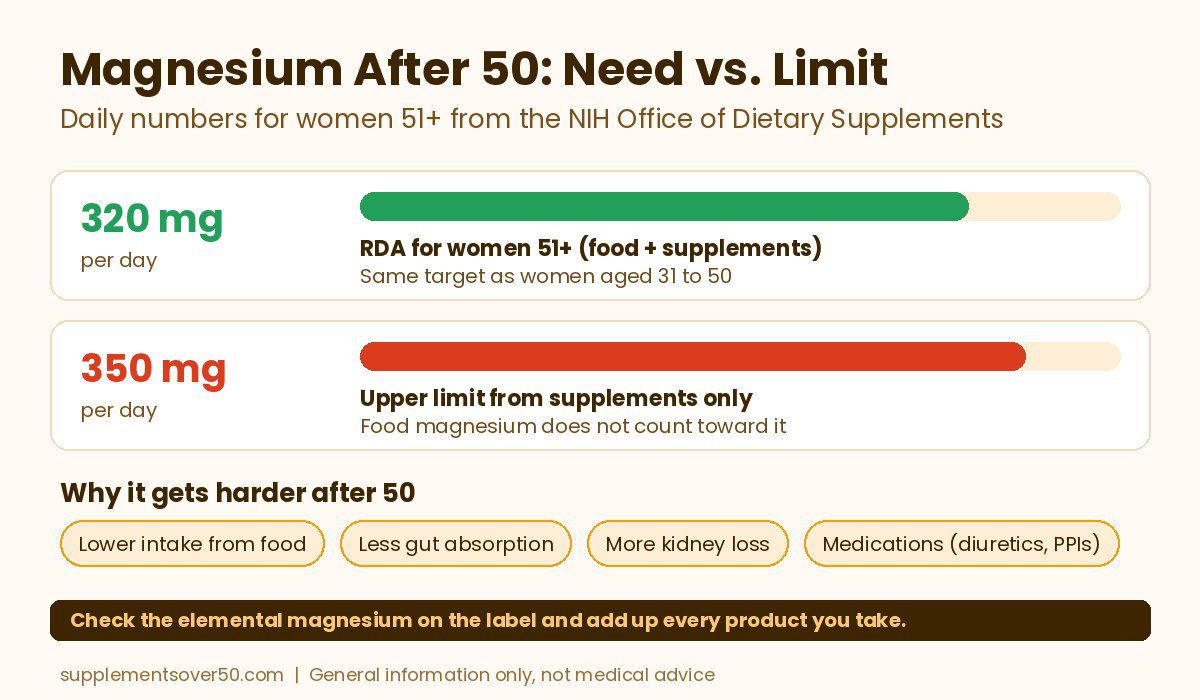
Your daily target does not jump at 50. According to the NIH Office of Dietary Supplements magnesium fact sheet, the Recommended Dietary Allowance for women 51 and older is 320 mg a day, the same as for women aged 31 to 50. That number covers magnesium from food, drinks and supplements combined.
What changes is how easy it is to hit that target. The NIH notes three things that stack up with age:
Popular Supplement Guides:




- Lower intake. Older adults tend to eat less magnesium than younger adults. Smaller appetites and fewer whole grains, beans, nuts and leafy greens all play a part.
- Less absorption, more loss. The gut absorbs less magnesium with age, and the kidneys excrete more of it.
- More medications. Women over 50 are more likely to take medications that affect magnesium status, including diuretics and proton pump inhibitors (common acid reflux drugs).
Menopause adds its own pressure. Bone loss speeds up after estrogen falls, and magnesium is part of the bone story: the NIH explains that it is involved in bone formation and influences the hormones that regulate bone, including parathyroid hormone and active vitamin D.
Does Magnesium Actually Help After Menopause?
It depends on what you want it to fix, and it is worth being honest about the gaps.
Bones. The NIH fact sheet reports that several population studies link higher magnesium intake with higher bone mineral density, and that some studies found low blood magnesium in women with osteoporosis. It also says more research is needed to know whether supplements actually help prevent or manage osteoporosis. So magnesium supports bone health as part of a good diet, but it does not replace calcium, vitamin D, strength training or any medication your doctor prescribes.
Muscle cramps. Cramps and muscle contractions are listed by the NIH among the symptoms of magnesium deficiency, along with numbness and tingling. If you are genuinely low, topping up may help. If your levels are normal, cramps may have another cause, such as dehydration, medication side effects or circulation problems.
Sleep and mood. This is where most women hope to feel a difference, and where the research is the least settled. Studies on magnesium for sleep are limited and the results are mixed, and the NIH fact sheet does not list sleep among its evidence-based uses. A nightly glycinate is still a low-risk thing to try at a sensible dose. Treat it as a support, not a sleeping pill.
The Dose Limit Most Labels Do Not Mention
The NIH sets the Tolerable Upper Intake Level for supplemental magnesium at 350 mg a day for adults. That limit applies to supplements and medications, not to magnesium from food. Going over it is the most common reason people get diarrhea, nausea and stomach cramps from magnesium, and the NIH notes that the carbonate, chloride, gluconate and oxide forms are the ones most often reported to cause diarrhea. Some products on Amazon list totals well above 350 mg per serving, so read the supplement facts panel carefully and include any magnesium in your multivitamin.
What to Look for in a Magnesium Supplement After 50
- Elemental magnesium, not compound weight. A capsule labeled “500 mg magnesium glycinate” may contain far less actual magnesium. Look for the elemental amount on the supplement facts panel.
- A form that suits your goal and your stomach. Glycinate is popular for evening use and is usually described as gentle on digestion. The NIH notes that forms that dissolve well in liquid, such as citrate, aspartate, lactate and chloride, tend to be better absorbed than oxide or sulfate. L-threonate is marketed mainly for cognitive support.
- A dose that stays under 350 mg from supplements. You do not need to cover the full 320 mg RDA with a pill, because food supplies part of it.
- Clean, tested ingredients. Supplements are not FDA approved. Third-party testing claims and a clear free-from list are useful signals.
- Overlap with other products. Many multivitamins, bone formulas and sleep blends already contain magnesium. Add them up.
- A format you will take every night. Capsules, gummies and powders all work if they deliver a similar amount of magnesium. Consistency matters more than form.
Best Magnesium for Women Over 50: Quick Comparison
| Product | Best for | Key details | Daily dose |
|---|---|---|---|
| Pure Encapsulations Magnesium (Glycinate) | Best overall | Magnesium glycinate; free from common allergens, artificial ingredients and GMOs; Amazon Best Seller | See label |
| NatureBell Magnesium Glycinate 500 mg | Gentle low dose and value | 500 mg magnesium glycinate (90 mg elemental) per serving; no fillers; 240 capsules | 1 capsule (one-a-day format) |
| BioEmblem Triple Magnesium Complex | Multi-form complex | Glycinate, malate and citrate; 300 mg magnesium per serving; vegan; third-party tested | See label |
| Life Extension Neuro-Mag | Memory and focus | Magnesium L-threonate for cognitive support; non-GMO, gluten free; Certificate of Analysis available | See label |
| Nature Made Magnesium Glycinate Gummies | Gummy format | 100 mg magnesium glycinate per serving; pectin based; gluten free; no synthetic dyes | 2 gummies |
Top Picks for the Best Magnesium for Women Over 50
1. Pure Encapsulations Magnesium (Glycinate) (Best Overall)
This is the one we would hand most women over 50 first. It carries an Amazon Best Seller badge at the time of writing, with more than 53,000 ratings, and it keeps things simple: magnesium glycinate in a capsule, with no common allergens, artificial additives or GMOs according to the brand. Pure Encapsulations positions it for heart and muscle function, energy production and bone support, including the body’s use of calcium and potassium.
The listing also says it may help support the sleep cycle and a sense of relaxation by raising your total daily magnesium intake, which is exactly how most women use it: a capsule or two in the evening. Check the label for the elemental amount per capsule, and build up gradually if you are sensitive to supplements.
2. NatureBell Magnesium Glycinate 500 mg (Best Gentle Low-Dose Pick)
NatureBell is a good choice if you already eat reasonably well and only want to fill a gap. Each serving provides 500 mg of magnesium glycinate, which the brand clearly states works out to 90 mg of elemental magnesium. That is a modest, easy-to-tolerate amount that leaves plenty of room under the 350 mg supplement limit, and it is refreshingly transparent compared with labels that only show the compound weight.
The bottle holds 240 vegetarian capsules with no fillers, and the brand describes it as a one-a-day formula that lasts up to eight months, which makes it one of the better values on this list. If you want a higher dose, talk to your doctor before simply doubling up.
3. BioEmblem Triple Magnesium Complex (Best Multi-Form Complex)
BioEmblem combines three forms in one capsule: magnesium glycinate, malate and citrate. The idea is that you get the calm, gentle glycinate form alongside citrate, which the NIH lists among the better-absorbed forms, plus malate. It provides 300 mg of magnesium per serving, which is close to a full RDA in one go.
It is vegan, non-GMO and third-party tested according to the listing. Because 300 mg per serving sits near the 350 mg supplement limit, it is the pick for women whose diet is genuinely low in magnesium, not for anyone already taking a multivitamin with magnesium in it. Check the serving size on the label before you start.
4. Life Extension Neuro-Mag Magnesium L-Threonate (Best for Memory and Focus)
Brain fog and forgetfulness are some of the most frustrating parts of the menopause transition. Neuro-Mag uses magnesium L-threonate, a form the brand describes as well studied for cognitive health. Life Extension says it helped maintain executive function and quick thinking in clinical studies, and markets it for short-term memory support.
Those claims come from the brand and the research is still young, so keep expectations modest and check the label for the elemental magnesium per serving. The brand notes most of its products are non-GMO and gluten free, and a Certificate of Analysis is available for every product.
5. Nature Made Magnesium Glycinate Gummies (Best Gummy)
If you already swallow a handful of pills every morning, a gummy may be the only way magnesium actually becomes a habit. Nature Made’s chewable gummies provide 100 mg of magnesium glycinate per two-gummy serving, in a mixed berry flavor. The brand describes the glycinate form as chelated and gentle on the stomach, and positions it for muscle relaxation, nerve, heart and bone health.
They are made with pectin rather than gelatin and are gluten free, with no synthetic dyes or high fructose corn syrup. The trade-offs: 100 mg is a light dose, and the 40-count bottle is only a 20-day supply. Gummies can also contain sugar, so check the label if you watch your blood sugar.
How to Choose the Best Magnesium for Women Over 50
- If you want one reliable everyday choice, pick Pure Encapsulations Magnesium (Glycinate).
- If you have a sensitive stomach or only need a top-up, pick NatureBell at 90 mg elemental per serving.
- If your diet is low in magnesium and you want a fuller dose, pick BioEmblem’s triple complex, and keep your total under 350 mg from supplements.
- If brain fog is your biggest menopause complaint, pick Life Extension Neuro-Mag.
- If you will not take another capsule, pick Nature Made gummies.
Take magnesium with a meal or in the evening, start at the low end, and give it a few weeks before you judge it. If sleep is your main goal, our guide to the best magnesium supplement for sleep after 50 compares glycinate and L-threonate in more detail. For a deeper look at the glycinate form, see the best magnesium glycinate for seniors, and for dose questions by goal and health condition, read how much magnesium seniors should take daily.
When to See a Doctor
Talk to your doctor before starting magnesium if you have kidney disease. The NIH explains that the risk of magnesium toxicity rises when the kidneys cannot clear the excess. Very high doses can cause low blood pressure, vomiting, trouble breathing and an irregular heartbeat.
Timing matters with some common medications for women over 50. The NIH advises taking magnesium at least 2 hours before or after oral bisphosphonates such as alendronate (Fosamax), which are used for osteoporosis, and taking quinolone antibiotics such as ciprofloxacin at least 2 hours before or 4 to 6 hours after magnesium. Diuretics and proton pump inhibitors can also change your magnesium levels, so ask your doctor or pharmacist whether you need a blood test.
See a doctor promptly for persistent numbness or tingling, frequent severe cramps, heart palpitations or an irregular heartbeat. These can be signs of low magnesium, but they can also point to other conditions that need proper care.
Frequently Asked Questions
How much magnesium should a woman over 50 take?
The RDA for women 51 and older is 320 mg a day from all sources combined, including food. The upper limit for supplemental magnesium is 350 mg a day. Most women only need a supplement to fill part of the gap, so a moderate dose is usually enough. Ask your doctor what suits you.
What is the best type of magnesium for menopause?
Magnesium glycinate is a popular choice for evening use because it is usually gentle on the stomach. Citrate is well absorbed but can loosen stools. L-threonate is marketed for memory and focus. The best type is the one that fits your goal and that you tolerate well.
Can magnesium help with menopause sleep problems?
It may help some women feel more relaxed at night, but the research on magnesium for sleep is limited and mixed. It is a reasonable, low-risk thing to try at a sensible dose. If insomnia is severe or ongoing, talk to your doctor.
Does magnesium help with leg cramps at night?
Muscle cramps are a recognized sign of magnesium deficiency, so magnesium may help if you are low. If your levels are normal, cramps may have other causes such as dehydration, medications or circulation issues, so mention frequent cramps to your doctor.
Can I take magnesium with calcium and vitamin D?
Yes, many women over 50 take them together for bone health. Check the total magnesium across all your products, since many bone formulas and multivitamins already include it. If you take an osteoporosis medication such as alendronate, separate it from magnesium by at least 2 hours.
Is it safe to take magnesium every day after 50?
For most healthy women, a daily supplement within the 350 mg supplemental limit is generally well tolerated. Diarrhea and stomach upset are the most common side effects. People with kidney disease should not take magnesium without medical advice.
Our Take
For most women over 50, Pure Encapsulations Magnesium (Glycinate) is the easiest place to start, and NatureBell is the smarter pick if you want a gentle, transparent low dose. Keep supplements under 350 mg a day, eat magnesium-rich foods such as leafy greens, beans, nuts, seeds and whole grains, and treat magnesium as one part of a bigger menopause plan. For the rest of that plan, see our guide to the best menopause supplement for women over 50.
This article is for informational purposes only and is not medical advice. Talk to your doctor before starting any new supplement, especially if you have kidney disease or take prescription medications such as osteoporosis drugs, antibiotics, diuretics or acid reflux medicine.